
Quick Answer
Senate Bill 7 (SB7) makes $2 billion available for Texas water reuse and new water supply projects over the next 22 years. The Texas Water Development Board (TWDB) is expected to put out roughly $100 million per year (as described in the webinar), using competitive interest-rate loans that are typically at or below market. To access SB7 funding, you generally need to be an eligible public entity or work through one, which is why many private developments form a Municipal Utility District (MUD) or special district. SB7 can help fund planning, engineering, permitting, and construction, and disadvantaged communities may have access to additional assistance such as grants on certain projects and, in some cases, principal forgiveness. If you need a MUD or district to apply, start entity formation at least 90 days before the application deadline.
Texas has allocated $2 billion for water reuse infrastructure through Senate Bill 7. At the time of the webinar recording, there were only 50 applicants statewide. For developers, municipalities, mobile home parks, and industrial facilities planning wastewater projects, this represents a significant funding opportunity that remains largely untapped.
What Is Senate Bill 7?
Senate Bill 7 provides funding for water reuse projects across Texas over the next 22 years. The TWDB is expected to release roughly $100 million per year, which is a substantial increase from prior years. This funding targets new water sources and related infrastructure including water reuse plants, desalination, aquifer storage, reservoirs, and pipelines.
The loans feature competitive interest rates, typically at or below market rates. Some projects may have principal forgiveness. If you are a disadvantaged community, there may also be opportunities for grants on certain projects (as discussed in the webinar). Projects ranging from $500,000 to $5 million can be funded, and applicants can potentially stack SB7 funding with other sources such as USDA loans.
Who Qualifies for Senate Bill 7 Funding?
Can mobile home parks qualify?
Mobile home parks with nonprofit water supply corporations are eligible entities. Parks operating for profit without this structure do not qualify. Eligible mobile home parks can use this funding to help offset residential fee costs for their communities.
Can private developments (developers) qualify?
For private developments, you generally need to establish a public entity to access SB7 funding. This is where MUDs and special districts come in. These are political subdivisions that can be recognized by the TWDB to access low interest loan programs.
Developers typically work with a MUD attorney who specializes in this process, and there are ongoing costs associated with establishing and maintaining the entity. A critical timeline point from the webinar: if you are pursuing SB7 funding through this pathway, entity formation should begin 90 days before the application deadline.
The developer advantage is cost recovery. Developers can enter into a developer agreement with the MUD they establish and recoup wastewater tap fees against their investment. As single family lots are built out, tap fees can reimburse the developer’s initial investment while the MUD repays the loan.
Can industrial facilities qualify?
Industrial facilities pursuing reuse, desalination, or additional water supply projects may need to set up partnerships with a city, county, or another water district to access funding and recover costs.
What Costs Does Senate Bill 7 Cover?
SB7 funding can cover comprehensive project costs including planning and feasibility studies, environmental reports, engineering design, preliminary engineering reports, TCEQ permit submittals, county development permit fees, and construction costs.
Projects may require up to 20% down payment from other funding sources. Developers may be able to recoup this through tap fees via developer agreements and then pay the remaining balance through the MUD structure.
What Are MUDs and Special Districts, and Why Do They Matter?
Creating a political subdivision recognized by the TWDB can provide direct access to SB7 loan programs. These structures allow developers to recover costs through user fees, developer credits, and tap fees. This approach can be tailored to projects of different sizes, from smaller systems (for example, around 40,000 gallons per day) to larger reuse projects (for example, around 2 MGD).
How Do SB7 Funded Projects Typically Move From Planning to Construction?
Phase 1: Initial engineering and feasibility
Upfront engineering includes initial studies and feasibility analysis required for applications to both TCEQ and TWDB. After TWDB reviews the application and addresses comments, they can lock in interest rates, similar to a mortgage rate lock.
Phase 2: Engineering and construction
Once approved, engineering and planning costs can be reimbursed. Construction funding is released based on milestones such as mobilization, site grading completion, foundation installation, and yard piping completion. As each milestone is met, reimbursements occur until the loan is closed out and the project begins servicing the development area.
Revenue Opportunities From Reuse Water
How can reuse water generate revenue?
The webinar described several revenue pathways for reuse water including construction demand, irrigation demand, and industrial partnerships.
Temporary water needs (construction water)
Bulk water sales for dust control, grading, compaction, and general construction water were described as commonly selling in the range of $5 to $15 per thousand gallons.
Irrigation applications
Reuse water can be sold for crops, golf courses, lawns, and sports fields including baseball, soccer, and football fields, often in the same $5 to $15 per thousand gallon range.
Industrial partnerships
Data centers can require significant cooling water and treatment capacity. The webinar described partnerships where wastewater facilities provide treated effluent to adjacent data centers for cooling and other manufacturing processes.
Infrastructure Investment Scenarios
Basic irrigation setup
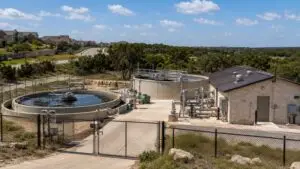
For existing wastewater plants, adding a reuse component with storage tanks can support local distribution or sales of reuse water.
Industrial plant conversion
Industrial wastewater plants may be able to convert to a 210E permit (described in the webinar as an exemption for industrial users) and add a reuse component with storage tanks. These projects were described as typically ranging from $500,000 to $1.5 million depending on plant size.
Comprehensive reuse systems
For a development starting from scratch with purple pipe, connections to fields and agricultural land for irrigation, and service to a community of roughly 1,000 residents plus commercial development, the webinar described a more complex network. For projects around 100,000 gallons per day with loading stations for bulk water sales, total investment was described as typically around $5 to $10 million.
Next Steps for Applicants
Developers and municipalities interested in SB7 funding should analyze loan rates and project financing, work with engineers to estimate lifecycle costs and evaluate soils for land application feasibility, engage a MUD attorney to establish the entity structure (starting 90 days before the application deadline), work with qualified engineering firms and application specialists, obtain necessary county and TCEQ permits, and proceed to construction through qualified contractors.
Why Modern Engineering Solutions?
Modern Engineering Solutions described having ongoing communication with TWDB staff and TCEQ officials and providing services under one roof including feasibility studies, preliminary engineering reports, TCEQ permit submissions, and construction oversight. Contact Modern Engineering Solutions to discuss your SB7 funding strategy and water reuse project planning.
FAQ
How early should a developer start MUD formation for a Senate Bill 7 application?
Start entity formation at least 90 days before the application deadline.
Can SB7 funding be combined with other programs?
Yes. The webinar described stacking SB7 funding with other sources such as USDA loans.
What types of projects does SB7 support besides reuse?
The webinar described water reuse plants as well as desalination, aquifer storage, reservoirs, and pipelines.