Source: LinkedIn Post “Your investors are going to fire you before that MUD gets approved”.
Quick Answer
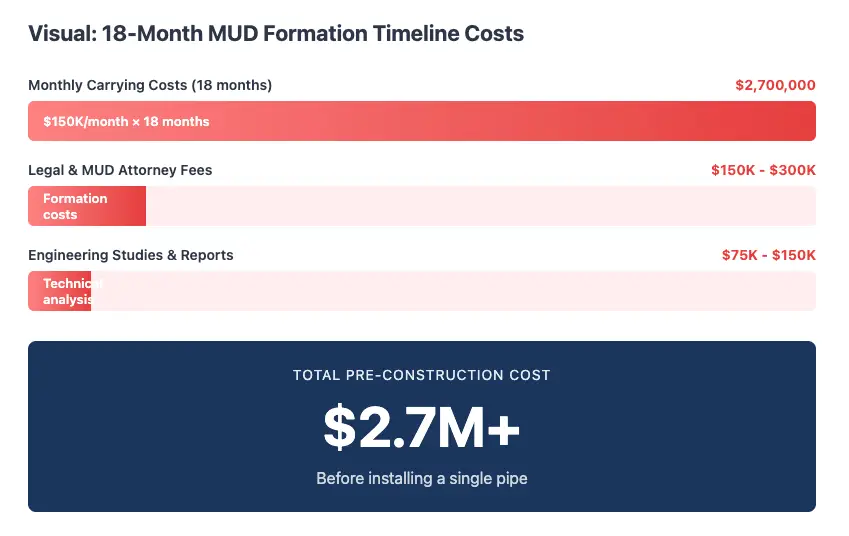
Texas Municipal Utility District formation typically requires 18-24 months from initial petition through TCEQ approval and bond authorization. For typical developments, this timeline translates to $150,000-$300,000 in legal fees and engineering costs, plus carrying costs of $100,000-$200,000 per month depending on project size and financing structure. Using an example calculation of $150,000 monthly carrying costs over 18 months, developers burn $2.7 million before construction begins. During this period, investors move to faster deals, market conditions shift, and competitors reach market first. Alternative wastewater strategies including reuse permits (8 weeks), irrigation discharge partnerships (12 weeks), and package WWTP solutions (16 weeks) eliminate MUD dependency and deliver 85% faster project timelines while maintaining full regulatory compliance.
Why Does MUD Formation Take 18-24 Months?
Municipal Utility District creation follows a multi-stage approval process involving city consent, TCEQ review, public hearings, and voter authorization. The Texas Water Code requires developers to obtain consent from cities in whose extraterritorial jurisdiction the proposed MUD would exist. If cities consent, the process moves to TCEQ petition. If cities refuse consent within 90 days, developers may negotiate utility contracts or proceed directly to TCEQ.
TCEQ evaluates petitions for MUD creation through detailed technical review including feasibility studies, environmental assessments, and financial projections. Following TCEQ approval, districts must hold confirmation elections where voters authorize the board to issue bonds for infrastructure financing. This sequential approval structure, combined with required public comment periods and board appointments, extends timelines to 18-24 months for most developments.
What Are the Real Costs of MUD Formation?
Beyond timeline delays, MUD formation requires substantial upfront capital investment. For typical developments, legal fees range from $150,000-$300,000 covering MUD attorney services, petition preparation, TCEQ coordination, and bond counsel. Engineering costs for preliminary engineering reports, utility feasibility studies, and rate studies add significant expense.
Carrying costs represent the larger financial burden. Monthly interest on land acquisition loans, property taxes, insurance, and opportunity costs compound throughout the formation period. For developments with $100,000-$200,000 monthly carrying costs, an 18-month MUD formation timeline translates to $1.8-$3.6 million in expenses before construction authorization.
These costs create project failure risk. Investors expect specific return timelines. Market conditions change. Competing developments with faster wastewater solutions capture tenants first. The pro forma assumptions made at project inception become obsolete during extended MUD formation periods.
What Wastewater Alternatives Eliminate MUD Dependency?
Three primary strategies allow Texas developers to bypass MUD formation entirely:
Reuse Permits: TCEQ permit-by-rule authorizations for industrial reclaimed water projects secure approval in approximately 8 weeks. Projects incorporating any industrial component qualify for this pathway, avoiding traditional discharge permit timelines and eliminating MUD necessity for wastewater disposal.
Irrigation Discharge Partnerships: Agricultural partnerships for treated effluent irrigation secure regulatory approval in approximately 12 weeks. Developers establish agreements with nearby agricultural operations, ranches, or landscape irrigation projects, creating beneficial reuse arrangements that satisfy disposal requirements without MUD formation.
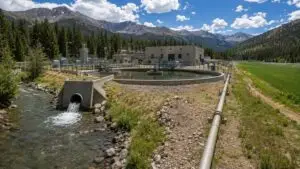
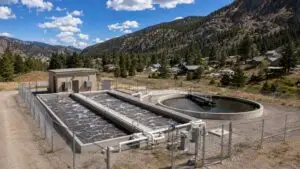
Package WWTP Solutions: Privately owned wastewater treatment facilities with design-build delivery achieve operational status in approximately 16 weeks. Modern package plants provide treatment capacity for developments without creating governmental districts or long-term political infrastructure.
All three approaches maintain full TCEQ compliance while delivering project timelines 85% faster than MUD formation. Developers retain operational control, avoid voter-dependent bond authorizations, and eliminate 18-24 month formation periods that threaten project viability.
Why Modern Engineering Solutions?
Modern Engineering Solutions helps Texas developers evaluate wastewater alternatives to MUD formation, including reuse permit strategies, irrigation partnerships, and package plant feasibility. Contact us to discuss whether your development qualifies for accelerated wastewater solutions.
FAQ
Can developments outside city limits avoid MUD formation entirely?
Yes. Reuse permits, irrigation discharge arrangements, and privately owned package plants provide compliant wastewater disposal without creating Municipal Utility Districts. Project feasibility depends on industrial components, irrigation demand availability, and site-specific conditions.
How do carrying costs during MUD formation compare to alternative approaches?
MUD formation’s 18-24 month timeline creates $1.8-$3.6 million in carrying costs for typical developments with $100,000-$200,000 monthly expenses. Alternative wastewater strategies delivering 8-16 week timelines reduce these costs by 85%, protecting project economics and investor timelines.
Do reuse permits require voter approval like MUD bonds?
No. Reuse authorizations through TCEQ permit-by-rule pathways require engineering submittals and regulatory review but eliminate voter-dependent bond authorizations, public elections, and political district formation required for MUD creation