
Blog
TxDOT Utility Installation Review: How Water and Sewer Lines Get Permitted in State Right of Way
How TxDOT utility installation review works for water and sewer lines: who files, what RULIS needs, the design rules in 43 TAC 21.40 and how review proceeds.
Quick answer
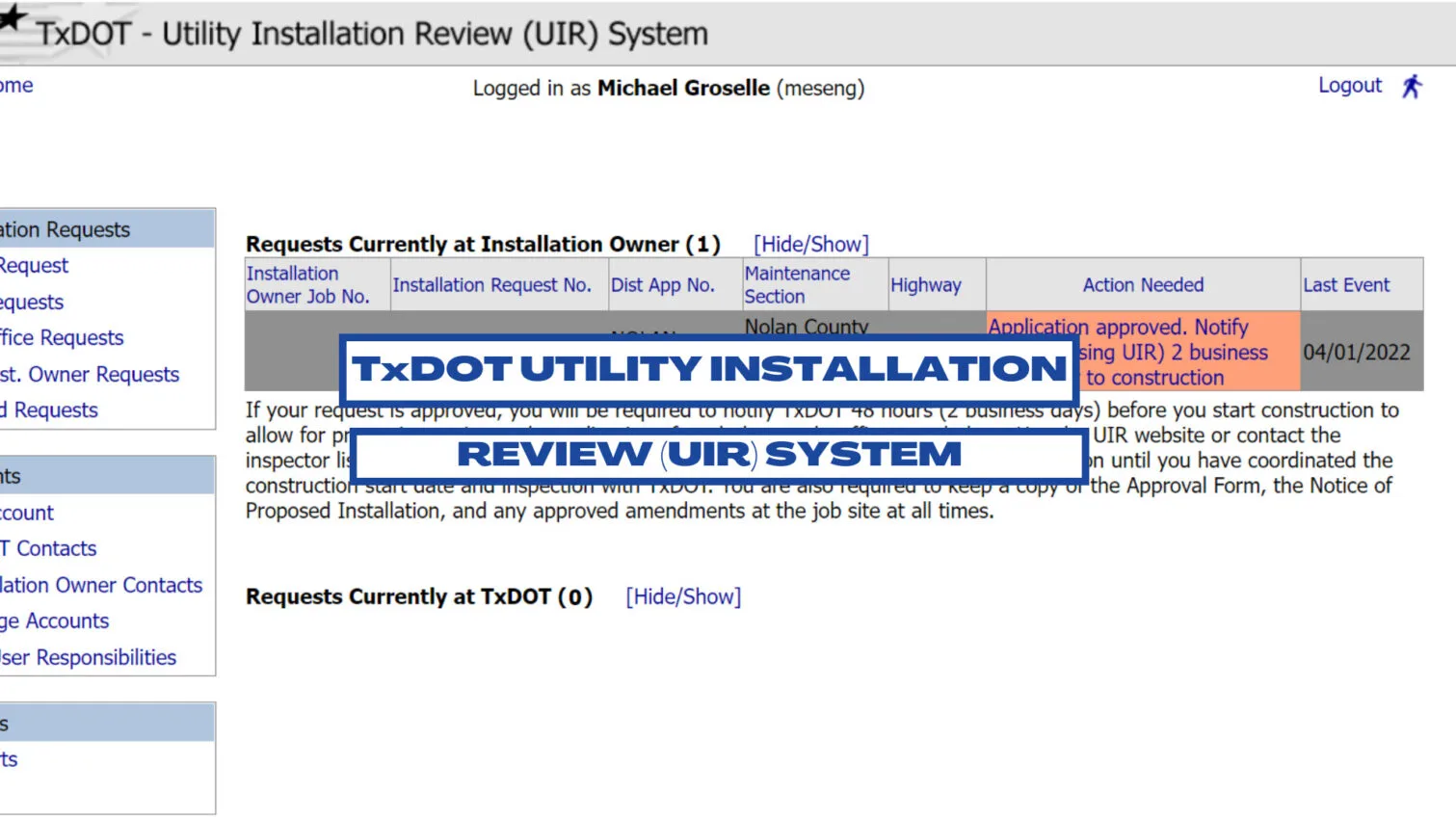
TxDOT utility installation review is the permit step for putting a water or sewer line in state highway right of way. The utility that will own the line applies, TxDOT's district reviews the plans, and work waits for approval. TxDOT built its RULIS system to replace the older Utility Installation Review (UIR) system, and utility permits now run through RULIS.
What is TxDOT utility installation review?
It is TxDOT's approval of where and how a utility goes in its right of way. TxDOT's utility accommodation rules, 43 TAC Chapter 21, Subchapter C, apply to new installations, additions to and maintenance of existing ones, and adjustments or relocations (§21.33).
A TxDOT permit is required for every utility installation in its right of way (§21.40(a)(4)(A)). The rules cover water, sewer, gas, petroleum, electric and communication lines.
The system has changed. The Use of Right of Way by Others Manual describes the Utility Installation Request, Form 1082, and encourages online submission through UIR. TxDOT's Right of Way Division built RULIS, the Right of Way Utility and Leasing Information System, to replace UIR, and lists utility permitting as a release in production.
If you have an older UIR permit or a paper Form 1082 question, ask the district permit coordinator which process applies.
Who files the permit application?
The utility that will own and maintain the line. TxDOT's RULIS job aid on creating a utility permit application (revised October 2025) says a utility owner must apply when it installs, maintains or adjusts a facility on TxDOT right of way.
A consultant can prepare the application. The utility owner then acknowledges it before TxDOT reviews it. TxDOT's policy is that utility consultants may not submit permits in RULIS, the same rule UIR had, and giving a consultant "User" privilege access is also against policy.
For a developer, the applicant is the entity that will own the line, such as a city, district or water supply corporation. Start that conversation early.
Ownership also limits where a line can go. Public utilities may build along and across highways, subject to highway purposes. A private utility may cross a highway but may not run a line lengthwise in the right of way (§21.36).
What goes into the application?
A mapped design, plans and a questionnaire. In RULIS, the applicant:
- picks the utility type (sewer is entered under water)
- draws the project boundary on the map
- draws the utility design as points and lines, or imports a shape file
- answers the questionnaire: general, plans and traffic control, abandonment, requested exceptions, contacts, timeframe and occupation
- submits to TxDOT
On a replacement job, complete the questionnaire's abandonment section. TxDOT's RULIS page lists abandonment of utility facilities among the processes now in production.
The plans must show the design, location, vertical elevations and horizontal position from a Texas registered professional land surveyor's survey or TxDOT's survey data. They also show the right of way line, highway facilities and existing utilities nearby (§21.37(c)(4)).
A district may require signed and sealed plans, with approval from the Maintenance or Right of Way Division director, for example on tight right of way or complex traffic control (§21.37(c)(7)).
What design rules do water and sewer lines have to meet?
TxDOT's minimums in §21.40, plus TCEQ's own design rules. Installations must meet 43 TAC §21.40 and TCEQ's design criteria in 30 TAC Chapter 217 for sewer and §§290.38 to 290.47 for public water systems (§21.37(a)).
The water and sewer minimums include:
- Water lines: 36 inches of cover for longitudinal runs and 60 inches for crossings, measured from the lowest point of grade, and casing under paved highways.
- Water service meters outside the right of way; fire hydrants at the right of way line where feasible, never in the sidewalk or within five feet of the back of curb.
- Gravity sewer: at least 30 inches of cover and at least 18 inches below any pavement structure.
- Force mains: 60 inches of cover at crossings and 36 inches for longitudinal runs.
- Sewer crossings of paved highways encased in the right of way.
- Lift stations and pump stations outside the right of way.
General rules apply to both. Crossings run at about 90 degrees to the highway centerline (§21.37(b)(4)). Lines under an existing highway are bored or tunneled, and lengthwise runs across driveways and side roads are bored unless the district approves open trench.
Add 12 inches of depth within 50 feet of a waterway, ditch or culvert. Keep at least 12 inches from existing utilities, and install a tracer wire or other approved detection with nonmetallic pipe. The district can set stricter requirements.
How does TxDOT review and approve the permit?
The district routes it to reviewers, asks questions, then approves or not. TxDOT's RULIS permit workflow sends an application to the district permit coordinator and subject matter reviewers, such as the area engineer, maintenance section and utility coordinator. A requested exception to policy goes up for added review.
If a reviewer asks for more information, answer within 10 days. The job aid says an unanswered request automatically withdraws the application.
After approval, the permit waits for you to enter a construction start date. Do not start until the district says so. Other steps follow:
- Changing the design, traffic control or highway design needs an amendment; a date change needs a new proposed schedule.
- For work on an existing approved facility, notify the district 48 hours ahead (§21.38(a)(4)).
- Post a sign at each end of the work with the utility's contact information (§21.38(c)(2)).
- Submit as-installed plans with location and elevations once the line is in (§21.37(c)(6)).
How does a permit relate to a TxDOT highway project relocation?
A relocation forced by a highway project is an adjustment, and it still needs TxDOT approval. The RULIS job aid lists an adjustment required by a transportation project as one reason to apply. The manual points to Utility Joint Use Agreements when existing facilities will be adjusted or relocated.
By agreement, TxDOT can include a utility's relocation in the highway construction contract. The utility approves the plans, specifications and estimate first, and pays any share that is not reimbursable (§21.38(e)).
For a corridor example, see what McKinney area developers must coordinate with TxDOT on the US-380 bypass.
Is your water or sewer line ready for a TxDOT permit?
Answer yes or no. If any answer is no, sort it out before the application goes in.
- Do you know which utility will own the line, and has it agreed to apply?
- Is the line public, or is it a private line that only needs to cross?
- Do you have survey data showing the TxDOT right of way line and existing utilities?
- Do the plans meet the depth, casing and clearance rules in §21.40?
- Is a traffic control plan ready to attach?
- Is someone assigned to answer reviewer questions within 10 days?
Then ask the district permit coordinator about any district rules beyond §21.40 and whether highway work is planned on the corridor. We design water and sewer utility lines for developers and builders with these rules in mind.
A note on limits: this is general education from TxDOT's rules, manuals and RULIS guidance as of October 2026. Districts can add requirements, and TxDOT's district staff have the final word on a permit.
Frequently asked questions
Can our engineering consultant submit the TxDOT permit for us?
A consultant can prepare the application, but TxDOT's policy is that consultants may not submit permits in RULIS. The utility owner acknowledges and submits it.
How long does TxDOT take to review a utility permit?
TxDOT's rules and RULIS guidance do not set a fixed review time. The one firm clock is yours: answer a request for more information within 10 days or the application is withdrawn.
I'm a developer in Collin County and our new water line must cross a state highway before the city takes it over. Who applies to TxDOT?
The utility that will own and maintain the line applies as the utility owner. In most cases that is the city that will take it over, so agree on who applies before design, since the permit comes before construction. A private utility may cross a highway but may not run lengthwise in the right of way (§21.36).
I'm a utility contractor on a Texas sewer job and the plans show an open trench across a driveway inside TxDOT right of way. Is that allowed?
Not without written approval. Under §21.40, lengthwise runs across driveways and intersecting roads are bored unless the district engineer approves open trench in writing.
Related resources
- The US-380 Corridor Boom: Utility Capacity Planning for Prosper, Celina, Anna, and Melissa Ahead of the Rooftops
- Reactive Clay Soils and Buried Utility Design: Engineering Water and Sewer Lines on Eagle Ford and Austin Chalk Formations
- Stormwater and Utility Coordination in McKinney's High Growth Subdivisions: Avoiding the Common Redesign Trap
- Hydrostatic Testing Records and the TCEQ Audit Trail: What Contractors Need Before an Inspector Shows Up
Need a water or sewer line through TxDOT right of way?
We prepare the design, plans and permit package so the utility owner can submit a complete application the first time.
We specialize in:
- Water and sewer utility design
- Water distribution system design
- Lift station and force main design
- TxDOT utility permit packages
- Construction administration
Modern Engineering Solutions, McKinney, Texas. Contact: (214) 833-6748 or mod-eng.com
Talk to an engineer
Tell us about your project
An engineer reads it
Not a salesperson. Someone who can tell you whether the pathway is real.
You get a first answer
Your options, the agencies involved and the questions that decide cost and schedule.
You decide
No commitment to have the first call.
Prefer the phone? (214) 833-6748