
Blog
The Texas Water Development Fund (DFund) Loan Program: Who Can Borrow and When It Fits
A TWDB DFund loan is state money for Texas water, sewer and flood projects, with no federal crosscutters and several components allowed in one commitment.
Quick answer
A TWDB DFund loan is a state-funded loan from the Texas Water Development Board for water supply, wastewater, water quality, conservation and flood projects. No federal money is in it, so the federal crosscutters tied to the state revolving funds do not apply, and one commitment can cover water and sewer work together.
What is the Texas Water Development Fund (DFund)?
It is TWDB's own state-funded loan program, paid for with bonds TWDB sells as needed. TWDB's DFund program page says the program does not receive federal subsidies and is not subject to federal crosscutters.
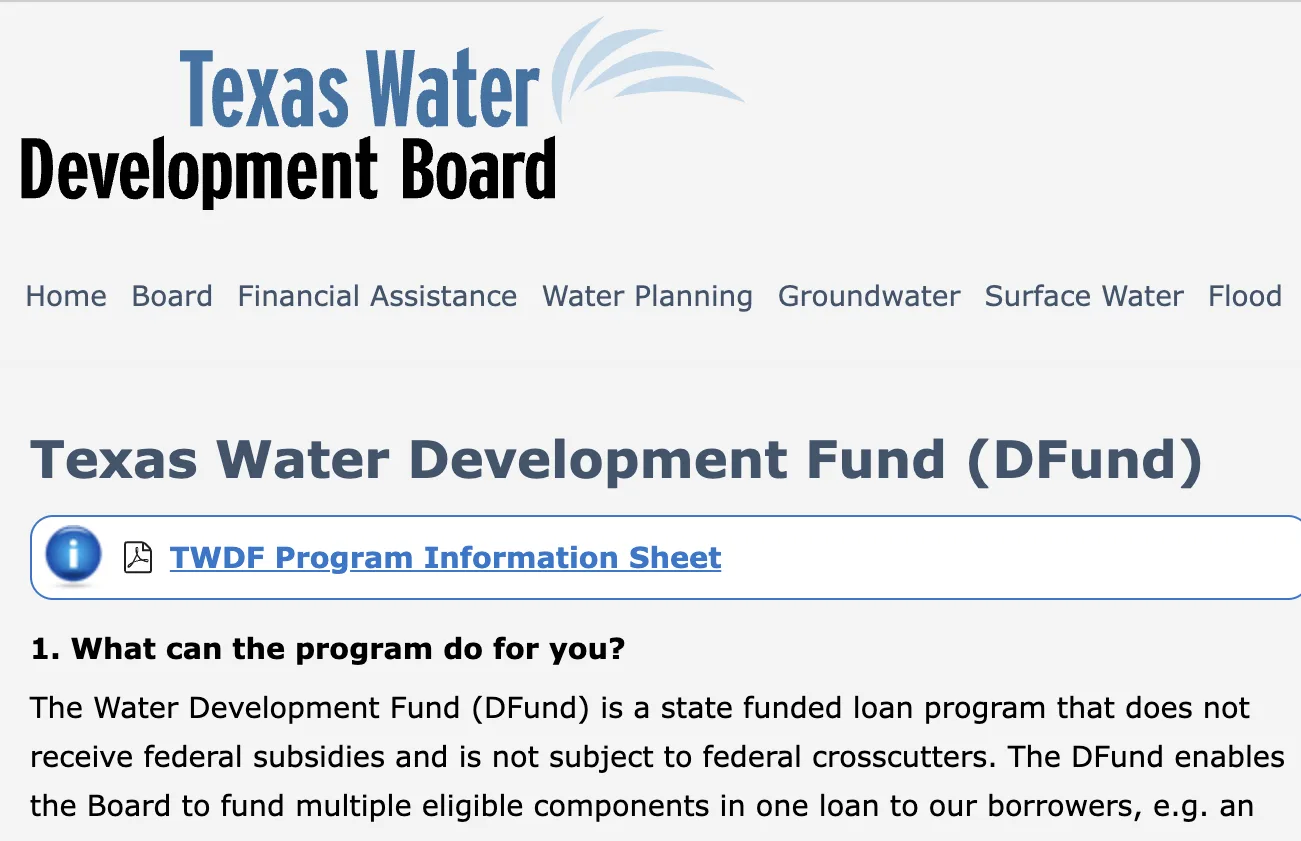
That one fact drives most of the program's value. Without federal strings, TWDB can fund several eligible components in one loan. A city or district can put a water line, a lift station and a flood control project in a single commitment.
The trade-off is price. DFund offers loans only, with no grants, and its rates sit near TWDB's own borrowing cost.
Who can borrow from the DFund?
Political subdivisions of Texas and nonprofit water supply corporations. TWDB's page lists two groups:
- Cities, counties, districts and river authorities, which borrow at tax-exempt rates
- Nonprofit water supply corporations, which borrow at taxable rates
For a water supply corporation, that taxable rate matters. Ask TWDB staff to compare it with your state revolving fund options on the same term before you choose.
What projects can a DFund loan pay for?
Planning, design, acquisition and construction for water supply, conservation, water quality, flood control and wastewater projects. The program page gives examples in each group.
- Water supply: wells, distribution and transmission lines, pumping facilities, storage tanks and reservoirs, water treatment plants, system acquisitions and water rights
- Wastewater: treatment plants, collection systems, system acquisitions, nonpoint source pollution abatement and new municipal solid waste disposal facilities
- Flood control: stormwater retention basins, channel enlargement, bridge modification, floodplain acquisition, flood warning systems and flood management plans
When does the DFund beat the state revolving funds?
When simple terms and your own schedule are worth more than a subsidized rate. The Clean Water and Drinking Water State Revolving Funds carry federal money, and federal requirements come with it.
TWDB's CWSRF page lists Davis-Bacon wage rates, EPA's American Iron and Steel provisions, a NEPA-type environmental review and added steps for hiring architects and engineers. DFund asks for a state-level environmental review instead. It still requires U.S. iron and steel.
DFund tends to fit when:
- One project mixes water, sewer and drainage work, and you want one commitment
- You cannot wait for the SRF cycle, where the CWSRF solicitation opens in December and closes in March
- Federal wage and procurement steps would slow a small project down
- Your project did not rank for SRF money this year
The SRFs win on price. The CWSRF page lists rates 30 to 35 percent below a market index, depending on the project, and limited principal forgiveness for eligible communities. DFund offers neither. More on that program is in our post on the Texas Clean Water State Revolving Fund.
What are the current DFund loan terms?
Long-term fixed rates based on TWDB's cost of funds, repaid over 20 to 30 years. Those terms come from TWDB's DFund program sheet, dated January 2025.
- Rates vary with market conditions and are set at about TWDB's borrowing cost. TWDB publishes current rates in an interest rate memo.
- There is no maximum funding limit, subject to eligibility and Board approval.
- Only loans are offered. TWDB says statutory limits rule out grants.
A pre-design option can get you a commitment early. For most water supply, treatment and wastewater projects, TWDB can commit a loan on the basis of preliminary engineering. Planning money is released at closing. Design and construction money waits in escrow until you need it.
Without pre-design, construction-only funding needs plans and specifications approved by TWDB staff, all necessary permits and opened bids before the loan closes.
What does TWDB require before it lends?
Proof that you qualify, can repay and have planned for water use. The program page and sheet list:
- Current financial audits with the application
- A state-level environmental review
- For water supply projects, consistency with the current state water plan
- Water Use Survey responses for the previous three years on file, under 31 TAC §358.5
- Adopted water conservation and drought contingency plans if you receive more than $500,000
- U.S. iron and steel requirements
- Reservoir funding that is segmented or phased, with permits in hand before a construction commitment
Water loss can change the deal. Under TWDB's water loss audit rules, 31 TAC §§358.11 to 358.13, a utility receiving TWDB financial assistance files a water loss audit every year by May 1. That audit must also be validated within 180 days of submittal or before the board considers a request for financial assistance, whichever comes first.
The rules set real loss thresholds of 30 gallons per connection per day for systems with 32 or more connections per mile, and 57 for less dense systems, plus an allowed apparent loss for each utility.
A utility at or over its real or apparent loss threshold must spend part of any TWDB water supply assistance on cutting water loss, unless the board waives that because mitigation is under way.
When can you apply for a DFund loan?
Start with a pre-application conference with your TWDB Regional Project Implementation Team. In October 2026, the DFund page listed an application deadline of 5:00 p.m. on September 30, 2026.
The program sheet describes access to funding on a periodic basis. Confirm the next window with TWDB before you build a schedule around it.
Is your project ready for a DFund application?
A no on any of the first three items means fix that first.
- Are you a Texas political subdivision or a nonprofit water supply corporation?
- Are your current audited financial statements ready to submit?
- Is your latest water loss audit filed and validated?
- Are three years of Water Use Survey responses on file?
- For a water supply project, is it consistent with the state water plan?
- If you need more than $500,000, are your conservation and drought contingency plans adopted?
- Do you have preliminary engineering for a pre-design commitment, or approved plans for construction-only funding?
Then take three questions to TWDB staff and your engineer. Does DFund or an SRF fit your schedule better? Should water, sewer and drainage go in one commitment? What rate applies on your term?
Our project funding page explains how we help utilities and municipalities work through those questions.
A note on limits: this is general education from TWDB's public pages, current as of October 2026. Rates, deadlines and requirements change with Board action and bond sales, so confirm them with TWDB before you commit to a plan.
Frequently asked questions
Does the DFund offer grants?
No. TWDB says statutory limits allow only loans through the DFund.
Can a water supply corporation get a DFund loan?
Yes. Nonprofit water supply corporations are eligible, at taxable rates. Cities, counties, districts and river authorities borrow at tax-exempt rates.
How long can a DFund loan run?
TWDB's January 2025 program sheet lists 20- to 30-year repayment terms at fixed rates.
I'm the general manager of a Texas utility district with a water plant and a sewer plant that both need work. Can one DFund loan cover both?
Yes. TWDB says the DFund can fund multiple eligible components in one loan, and its program sheet uses water and wastewater as the example. Each component still has to be eligible, and water supply work must be consistent with the state water plan.
I run a small Texas city that missed the March deadline for SRF project information forms. Is the DFund a way to keep our sewer upgrade moving?
It may be. DFund does not use the SRF solicitation, but it has its own application dates, and the last one TWDB posted was September 30, 2026. Ask for a pre-application conference now, and expect a rate near TWDB's cost of funds rather than an SRF subsidy.
Related resources
- The Texas Drinking Water State Revolving Fund (DWSRF)
- The State Water Implementation Fund for Texas (SWIFT)
- The Rural Water Assistance Fund (RWAF)
- USDA Water and Waste Disposal loans and grants in Texas
Deciding between DFund and an SRF loan?
Send us your project list and the date you need funding. We will help you compare the programs and prepare the preliminary engineering TWDB reviews.
We specialize in:
- Funding applications and engineering reports
- Water and sewer utility design
- Water distribution system design
- Lift station and force main design
- Construction administration
Modern Engineering Solutions, McKinney, Texas. Contact: (214) 833-6748 or mod-eng.com
Talk to an engineer
Tell us about your project
An engineer reads it
Not a salesperson. Someone who can tell you whether the pathway is real.
You get a first answer
Your options, the agencies involved and the questions that decide cost and schedule.
You decide
No commitment to have the first call.
Prefer the phone? (214) 833-6748