
Blog
What is an Extraterritorial Jurisdiction (ETJ) in Texas?
An ETJ in Texas is the unincorporated land around a city where it can require plats but not zone, and since 2023 many owners can petition to leave.
An ETJ in Texas is the band of unincorporated land just outside a city's limits where the city can enforce its plat and subdivision rules, but cannot zone the land or limit building size or density. ETJ stands for extraterritorial jurisdiction. It reaches half a mile to five miles out, set by the city's population, and since September 2023 many owners can petition to leave it.
What does ETJ (extraterritorial jurisdiction) mean?
ETJ means extraterritorial jurisdiction: authority a city holds over land outside its own boundaries. The land is not in the city, but the city has a say in how it is subdivided.
Texas Local Government Code Chapter 42 defines it as the unincorporated area next to a city's corporate boundaries, out to a set distance, to protect the health, safety and welfare of people living in and near cities. Outside land development, the phrase is a broader legal term for a government applying its laws beyond its borders, such as U.S. criminal laws that reach conduct abroad.
What does ETJ mean in zoning?
It means the land sits outside the city's zoning. A Texas city can extend its subdivision rules into its ETJ, but not rules on land use or density.
Under Section 212.003 of Local Government Code Chapter 212, a city may extend its plat rules, plus rules on public road access and certain groundwater use, into its ETJ. Unless another state law allows it, the city may not regulate how a building or property is used, the bulk, height, number or size of buildings, or residential units per acre. So the city can require a plat that meets its standards, but cannot tell you the tract must be single family. One exception is a recorded development agreement under Section 212.172, which can apply agreed city rules and guarantee the land against annexation, for up to 45 years.
How far does a city's ETJ extend in Texas?
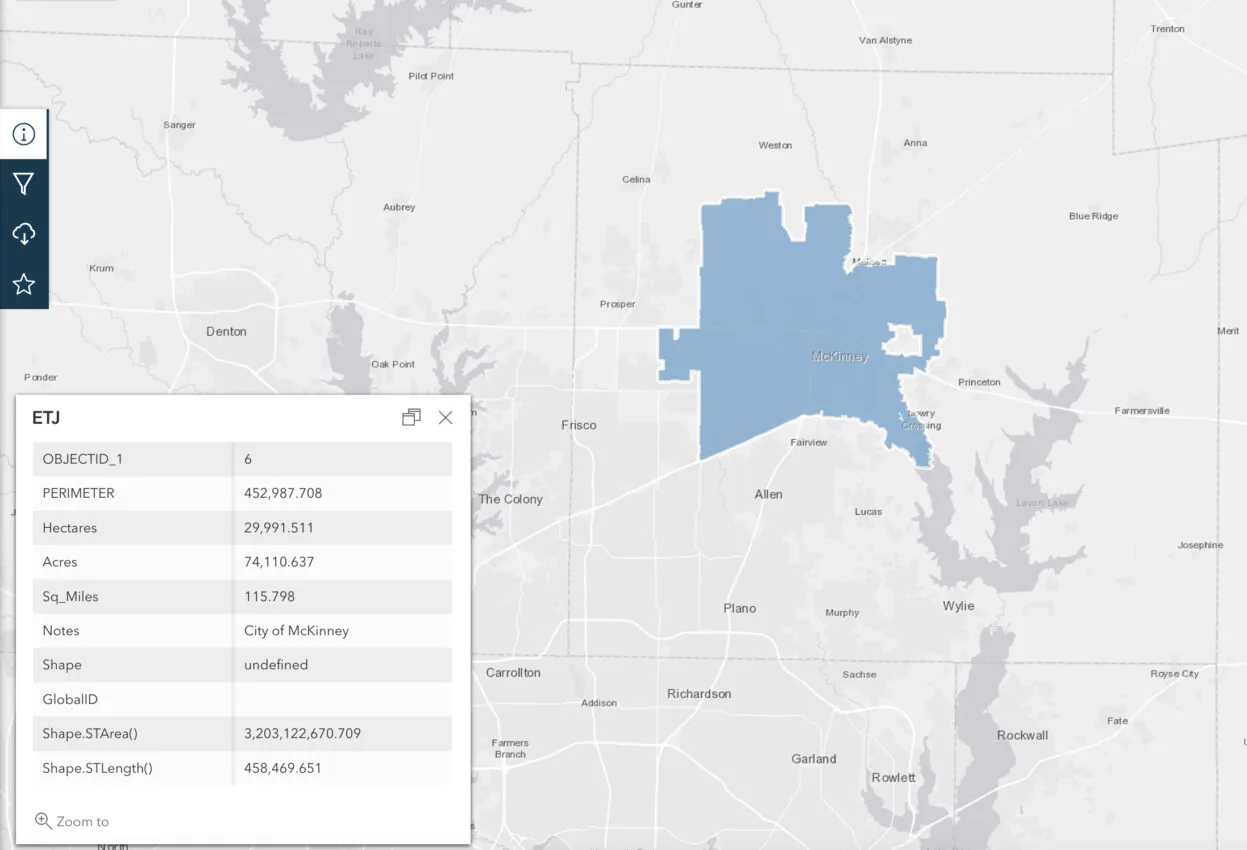
Between half a mile and five miles past the city limits. Section 42.021 sets the distance by population:
- fewer than 5,000 residents: one-half mile
- 5,000 to 24,999: one mile
- 25,000 to 49,999: two miles
- 50,000 to 99,999: three and a half miles
- 100,000 or more: five miles
One city's ETJ cannot take in another's unless the cities agree in writing. An annexation started after January 1, 2023 no longer pushes the ETJ outward unless the owners of that land ask. Treat any ETJ map as a starting point and confirm the current line with the planning department.
Who approves a plat in a Texas ETJ?
Usually one office, the city's or the county's, picked by a written city-county agreement. You need a plat in the ETJ just as inside city limits.
Section 212.004 requires a plat when a tract in the city limits or ETJ is divided into lots or streets, except parts over five acres that each have access and dedicate no public improvement. Local Government Code Section 242.001 has the city and county agree on who regulates ETJ plats: the city, the county, a split by area, or one joint office with one set of rules. In some counties both must approve, and the stricter rule wins.
Are building permits required in an ETJ in Texas?
Usually not from the city, but no city permit does not mean no rules.
The state's residential and commercial building codes apply in a municipality (Local Government Code Sections 214.212 and 214.216). A county that opts in under Local Government Code Chapter 233, Subchapter F requires new homes and duplexes in unincorporated areas to meet the International Residential Code, with at least three inspections for a new house, unless a city has adopted a building code for its ETJ. Septic is separate: TCEQ's on-site sewage facility program page has a county map for finding the authorized agent that runs the septic program locally. Ask the city and the county what this tract needs.
Can you get your land out of a Texas ETJ?
Often, yes. Senate Bill 2038, effective September 1, 2023, lets owners and residents petition for release, and the city must release land when a petition meets the rules.
Under Chapter 42, Subchapter D, the petition needs signatures from more than half the area's registered voters, or from the owners of a majority in value of the land on the appraisal district rolls, gathered within 180 days. If the city does not act by the later of the 45th day or its next council meeting after the 30th day, the land is released by law. Released land cannot be put back in any city's ETJ unless the owners ask. Residents can also petition for a release election with signatures from at least 5 percent of the area's voters, and House Bill 2512 (2025) lets landowners in that area opt to stay. Some land is excluded, including areas near active military bases, industrial districts and strategic partnership areas.
For landowners planning a sale or development, release changes the reviewer, not the basics. County plat rules still apply, and release does not bring water or sewer with it.
Can a Texas city annex land in its ETJ?
Not on its own in most cases. Under Local Government Code Chapter 43, a city needs every owner's request, a petition of the area's voters for areas under 200 residents, or an election in the area for 200 or more, plus a landowner petition when voters do not own most of the land. A few exceptions remain, such as industrial districts.
How does the ETJ affect water and wastewater service?
It decides whether you need the city's consent to create a utility district. A municipal utility district or other district for water, sewer, roads or drainage cannot be created in a city's ETJ without the city's written consent.
That rule is in Local Government Code Section 42.042 and Water Code Section 54.016. If the city does not consent within 90 days, a majority of the area's voters and the owners of at least half the land can petition the city to serve them instead. No service contract within 120 days counts as consent. After either refusal, the applicant can also petition TCEQ, which must allow the district if the city cannot reasonably serve the land or has made no binding, funded commitment to serve it. A city also cannot require annexation as a condition of consent. ETJ status does not mean sewer is coming, as covered in wastewater capacity in an ETJ when the city will not annex.
What should you check before you buy or plat land in an ETJ?
Check five things. If any answer is no, settle it before you lock a lot layout or a closing date.
- Has the planning department confirmed whether the tract is in city limits, an ETJ, or neither?
- Do you know which office approves plats there?
- Do you know the county's building and septic permit requirements?
- Have you checked for a recorded development agreement, strategic partnership or industrial district?
- Do you know where water and wastewater service will come from, and whether a district needs city consent?
Ask your engineer and attorney whether a release is worth it and which utility path fits your schedule. These checks belong in early site feasibility, before the layout is drawn.
A note on limits: this is general education on Texas statutes as of October 2026, not legal advice. ETJ rules changed in 2023 and 2025, and city-county agreements differ, so confirm current rules with the city, the county and a land use attorney.
Frequently asked questions
Does land in an ETJ pay city property taxes?
Not because of ETJ status. Section 42.902 says ETJ status does not by itself let the city impose a tax.
Can a city fine me for breaking its rules in the ETJ?
Not under the rules it extends there. Under Section 212.003, those ordinances' fines and criminal penalties do not apply in the ETJ, but the city can seek an injunction in district court.
I'm a developer under contract on 60 acres in a Texas city's ETJ, and the seller is petitioning out before closing. If the release goes through, who reviews our plat, and do we still need city consent for a MUD?
The county would review the plat under Local Government Code Chapter 232, since the land would sit outside any city's limits and ETJ. Water Code Section 54.016 consent covers land in a city's limits or ETJ, so it would no longer apply, but the district would still need creation, for example by petition to TCEQ under Section 54.014.
I own 20 acres in the ETJ of a North Texas city and want to sell a few lots. If I leave the ETJ, can I skip platting?
Usually not. Outside city limits, Chapter 232 generally requires a plat approved by the commissioners court, with narrow exceptions such as agricultural use, some family transfers, and lots all over 10 acres with no streets or public dedications.
Related resources
- Dallas Subdivision Wastewater Planning: When City Sewer Isn't an Option in ETJ Growth Areas
- What a Utility Feasibility Study Actually Tells You, and When to Get One
- Texas Land Development Application Process
- Types of Zoning Classifications
Not sure who regulates your land near a Texas city?
The ETJ line decides who reviews your plat, which rules apply and how water and wastewater reach the site.
Modern Engineering Solutions is a civil engineering firm headquartered in McKinney, Texas, with 525+ projects completed. We sort out the jurisdiction, plat path and utility options before you commit to a layout.
Talk to an engineer about your site or call (214) 833-6748.
Talk to an engineer
Tell us about your project
An engineer reads it
Not a salesperson. Someone who can tell you whether the pathway is real.
You get a first answer
Your options, the agencies involved and the questions that decide cost and schedule.
You decide
No commitment to have the first call.
Prefer the phone? (214) 833-6748