
Newsletter
You need more engineers and you need AI. The answer to both is the same place
It's your proposal process. Our own records now show what ours costs in senior time. It isn't zero, and the real answer is more useful.
For engineering firm owners
It's your proposal process. Our own records now show what ours costs in senior time. It isn't zero, and the real answer is more useful.
Updated November 2026 from my March letter. What changed: the proposal numbers now come from our own records, and they show a senior engineer, me, still builds every proposal.
Your board has told you to integrate AI. Your ops team has told you they need more engineers. You're squeezed from both directions, and the answer to neither is obvious.
The hiring market won't bail you out, and most AI talks you've sat through were long on vision and short on a workflow you could run next quarter.
Here's what nobody in those rooms says directly: the capacity problem and the AI problem are the same problem. The fastest place to work on both is a process your firm runs every month, one that quietly eats the hours of your most valuable technical people while nobody tracks the cost.
Your proposal process.
Think about who writes your proposals. It isn't your junior staff. It's the engineers with 15 and 20 years in, the ones who can read a client, scope a job and make the technical argument that wins it. They spend hours hunting through SharePoint for the right past project, reformatting a qualifications page built for a different RFP, and rewriting scope language that looks a lot like the last one. That is what your most expensive judgment is doing this week.
In March I told you ours took zero senior hours. It doesn't.
Our proposal system has recorded every proposal since Sept. 25. Here's what it shows.
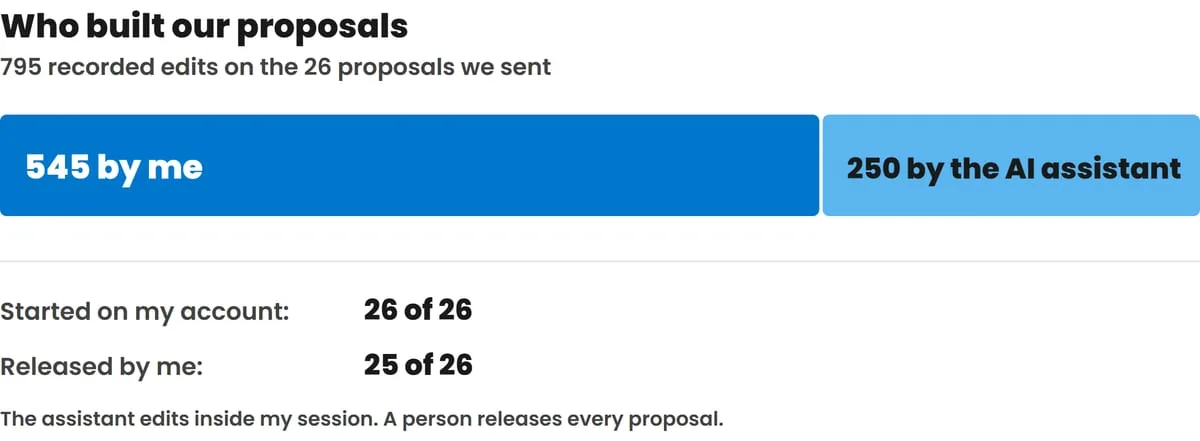
Twenty-six proposals have gone out through it. All 26 were started on my account, and I released 25 of them. On those 26, the system recorded 795 edits: 545 by me and 250 by the AI assistant working inside my session. The senior engineer building our proposals is the CEO.
I also told you a recent business graduate was writing them. Our records don't show that today, so it's out.
The hours are harder, and here's why. I don't log my proposal time. Of the 23 sent proposals still on file, only 1 has any time logged against it. What the system does record is when I touched each one. A typical proposal had my edits in 6 different clock hours, spread over 2 days. Those aren't full hours, and they miss calls and reading. They're still far from zero.
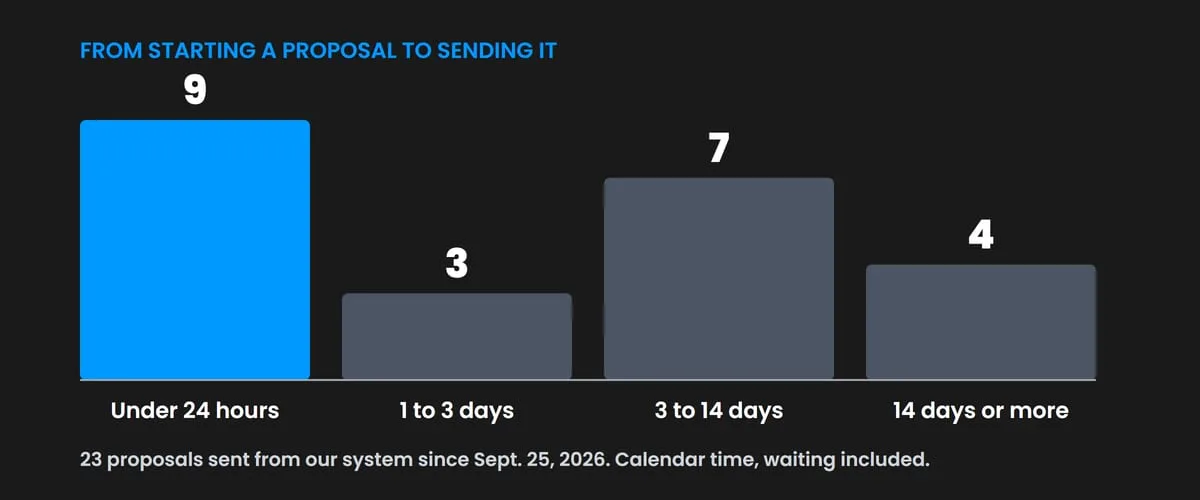
The calendar is clearer. From starting a proposal to sending it, the median was about 3 days. Nine of the 23 went out inside 24 hours, and 3 more within 3 days. Seven took 3 to 14 days, and 4 took two weeks or more.
The machine works. It hasn't moved the work off the senior engineer yet.
Here's what it does today, and what it doesn't.
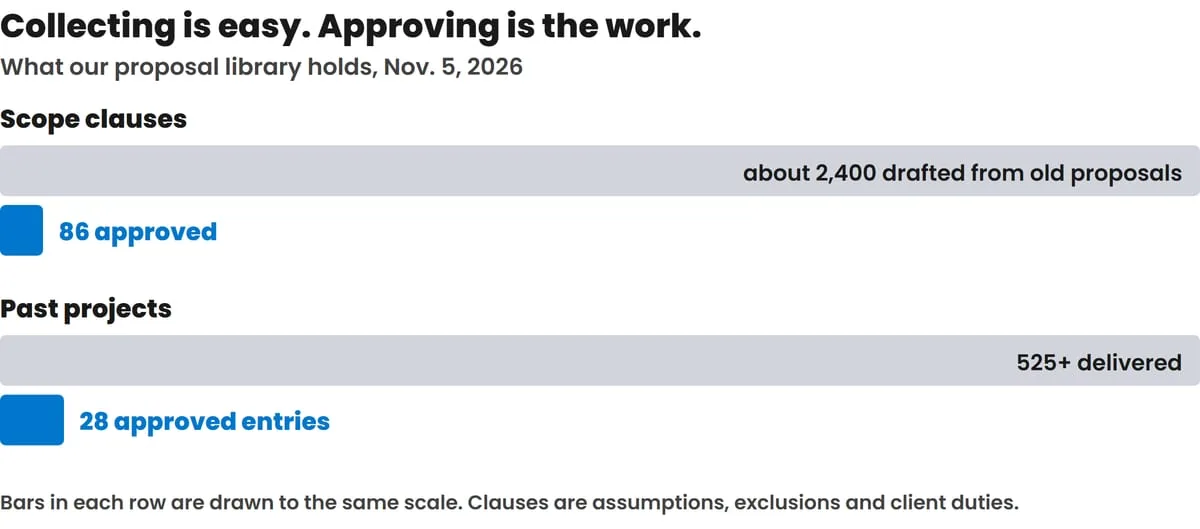
It starts from a library, not a shared drive. Reading our old proposals into it, and learning from new ones, left about 2,400 draft scope clauses. We've approved 86. On past work, we hold 28 approved project entries against the 525+ projects we've delivered. Collecting is easy. Approving is the work.
It writes to the client's own words. The assistant reads the newest recorded call on that deal first, then the contact's, and never a call tied to a different deal.
It keeps the team page short: three to six past projects, each with a sentence on why it fits this job, and a short bio instead of a CV with 50 projects on it.
It never invents a fee. Amounts come only from what a person typed.
And it checks itself. 46 fixed rules run on every draft, with no AI in them. A person must release every proposal before it goes, and any change after release sends it back for review. When a proposal goes out, what we changed feeds back into the library. That has happened 66 times, across 25 proposals.
Faster isn't proven to win more.
That's the counter-evidence, and it applies to us.
Deltek's latest study of 896 architecture and engineering firms found 70 percent now use AI, but only 38 percent report a measurable positive business impact. Another 39 percent say it's too early to tell or they're still piloting. Count us in the 39. Seven of our 23 are signed, and none has been out more than a month. I can't tell you yet that speed wins work.
So here's the honest version of my March letter. A proposal can now go from start to send in a day. It did 9 times out of 23. What the system hasn't done is take the senior engineer out of the building. That step is a decision about people, not software, and we haven't made it.
The capacity problem is real. The first move still isn't a hiring plan. It's stopping the bleed of senior hours into work a system can draft. Your senior engineer should read the proposal once and sign off, not build it. I think the firms that make that handoff will be cheaper to run within two years. That's my judgment, not a study.
This week, pull your last ten proposals. For each one, write down who started it, who released it, and the days from request to send. Then look for the senior hours. If nobody logged them, that's your first finding. It was mine.
Tell me who built your last ten proposals through our contact page. I read every one.
Michael Groselle, PE
Founder and CEO
Modern Engineering Solutions
mod-eng.com
Keep reading
More to read
- Your project manager inherits the files. Everything that actually matters stays with whoever sold the work
- 192 hours worked. $50,000 short on billing. The problem was not effort
- I spent eight rounds making a blind tool smarter. A plain chat beat it, so I closed it
- I told you to audit the setting. I didn't audit mine
What we do
Planning a project?
Talk to an engineerTalk to an engineer
Tell us about your project
An engineer reads it
Not a salesperson. Someone who can tell you whether the pathway is real.
You get a first answer
Your options, the agencies involved and the questions that decide cost and schedule.
You decide
No commitment to have the first call.
Prefer the phone? (214) 833-6748