Last updated: March 10, 2026
Source: “Who Pays For Infrastructure When Affordable House Can’t?”
Quick Answer
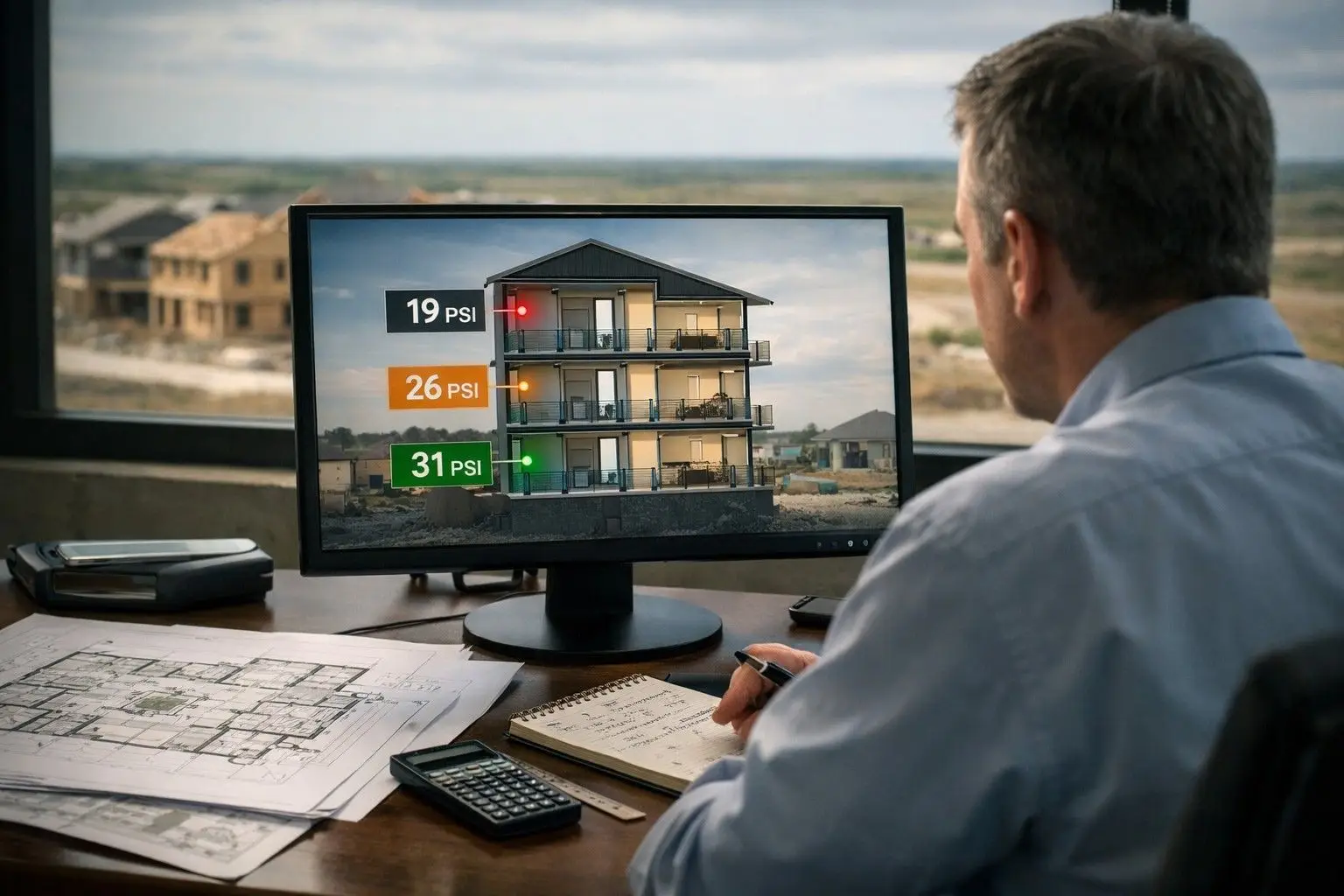
A Texas developer planned 190 affordable housing units. Cut to 109 trying to meet state water pressure requirements. Still couldn’t make code. Hydraulic modeling showed 31 PSI at street level during peak demand. Three-story buildings lose 12 PSI from elevation. That leaves 19 PSI at third-floor fixtures during fires. Texas state minimum is 20 PSI. One PSI short. The available fixes, booster pumps, a pump station, and an elevated tank, none pencil for affordable housing where rents can’t be raised. The town water superintendent wanted the project built and still said no. Multiple developers tried this site. Every one walked away. The infrastructure funding gap is real. Right now, nobody is paying for it. So nothing gets built.
Note: Project details sourced from LinkedIn post by Michael Groselle, P.E. Michael should confirm all figures before publishing.
The Three Constraints That Can’t Be Negotiated
Affordable housing development runs into a wall that market-rate development can sometimes spend its way around. Three constraints exist simultaneously on this type of project, and none of them move.
You can’t raise rents. The project is affordable housing. The revenue ceiling is fixed by definition. You can’t skip safety requirements. Texas state law sets a minimum water pressure of 20 PSI at fixtures during fire flow conditions. You can’t eliminate elevation loss. Physics dictates that every story of building height costs roughly 4 PSI. A three-story building loses 12 PSI before water reaches the top floor.
When those three constraints converge on one site, the math either works or it doesn’t. On this project, it didn’t.
What the Hydraulic Modeling Showed
The developer started with 190 planned units. After reviewing the site’s water system capacity, that number was cut to 109, a 43 percent reduction, in an attempt to bring pressure within code.
It wasn’t enough.
Hydraulic modeling of the 109-unit configuration showed 31 PSI at street level during peak demand. Three-story buildings lose 12 PSI from elevation. That leaves 19 PSI at third-floor fixtures during fire flow conditions. Texas state minimum is 20 PSI.
One PSI short. Cutting units didn’t change the pressure loss from building height. To solve the pressure problem by cutting units alone, you would have to cut building height. And cutting building height kills the unit count that makes the project financially viable in the first place.
The math doesn’t move.
The Fixes and Why None of Them Pencil
Three infrastructure solutions exist for low-pressure developments. Each one solves a different part of the problem. None of them work for affordable housing on this site.
Booster pumps address domestic pressure but do not solve fire flow requirements. They are also an ongoing operational cost that compounds over the life of the project.
A pump station solves more of the pressure problem but requires a backup generator and Homeland Security compliance. The capital cost and ongoing compliance burden push the project further from viable.
An elevated storage tank solves everything. It is also the most expensive option of the three, and the cost cannot be recovered through rent increases on an affordable housing project.
The town water superintendent had worked this site for four years. He wanted it built. His answer was still no. His reasoning was direct: low pressure developments are a continuous operational headache, and the utility did not want another problem area on its water system.
Multiple developers attempted this site. Every one walked away.
The Infrastructure Funding Gap Nobody Is Solving
The deeper issue this project exposes is not unique to this site. Texas is facing a $153.8 billion infrastructure gap over the next 50 years. Aging water systems in smaller Texas municipalities frequently cannot support the pressure requirements of multi-story residential development without significant upstream investment.
That investment has to come from somewhere. For market-rate development, it can sometimes be factored into the project pro forma. For affordable housing, where rents are fixed and margins are thin, there is no mechanism to recover infrastructure costs.
Right now, nobody is paying for it. So nothing gets built.
What This Means for Texas Developers
Water pressure is not a detail to confirm after site selection. It is a threshold constraint that determines whether a project is buildable at all. For any Texas development with multi-story buildings, hydraulic modeling during due diligence is not optional.
Knowing the pressure available at street level, the loss from elevation, and the gap between what exists and what code requires tells you before any money is spent whether the site can support the project you are planning.
On this site, that analysis took four years and multiple developer attempts to reach a conclusion that hydraulic modeling could have surfaced in weeks.
What would you do with this site?
Frequently Asked Questions
Q: What is the Texas state minimum water pressure requirement for residential buildings?
Texas state law requires a minimum of 20 PSI at fixtures during fire flow conditions. This applies at the highest fixture in the building, meaning multi-story buildings must account for pressure loss from elevation before determining whether a site meets code.
Q: How much water pressure does building height cost?
Every story of building height costs roughly 4 PSI. A three-story building loses approximately 12 PSI before water reaches the top floor fixtures. This pressure loss occurs regardless of how many units are in the building and cannot be eliminated by reducing unit count. See how water distribution modeling helps quantify this early.
Q: Why can’t booster pumps solve the water pressure problem for affordable housing?
Booster pumps address domestic water pressure but do not solve fire flow requirements, which are the binding constraint in Texas code compliance. They also add ongoing operational costs that cannot be recovered through rent increases on affordable housing projects.
Q: When should water pressure analysis happen in a Texas development project?
During due diligence, before site acquisition or design begins. Hydraulic modeling of the municipal water system serving a site can identify pressure constraints early enough to inform whether the project is viable and at what density, before significant capital is committed.
Related Resources
2022 Texas State Water Plan, Texas Water Development Board
Texas 2036 Water Infrastructure Assessment
Texas Commission on Environmental Quality, Water Supply Requirements
Evaluating a Texas Development Site With Infrastructure Constraints?
Modern Engineering Solutions performs hydraulic modeling and infrastructure feasibility assessments for Texas developers during due diligence, before capital is committed to sites that can’t support the project.
We specialize in water distribution system modeling and pressure analysis, fire flow analysis for multi-story residential development, pump station and booster pump design, infrastructure feasibility assessments during due diligence, and TCEQ permitting strategy.
Modern Engineering Solutions, McKinney, Texas. Contact: (214) 833-6748 or mod-eng.com
Share via: