Quick Answer
If your Texas development cannot connect to municipal sewer and a discharge permit is not practical, a Texas Land Application Permit (TLAP) may be your fastest path to approval. Well-prepared TLAP applications on qualifying sites typically reach approval in 10 to 18 months. Discharge permits in the same jurisdictions often take 18 to 36 months and face public opposition that TLAP avoids entirely. The difference is that land application routes treated effluent to soil and vegetation rather than a stream, removing receiving water analysis from TCEQ’s review scope. That narrower review is what compresses the timeline. But the 330-day statutory lead time is real, the application package is detailed, and sites need to qualify. Know your options before committing capital to a path that may not work for your project.
What a Land Application Permit Actually Authorizes
If your project cannot connect to an existing municipal sewer system, you have a short list of options. Most Texas developers default to pursuing a TCEQ discharge permit. That instinct is understandable. It is also increasingly costly.
Discharge permits now routinely take 18 to 36 months in Texas. In restricted watersheds, they attract public opposition that pushes timelines further and adds unpredictable risk. For a developer carrying land, every additional month translates directly into financing costs, missed construction windows, and deals that fall apart.
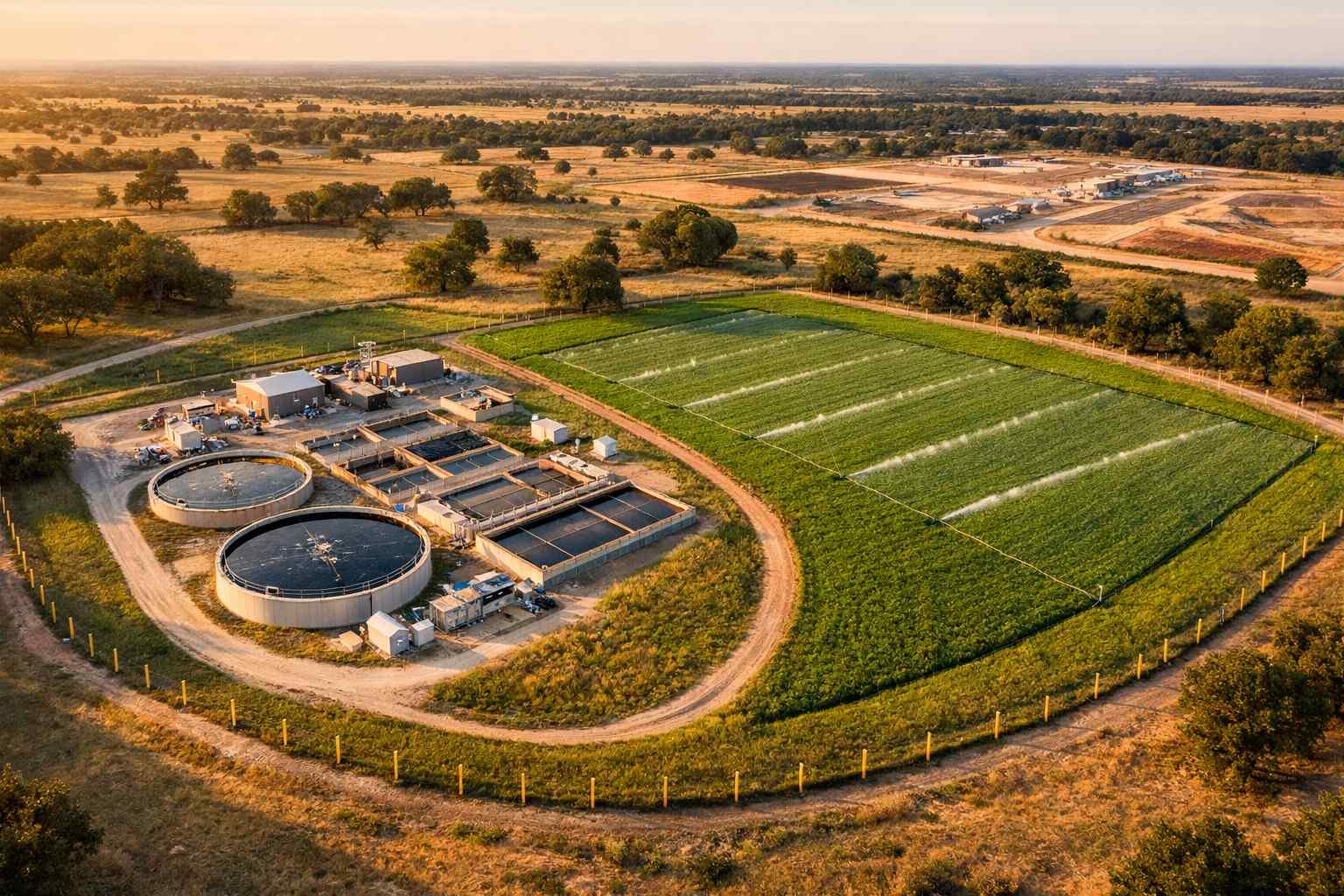
A Texas Land Application Permit, known as a TLAP, is not a discharge permit. It is a beneficial reuse authorization. Under a TLAP, treated effluent is applied to land through surface irrigation or a subsurface system such as a drain field or drip system. The effluent is absorbed by soil and vegetation rather than flowing into a creek or river.
From a regulatory standpoint, that distinction drives the entire timeline advantage. TCEQ’s review for a TLAP focuses on groundwater protection and site capacity. There is no receiving water dilution analysis, no effluent toxicity testing tied to aquatic life, and no EPA coordination required for standard domestic applications. Removing those steps is what compresses the timeline compared to a TPDES discharge permit for the same project.
When Land Application Is the Right Call
This approach is not right for every site. But it fits a larger range of projects than most developers expect.
Remote or rural developments are the most obvious candidates. Projects far from municipal infrastructure avoid the cost of long force mains and off-site agreements. Land application lets development move forward on site.
Projects with existing irrigation demand are a natural fit. Developments with green space, parks, golf courses, or adjacent agricultural land can put treated effluent to productive use rather than treating disposal as a pure cost.
Restricted watersheds are another driver. Some Texas watersheds carry strict discharge limits that make traditional permits slow, expensive, or politically contentious. Land application removes the project from surface water scrutiny entirely.
Schedule-driven projects benefit most. If your financing window or tenant commitment depends on a predictable construction start, a 10 to 18 month permitting path protects that schedule in a way that a 24 to 36 month discharge process cannot.
What TCEQ Actually Reviews for a TLAP
The review scope is narrower than a discharge permit, but the technical requirements are real. TCEQ concentrates on four areas.
Hydraulic Loading and Site Capacity
TCEQ engineers calculate whether the proposed application site can absorb the projected effluent volume without ponding, runoff, or saturating the soil profile. Sandy loams and well-drained silty soils common across central and east Texas generally perform well. Heavier clay-dominant soils require more acreage or subsurface drip design. Applications that propose a tight margin between design flow and maximum hydraulic loading rate tend to draw extended technical questions. Size conservatively.
Agronomic Rate Compliance
TCEQ requires that application rates align with the nitrogen uptake capacity of the vegetation or crops on the application site. Your application must account for nitrogen content in the treated effluent and demonstrate that the receiving vegetation can assimilate that load without groundwater nitrate accumulation. This is the primary mechanism TCEQ uses to protect groundwater quality under a TLAP.
Setbacks and Buffer Distances
Title 30 TAC Chapter 309 establishes minimum distances between application zones and property lines, water supply wells, public roads, occupied structures, and surface water bodies. Getting setback calculations wrong is one of the fastest ways to draw a Notice of Deficiency and, in some cases, requires a full redesign of your treatment system layout. Projects near Edwards Aquifer contributing zones face additional requirements regardless of permit type.
Treatment Standards
The treated effluent must meet specific quality thresholds before it reaches the soil. Secondary treatment is the baseline for domestic wastewater. If agronomic rate calculations require additional nutrient reduction, that needs to be built into your treatment plant design from the start.
Application Requirements That Catch Developers Off Guard
A complete TLAP application requires Form TCEQ-10400 (facility information), TCEQ-10053 (administrative report with applicable fees), and TCEQ-10054 (technical specifications). Two requirements create the most avoidable delays.
Public Involvement Plan (PIP): All new wastewater permit applications received on or after November 1, 2022 must include a completed PIP form. This is mandatory. Missing it means the application is returned before TCEQ begins technical review. There is no grace period.
Dual Submission Format: TCEQ requires electronic copies via the agency FTP server and a hardcopy original with two additional copies by mail. The review clock does not start until the physical copy arrives. Electronic-only submission does not trigger the review period.
Once TCEQ declares the application administratively complete, the applicant must publish a Notice of Receipt of Application and Intent to Obtain a Permit within 30 calendar days. After technical completeness is confirmed, a Notice of Application and Preliminary Decision must be published within 45 calendar days. Public notice is required, but land application permits draw significantly less opposition than discharge permits because there is no direct surface water impact.
Realistic Approval Windows
Well-prepared TLAP applications on qualifying sites typically reach approval in 10 to 18 months from submission. More complex applications or those requiring supplemental technical information can stretch beyond that.
The planning trigger most developers miss: TCEQ requires applications 330 days before your planned operational date. That is legally mandated and non-negotiable.
If your project calls for first occupancy in Q3 of a given year, your TLAP application needs to be submitted approximately 11 months before that date. Add 2 to 3 months for engineering, soil studies, and application preparation, and you are starting the permitting process 14 to 18 months before your target operational date.
A pre-application meeting with TCEQ staff is not required but is strongly recommended for new facilities. Staff will confirm permit type, flag site-specific concerns, and clarify what your package needs before you invest in a full submittal.
Site Conditions That Make a Strong TLAP Candidate
Not every development site is suited for land application. The following conditions indicate a strong fit.
Available land area. You need a dedicated application site, typically 2 to 3 times the treatment plant footprint or more depending on loading rates. Master-planned communities, rural residential subdivisions, and developments with open space or agricultural components generally have the land basis to make it work.
Favorable soil conditions. Well-drained soils with moderate permeability are ideal. Loamy or sandy loam profiles produce cleaner hydraulic loading calculations. Caliche-heavy soils and shallow-bedrock sites require additional design to compensate.
No nearby sensitive receptors. Setback compliance is straightforward when the application field is buffered from neighboring property lines, water supply wells, and structures.
No accessible receiving stream. If your site lacks a nearby permitted receiving water body, or the nearest stream is on TCEQ’s impairment list, a TLAP is often the only practical path. This is increasingly common in fast-growing Texas counties where infrastructure has not kept pace with development.
Consistent effluent quality. Secondary treatment systems, including oxidation ditches, sequencing batch reactors, and membrane bioreactors, reliably produce effluent that meets TLAP application standards when properly designed and operated.
Start the Permitting Process Earlier Than You Think You Need To
The TLAP route is genuinely faster and less politically exposed than a TPDES permit for qualifying projects. But the timeline does not compress just because the permit type is different. Every month you delay starting engineering and application preparation is a month of project schedule risk at the back end.
At Modern Engineering Solutions, we evaluate land application feasibility early in the project, not as a fallback after a discharge permit stalls. The questions worth answering before committing to any permitting path are whether the site can support it, what treatment system is appropriate, and whether the timeline fits your financing and construction schedule.
If you are evaluating a Texas development with wastewater constraints, contact our team early. The earlier we get into your site data and project schedule, the more options you have.
Have you ever had a Texas development project stalled by a discharge permit timeline? What did you do with the site?
Frequently Asked Questions
What is the difference between a TLAP and a TPDES permit in Texas?
A TPDES permit authorizes discharge of treated wastewater to a surface water body such as a creek or river. A TLAP authorizes application of treated effluent to land for beneficial use, such as irrigation. Because a TLAP involves no surface water discharge, TCEQ’s review does not include receiving water analysis, anti-degradation review, or EPA coordination for standard domestic applications. That narrower scope is what makes TLAP approvals faster and less contentious than TPDES permits for qualifying sites.
How long does a TLAP approval take in Texas?
Well-prepared applications on qualifying sites typically reach approval in 10 to 18 months from submission. TCEQ also requires that applications be submitted at least 330 days before your planned operational date, which is a legally mandated timeline. Add 2 to 3 months for engineering and application preparation upfront, and plan to start the process 14 to 18 months before your target operational date.
What forms are required for a Texas Land Application Permit application?
A complete TLAP application requires Form TCEQ-10400 (facility information), TCEQ-10053 (administrative report with applicable fees), and TCEQ-10054 (technical specifications). Applications submitted on or after November 1, 2022 must also include a completed Public Involvement Plan form. Missing the PIP results in automatic return of the application before technical review begins.
What does TCEQ review in a TLAP application?
TCEQ’s technical review focuses on hydraulic loading and site capacity (can the soil absorb the volume without runoff or saturation), agronomic rate compliance (can the vegetation assimilate the nitrogen load without groundwater accumulation), setbacks and buffer distances from wells, property lines, and structures, and treatment system performance against required effluent quality thresholds.
What site conditions make a project a good TLAP candidate?
Strong candidates include projects with available land for a dedicated application field, well-drained soils with moderate permeability, adequate buffer distances from neighboring properties and water supply wells, no accessible permitted receiving stream, and developments with irrigation demand such as parks, green space, or adjacent agricultural land.
When should a developer evaluate land application as a permitting option?
During due diligence, before site acquisition or design begins. Evaluating feasibility early, including soil conditions, available land area, and TCEQ requirements, tells you whether the TLAP route is viable for your site and how it fits your project schedule before significant capital is committed.
Evaluating a Texas Development Site With Wastewater Permitting Constraints?
Modern Engineering Solutions works with Texas developers through the full TLAP process, from early site feasibility and soil analysis through treatment system design, application package preparation, and TCEQ response management.
We specialize in:
- Texas Land Application Permit (TLAP) preparation and TCEQ coordination
- Wastewater feasibility studies for development sites
- Treatment plant and package plant design
- Hydraulic loading and storage calculations
- TCEQ permitting strategy across all three Texas wastewater permit types
Modern Engineering Solutions, McKinney, Texas. Call (214) 833-6748 or email sales@mod-eng.com
Share via: