Quick Answer
TCEQ discharge permits now take 24 to 36 months in Texas. For most development projects, carrying costs run $50,000 to $200,000 per month in financing, holding costs, and lost lease revenue. That means a standard discharge permit process adds $1.2 million to $7.2 million in unplanned carrying cost exposure to your project before construction starts. The permit strategy that fixes it is not faster engineering. It is choosing the right permit pathway before the clock starts, specifically, reuse-based authorizations that compress the TCEQ timeline from years to weeks for qualifying projects.
Wastewater Permitting Is a Financial Decision, Not Just a Regulatory One
Most managing partners and project directors review wastewater permitting the same way they review any regulatory line item: confirm it is being handled, trust the engineering team, move on. That approach made sense when TCEQ discharge permits took 12 months. It does not make sense now.
TCEQ discharge permit timelines have stretched to 24 to 36 months under current staffing and review conditions. In restricted Texas watersheds near the Edwards Aquifer, along the San Marcos River corridor, in areas with active third-party opposition, contested case hearings push timelines further. The permit itself has not changed. The exposure it creates on your pro forma has.
A developer in Montgomery County came to MES eight months into carrying costs on a 130,000 GPD development. TCEQ informed him to expect another 12 or more months before discharge permit approval. Monthly carrying costs were deteriorating the project economics. Investor confidence was eroding alongside them. The infrastructure cost was manageable. The timeline was not.
What Carrying Cost Exposure Actually Looks Like on a Pro Forma
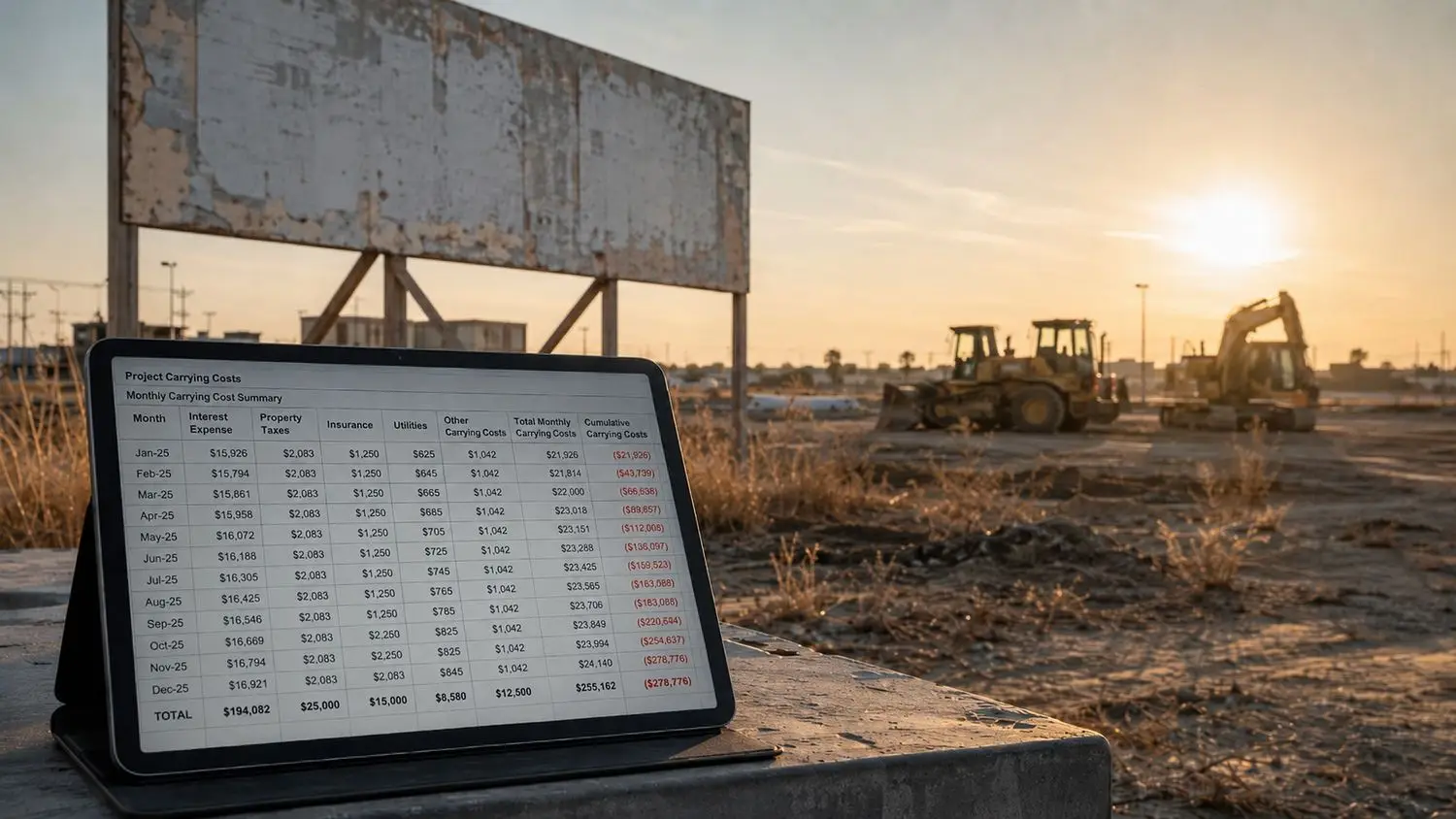
The carrying cost calculation is straightforward. Take your monthly financing cost, property taxes, insurance, and foregone lease revenue. Multiply by the number of months between land acquisition and construction start. Every month of permit delay adds directly to that number.
For a Texas development with $100,000 per month in carrying costs, a conservative figure for a project of meaningful scale, the difference between a 210E authorization approved in 8 weeks and a TPDES discharge permit that runs 24 months is $2.1 million in carrying cost exposure. That number does not appear anywhere on the original pro forma. It appears when the permit stalls.
The developers who protect their IRR on Texas projects are the ones who run this calculation before committing to a permitting pathway, not after they are already inside a 24-month process with no exit.
The Three Permit Pathways and What Each Costs You in Time
Not every Texas development qualifies for every pathway. But most developers default to the discharge permit before evaluating whether a faster option applies to their project.
A TPDES discharge permit authorizes discharge to a water of the state. Current timeline: 24 to 36 months. Public hearing exposure: yes. Third-party opposition risk: yes, particularly in sensitive watersheds. This is the default pathway and the one with the highest carrying cost exposure.
A Texas Land Application Permit (TLAP) authorizes beneficial reuse of treated effluent through land application, typically irrigation. No receiving water analysis. No EPA coordination for standard domestic applications. Timeline: 10 to 18 months on qualifying sites. TCEQ requires application at least 330 days before planned operational date.
A 210E Industrial Reclaimed Water Authorization is available for projects with any industrial wastewater component. No public hearing. No third-party referral process. State-level authorization supersedes local jurisdiction. Timeline: 4 to 10 weeks. MES has secured 210E approvals for Texas developments from 5,000 GPD to 2.0 MGD. For the Montgomery County developer referenced above, switching to a reuse-based approach eliminated the permit dependency entirely, construction started on schedule, carrying costs stopped.
What Qualifies for the Faster Pathways
The 210E pathway requires an industrial wastewater component. Under 30 TAC §210.53(b)(2), that component can represent as little as 10% of total project flow. A data center cooling operation, a concrete batch plant, or a light manufacturing facility qualifies, even alongside predominantly residential or commercial development.
The TLAP pathway requires a dedicated land application site with soil and agronomic conditions that meet TCEQ’s hydraulic loading and nitrogen uptake requirements. Master-planned communities, rural residential subdivisions, and developments with irrigation demand are natural candidates.
The question worth asking before any TCEQ permit application is filed: which pathway applies to this specific project, and what is the carrying cost exposure of each? That is a two-to-four week feasibility evaluation. It is far less expensive than discovering the answer 18 months into the wrong process.
Frequently Asked Questions
How much do carrying costs typically run on a Texas development project?
Most development projects of meaningful scale run $50,000 to $200,000 per month in carrying costs including financing, property taxes, insurance, and foregone lease revenue. Every month of TCEQ permit delay adds directly to that exposure.
Can a project switch from a TPDES discharge permit to a 210E authorization mid-process?
Yes. MES has helped developers redesign permitted projects for beneficial reuse after discharge permits stalled. The redesign eliminates the permit dependency and allows construction to start on a defined timeline rather than waiting on TCEQ’s queue.
What is the minimum industrial component needed to qualify for a 210E authorization?
No minimum percentage is required. Under 30 TAC §210.53(b)(2), any industrial wastewater commingled with domestic wastewater qualifies. TCEQ has approved 210E authorizations where industrial flows represent as little as 10% of total project volume.
When should a developer evaluate permit pathway options?
During due diligence, before land acquisition is finalized. Evaluating the permitting pathway before committing capital is what keeps the carrying cost exposure off the pro forma entirely. After closing, the options still exist – but they cost more to execute.
Is Permit Delay Exposure on Your Current Pro Forma?
Modern Engineering Solutions works with Texas developers to evaluate permit pathway options, quantify carrying cost exposure, and select the fastest viable route to construction authorization.
We specialize in:
- Permit pathway feasibility analysis, TPDES, TLAP, and 210E comparison
- 210E Industrial Reclaimed Water Authorization preparation and TCEQ coordination
- Carrying cost analysis tied to permitting timeline for pro forma and lender underwriting
- Permit rescue for stalled TCEQ discharge applications
- Water and wastewater feasibility analysis during land due diligence