
Blog
What Is a 210E Authorization and How Can It Save Your Texas Development Project?
Learn what a 210E authorization is, who qualifies under 30 TAC Chapter 210, and what a Texas project needs to reuse wastewater instead of discharging it.
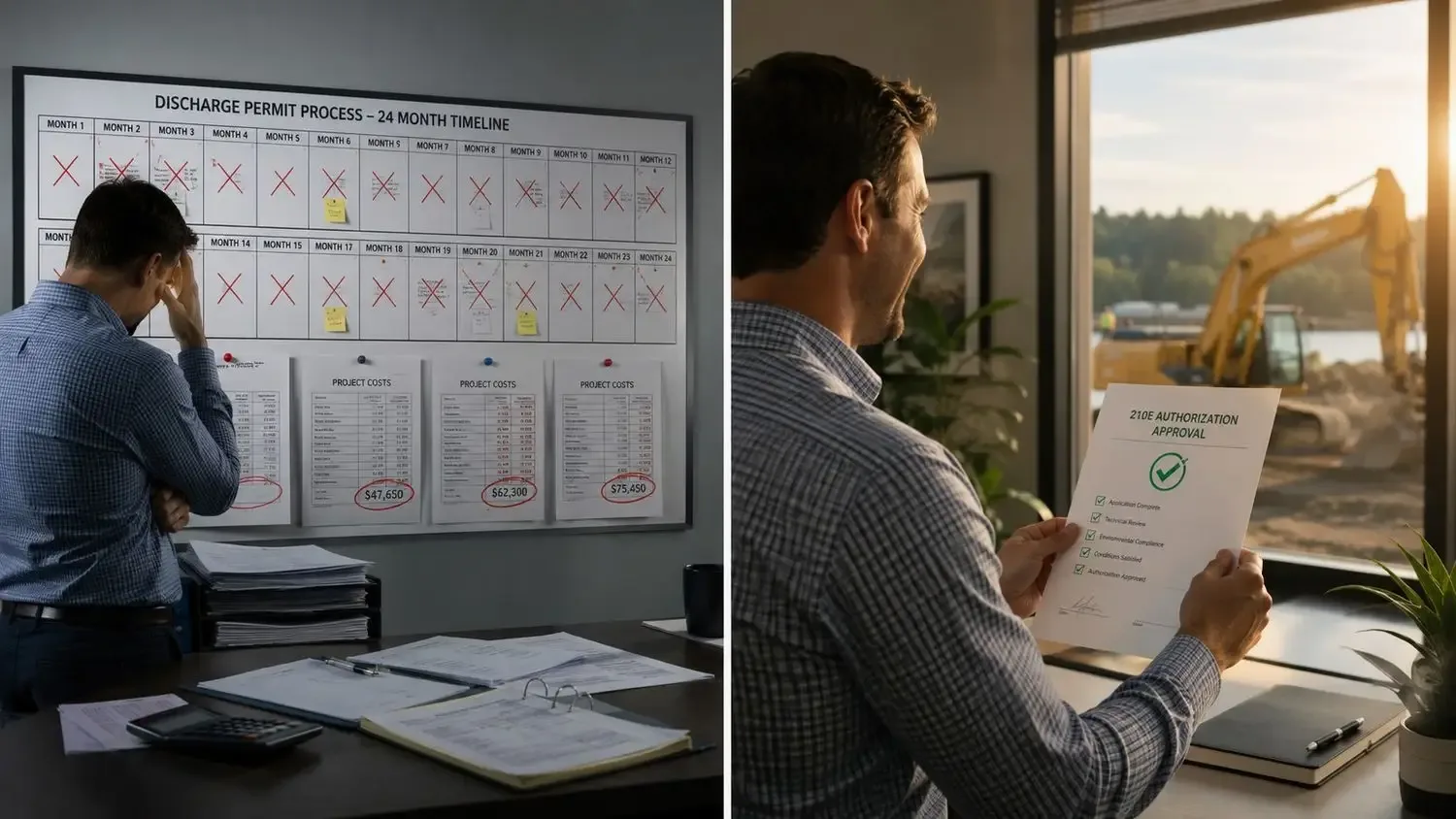
A 210E authorization is TCEQ's written approval to reuse industrial wastewater, alone or mixed with domestic sewage, for irrigation and other approved uses instead of discharging it. It can save a Texas development with no good sewer or discharge option, because it is separate from the discharge permit process. It needs an eligible industrial stream, a real reuse plan, a place for the water when reuse stops and, with sewage mixed in, a plant that meets the full reclaimed water rules.
What is a 210E authorization?
It is an authorization under 30 TAC Chapter 210, Subchapter E, the Texas rules for industrial reclaimed water. The "E" is the subchapter, sections 210.51 through 210.60.
The end uses it names include landscape irrigation, dust suppression, soil compaction, impoundment maintenance and other beneficial land application (§210.51(c)).
There are two levels. TCEQ's industrial reclaimed water guidance explains that Level I covers listed streams reused on site, which needs no TCEQ notice. Off-site Level I reuse and all Level II reuse need written approval on Form TCEQ-20094 before reuse starts (§210.55(b)).
Two lines explain why developers care. An approved project does not need a new or amended commission permit, except as §210.5 provides (§210.51(f)). And the authorization is separate from discharge permits under Chapters 205 and 305 (§210.56(j)).
Can a mixed-use development with domestic sewage qualify?
Yes, through Level II. Subchapter E defines commingled wastewater as industrial wastewater that contains any amount of domestic wastewater (§210.52(3)), and 30 TAC §210.53 sends that mix to Level II in subsection (b)(2).
The definition puts no cap on the domestic share, but it needs a real industrial wastewater stream to start from. The Level I list in §210.53(a) shows the kind of streams the rule has in mind: cooling tower blowdown below 2,000 mg/L total dissolved solids, non-process condensate, non-contact cooling water, filter backwash, and exterior building and pavement washwater with no detergents or chemicals.
Section 210.56(a)(3) frees an industrial reclaimed water producer from treating the water or holding a treatment and disposal permit. But §210.56(a)(1) says that relief does not apply to commingled water, which has to meet Subchapters A, B and C of Chapter 210, including the Type I or Type II quality standards in §210.33. Subchapter A also includes 30 TAC §210.2(e), which on its face asks a producer of reclaimed water for a TPDES permit, a Texas Land Application Permit or a Chapter 321, Subchapter P authorization before building and running the treatment facility. In MES's experience, TCEQ has not required a separate treatment permit for a commingled 210E plant. Site-specific facts can change what TCEQ asks for. For the quality numbers, read what Chapter 210 requires for effluent quality under a 210E authorization.
Which industrial wastewater does not qualify?
Some streams are out no matter how clean they are. 30 TAC §210.54 excludes, among others:
- Wastewater with regulated radioactive material, dioxins or furans, or pesticides
- Hazardous wastewater, listed or characteristic, under 40 CFR Part 261
- Process wastewater regulated under 40 CFR Parts 400 to 471, except listed industries such as dairy processing, fruit and vegetable canning, cement manufacturing and steam electric power generation
- Septic tank, chemical toilet, grit trap and grease trap waste
- Air scrubber wastewater
- Wastewater that a Chapter 321 permit by rule or a general land application permit can cover
Before you count on a tenant to make a project eligible, find out what its wastewater actually is.
How can a 210E authorization save a Texas development project?
For an industrial stream with no domestic sewage, it gives you a reuse path that does not run through the discharge permit's public notice track. That matters most where a discharge permit would draw opposition. With sewage in the mix, the plant treats to a higher standard, and in MES's experience TCEQ has not required a separate treatment permit.
TCEQ's guide to public participation in municipal wastewater permits lists the steps for a new permit: a notice of receipt, a notice of the preliminary decision, a comment period that typically ends 30 days after that notice is published, public meetings, and the right of an affected person to request a contested case hearing.
Section 210.55(b) lists what a Level II application must contain: the parties, the locations, the end use, the wastewater source, the backup disposal method, volumes, effluent test results, Edwards Aquifer location and liner certification. There is no public notice step in that list.
Neither source gives a review time to put in a project timeline. What you control is how complete the application is. For developers and builders, that means the reuse plan, the land and the backup disposal are settled before you file, not during review.
What does the reuse plan have to show?
Where every gallon goes, every day, including the days you cannot irrigate. The rules make that a design problem, not paperwork.
The irrigation and storage rules in 30 TAC §210.56 set the constraints:
- No land application on frozen or saturated ground or during rainfall
- Tail water control where needed to keep runoff out of water in the state
- No application within 250 feet of a private water well or 500 feet of a public water supply well
- Storage ponds keep at least two feet of freeboard and cannot be used for disposal
- Level II limits of 55 mg/L total organic carbon, sampled monthly, and pH between 6.0 and 9.0, sampled weekly, plus anything else TCEQ adds
Wet weather is where weak plans fail. The application has to name the disposal method used when reuse does not occur (§210.55(b)(7)). If that backup is a discharge to a creek, 30 TAC §210.5 requires a Chapter 305 permit before reclaimed water goes into water in the state. Water rights are separate too (§210.51(g)). TCEQ's guidance says you need one if the water enters a conveyance that could be a state watercourse before it reaches the user.
Is your project ready to apply?
If any answer is no, fix it before you file.
- Does the project have an industrial wastewater stream that is not on the §210.54 exclusion list?
- Do you know whether that stream is commingled with domestic wastewater, and therefore Level II?
- If commingled, does the plant meet the Type I or Type II standard your end use needs?
- Do you control the reuse land, or have a signed agreement with the user?
- Is storage sized for the days you cannot irrigate, with two feet of freeboard?
- Is there a named disposal method for when reuse stops, with its own authorization?
- Have you checked well setbacks and whether the site is in the Edwards Aquifer recharge zone?
Then ask your engineer three questions. Which end uses will take water in January? What happens if the industrial tenant leaves? Who signs as producer, provider and user? The time to answer them is during site feasibility, before the land closes.
A note on limits: this is general education on 30 TAC Chapter 210 as read in October 2026, not a review of your site. TCEQ decides eligibility and conditions, so check the current rule and form instructions before you file.
Frequently asked questions
Is a 210E authorization a permit?
Not a discharge permit. TCEQ's guidance describes it as a written approval, and §210.56(j) keeps it separate from discharge permits under Chapters 205 and 305. With domestic sewage mixed in, the plant must meet the stricter commingled water rules (§210.56(a)(1)). In MES's experience, TCEQ has not required a separate treatment facility permit for these plants.
Does a 210E authorization work outside Texas?
No. It is a Texas rule, administered by TCEQ. Other states have their own reuse rules.
I'm a developer in Texas planning homes and a light industrial pad on one treatment plant. Does the residential sewage rule out a 210E authorization?
Not by itself. Mixed with any amount of domestic wastewater, the industrial stream is commingled and goes to Level II, where the plant treats to the Type I or Type II standard. The industrial stream must also be eligible under §210.54.
I'm a land developer in Central Texas and part of my reuse area sits in the Edwards Aquifer recharge zone. What changes for my application?
Expect more review before construction. The Level II application asks for the site's location relative to the Edwards Aquifer (§210.55(b)(10)). For commingled water, irrigation with effluent in the recharge zone needs disposal system plans approved by TCEQ before construction under Chapter 213 (§210.4(d)). Subchapter E also excludes discharges that Chapter 213 prohibits (§210.54(c)).
I'm a civil engineer in Texas and my developer client wants to skip the discharge permit completely. What happens to the treated water after a week of rain?
It goes to storage or to the backup disposal method named in the application. You cannot land apply during rainfall or on saturated ground, and ponds cannot be used for disposal. Size storage from a water balance for your site's wet periods, and settle the backup before you file.
Related resources
- 210E Authorization vs. TPDES: A Side by Side Comparison of Design Standards, Cost, and Timeline
- How Mixed-Use Developments Qualify for 210E Even When 90% of Their Flow Is Residential
- What Happens to Your 210E Permit When Your Industrial Tenant Leaves?
- Getting a Discharge Permit as a Backup After Your 210E Is Operational
Weighing a 210E authorization against a discharge permit?
The answer usually turns on three things: the industrial stream, the reuse land and the backup disposal.
MES engineers can check those against Chapter 210 before you commit to a path.
Contact Modern Engineering Solutions in McKinney, Texas, or call (214) 833-6748.
Keep reading
More to read.
Talk to an engineer
Tell us about your project.
An engineer reads it
Not a salesperson. Someone who can tell you whether the pathway is real.
You get a first answer
Your options, the agencies involved and the questions that decide cost and schedule.
You decide
No commitment to have the first call.
Prefer the phone? (214) 833-6748