
Blog
Land Application Permits in Texas: A Faster Path to Wastewater Approval for Developers
A TLAP permit lets a Texas development irrigate treated wastewater instead of discharging it, and this guide covers what TCEQ reviews and requires.
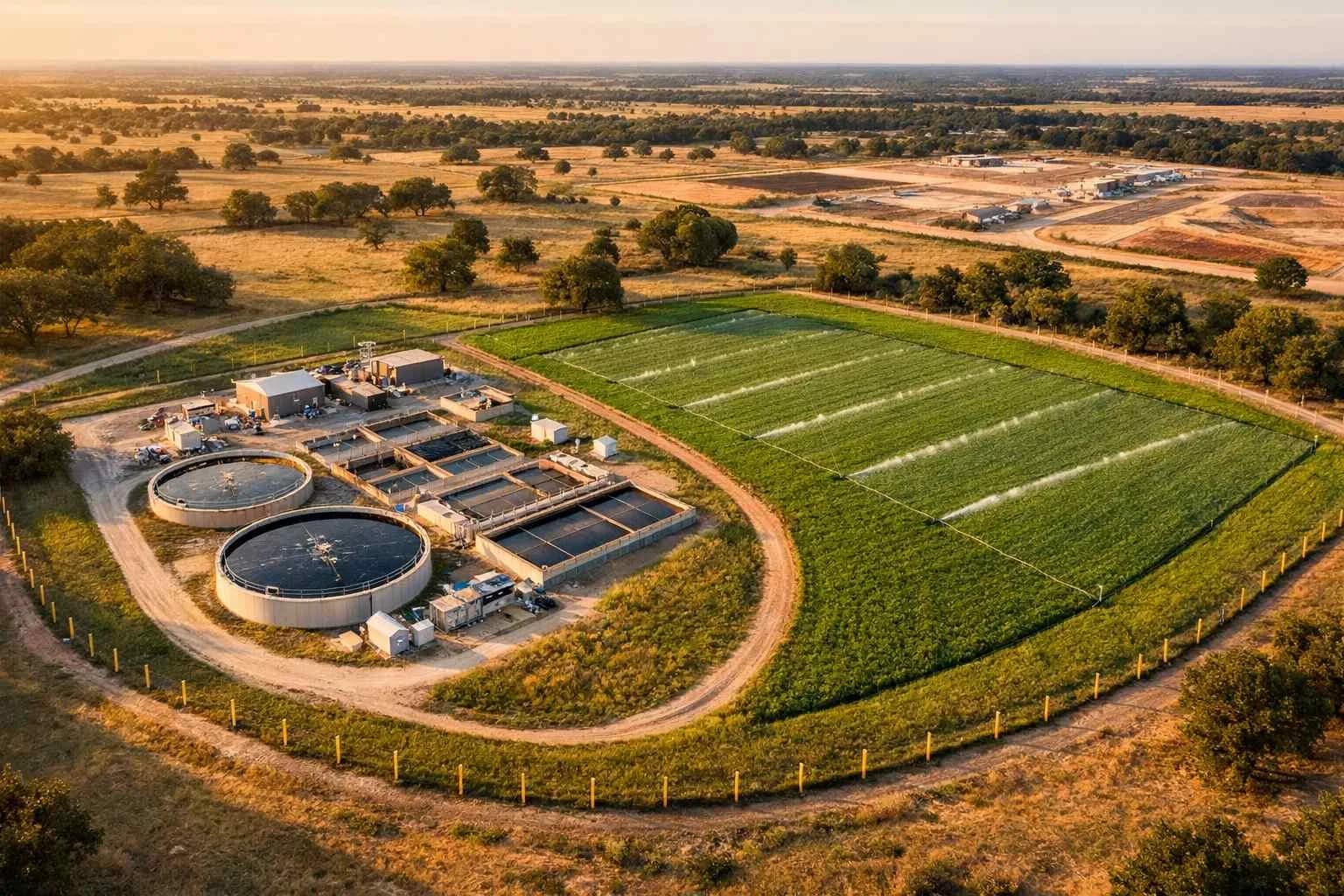
A TLAP permit, or Texas Land Application Permit, is the TCEQ permit for treated domestic wastewater that goes onto or into the land instead of into a creek. For a Texas development with no sewer to connect to, it can be the faster wastewater permitting path, because there is no receiving stream for TCEQ to study. The tradeoff is land, storage and land application compliance that runs every year the permit is active.
What is a TLAP permit?
It is the permit TCEQ requires when a facility disposes of treated domestic effluent on land instead of discharging it to water in the state.
TCEQ's municipal domestic wastewater permits page lists the methods that trigger one: surface irrigation, evaporation, drainfields or subsurface land application. A plant that discharges to a waterway needs a Texas Pollutant Discharge Elimination System (TPDES) permit instead.
A TCEQ presentation on TLAP agronomy reviews from October 2025 puts evaporation, surface irrigation and subsurface irrigation under 30 TAC Chapter 309, and subsurface area drip dispersal systems (SADDS) under 30 TAC Chapter 222. Pick the method early; it drives the rules, field layout and worksheets.
Why can a land application permit be a faster path to wastewater approval?
Because nothing reaches a stream, the review does not hinge on a receiving water body. The technical questions move to the soil, the crop and the groundwater.
For a discharge, TCEQ's public guide to municipal wastewater permits says the agency studies the receiving lakes and streams, how that water is used and how much added load it can tolerate, then sets effluent limits to protect those uses. For a TLAP, the agronomy presentation describes two technical reviews instead: geology and agronomy.
What does not change is the public process. A TLAP still gets two newspaper notices, public comment and the chance for a public meeting, and a person who filed a timely comment and would be adversely affected in a way not common to the general public can request a contested case hearing.
When does land application make sense for a Texas development?
When there is no practical sewer connection, the site has land to spare, and the treated water has a useful place to go.
Good candidates include rural subdivisions, master-planned communities with parks, golf courses and sites next to hay or pasture. Irrigating land you already have to water turns disposal into a use. Poor candidates are tight sites, shallow soils and land over the Edwards Aquifer recharge zone, where 30 TAC §213.6 prohibits land application systems that rely on percolation, except licensed private sewage facilities, and considers irrigation or evaporation case by case with at least secondary treatment.
Answer the question in a site feasibility study, before you close. For developers and builders, the lot plan and the irrigation fields compete for the same acres, so draw them together.
What does TCEQ review in a TLAP application?
Whether the land can take the water and the nitrogen without runoff, ponding or buildup, and whether storage and separation distances protect wells and neighbors.
Most of the numbers come from 30 TAC §309.20, Land Application of Sewage Effluent:
- A water balance study sets the hydraulic application rate (b)(3)(A).
- Storage is sized for a design rainfall year with a return frequency of at least 25 years (b)(3)(B). You cannot irrigate a saturated field, so the pond carries the plant through wet months.
- Nitrogen loading is held to an agronomic rate: no more than the crop needs, allowing 20% for volatilization (b)(3)(C).
- Root zone soil tests set a baseline before operation (b)(4).
- Every water well within a half mile of the application site has to be located (a)(4)(A).
- Land open to the public needs effluent treated to the equivalent of secondary standards (b)(1).
Setbacks and buffers sit in 30 TAC §309.13: irrigated land at least 150 feet from a private water well and 500 feet from a public water well site, with buffer zones for irrigated land evaluated case by case.
In the agronomy review, the permitted rate is the most stringent of four numbers: volume over acreage, the nutrient-limited rate, the water balance and the rate you requested. Size the fields with margin.
What goes into a TLAP wastewater permit application?
The standard TCEQ domestic wastewater application, plus the land application worksheets and the agronomy data behind them. TCEQ's permitting process page lists the forms:
- Domestic Administrative Report, TCEQ-10053
- Domestic Technical Report, TCEQ-10054
- Core Data Form, TCEQ-10400
- Summary of Application in Plain Language, TCEQ-20972
- Public Involvement Plan form, TCEQ-20960, for new and major amendment applications submitted on or after November 1, 2022
The same page encourages filing through STEERS ePermits. The agronomy presentation adds Domestic Worksheets 3.0 to 3.3, the land application worksheets for TCEQ-10054, and the items its reviewers check: a cropping plan, an NRCS soil map of the actual application area, soil analyses, effluent quality and a site preparation plan.
How early should you start a TLAP application?
Well before the 330 days TCEQ asks for, because the soil work, cropping plan and storage design must exist before you file.
The permitting process page says to submit a complete package at least 330 days before the proposed discharge begins. For a TLAP, read that as the day the plant starts applying effluent. The same page calls a pre-application meeting highly recommended for new facilities. Take it.
After administrative review, 30 TAC §39.418 has the applicant publish the first notice within 30 days of administrative completeness. Technical review, a draft permit and the second notice under 30 TAC §39.419 follow. Each notice of deficiency adds a loop. Our post on why Texas wastewater permits take longer than developers expect shows where the time goes.
What does land application permit compliance involve?
Running the fields like a farm and the plant like a utility, for as long as the permit is active.
The agronomy presentation lists what it calls important special provisions for these permits:
- No application during rainfall or on frozen or saturated ground.
- Irrigation managed to prevent pooling, with fields monitored.
- The crop harvested at least once a year, clippings removed.
- For SADDS, at least 12 inches of rootable soil below the drip lines.
Section 309.20(b)(4) also requires at least one soil test a year from each application site for the system's design life. The permit sets effluent limits, monitoring and reporting, and TCEQ's wastewater compliance resources page carries the noncompliance notification form, TCEQ-00501. Plan operator time before you decide who owns the plant.
Is your site ready for a TLAP?
It is a real candidate if it passes all six checks below.
- Is there no practical sewer connection within reach?
- Do you control enough contiguous land for fields, storage and buffers after the lot plan?
- Do NRCS soil maps of the field area show soils that take water without ponding?
- Can the fields sit at least 150 feet from private wells and 500 feet from public water well sites?
- Is the site off the Edwards Aquifer recharge zone, or are you ready for a case-by-case review?
- Is there a crop or landscape to use the water and nitrogen, and someone to harvest it?
Six yeses mean the site is worth a TLAP feasibility study; any no needs an answer before design starts.
Questions for your engineer: What design flow are we permitting, and in what phases? Does the water balance or the nitrogen balance control the acreage? Where does the storage pond go? What happens in a wet year?
A note on limits: this is general education from TCEQ rules and guidance as published in October 2026. Your permit's conditions govern, and no article can predict a review outcome or a schedule.
Frequently asked questions
What does TLAP stand for?
Texas Land Application Permit. TCEQ requires one when a domestic facility disposes of treated effluent on land by surface irrigation, evaporation, drainfields or subsurface application.
Is a TLAP faster than a TPDES permit?
It can be, because there is no receiving stream to study. Both still go through public notice and comment, and neither comes with a guaranteed schedule.
I'm a developer planning a 300-lot subdivision in the Texas Hill Country with no city sewer nearby. How do I know if I have enough land for a TLAP?
Run the water balance and the nitrogen balance at your design flow, then add the storage pond and buffers. Whichever rate controls sets the field size. Check the Edwards Aquifer recharge zone first, because 30 TAC §213.6 changes the rules there.
I own a commercial site in Texas with an existing land application permit and I'll run the plant myself. What compliance work should I plan for every year?
At least one soil test per application site, a crop harvest with clippings removed, and irrigation that stops in rain and on frozen or saturated ground. Then follow the monitoring and reporting in your permit. Read its special provisions closely; that is where your site-specific rules live.
Related resources
- Texas Land Application Permits Explained: Spray Irrigation, Subsurface Drip, and Evaporation Ponds
- Your Three Wastewater Disposal Options in Texas: Discharge, Reuse, or Land Application
- Industrial TPDES vs. TLAP: Which Wastewater Permit Path Fits Your Texas Facility?
- How to Evaluate Wastewater Utility Options Before You Close on Land (Connect, Build, or Wait)
Weighing a TLAP for a Texas site without sewer?
We test whether the land, soils and storage can carry the flow before you commit to a permit path, then design the plant and fields around what TCEQ reviews.
Talk to Modern Engineering Solutions about your site, or call (214) 833-6748.
Keep reading
More to read.
Talk to an engineer
Tell us about your project.
An engineer reads it
Not a salesperson. Someone who can tell you whether the pathway is real.
You get a first answer
Your options, the agencies involved and the questions that decide cost and schedule.
You decide
No commitment to have the first call.
Prefer the phone? (214) 833-6748