
Blog
EPANET Water Modeling
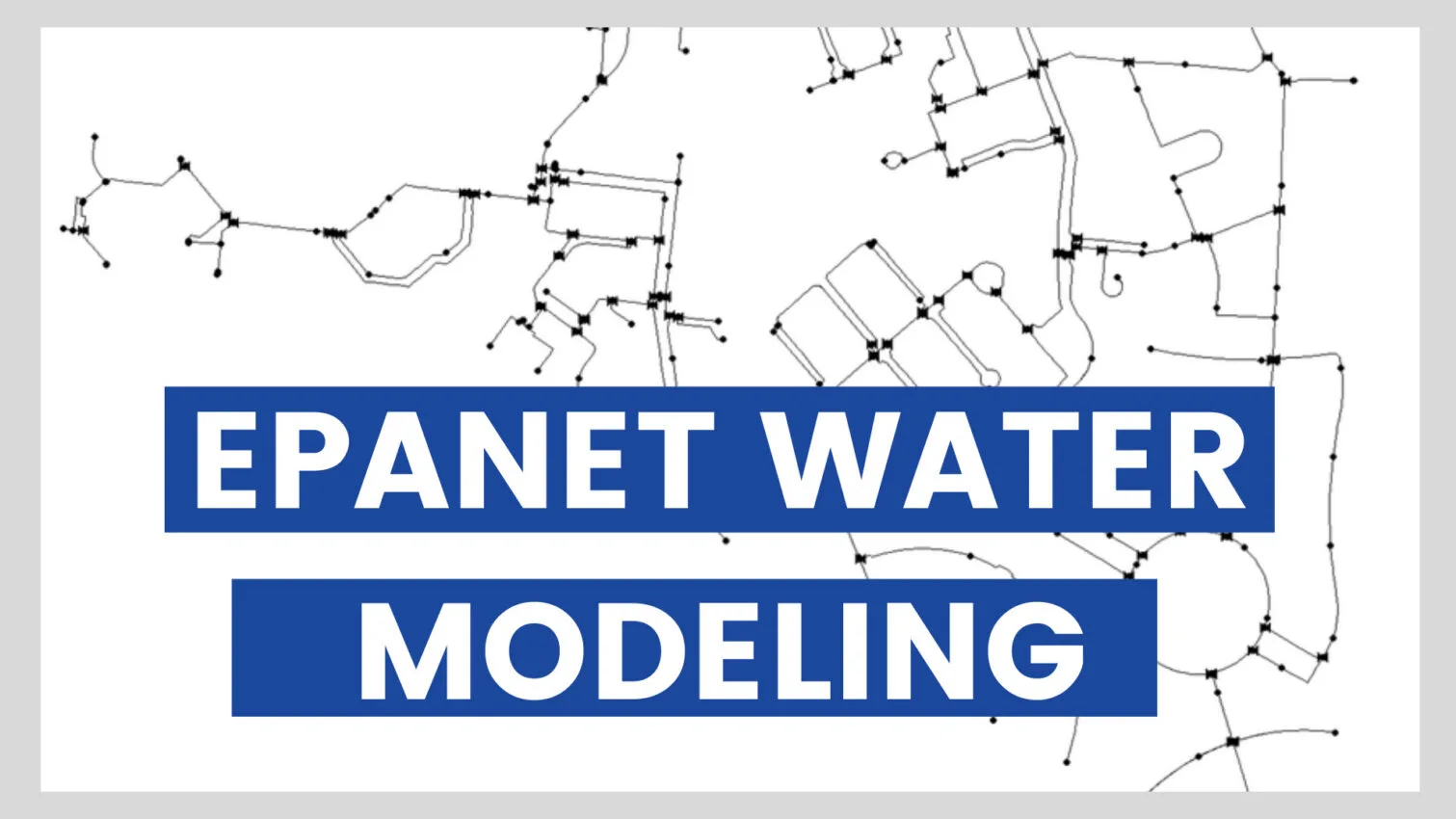
EPANET water modeling software uses mathematical models to predict pollutant fate and transport, pressure within a pipe network and flows.
EPANET is a free, public-domain software tool developed by the U.S. Environmental Protection Agency to model the hydraulic and water quality behavior of pressurized drinking water distribution systems. It performs extended-period simulation of how water moves through networks of pipes, junctions, pumps, valves, and storage tanks, tracking flow in each pipe, pressure at each node, tank water levels, and water quality parameters over time.
EPANET was first released by the EPA’s Water Supply and Water Resources Division in 1993, and remains one of the most widely used hydraulic modeling tools in the water industry. Its underlying computational engine is also used as the foundation for several commercial modeling packages, including WaterCAD, WaterGEMS, and InfoWater, and its standardized .inp input file format is supported across many free and commercial tools. This has made EPANET something close to an industry standard for water distribution modeling.
What EPANET Can Model
EPANET provides an integrated environment for building a network model, running hydraulic and water quality simulations, and reviewing results as network maps, data tables, and time series graphs. Its core capabilities include:
- Calculating flow rates and velocities in each pipe
- Determining pressure at every node across the network
- Tracking water levels in storage tanks over time
- Simulating water age throughout the distribution system
- Modeling the movement and decay of a tracked substance, such as chlorine residual
- Representing storage tanks as complete-mix, plug-flow, or two-compartment reactors
- Accounting for both bulk-flow reactions and pipe-wall reactions, including mass transfer limitations at the pipe wall
- Applying reaction coefficients globally or adjusting them pipe by pipe
- Correlating wall reaction rates to pipe roughness
- Simulating mass inputs at any point in the network, with intensity varying over time
Common Applications
Drinking water distribution system modeling. Engineers use EPANET to simulate how a distribution network behaves under different demand scenarios, helping evaluate system capacity, plan upgrades, and troubleshoot performance issues before committing to physical changes. Model accuracy depends heavily on the quality of the input data, which can be difficult to gather completely for older or undocumented systems.
Pressure network analysis. A pressure network represents a distribution system as a set of nodes connected by pipes, each with an associated pressure loss, the difference between a node’s actual pressure and the pressure it would have if isolated from the rest of the system. This approach lets engineers model an entire network’s behavior without manually estimating pressure drop between every connection.
Fire flow analysis. Fire flow analysis uses the EPANET model to determine the maximum available flow at a given hydrant while maintaining minimum required system pressure. A common approach is to start at the most remote hydrant in the network and test flow at that point, since it typically represents the worst-case condition. Results from this analysis help determine the maximum square footage allowed for sprinklered and non-sprinklered buildings under local fire code.
Water quality modeling. EPANET can track water age, simulate chlorine residual decay, and model the movement of a non-reactive tracer substance through the network over time, giving utilities insight into how water quality changes as it travels from treatment to tap.
If you need modeling support for your water distribution network, Modern Engineering Solutions can help.
Keep reading
More to read.
Talk to an engineer
Tell us about your project.
An engineer reads it
Not a salesperson. Someone who can tell you whether the pathway is real.
You get a first answer
Your options, the agencies involved and the questions that decide cost and schedule.
You decide
No commitment to have the first call.
Prefer the phone? (214) 833-6748