
Blog
How to Work With TCEQ Reviewers: What Slows Approvals and What Speeds Them Up
Most TCEQ delays are preventable. Complete applications and responsive deficiency answers determine whether permits take 4 weeks or 24 months.
Quick Answer
TCEQ permit approvals stall for predictable reasons: incomplete water balance studies, inadequate site characterization, unsupported flow projections, and missing documentation that the reviewer needs to make a determination. None of these are random. They are all avoidable with a complete, well-prepared submittal. MES has secured 210E approvals in 4 to 10 weeks during TCEQ’s busiest periods not because TCEQ moved faster for us, but because our applications arrived complete the first time, addressed the reviewer’s known questions before they asked them, and did not require a deficiency notice cycle to move forward.
What TCEQ Reviewers Are Actually Evaluating
Before discussing what slows approvals, it helps to understand what a TCEQ reviewer is actually looking for when they open an application.
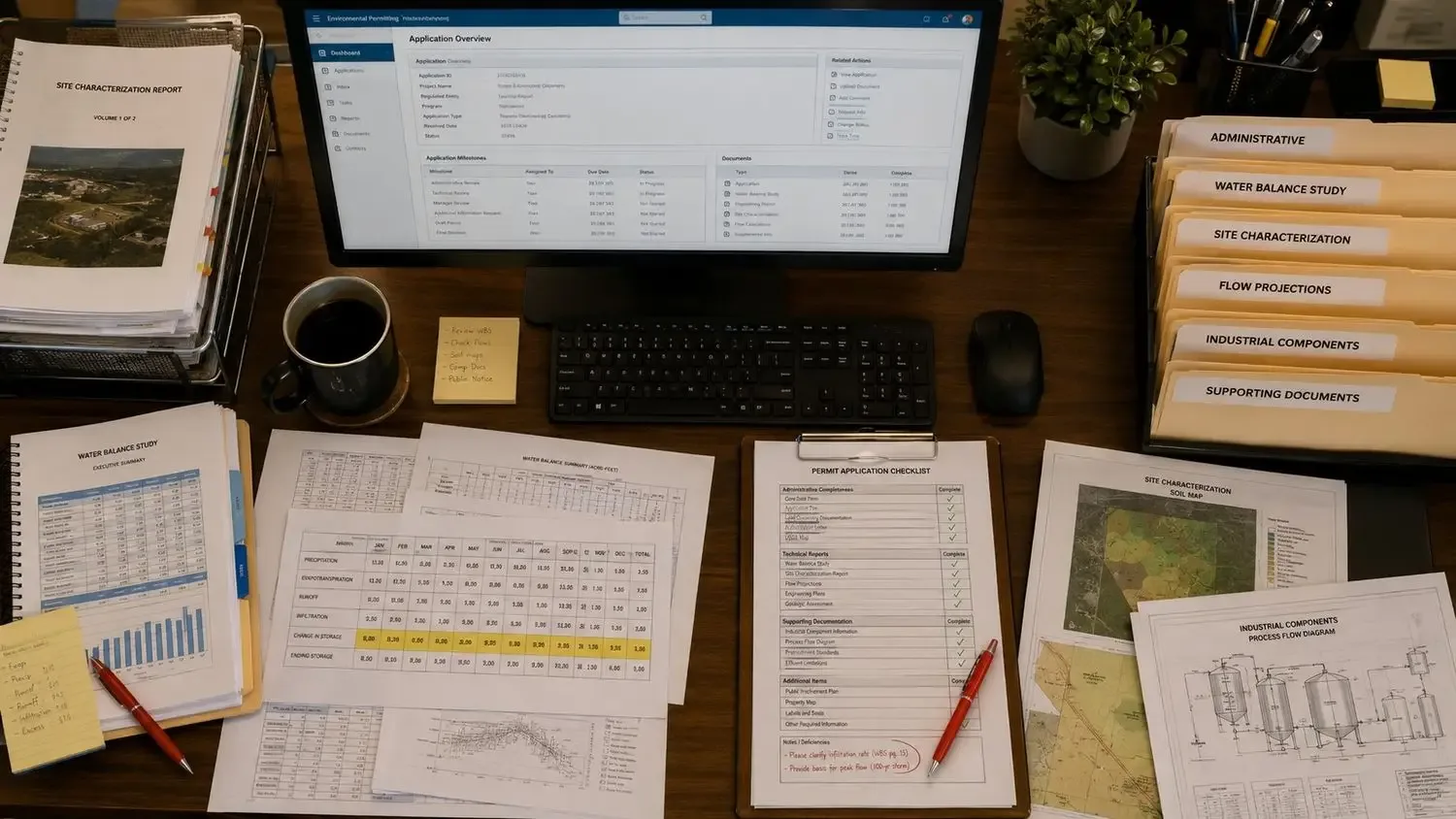
For a 210E Industrial Reclaimed Water Authorization, the reviewer’s job is to verify that the application meets the requirements of 30 TAC Chapter 210, Subchapter E. That means confirming the industrial component qualification under §210.53(b)(2), verifying that the reuse plan is compliant and that the reuse site and method are specifically documented, confirming that the water balance study meets §309.20 requirements using worst-case 25-year precipitation data, reviewing the site characterization for the reuse area, and confirming that the treatment system is described with enough specificity to support the authorization.
The reviewer is not trying to slow the project down. They are working through a defined checklist against a defined set of regulatory requirements. An application that answers every question on that checklist completely, with supporting documentation moves through review. An application that leaves questions open generates a deficiency notice, which pauses the clock until the applicant responds, and often generates a second round of questions when the response is submitted.
Every deficiency cycle adds weeks to months to the timeline. Most deficiency cycles are preventable.
What Causes Deficiency Notices
The most common triggers for TCEQ deficiency notices on 210E and reuse permit applications fall into four categories.
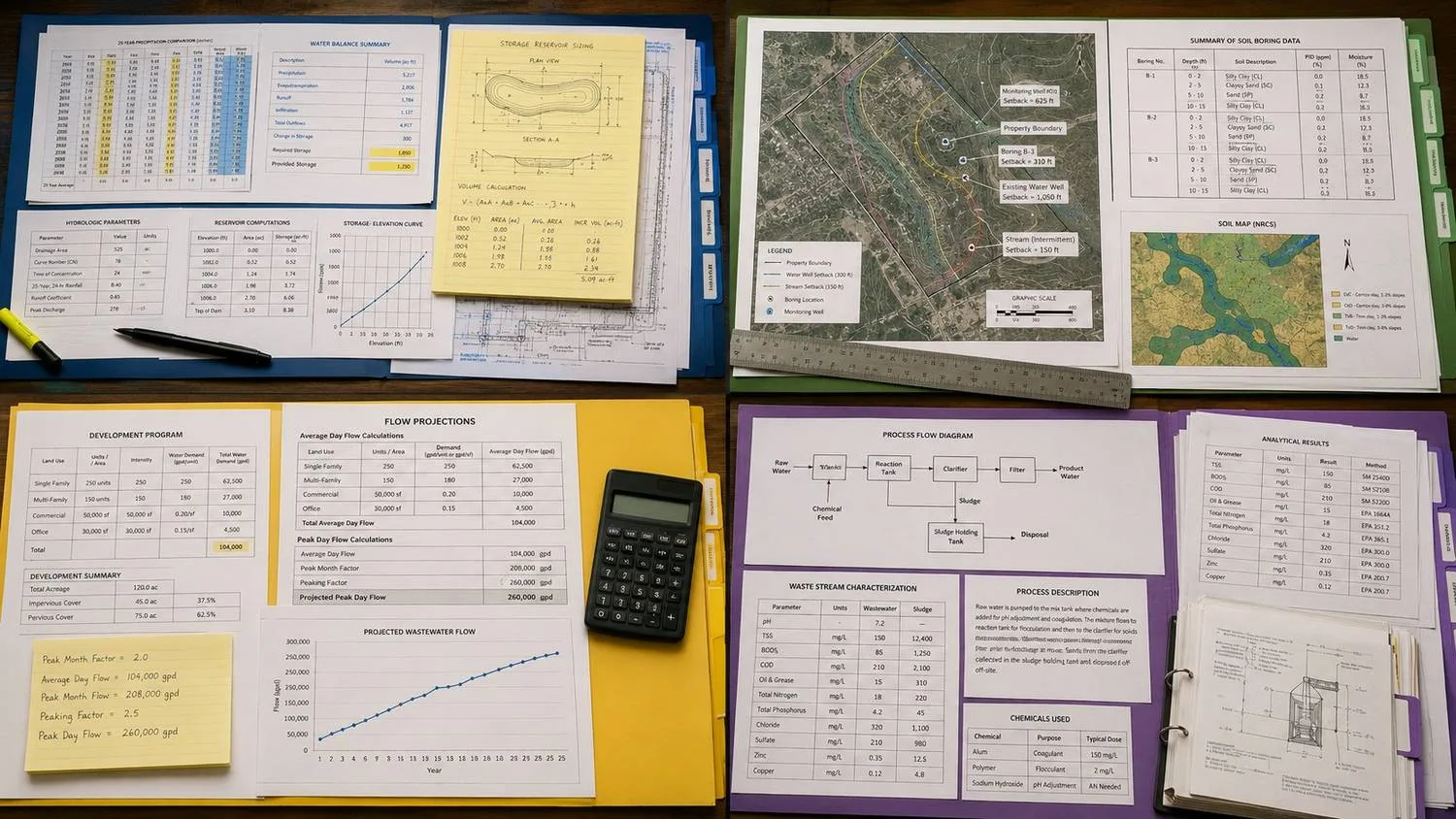
Incomplete water balance study. The water balance study per 30 TAC §309.20 is one of the most frequently deficient elements in Texas reuse permit applications. A complete water balance study for a 210E authorization uses worst-case 25-year precipitation data to demonstrate that treated effluent can be fully absorbed by the reuse site under the most adverse seasonal conditions. Applications that use average annual precipitation data, that do not account for the wet weather months when irrigation demand drops to near zero, or that do not properly size the storage reservoir against the worst-case scenario draw immediate technical questions. The reviewer cannot approve a reuse plan that does not demonstrate 100% capture and disposal of treated effluent under the conditions the regulation requires.
Inadequate site characterization for the reuse area. TCEQ requires specific documentation of the reuse site soil type, agronomic capacity, irrigation method, setbacks from wells and property lines, ownership or control documentation, and a demonstrated connection between the hydraulic loading rate and the site’s ability to accept it. Applications that describe the reuse site in general terms without site-specific data force the reviewer to ask for it. That question adds a deficiency cycle. Applications that arrive with a complete site characterization report, soil data, and documented loading calculations move directly through technical review.
Unsupported flow projections. Flow projections that cannot be tied back to a documented development program — unit counts, square footage by use type, industry-standard GPD assumptions generate reviewer questions about whether the permitted design flow is accurate. An application that presents a 130,000 GPD design flow without documenting how that number was calculated from the development program is incomplete. The reviewer needs to verify that the permitted capacity matches the actual project to prevent future permit modifications as the development grows.
Missing or vague industrial component documentation. Under 30 TAC §210.53(b)(2), the application must document the industrial wastewater component and confirm that it qualifies for Level II authorization. Applications that describe the industrial component in general terms “the project includes a warehouse with industrial operations” without characterizing the waste stream type, the estimated flow contribution, and the specific industrial activity invite technical questions. Reviewers need enough documentation to confirm qualification. Providing it in the initial submittal eliminates that question entirely.
What Pre-Submittal Coordination With TCEQ Actually Accomplishes
For complex applications facilities with unusual waste stream characteristics, large-scale reuse systems, or sites in sensitive regulatory areas a pre-submittal meeting or coordination call with TCEQ’s Water Quality Division staff before the application is filed can identify reviewer concerns before they become deficiency notices.
Pre-submittal coordination is not a standard step for every 210E application. For straightforward projects with a clear industrial component, a well-documented reuse plan, and a complete water balance study, the application speaks for itself and coordination adds time rather than saving it. For projects with any ambiguity a borderline industrial qualification, an off-site reuse arrangement with a complex ownership structure, or a site in an Edwards Aquifer recharge zone with stricter storage liner requirements under §210.4(d) pre-submittal coordination with the assigned reviewer is worth the time investment.
The goal is to surface the reviewer’s questions before the application is filed, address those questions in the submitted documentation, and arrive at the reviewer’s desk with an application that has already answered what they would have asked.
How Responsive Communication Compresses Timelines
Even a well-prepared application may receive a limited deficiency notice on minor items. How quickly and completely the applicant responds determines whether that notice costs two weeks or two months.
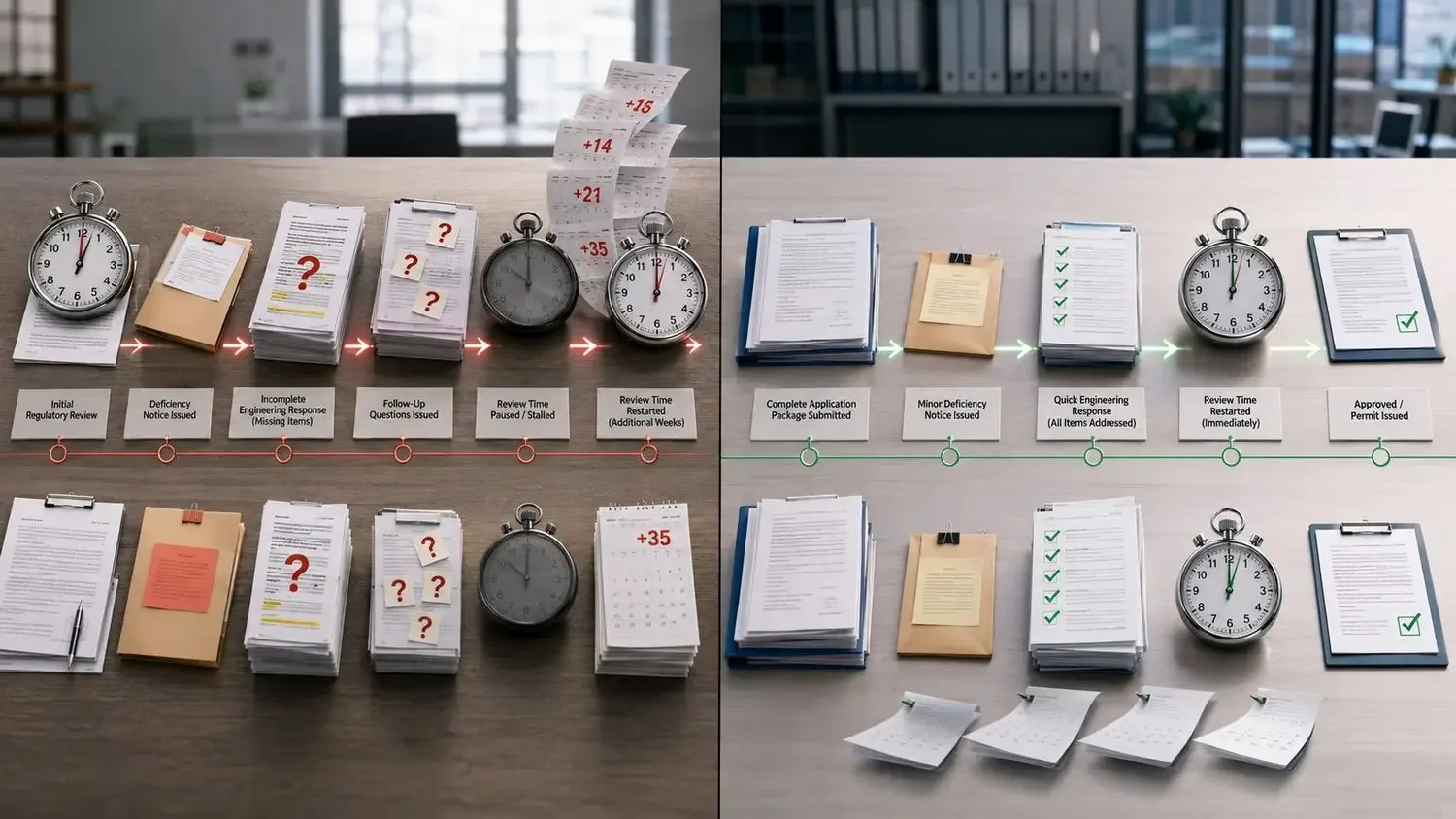
When TCEQ issues a deficiency notice, the clock on the review pauses. The agency’s timeline does not restart until a complete response is received. A response that partially addresses the questions or that requires TCEQ to follow up with a second request extends the pause. A complete, well-organized response that addresses each deficiency item directly and provides the supporting documentation in a form the reviewer can act on without additional requests restarts the clock immediately.
The engineering team’s responsiveness to deficiency notices matters as much as the completeness of the initial submittal. On MES’s 210E applications that have run 4 to 10 weeks, the pattern is consistent: complete first submittal, responsive communication on any minor deficiencies, and a reviewer who has no outstanding questions that prevent issuance. That is the sequence that produces fast approvals not a special relationship with TCEQ, and not favorable treatment. It is a well-prepared application handled by an engineering team that communicates quickly and clearly when the reviewer has a question.
Frequently Asked Questions
What is the most common reason 210E applications get deficiency notices?
Incomplete water balance studies are the most frequent trigger. The study must use worst-case 25-year precipitation data per 30 TAC §309.20 and demonstrate full effluent capture under adverse seasonal conditions. Applications that use average annual data or do not properly size storage for the wet weather period consistently draw technical questions.
Does pre-submittal coordination with TCEQ delay the application process?
For straightforward projects, no and it may not be necessary at all. For complex projects with unusual characteristics, pre-submittal coordination can identify and resolve reviewer questions before the application is filed, preventing deficiency cycles that would add more time than the coordination meeting cost.
How quickly does TCEQ typically respond to deficiency notice responses?
TCEQ’s response time after receiving a complete deficiency response varies by current workload and application type. For 210E applications, the review cycle after a complete response is typically faster than the initial review period, particularly when the response fully addresses all deficiency items and requires no follow-up questions.
Related Resources
- What Is a 210E Authorization and How Can It Save Your Texas Development Project
- Reuse vs. Discharge: Which Wastewater Strategy Fits Your Texas Development
- Land Application Permits in Texas: A Faster Path to Wastewater Approval for Developers
- TCEQ 30 TAC Chapter 210, Subchapter E Industrial Reclaimed Water Authorizations
- TCEQ Wastewater Permitting
Need a TCEQ Application That Gets Approved the First Time?
Modern Engineering Solutions works with Texas developers to prepare complete, reviewer-ready permit applications eliminating the deficiency cycles that add months to permit timelines.
We specialize in:
- 210E Industrial Reclaimed Water Authorization preparation and TCEQ coordination
- Water balance studies per 30 TAC §309.20 using worst-case 25-year precipitation data
- Site characterization, hydraulic loading calculations, and reuse plan documentation
- Pre-submittal TCEQ coordination for complex applications
- Deficiency notice response and revision management for stalled applications
Modern Engineering Solutions, McKinney, Texas. Contact: (214) 833-6748 or mod-eng.com
Keep reading
More to read.
Talk to an engineer
Tell us about your project.
An engineer reads it
Not a salesperson. Someone who can tell you whether the pathway is real.
You get a first answer
Your options, the agencies involved and the questions that decide cost and schedule.
You decide
No commitment to have the first call.
Prefer the phone? (214) 833-6748