
Blog
Permit-by-Rule vs. Standard Permit: When Each Path Applies to Your Development
Permit by rule vs standard permit in Texas wastewater: TCEQ has no permit by rule for a development's plant. Learn the 5,000 GPD OSSF line and the permits.
Quick answer
For a development's wastewater in Texas, the permit by rule vs standard permit question has a short answer. TCEQ has no permit by rule for a plant that treats and disposes of a development's sewage. A domestic system of 5,000 gallons per day or less that serves one property is an on-site sewage facility, permitted locally. A bigger plant, or a new system shared by several lots, falls into TCEQ's permit program, in practice an individual TPDES or TLAP permit.
Where do "permit by rule" and "standard permit" come from?
Both are real TCEQ terms, but they belong mostly to the air program. Air permits by rule are in 30 TAC Chapter 106, and air standard permits are in 30 TAC Chapter 116, Subchapter F. A developer meets them for emission sources, not sewage.
The water program has its own by-rule chapter, 30 TAC Chapter 321, Control of Certain Activities by Rule. Its current subchapters cover boat sewage, animal feeding operations, meat processing, sand and gravel washing, livestock trailer cleaning and reclaimed water production facilities. None of them authorizes a plant that treats and disposes of a subdivision's or a commercial site's sewage.
So when someone on a Texas development says "standard permit" for wastewater, they almost always mean an individual permit under 30 TAC Chapter 305.
Is there any permit by rule that touches a development's wastewater?
One narrow one, and it depends on someone else's permitted plant. Chapter 321, Subchapter P authorizes reclaimed water production facilities: plants that make reclaimed water at a site other than a permitted domestic treatment plant, tied to that "associated" plant.
The conditions are tight. The owner must own the associated plant or have its consent. All sludge must go back through the collection system to the associated plant. The facility's capacity cannot exceed the associated plant's permitted capacity. The executive director still reviews an application, and public notice is required.
So it does nothing for a greenfield site with no sewer to send solids to.
What does the 5,000 gallons per day line decide?
It decides whether you are in the on-site sewage program or TCEQ's wastewater permit program. Texas Health and Safety Code Chapter 366 defines an on-site sewage disposal system as one that produces not more than 5,000 gallons of waste a day and disposes only of sewage produced on its own site.
Those systems, often called OSSFs, are permitted by a local authorized agent: a city, county, river authority or special district. Where no local agent is authorized, the TCEQ regional office issues the permit.
The line is cumulative. 30 TAC §285.3(g)(1) excludes "one or more systems that cumulatively treat and dispose of more than 5,000 gallons of sewage per day on one piece of property." Splitting one property into several small systems does not keep you in the on-site program.
Sharing a system between lots takes you out too. The same §285.3(g) also excludes any new cluster system, any system that takes industrial, agricultural or municipal waste, and any system that discharges into or adjacent to water in the state. Under §285.2, a cluster system serves two or more buildings on separate legal tracts with no more than 5,000 gallons per day combined.
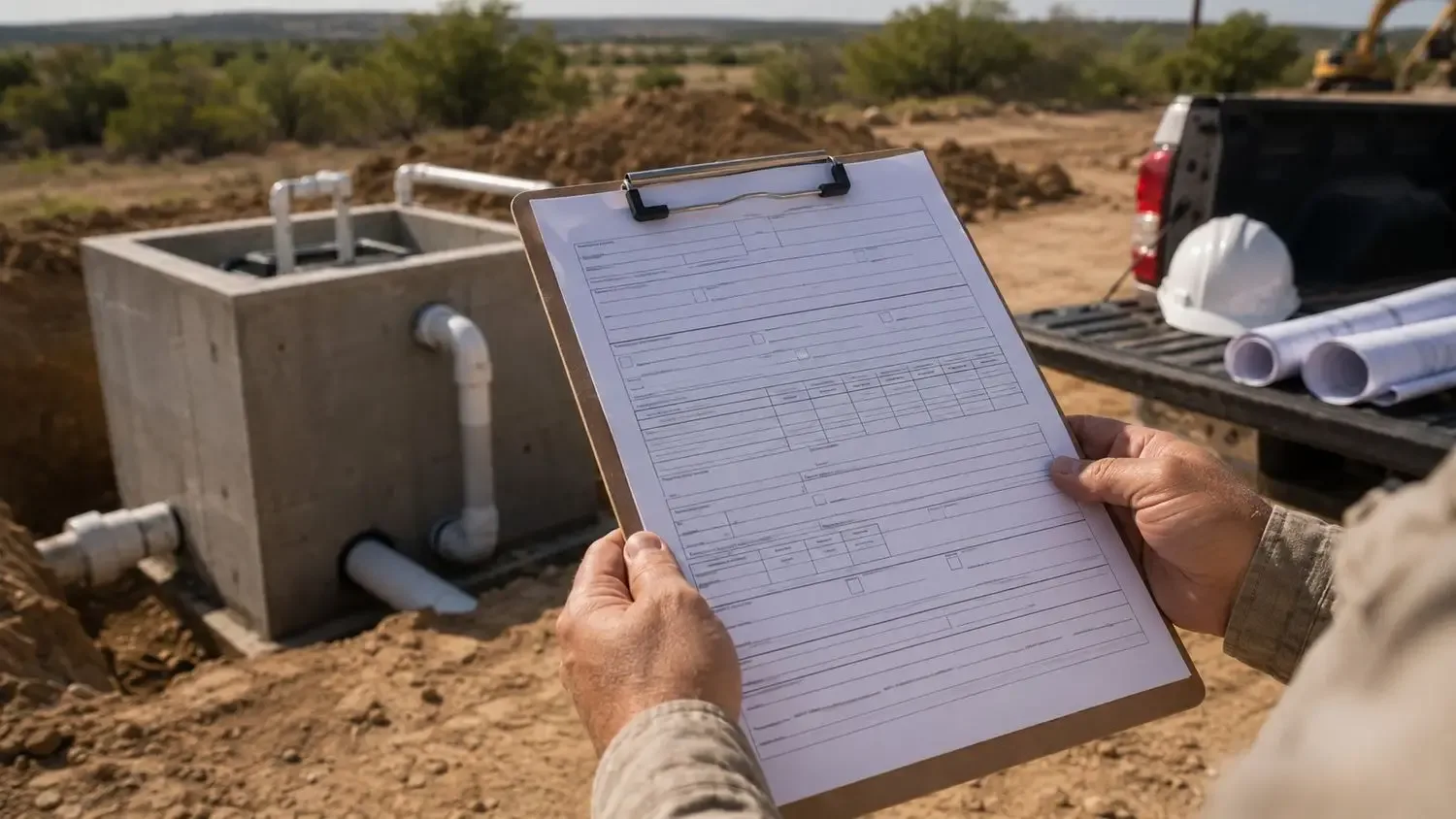
Which permit does a plant over 5,000 gallons per day need?
A TCEQ permit, chosen mostly by where the treated effluent goes. Section 285.3(g) points to Chapter 205, general permits, or Chapter 305, consolidated permits. For a private wastewater treatment plant, that usually means one of two individual permits.
- TPDES discharge permit. Treated effluent goes to water in the state. The permit sets effluent limits based on the receiving stream.
- Texas Land Application Permit (TLAP). No discharge. Effluent is irrigated or otherwise applied to land you control, under the siting and land rules in 30 TAC Chapter 309. Subsurface drip dispersal has its own permit under 30 TAC Chapter 222.
TCEQ's current list of water quality general permits has none for a development's shared plant. The closest, TXG530000, covers on-site systems serving single-family homes in Harris County.
Individual applications go through technical review and public notice. TCEQ's wastewater permitting page says new and major amendment individual applications received on or after November 1, 2022 must include a Public Involvement Plan form. Affected persons can request a contested case hearing under 30 TAC Chapter 55.
Plan the schedule around those steps, not around a notification that does not exist.
Is a 210E authorization a permit by rule?
Not the kind a development needs. 30 TAC Chapter 210, Subchapter E covers industrial reclaimed water at two levels. Level I covers listed industrial wastes, such as condensate and non-contact cooling water, used on site with a listed end use and a backup disposal method. Section 210.55(a) lets those producers proceed without notifying TCEQ or getting its approval.
Level II is where a mixed-use development lands. Under §210.53(b)(2) it covers industrial reclaimed water that contains any amount of domestic wastewater, and §210.55(b) requires a complete application and written authorization before use begins.
Check one detail before you plan around it. Section 210.56(a)(3) says a producer of industrial reclaimed water is not required to treat it or hold a permit for treatment and disposal. But §210.56(a)(1) says paragraphs (2) through (6), that one included, "do not apply to commingled water." Section 210.52 defines commingled wastewater as industrial wastewater that contains any amount of domestic wastewater.
Instead, §210.56(a)(1) puts commingled wastewater under all of the domestic reclaimed water rules in Subchapters A to C, quality standards included. The rule does not say in so many words whether that means a separate treatment permit.
For a mixed-use project, settle with TCEQ early how your waste streams will be treated. Our 210E authorization work starts with that question.

How can you tell which path applies before design starts?
Answer each item yes or no. If items 2, 3 and 4 are all yes, you are likely in the on-site program. Any other result means a TCEQ permit and its review.
- Have you estimated design flow from TCEQ's own tables: 30 TAC §285.91, Table III, for on-site systems, or §217.32, Table B.1, for treatment facilities?
- Is the total for the whole property 5,000 gallons per day or less, counting every system on it?
- Is the waste only domestic sewage, with no industrial stream?
- Does each system serve only its own legal tract, with nothing shared between lots and nothing discharged to water?
- Do you know where treated effluent will go: a receiving stream, land you control, or a reuse customer?
- If you plan land application, do you control enough land for it?
- Have you checked whether a regional sewer system is within reach? TCEQ weighs regionalization when it reviews domestic permit applications.
Then ask your engineer which permit fits the disposal plan and what must be designed before filing.
Limits: this is general education on TCEQ rules as they read in October 2026. Your site, waste streams and local authorized agent decide the actual path, and nothing here predicts a review outcome.
Frequently asked questions
Does TCEQ have a permit by rule for a private wastewater treatment plant?
No. Chapter 321's by-rule authorizations do not cover a plant that treats and disposes of a development's sewage. The closest, the reclaimed water production facility rule, depends on an existing permitted plant.
Is the 210E Industrial Reclaimed Water Authorization a permit by rule?
Not for a development. Level II, which covers industrial reclaimed water with any domestic wastewater in it, needs a complete application and written authorization before use. Only Level I, for certain on-site industrial wastes, works without TCEQ approval.
If my project is under 5,000 gallons per day, does TCEQ stay out of it?
Not entirely. A domestic system serving one property is an OSSF under TCEQ's Chapter 285 rules, permitted by the local authorized agent, or by the TCEQ regional office where there is none. Local programs can be stricter than the state minimums.
I'm developing a 60-lot subdivision outside Austin with no sewer nearby, and my lender asked whether we need a TCEQ permit or just septic. How do I answer?
It depends on the layout. If each lot has its own septic system, each is an OSSF permitted locally, subject to Chapter 285's lot size and site rules. If the lots share one system, Chapter 285 does not cover it at any flow: a new cluster system is excluded, and so is anything over 5,000 gallons per day. Plan on a TCEQ permit for that plant.
I'm a civil engineer in Texas on a mixed-use project with a small industrial tenant. Should we plan on a 210E or a land application permit?
A 210E needs a real use for the reclaimed water and an application, and its rules treat commingled water differently from purely industrial water. A TLAP needs enough land for the effluent. Confirm the path with TCEQ before final design.
Related resources
- OSSF vs. Centralized Sewer: Choosing Between Travis County Septic Permitting and TCEQ Wastewater Permits for Exurban Sites
- Land Application Permits in Texas: A Faster Path to Wastewater Approval for Developers
- 210E vs. TPDES Discharge Permit: A Side-by-Side Comparison for Developers
- Texas Wastewater Permitting Guide For Developer
Not sure which TCEQ pathway applies to your project?
We sort out the permit path before design starts, so the schedule matches the rules the project actually falls under.
We specialize in:
- Wastewater permit pathway reviews for Texas developments
- TPDES and TLAP permit applications
- 210E industrial reclaimed water authorizations
- Private wastewater treatment plant design
- Utility feasibility during land due diligence
Modern Engineering Solutions, McKinney, Texas. Contact: (214) 833-6748 or mod-eng.com
Talk to an engineer
Tell us about your project
An engineer reads it
Not a salesperson. Someone who can tell you whether the pathway is real.
You get a first answer
Your options, the agencies involved and the questions that decide cost and schedule.
You decide
No commitment to have the first call.
Prefer the phone? (214) 833-6748