Quick Answer
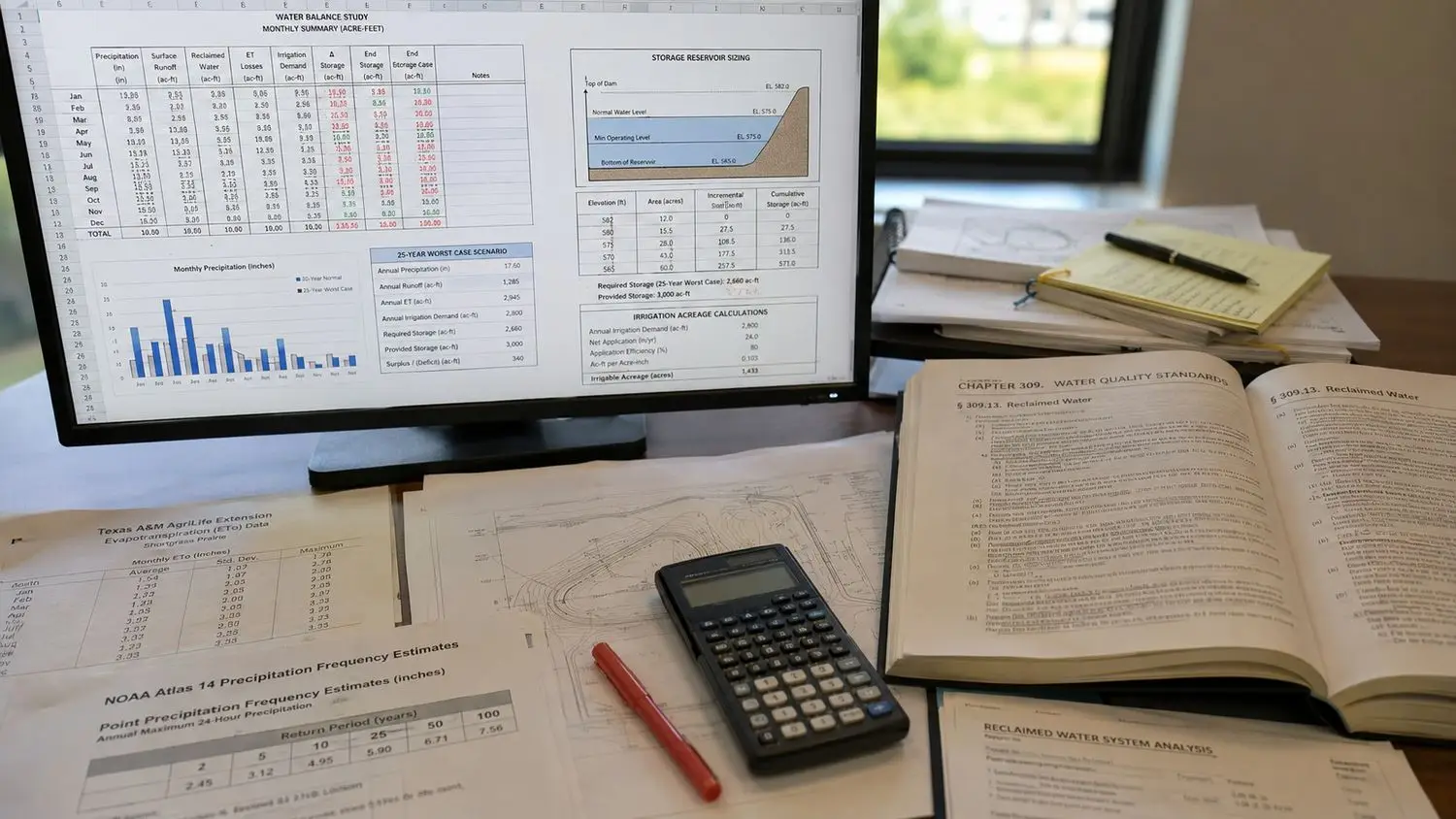
A water balance study under 30 TAC §309.20 is a month-by-month engineering analysis that demonstrates a proposed land application or reuse system can capture and dispose of all treated effluent under the most adverse conditions the site will experience specifically, worst-case 25-year precipitation data. The study sets the irrigation acreage requirement and the storage reservoir size. It must be prepared by a licensed Professional Engineer and submitted as part of any TCEQ permit application involving land application or beneficial reuse of treated wastewater. Applications that omit it, or submit it using average precipitation data instead of the required worst-case standard, receive a deficiency notice that restarts the review clock.
What 30 TAC §309.20 Actually Requires
Texas Administrative Code Chapter 309, Subchapter B establishes the design and operational requirements for land application of treated wastewater. Section 309.20 specifically addresses the water balance analysis required for any proposed land application site.
The regulation requires the applicant to demonstrate that the proposed land application system has sufficient capacity in both acreage and storage to manage all treated effluent generated by the facility throughout the year, under conditions that include the worst-case precipitation scenario represented by 25-year historical records.
The standard is not average annual performance. It is worst-case performance. The distinction matters because a reuse system that works fine under average conditions may have no capacity to accept effluent during an exceptionally wet year when rainfall prevents irrigation, evapotranspiration rates are suppressed, and soil moisture is at or near saturation. A facility that cannot demonstrate it can manage effluent under those conditions does not have an adequate reuse plan under Texas law regardless of whether average conditions would make the system perform adequately.
The water balance analysis must be submitted as a sealed engineering document. It is a licensed PE deliverable. TCEQ will not accept an unsupported spreadsheet, a general planning estimate, or a narrative description of the reuse strategy in lieu of a complete, stamped engineering analysis.
The Inputs: What Goes Into the Analysis
A complete water balance study under §309.20 requires the following inputs, each of which must be based on documented site-specific or regionally appropriate data rather than general estimates.
Monthly treated effluent volume. Calculated from the facility’s design flow in gallons per day, multiplied by the number of days in each month. This is the volume the reuse system must accept every month of the year, regardless of weather, irrigation demand, or seasonal conditions. For a 300,000 GPD facility, that is approximately 9 million gallons in January and 9.3 million gallons in July constant production regardless of whether the reuse site has any irrigation demand.
Monthly evapotranspiration (ET) rates. ET is the rate at which water leaves the soil through evaporation and plant transpiration. High ET in summer months means the soil is pulling water out of the root zone rapidly irrigation is effective and the reuse site can accept high application volumes. Low ET in winter months means the soil retains moisture longer and the site’s capacity to accept additional irrigation is reduced. ET rates are site-specific and climate-dependent. Texas ET data from Texas A&M AgriLife Extension and NOAA records provides the regional datasets required for this analysis.
Monthly precipitation loading. Precipitation adds water to the irrigation site. During wet months, precipitation may fully or partially satisfy the soil moisture deficit that irrigation would otherwise address meaning the reuse site cannot accept as much treated effluent as it can during dry months. The §309.20 analysis must use worst-case 25-year precipitation data. This is one of the most consistently cited deficiencies in Texas reuse permit applications. Average annual precipitation data is not the required standard. Worst-case 25-year monthly precipitation data must be used, and the analysis must demonstrate that the reuse system can manage effluent even during the wettest periods in the historical record.
Soil hydraulic loading capacity. The soil at the irrigation site has a finite capacity to accept water per unit area per unit time the hydraulic loading rate. This rate depends on soil texture, drainage characteristics, and groundwater depth. Sandy soils accept water faster than clay soils. Shallow groundwater limits application rates. The agronomic loading rate the maximum rate at which treated effluent can be applied without causing surface runoff, groundwater contamination, or nitrogen loading that exceeds crop uptake must be calculated for the specific soil conditions at the proposed reuse site and documented in the water balance analysis.
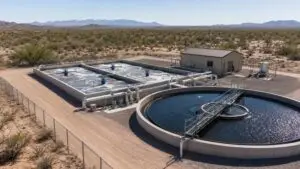
Storage reservoir sizing. The storage reservoir is what bridges the gap between months when the reuse site cannot accept all the treated effluent being produced and months when it can. In Texas, the critical storage period is typically November through February, when ET rates are low, precipitation is elevated relative to irrigation demand, and agricultural irrigation demand may be near zero. The reservoir must be sized to hold the maximum accumulated volume that cannot be applied to the reuse site during the critical storage period, using worst-case 25-year precipitation data to define that period. MES designed the 53 acre-foot storage reservoir for the 2.0 MGD River Valley Water Reclamation Facility in Caldwell County specifically to meet this standard under worst-case conditions sized to bridge the wet season when 2 million gallons per day of effluent had to be held because the agricultural reuse site could not accept it.
How the Analysis Connects to Irrigation Acreage
The water balance analysis and the irrigation acreage requirement are mathematically linked. The acreage requirement is determined by working backward from the monthly water balance identifying the month with the highest net effluent surplus after ET demand and precipitation effects are accounted for, and calculating the acreage required to accept that volume at the permitted hydraulic loading rate.
For agricultural irrigation of grass and tree crops in Central Texas, the standard planning rate is approximately 2,000 gallons per day per acre. A 300,000 GPD facility generates effluent at a rate that requires approximately 150 acres of confirmed irrigation land plus a properly sized storage reservoir to meet the §309.20 standard. A facility with 75 acres identified for a 300,000 GPD system cannot demonstrate compliance the water balance will show a monthly surplus that the available acreage cannot absorb, which is a deficiency that TCEQ will identify in review.
The storage reservoir and the irrigation acreage are not independent variables that can be sized separately. They are jointly determined by the water balance calculation. Increasing storage capacity can reduce the peak acreage requirement during critical months by accumulating surplus effluent rather than requiring it to be applied immediately. Increasing acreage reduces the storage requirement by providing more land to absorb effluent during the periods when demand is lowest. The engineer’s job is to find the combination that meets §309.20 requirements at the lowest total cost for the specific site conditions.
What Happens When It Is Done Wrong
The consequences of an inadequate water balance study fall into two categories: permit delay and operational failure.
At the permit stage, an inadequate water balance study generates a TCEQ deficiency notice. The most common deficiencies are use of average precipitation data instead of worst-case 25-year data, storage reservoir sizing that does not account for the full critical storage period, and irrigation acreage calculations that use a simplified annual average rather than a month-by-month analysis that identifies the limiting month. Each of these deficiencies requires a revised engineering analysis before TCEQ can proceed with review. A single deficiency cycle on a water balance study typically adds four to eight weeks to the review timeline.
At the operational stage, a water balance that was computed incorrectly even one that passed TCEQ review creates a facility that runs out of reuse capacity during the critical storage period. A facility that cannot apply effluent to the reuse site and does not have sufficient storage to accumulate it has no compliant disposal pathway. That is a permit compliance failure. It triggers TCEQ enforcement contact, requires an emergency response to identify alternative reuse capacity or additional storage, and may require a permit modification a process that adds months to the timeline and significant cost to a facility that is supposed to be in stable operations.
Frequently Asked Questions
Can the water balance study be prepared by someone other than a licensed PE?
No. The water balance study is an engineering analysis that must be sealed by a licensed Professional Engineer registered in Texas. It involves engineering calculations for hydraulic loading, storage sizing, and agronomic capacity that require professional engineering judgment and carry regulatory consequences if they are wrong. TCEQ will not accept an unsealed water balance study as part of a permit application.
Does the 25-year worst-case precipitation requirement apply to all reuse applications in Texas?
Yes. The §309.20 standard applies to all land application and beneficial reuse systems subject to TCEQ permitting in Texas, including 210E Industrial Reclaimed Water Authorizations and Texas Land Application Permits. The worst-case 25-year precipitation standard is not a guideline, it is the regulatory requirement, and applications that use a different precipitation basis are deficient on that element.
How long does it take to complete a water balance study?
A complete water balance study for a straightforward reuse application typically takes two to four weeks from engagement to a sealed deliverable. Complex projects, large-scale facilities, sites with multiple reuse methods, or locations within Edwards Aquifer recharge zones with stricter requirements under §210.4(d), may take four to six weeks. The water balance study is on the critical path of the permit application and should be initiated as early as possible in the engineering process.
Related Resources
- What Is a 210E Authorization and How Can It Save Your Texas Development Project
- Land Application Permits in Texas: A Faster Path to Wastewater Approval for Developers
- Reuse vs. Discharge: Which Wastewater Strategy Fits Your Texas Development
- TCEQ 30 TAC Chapter 309 Land Application Requirements
- TCEQ Wastewater Permitting
Need a Water Balance Study for a Texas Reuse Permit?
Modern Engineering Solutions prepares complete water balance studies under 30 TAC §309.20 for 210E authorizations, Texas Land Application Permits, and other TCEQ reuse permit applications sealed by a licensed PE and prepared to meet the worst-case 25-year precipitation standard the first time.
We specialize in:
- Water balance studies under 30 TAC §309.20 using worst-case 25-year precipitation data
- Storage reservoir sizing and irrigation acreage determination
- ET analysis and agronomic loading rate calculations for Texas reuse sites
- Complete 210E and TLAP permit application preparation
- Deficiency notice response for applications with inadequate water balance documentation
Modern Engineering Solutions, McKinney, Texas. Contact: (214) 833-6748 or mod-eng.com