
Blog
What Engineers Submit to TCEQ and Why Your Application Gets Rejected
Most TCEQ permit applications stall due to incomplete water balance studies, missing waste stream data, or inadequate reuse plans. Here's what's required.
Quick Answer
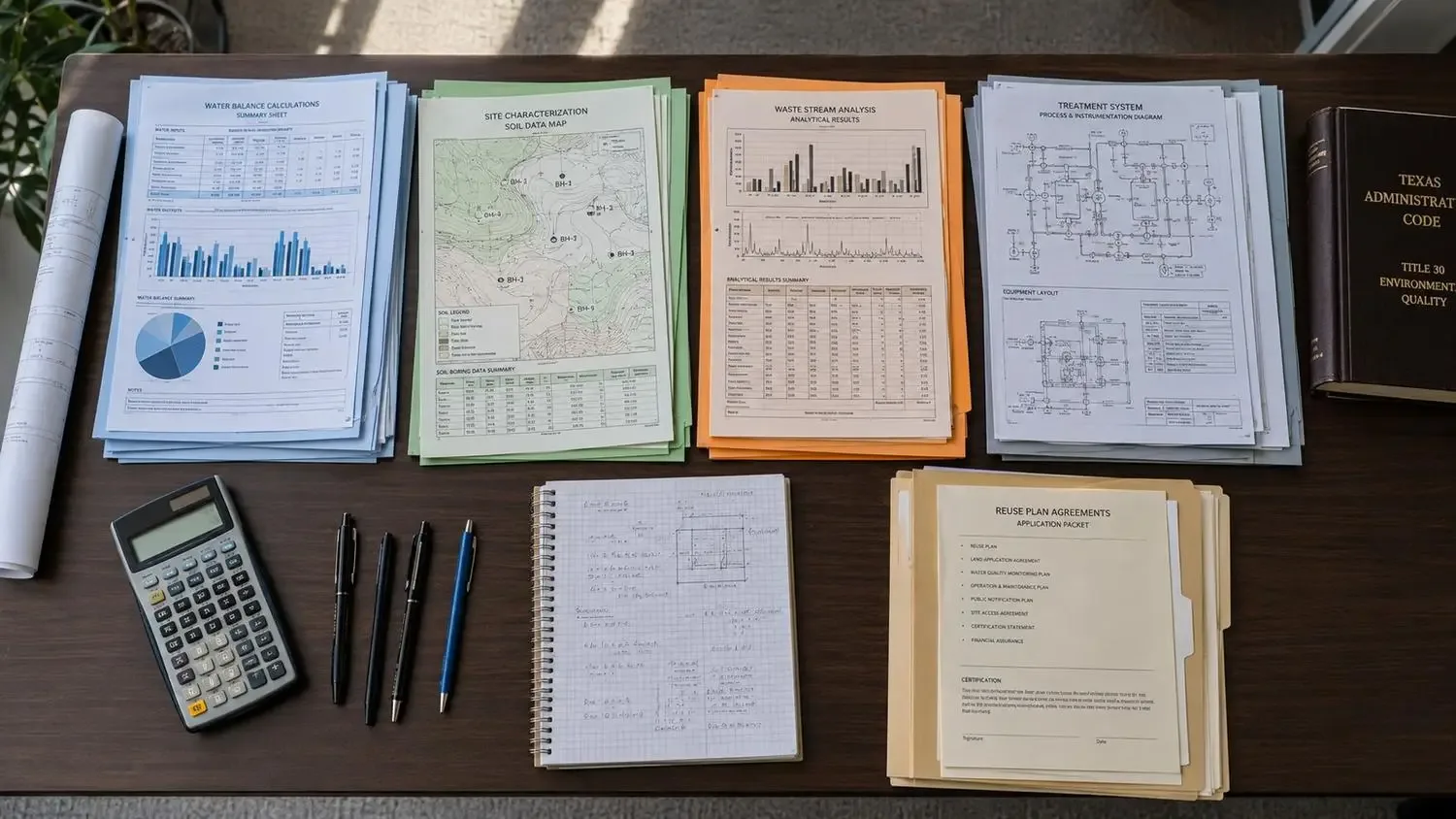
A complete TCEQ wastewater permit application for a reuse-based facility requires five core elements: a water balance study, a site characterization, a waste stream analysis, a treatment system design description, and a reuse plan with documented industrial user identification. Most applications that receive deficiency notices or sit in review indefinitely are missing defensible documentation on one or more of these elements. The reviewer cannot make a determination without them. Understanding what each element requires, and what makes it complete versus deficient, is what separates an application that gets approved in 4 to 10 weeks from one that cycles through revision for months.
Element 1: The Water Balance Study
The water balance study per 30 TAC §309.20 is required for every reuse-based facility in Texas. Its purpose is to demonstrate that treated effluent can be fully captured and disposed of under the most adverse conditions the site will experience not average conditions, not favorable conditions, but worst-case conditions.
The regulation requires the water balance analysis to be based on worst-case 25-year precipitation data. This is one of the most consistently deficient elements in Texas reuse permit applications. Applications that use average annual rainfall data instead of 25-year worst-case data will draw a deficiency notice every time. Applications that use historical averages to estimate irrigation demand without accounting for the wet season months when irrigation demand drops to zero while the treatment plant continues generating effluent will draw the same deficiency.
A complete water balance study accounts for monthly treated effluent volume at design flow, monthly evapotranspiration and irrigation demand at the reuse site, monthly precipitation loading on the reuse area, storage reservoir volume required to bridge the gap between high-production and low-demand months, and reservoir liner requirements under §210.23 depending on site location. The 53 acre-foot storage reservoir on MES’s 2.0 MGD reuse project at a mixed-use development near Martindale in Caldwell County was designed specifically to meet the worst-case 25-year precipitation standard sized for the scenario where the wet season eliminates irrigation demand while the plant continues operating at design flow. That level of specificity is what a complete water balance study looks like.
Element 2: Site Characterization
Site characterization for the reuse area is the documentation that proves the land can accept the applied effluent volume at the proposed loading rate without causing groundwater contamination, surface runoff, or violation of setback requirements.
A complete site characterization includes soil texture and infiltration rate data from field investigation not from county soil survey maps alone, which TCEQ does not accept as a substitute for site-specific data. It includes topographic information confirming that the irrigation area can be spray-irrigated without runoff to adjacent properties or surface water bodies. It includes setback measurements from all water supply wells, property lines, surface waters, and public access areas that apply to the proposed application method. For agricultural reuse, it includes agronomic analysis confirming that the proposed hydraulic loading rate and the associated nitrogen loading rate can be taken up by the crop type proposed for the site.
Applications that describe the reuse site as “approximately X acres of agricultural land suitable for irrigation” without site-specific soil data, hydraulic loading calculations, or setback documentation are incomplete. TCEQ cannot approve a reuse plan without confirming the site can actually accept the volume the application proposes to apply to it.
Element 3: Waste Stream Analysis
For 210E Industrial Reclaimed Water Authorization applications, the waste stream analysis per 30 TAC §210.53 must document the industrial wastewater component and confirm qualification for Level II authorization under §210.53(b)(2).
The most common deficiency in waste stream analysis is insufficient industrial user documentation. An application that states “the project includes a data center” without identifying the specific industrial component, estimating its flow contribution, and documenting the waste stream characteristics cooling tower blowdown, equipment wash water, or other specific industrial waste types is incomplete. TCEQ reviews the waste stream analysis to confirm that an industrial component exists and that the combined waste stream qualifies for 210E authorization. Vague descriptions of the industrial use do not satisfy that review.
For larger mixed-use developments with multiple industrial components, the waste stream analysis should document each contributing source, estimate its flow at design conditions, and characterize its waste type. A 2.0 MGD facility with data center cooling wastewater at 6% of total flow and concrete batch plant wash water at 0.03% of total flow, as documented in MES’s application for a mixed-use development near Martindale, Texas, is the level of specificity that supports a complete waste stream determination.
Element 4: Treatment System Design Documentation
TCEQ’s review of the treatment system for a 210E application focuses on confirming that the proposed system will meet the permit’s effluent quality standards pH 6.0 to 9.0 and total organic carbon ≤55 mg/L per §210.56(d) at actual design flow and under peak loading conditions.
Applications that submit manufacturer specifications for a package treatment plant without site-specific process calculations are incomplete. Manufacturer specifications confirm that the equipment can achieve certain effluent quality under defined conditions. They do not confirm that it will achieve the required standards at the project’s specific design flow, with the project’s specific waste stream characteristics, under the project’s peak flow and loading conditions. Site-specific process calculations that demonstrate BOD removal, solids separation, and disinfection performance at the design conditions the application represents are the documentation the reviewer needs.
For package extended aeration systems the most common treatment technology on Texas development-scale 210E projects the process documentation should include design hydraulic retention time at design flow, aeration capacity relative to oxygen demand at design BOD loading, peak hydraulic flow handling, and disinfection system performance at both average and peak conditions.
Element 5: Reuse Plan and Industrial User Identification
The reuse plan must document who is accepting the treated effluent, how it will be used, and how the reuse arrangement is structured. For 210E applications, reuse users are specifically listed on the authorization per 30 TAC Chapter 210. An application that describes a reuse strategy in general terms “treated effluent will be used for agricultural irrigation in the area” without identifying the specific reuse site, the owner or operator of the reuse site, the reuse application method, and the basis for the hydraulic loading rate calculation is incomplete.
Applications that propose off-site agricultural reuse must document a confirmed arrangement with the reuse land owner. A letter of intent or reuse agreement naming the parties, identifying the reuse site by legal description, and confirming the reuse method and volume is the minimum documentation for off-site reuse. Applications that propose on-site reuse must document the reuse area acreage, the irrigation method, and the connection between the reuse volume and the site’s agronomic capacity.
Insufficient reuse acreage documentation is one of the most common reasons 210E applications stall. For agricultural irrigation in Central Texas, 2,000 gallons per day per acre is the standard planning rate for grass and tree crops. A 300,000 GPD facility requires approximately 150 acres of confirmed, documented, agronomically characterized reuse land plus a properly sized storage reservoir. An application that identifies 75 acres for a 300,000 GPD system without addressing the capacity gap will draw a deficiency notice on reuse acreage adequacy every time.
What a Deficiency Notice Actually Means
When TCEQ issues a deficiency notice, the review clock pauses. The agency’s timeline does not restart until a complete response addressing every deficiency item is received. A partial response one that addresses some items but leaves others open generates another exchange. Each cycle adds weeks.
The developers who wait months for a TCEQ response are typically waiting on a deficiency cycle that was preventable. A complete first submittal one that addresses all five elements with site-specific documentation, supported calculations, and confirmed industrial user and reuse site identification does not generate a deficiency notice. It generates an approval.
Frequently Asked Questions
What is the most common reason a 210E application receives a deficiency notice?
Incomplete water balance study, most frequently. Using average annual precipitation instead of worst-case 25-year data, or failing to properly size the storage reservoir for the months when irrigation demand drops to near zero while the plant continues generating effluent, draws a technical deficiency on almost every application that makes this error.
What documentation is required to identify industrial users in a 210E application?
The waste stream analysis under 30 TAC §210.53 must identify the specific industrial activity, characterize the waste stream type, and estimate the flow contribution. General descriptions of the industrial use are insufficient. For off-site industrial reuse users, TCEQ requires documentation of the confirmed reuse arrangement with the industrial user identified by name and facility.
Can a developer respond to a TCEQ deficiency notice without an engineer?
Technically yes, but practically no. Deficiency notices on wastewater permit applications ask technical questions about calculations, site data, and regulatory compliance that require engineering analysis to answer correctly. A non-technical response that does not address the underlying calculation deficiency generates a follow-up question. The fastest path through a deficiency cycle is a complete, engineering-supported response that answers every item the reviewer asked.
Related Resources
- What Is a 210E Authorization and How Can It Save Your Texas Development Project
- Reuse vs. Discharge: Which Wastewater Strategy Fits Your Texas Development
- Land Application Permits in Texas: A Faster Path to Wastewater Approval for Developers
- TCEQ 30 TAC Chapter 210, Subchapter E Industrial Reclaimed Water Authorizations
- TCEQ Wastewater Permitting
Is Your TCEQ Application Stalled?
Modern Engineering Solutions reviews stalled TCEQ applications, identifies deficiency gaps, and prepares complete responses that restart the review clock.
We specialize in:
- Complete 210E application preparation water balance, site characterization, waste stream analysis, treatment design, and reuse plan
- Deficiency notice response and revision for stalled TCEQ applications
- Pre-submittal review to identify gaps before the application is filed
- TCEQ coordination throughout the review process
- Application rescue for projects that have been waiting months without approval
Modern Engineering Solutions, McKinney, Texas. Contact: (214) 833-6748 or mod-eng.com
Keep reading
More to read.
Talk to an engineer
Tell us about your project.
An engineer reads it
Not a salesperson. Someone who can tell you whether the pathway is real.
You get a first answer
Your options, the agencies involved and the questions that decide cost and schedule.
You decide
No commitment to have the first call.
Prefer the phone? (214) 833-6748