Last updated: Feb 22, 2026
Source: “Let’s stop treating a redesign like it’s just an inconvenient bump in the road.“
Quick Answer
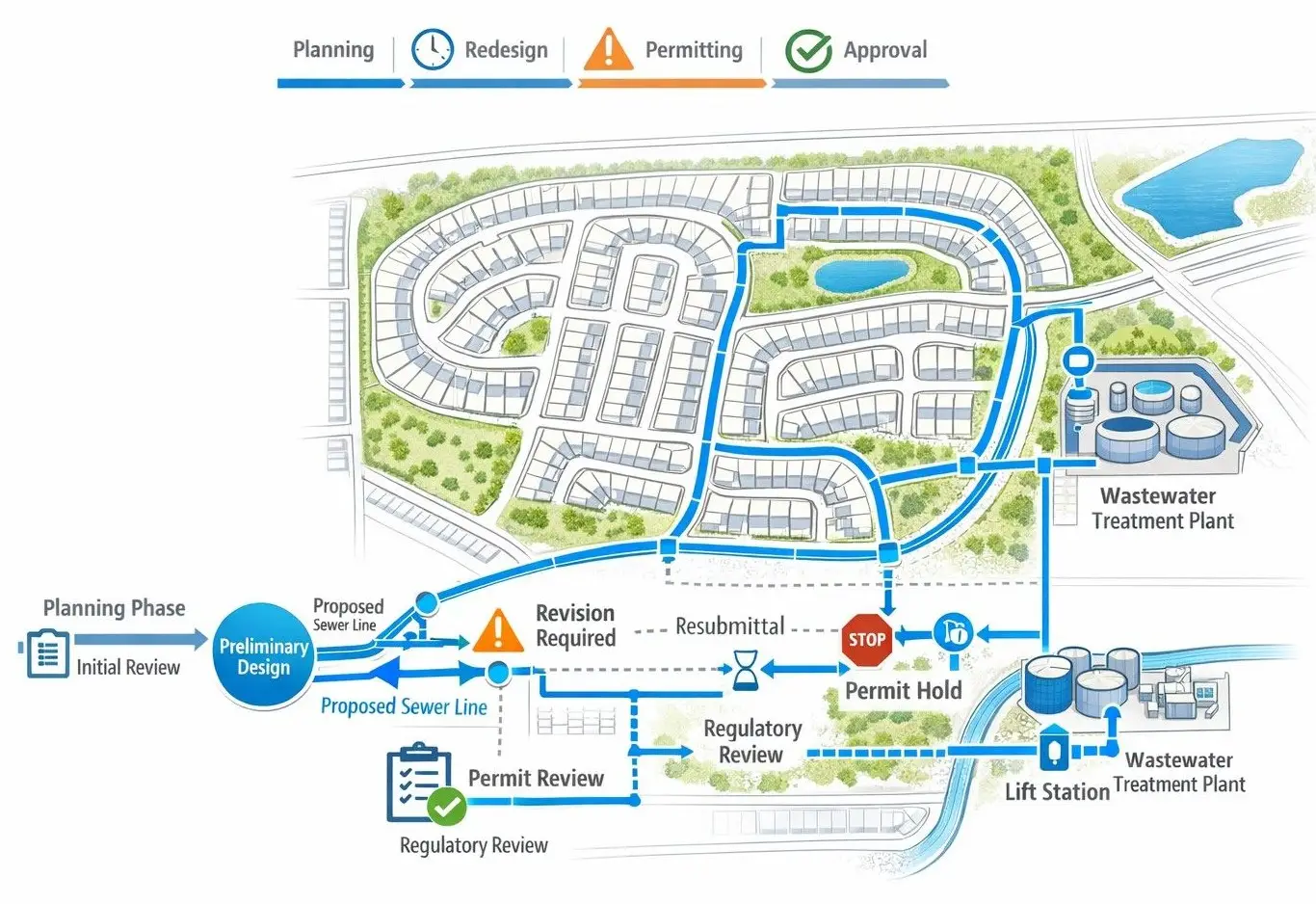
A rejected TCEQ wastewater submittal doesn’t just delay a Texas development project. It resets the entire permit review clock and runs carrying costs of $50,000 to $200,000 per month against a project that hasn’t moved. The typical post-rejection sequence takes 8 to 9 months before construction can restart, by which point the deal’s margin is already compromised. For qualifying Texas developments, beneficial reuse under 30 TAC Chapter 210 eliminates the need for a TCEQ discharge approval entirely, replacing a 24 to 36 month permit process with a 2 to 3 month notification process. That option belongs in the conversation before the first submittal, not after the first rejection.
The Problem Most Texas Developers Underestimate
Texas is facing a $153.8 billion infrastructure gap over the next 50 years. Every month a development project sits waiting on a permit, that pressure compounds. And yet most Texas developers still respond to a rejected TCEQ submittal the same way: get a new engineer, redesign, resubmit, and recover the loss in construction savings.
That optimism makes sense early in a project. But a redesign isn’t a bump in the road. It’s a compounding loss.
What a Rejected TCEQ Submittal Actually Costs Month by Month
Monthly carrying costs on a stalled Texas development typically run $50,000 to $200,000 or more depending on project size and financing terms. A rejected submittal doesn’t reset just the engineering fee. It resets the entire review clock.
Here is how that timeline unfolds for most Texas developments:
Months 1 and 2 go to a new engineer getting up to speed on someone else’s flawed design. Months 3 and 4 are consumed by the redesign and preparing a new TCEQ resubmittal. Months 5 through 8 are a waiting period, with traditional TCEQ discharge permits currently taking 24 to 36 months for approval. By month 9 or later, construction finally starts, but the deal’s margin is already compromised before a single shovel hits the ground.
That is not a worst-case scenario. It is a predictable pattern for Texas developments that enter the wrong permitting path from the start.
The Montgomery County Developer Who Was 20 Months From Breaking Ground
A developer in Montgomery County, Texas was 8 months into carrying costs when TCEQ told him to expect another 12 months before his discharge permit would be approved. That is 20 months from that conversation to construction, with financing costs running the entire time.
Modern Engineering Solutions did not speed up the same permit. We eliminated the dependency entirely.
The project was redesigned for beneficial reuse. Under that path, TCEQ discharge approval was not required, only notification. Construction started on schedule. Carrying costs stopped.
That outcome was available on day one of that project. Nobody had positioned it that way before MES got involved. See how we delivered similar results at our River Valley Wastewater Treatment Plant.
What This Means for Texas Developers Right Now
For Texas developers, a rejected submittal isn’t just a paperwork problem. It’s a project economics problem.
When carrying costs run $50,000 to $200,000 per month, a 9-month delay on a redesign represents $450,000 to $1.8 million in losses before construction even begins. Add a second permit review cycle on top of a first rejection, and many deals become unprofitable before they break ground. See how MES approaches project economics differently.
Before committing to a permitting path on any Texas development with wastewater infrastructure, developers should confirm whether a traditional TCEQ discharge permit is actually required for their project, or whether a beneficial reuse authorization eliminates that dependency entirely. For developments with any industrial component, that question can change the entire project timeline.
The Question Most Texas Developers Never Ask Before Submitting
The instinct after a rejection is to ask: “How do we fix this design?”
The more important question is: “Are we even on the right permitting path?”
For Texas developments, beneficial reuse under 30 TAC Chapter 210 can eliminate the need for a traditional TCEQ discharge permit entirely for qualifying projects, replacing a 24 to 36 month approval process with a 2 to 3 month notification process. That distinction belongs in the conversation before the first submittal, not after the first rejection.
What would your project economics look like if you had eliminated the permit bottleneck from the start?
Frequently Asked Questions
Q: What is the real cost of a rejected TCEQ wastewater submittal for a Texas developer? Beyond engineering fees for the redesign and resubmittal, a rejection resets the TCEQ review clock entirely. For a developer already 8 months into carrying costs at $50,000 to $200,000 per month, an additional 12-month permit timeline represents a significant compounding financial loss that can kill project profitability before construction begins.
Q: How long do TCEQ wastewater discharge permits take in Texas? Traditional TCEQ discharge permits currently take 24 to 36 months or more. Projects with public opposition or incomplete submittals can take significantly longer. TCEQ staffing constraints have extended timelines further in recent years. Explore Texas wastewater engineering and permitting to understand the full process.
Q: Can a Texas developer avoid a TCEQ discharge permit entirely? In many cases, yes. For developments that include an industrial component, the 210E Industrial Reclaimed Water Authorization under 30 TAC Chapter 210, Subchapter E can replace the traditional discharge permit for initial operations. Approvals typically take 2 to 3 months. This pathway is specific to Texas and is not available in other states.
Q: When should a Texas developer ask about permitting strategy? Before the design begins. Permitting path selection is an engineering decision that belongs at the front of project planning. By the time a submittal is rejected, the project has already absorbed months of unnecessary carrying costs.
Related Resources
Texas 2036 Water Infrastructure Assessment
2022 Texas State Water Plan, Texas Water Development Board
30 TAC Chapter 210, Subchapter E, TCEQ Industrial Reclaimed Water Authorizations
Need a Permitting Strategy That Protects Your Timeline?
Modern Engineering Solutions helps Texas developers navigate TCEQ permitting through alternative pathways that protect project economics.
We specialize in:
Modern Engineering Solutions, McKinney, Texas. Contact: (214) 833-6748 or mod-eng.com
Share via: