

Blog
How to Size a Wastewater Storage Reservoir for a Texas Reuse Project
Size a wastewater storage reservoir for a Texas reuse project with a monthly storage study run through TCEQ's 25-year design rainfall year, step by step.
To size a wastewater storage reservoir for a Texas reuse project, run a monthly storage study. Effluent goes in, irrigation demand and pond evaporation come out, and you carry the running total through a wet design year. For land application under a Texas Land Application Permit, TCEQ's rule sets that year at a rainfall return frequency of at least 25 years. The peak of the running total is your minimum storage volume.
Why does a reuse project need a storage reservoir?
Because the plant makes effluent every day and the reuse site cannot take it every day.
A 300,000 gallon per day plant makes about 9 million gallons a month, roughly 28 acre-feet, wet January or not. In winter, evapotranspiration drops, rain wets the soil, and the site runs out of room. Under 30 TAC §210.7, reclaimed water goes to a user on a demand-only basis, and the user may refuse delivery at any time, subject to any contract or ordinance. Chapter 210's irrigation rule, §210.24, bars applying effluent to saturated or frozen ground. The reservoir holds what the site cannot take until it can.
Which Texas rule sets the storage volume?
For irrigation under a Texas Land Application Permit (TLAP), 30 TAC §309.20(b)(3)(B) does. Chapter 210 sets siting, liner and no-discharge rules for reclaimed water ponds, but no design rainfall year.
Under §210.1(b), Chapter 210 does not apply to treated wastewater used under a permit that authorizes disposal by irrigation. That is a TLAP, and 30 TAC §309.20, Land Application of Sewage Effluent, requires an effluent storage study. It must use a design rainfall year with a return frequency of at least 25 years, or the highest annual rainfall in the last 25 years of record, with a normal monthly distribution.
Chapter 210 has the provider or user document irrigation demand on average monthly rainfall and prevent overflow. Our read: if a pond carries the wet months, run the §309.20 storage study anyway.
What goes into the monthly storage study?
Four monthly inputs: effluent received, design-year rainfall, irrigation demand and pond evaporation.
The worked example attached to §309.20 works in inches of water per irrigated acre. Its values are examples only; the rule says the water balance should generally follow it:
- Effluent received. Design flow, spread evenly by month, with room to adjust for seasonal flow.
- Design-year rainfall. The highest annual total in the past 25 years, distributed by monthly averages, less runoff by an accepted method such as SCS Technical Release 55.
- Irrigation demand. Crop water needs minus infiltrated rain, divided by irrigation efficiency, 0.85 unless you support another value.
- Pond evaporation. The lowest annual evaporation in the past 25 years, net of rain on the pond, scaled to its surface area.
Do not mix the rainfall bases. The application rate in §309.20(b)(3)(A) uses average yearly rainfall. Storage uses the wet year. The example's crop needs no effluent in December, January or February, so nearly all of that winter flow goes to storage.
Start from a defensible flow rate projection for the development. For climate inputs, the Texas Water Development Board's precipitation and lake evaporation data give monthly values by one-degree quadrangle.
How do you turn the monthly balance into a reservoir volume?
Carry a running total of what goes into storage each month and take the peak.
- Each month, take effluent received minus pond evaporation and irrigation demand. If rain covers the crop, the whole month's effluent, less evaporation, goes to storage.
- Start the sum in the first month that adds to storage. The rule's example starts in October to capture the worst condition.
- Add month by month. The total draws down when the site takes more than the plant makes, but never below zero.
- Multiply the peak, in inches per irrigated acre, by the irrigated acreage, then divide by 12.
In the example, a 240,000 gallon per day plant irrigates 100 acres. Storage peaks at 14.36 inches per irrigated acre, about 120 acre-feet. That plant makes about 22 acre-feet a month, so the pond holds more than five months of flow. Your number will differ with climate, crop, soil and acreage, but storing only a few weeks of flow will not cover a winter like the example's.
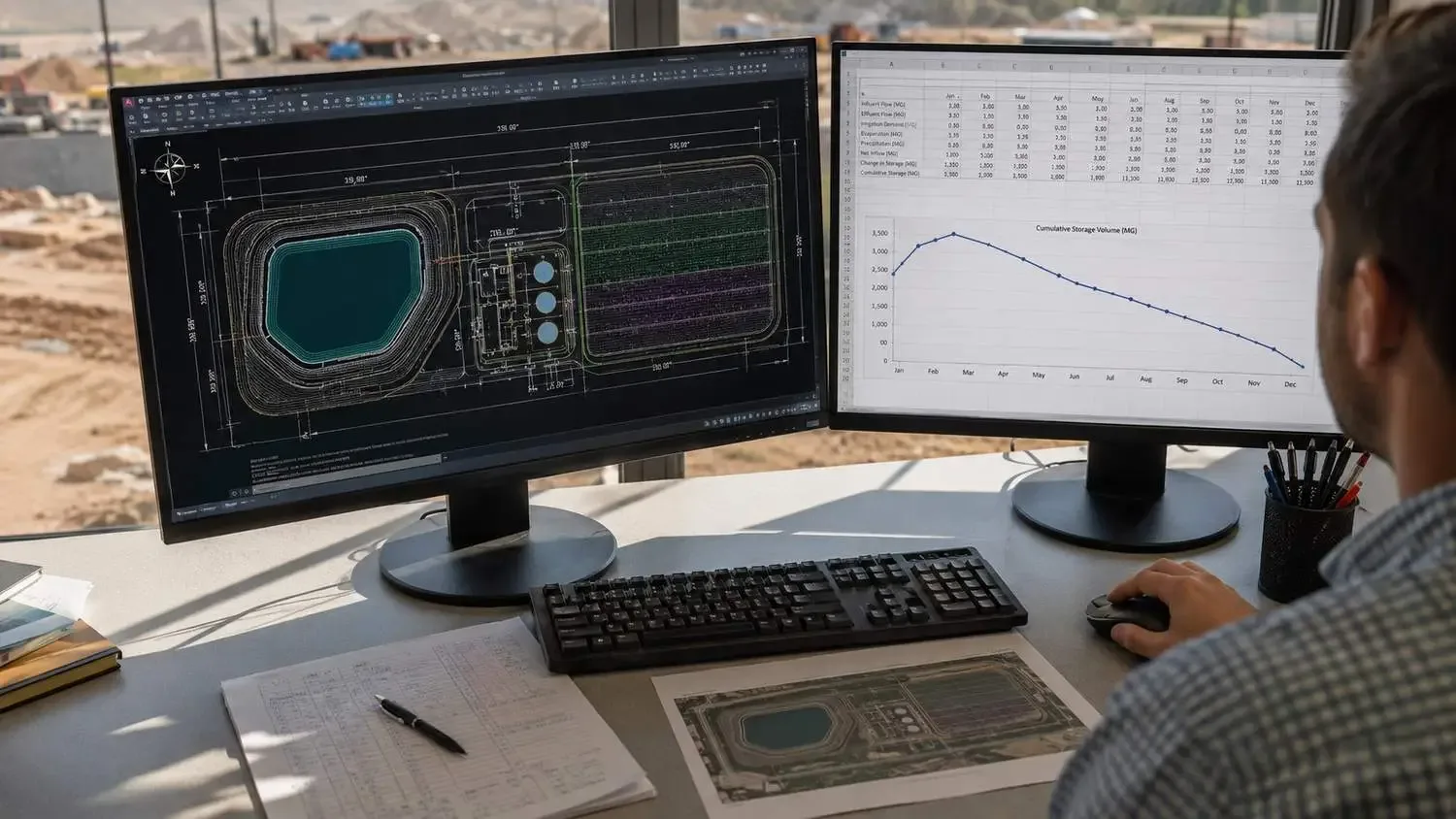
Acreage and storage trade against each other: more irrigated land shrinks the pond. Settle both in a site feasibility study, before the land plan locks the pond footprint. For the full report, see what a §309.20 water balance study requires.
What liner does the storage pond need?
It depends on where the pond sits and what it holds.
Under 30 TAC §210.23, the strict class covers every reclaimed water pond in the Edwards Aquifer recharge zone, plus initial holding ponds with Type II water in areas rated 110 or more on the state DRASTIC map. Those need a compacted soil liner at least 24 inches thick, in lifts of 6 inches or less at 95% of Standard Proctor density, with permeability of 1 x 10^-7 cm/sec or less. The rule also sets gradation and plasticity limits. A 40-mil synthetic membrane with leak detection is an alternative.
Initial holding ponds elsewhere may use a 24-inch soil liner at 1 x 10^-4 cm/sec or less, or a 40-mil membrane. Both classes need a Texas professional engineer's certification before use, a 5-foot top width and slopes no steeper than 1 vertical to 3 horizontal unless stabilized another way. Storage stays out of the floodway unless it is an authorized on-channel pond.
For a surface impoundment at a wastewater treatment facility, 30 TAC §309.13(d) adds a rule over the recharge zone of any major or minor aquifer: 3 feet of material at 1 x 10^-7 cm/sec or less, or a 40-mil liner with leak detection. A TLAP application lists each pond's area, storage volume and liner type in Worksheet 3.0 of Form TCEQ-10054, with a sealed liner certification for each.
What happens if the reservoir is too small?
The water has nowhere legal to go.
Under §210.22(e), storage ponds must not discharge into water in the state, except discharges that result directly from rainfall or that a permit allows. An unauthorized overflow into or next to water in the state must be reported, with a written report within five working days of learning of it. Industrial reclaimed water ponds fall under §210.56(g) instead: at least 2 feet of freeboard, and no use for disposal. That freeboard sits above the volume your study produces.
Are you ready to size the reservoir?
You are ready when all six answers are yes. Any no is your next task.
- Do you know whether the project is a TLAP, a Chapter 210 reuse, or both?
- Is the design flow settled, phase by phase?
- Do you have 25 years of monthly rainfall and evaporation data?
- Is the crop chosen, with monthly water needs from a documented source?
- Is the irrigated acreage fixed, net of buffers and setbacks?
- Have you checked the pond site against the floodway and aquifer recharge zones?
Then ask your engineer: Which design rainfall year did you use? In which month does storage peak? What irrigation efficiency did you assume, and why?
A note on limits: this is general education on TCEQ rules as published in October 2026, not a design or a permit opinion. Your site data, your permit and TCEQ's review decide the final volume.
Frequently asked questions
What return period does TCEQ use to size effluent storage?
At least 25 years, for land application under §309.20(b)(3)(B). The highest annual rainfall in the last 25 years of record is an allowed alternate.
Does the storage pond count as irrigated acreage?
No. Irrigated area comes from the crop's water and nitrogen needs. Pond evaporation counts as a loss in the balance, but it does not replace acreage.
I'm developing a mixed-use project near Austin and want to irrigate common areas with reclaimed water under Chapter 210. Do I still need a 25-year storage study?
Chapter 210's storage and irrigation rules name no design rainfall year. But reuse runs on demand only, ponds cannot discharge except from direct rainfall or under a permit, and the plant still needs its own TPDES permit, TLAP or Chapter 321 Subchapter P authorization under §210.2(e). So it depends on that permit: a discharge permit's outfall can take the surplus, while a TLAP for irrigation brings the §309.20 storage study.
I'm the civil engineer on a Hill Country subdivision and the storage pond may sit over the Edwards Aquifer recharge zone. Which rules change for the pond and the irrigation?
A reclaimed water pond there takes the strict §210.23(c) liner. A facility impoundment over a recharge zone also falls under §309.13(d). And irrigating effluent in the recharge zone needs disposal system plans approved under Chapter 213 before construction, per §210.4(d). Confirm the zone boundary before you draw the pond.
Related resources
- Texas Land Application Permits Explained: Spray Irrigation, Subsurface Drip, and Evaporation Ponds
- Chapter 210 Reclaimed Water: What Texas Developers Need to Know About Water Reuse
- Reuse vs. Discharge: Which Wastewater Strategy Fits Your Texas Development?
- Edwards Aquifer Recharge Zone Development: What Austin Area Developers Must Do Differently for Wastewater
Sizing a storage reservoir for a Texas reuse project?
We run the monthly storage study, size the pond together with the irrigated acreage, and specify the liner the site calls for.
Talk to Modern Engineering Solutions about your reuse site, or call (214) 833-6748.
Keep reading
More to read
- Knowing When to Fold: How Kiosk Operators Can Spot a Stalled Permit and Redeploy Before More Design Hours Are Spent
- Still Fixing Your Team's Drawings? How Engineering Leaders Stop Heroic Engineering and Get Their Time Back
- When does a Texas development need a municipal utility district (MUD), and what comes before the TCEQ petition?
Talk to an engineer
Tell us about your project
An engineer reads it
Not a salesperson. Someone who can tell you whether the pathway is real.
You get a first answer
Your options, the agencies involved and the questions that decide cost and schedule.
You decide
No commitment to have the first call.
Prefer the phone? (214) 833-6748