

Blog
Ongoing Compliance After Permit Approval: What a Developer-Operator Needs to Track
Compliance after permit approval means sampling, monthly reports, a licensed operator, kept records and renewal dates, all owned by the Texas permittee.
Compliance after permit approval is a standing job, and it belongs to the permittee. A Texas developer who owns a private wastewater plant has to track five things: the sampling the permit sets, a monthly report, a licensed operator, records kept for three to five years, and the deadlines that come back, from a 24-hour noncompliance notice to the renewal application. A 210E reuse authorization adds its own sampling and an irrigation log.
Who is responsible for compliance once the permit is issued?
The permittee: the entity named on the permit. For a private plant that is usually you, not your engineer or your contractor.
Under 30 TAC §305.64, a permit "is issued in personam," to a named person. The standard permit conditions in 30 TAC §305.125 give the permittee a duty to comply with every condition and to properly operate and maintain the plant at all times. A failure is grounds for enforcement, revocation or denial of a renewal.
You can hire an operator and a lab to do the work. The duty stays with the permittee.
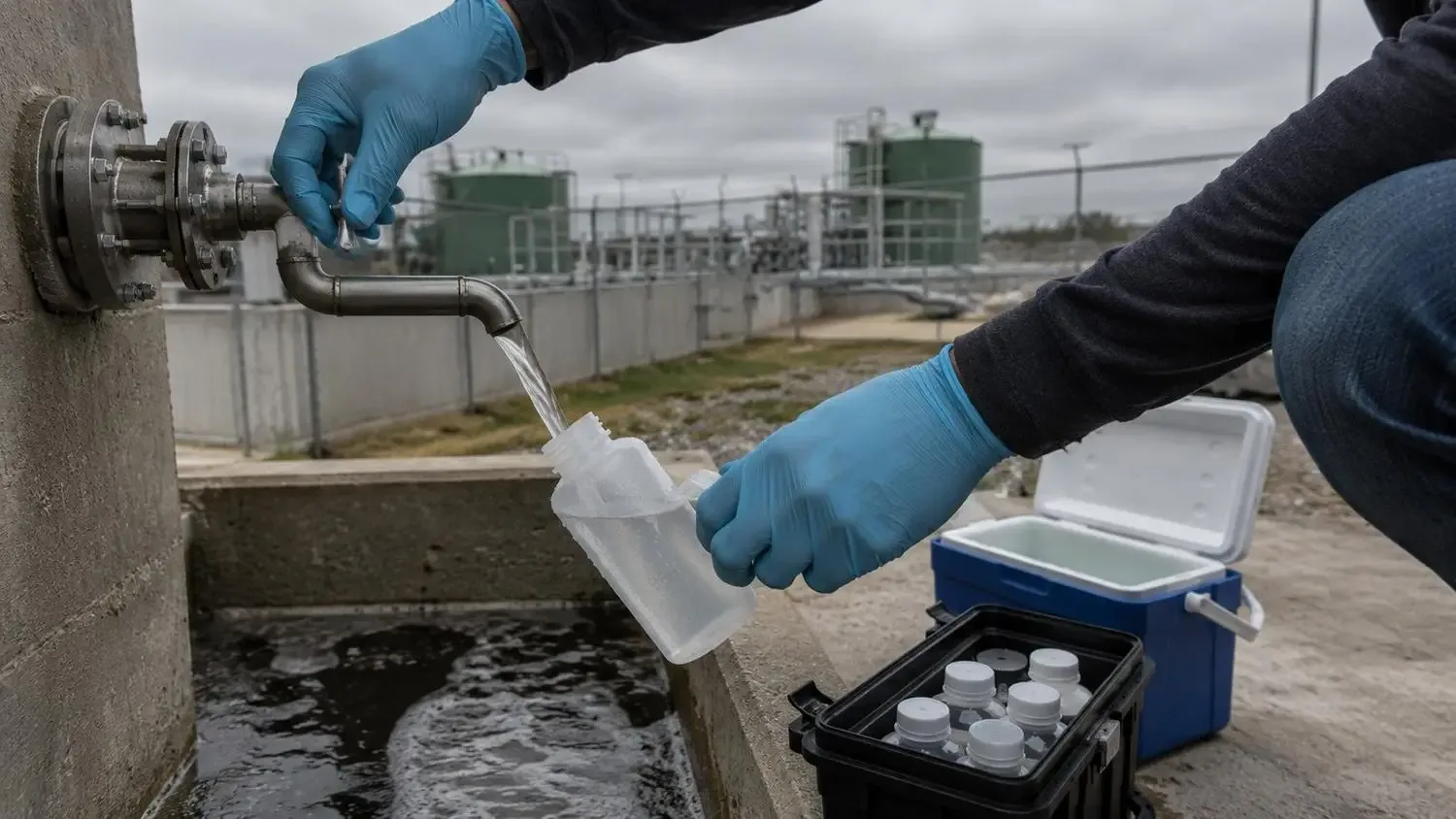
What do you sample, and how often?
Whatever your permit's effluent limits and monitoring requirements list, at the frequency and sample type it lists.
Section 305.125 requires samples to be representative of the monitored activity, so the sample point, timing and sample type are not for the operator to improvise.
The lab matters too. 30 TAC §319.11 sets containers, holding times, preservation and analysis by 40 CFR Part 136 methods, and lab results submitted to show compliance must meet Chapter 25, TCEQ's laboratory accreditation rules. Confirm your lab qualifies before the first sample.
What do you report, and when?
A monitoring report every month, filed electronically, plus fast notice when something goes wrong.
Under 30 TAC §319.7, unless your permit says otherwise, the discharge monitoring report (DMR) is due by the 20th of the following month for each permitted discharge, whether or not you discharged. TCEQ's NetDMR page says DMR data must be submitted electronically, unless TCEQ grants a waiver. Set up an EPA Central Data Exchange account and NetDMR access, with a signature role for whoever certifies reports.
Problems have shorter clocks. Section 305.125(9) requires an oral report within 24 hours, and a written one within five days, of noncompliance that may endanger health, safety or the environment. Under a TPDES permit that includes an unanticipated bypass that exceeds an effluent limit and a violation of a maximum daily limit for a pollutant the permit lists for 24-hour reporting. Other noncompliance is reported as promptly as possible. Our post on self-reporting violations and TCEQ enforcement discretion covers what follows.
Do you need a licensed operator?
Yes. A permitted wastewater treatment facility needs licensed operators at the level its category requires.
30 TAC §30.350 requires the permit holder to employ or contract with licensed operators, or a registered operations company that employs them. It also sets the working rules:
- The chief operator's license is at or above the facility's category.
- A properly licensed operator runs the plant at least five days a week and is reachable by phone seven days a week.
- The chief operator or operator in charge attends scheduled TCEQ inspections.
Permit terms can raise the category. A Category D plant becomes Category C if its permit requires nutrient reduction or a daily average BOD5 or TSS below 10 mg/L. Our post on package plant operator staffing requirements walks through the license levels.
What records do you keep, and for how long?
Every monitoring and reporting record, kept at the plant site for three years, or longer if TCEQ asks. Sludge records and 210E Level II records run five years.
Section 305.125(11) covers monitoring records, strip charts, calibration and maintenance records, and copies of every record the permit requires. Each sample record shows the date, time and place, who sampled, the analysis date, who analyzed it and where, the method and the result.
Write the record when the work happens. Knowingly false statements in a record and tampering with a monitoring method carry administrative, civil and criminal penalties, as applicable (§305.125(20)). A log rebuilt from memory before an inspection is a liability, not a record.

What changes under a 210E reuse authorization?
Chapter 210, Subchapter E sets the limits and logs. A Level II producer samples total organic carbon monthly and pH weekly, and keeps five years of records.
30 TAC §210.56(d) limits total organic carbon to 55 mg/L, by monthly grab sample, and pH to 6.0 to 9.0, by weekly grab sample. TCEQ can add limits or raise frequencies. You sample only in periods when reuse happens.
Under 30 TAC §210.57, the producer samples after final treatment and before distribution. Water that exceeds a limit cannot be reused and goes to the disposal method, unless more treatment brings it into compliance. The user keeps a daily log of irrigation volume and area wetted. Both sets of records are kept five years.
Industrial wastewater with any domestic sewage in it is commingled water, which §210.56(a)(1) puts under the reclaimed water rules in Subchapters A to C, including twice-weekly sampling for Type I uses under §210.34 and a monthly report under §210.36. See our post on 210E authorization compliance deadlines.
When does the permit come up for renewal?
A TPDES permit runs five years at most, and the renewal application is due at least 180 days before it expires.
The term limit is in 30 TAC §305.127; land application permits can run up to ten years. 30 TAC §305.65 sets the 180 days and keeps the permit in effect until the commission acts, if renewal starts before expiration.
Your record counts. 30 TAC §60.3 requires the commission to consider compliance history when it renews or amends a permit to discharge effluent made up mostly of sewage or municipal waste. Under 30 TAC §60.1, that history covers the five years before TCEQ receives the application, so an enforcement order from early in a five-year term still counts at renewal.
Is your compliance program ready for startup?
Run this check before the first flow reaches the plant.
- Is every monitoring requirement on a dated calendar with a named person?
- Is a licensed operator at the right level employed or under contract from day one?
- Does your lab meet Chapter 25?
- Is NetDMR access set up, with a signature role assigned?
- Does someone own the 24-hour call and the five-day written report?
- Is there one record file at the plant site?
- Is the date 180 days before permit expiration on the calendar?
Pass means every answer is yes. Any no is a gap to close before startup.
Questions for your engineer: Which conditions apply at startup and which wait for a later phase? Does anything in the permit raise the operator category? Where does the water go on a day you cannot reuse it?
A note on limits: this is general education on TCEQ rules as read in October 2026, not legal advice or a review of your permit. Your permit or authorization sets the actual parameters, frequencies and dates.
Frequently asked questions
Does TCEQ inspect private wastewater plants on a set schedule?
The rules cited here give no schedule to plan around. They allow inspection and entry (§305.125(10)), make monitoring records subject to routine inspection (§319.7(b)), and require your chief operator or operator in charge at scheduled inspections (§30.350(l)). Keep the file ready every month.
What happens when a sample exceeds a permit limit?
It goes on the DMR. If it may endanger health or the environment, or breaks a maximum daily limit your TPDES permit lists for 24-hour reporting, make the 24-hour call and file the written report within five days. Under a 210E Level II authorization, stop reuse and send the water to the disposal method unless more treatment brings it within limits.
Do compliance duties pass to a buyer when the development sells?
Not automatically. A permit moves only when TCEQ approves a transfer under §305.64, applied for at least 30 days before the transfer date. Until then, the seller is still the permittee. After approval the buyer is responsible unless an agreement says otherwise, so review the plant's records before closing.
I'm a Texas developer and our contract operator gives notice next month. What has to be in place the day they leave?
Another licensed operator or registered operations company at your plant's category, covering at least five days a week and reachable seven. Keep the records at the plant site and update NetDMR access.
I manage an industrial site in Texas with a 210E Level II authorization for irrigation. If it rains all week and we don't irrigate, do we still sample?
Not for the Subchapter E limits. Section 210.56(d) requires sampling only when reuse happens in the monitoring period, and you cannot land apply during rainfall or on saturated ground. Sample during use when irrigation resumes.
Related resources
- Building a Private WWTP in Texas: What Developers Need to Know Before They Commit
- TPDES Permit Transfer During a Property Sale: What Happens to an Active Discharge Permit When a Developer Sells a Partially Built Project
- Permit Modification vs. Renewal vs. Amendment: When You Need to Change Your Discharge Permit
- What Happens to Your 210E Permit When Your Industrial Tenant Leaves?
Starting up a private plant and unsure what your permit asks of you?
A permit is easier to keep once it is a calendar with names on it.
MES engineers can read your permit or 210E authorization with you and list what it requires, how often and from whom, before the plant starts.
Modern Engineering Solutions, McKinney, Texas. Call (214) 833-6748 or contact our team.
Keep reading
More to read.
Talk to an engineer
Tell us about your project.
An engineer reads it
Not a salesperson. Someone who can tell you whether the pathway is real.
You get a first answer
Your options, the agencies involved and the questions that decide cost and schedule.
You decide
No commitment to have the first call.
Prefer the phone? (214) 833-6748