
Blog
What a Utility Feasibility Study Actually Tells You, and When to Get One
A utility feasibility study shows whether water and sewer can serve a site, what each option needs and why to order it in week one of due diligence.
A utility feasibility study tells you whether water and sewer can actually serve a site, which options are real, which permits each option needs and what has to happen before you can build. Order it in the first week of your due diligence or option period, while you can still renegotiate, restructure or walk away. Ordered after closing, it gives you the same answers, but by then you own the problem at the price you paid.
What does a utility feasibility study actually tell you?
It answers five questions before you commit capital.
- Can the site be served? A line on a plat is not capacity. The pipe at your connection, every lift station downstream and the plant all need room for your flow.
- What are the options? Connect, extend a line or build on site, each with the infrastructure it takes and a rough cost range for the pro forma.
- Which permits apply? The pathway you land on sets the schedule more than any other single variable.
- What is the sequence? Applications, notices and reviews, in order, so financing and construction dates reflect them.
- What will others ask for? Lenders, anchor tenants and the platting authority may each want utility documents at a different stage.
The study is one part of site feasibility and due diligence, next to title, survey, zoning and environmental work. Treat it as acquisition pricing information, not a design deliverable.
When should you get a utility feasibility study?
In the first week after you go under contract. Not after closing, and not in the last days before the option expires.
During the feasibility period, the answers still change the deal. A long line extension nobody modeled can move the price. A faster permitting pathway can go into the plan before capital is committed. A site with no wastewater solution that pencils can be passed on.
After closing, the infrastructure cost is absorbed, not negotiated, and the permit delay is absorbed, not planned for. For developers and builders buying land, that is the whole reason to start in week one.
How do you know an existing utility can serve the site?
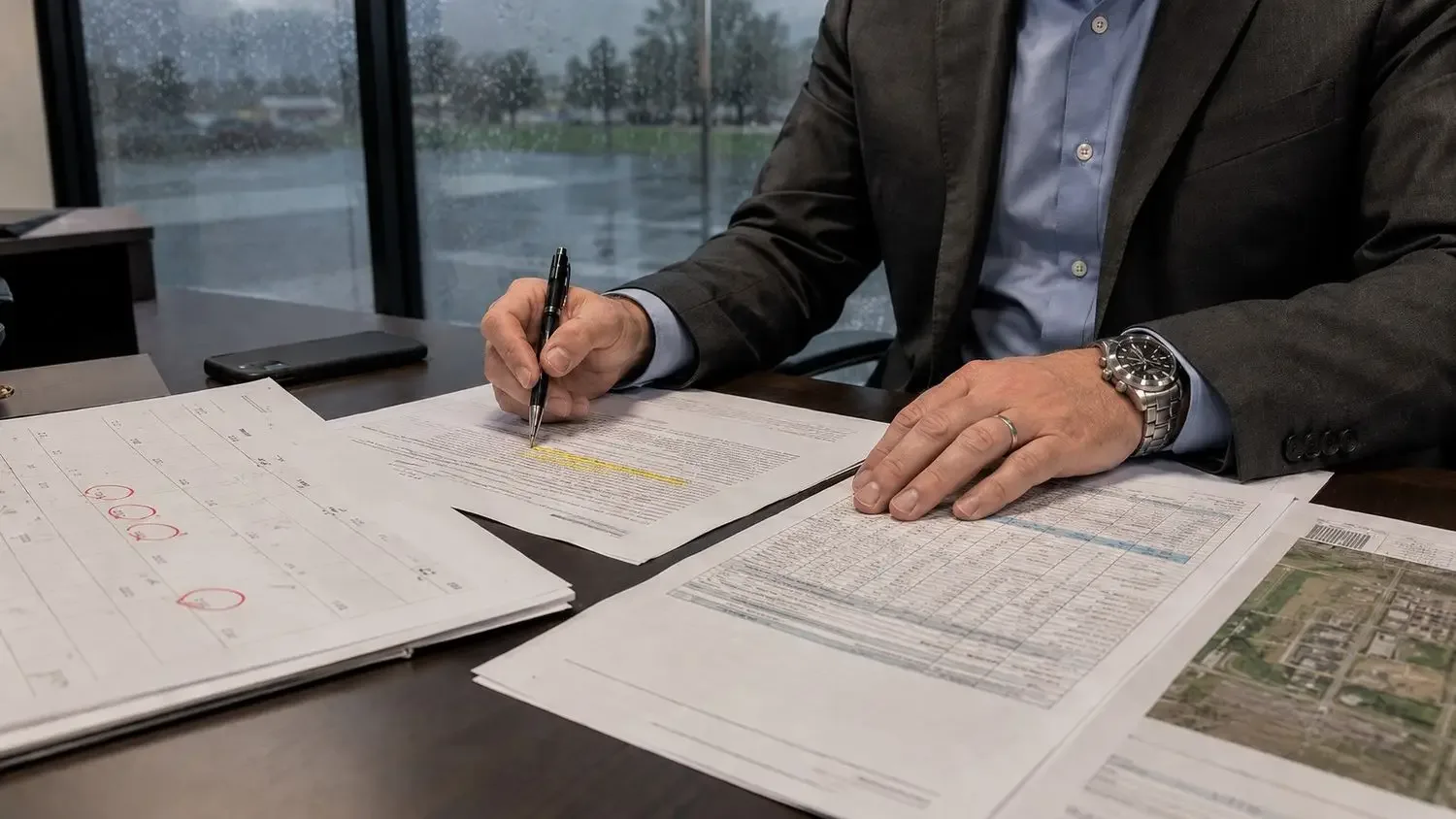
Get the provider's answer in writing, and make sure it covers capacity at your connection point, not just a nearby line.
In Texas, start with who holds the right to serve. According to the Public Utility Commission's CCN mapping resources page, a certificate of convenience and necessity (CCN) gives a retail public utility the exclusive right to provide retail water or sewer service in its area, and the holder must provide continuous and adequate service there. The page links the PUC's Water and Sewer CCN Viewer, which searches by address. Cities and districts need a CCN only to serve inside another utility's certificated area, so an empty result does not mean nobody serves the tract.
Then check the plant. Under 30 TAC §305.126(a), a permitted plant at 75 percent of its permitted flow for three consecutive months must start planning expansion, and at 90 percent for three months it needs the commission's authorization to begin construction. A plant in that range may not have room for you on your schedule.
What options does the study compare when there is no connection?
A small on-site system, a private plant under a land application or discharge permit, and sometimes reuse. Texas also expects you to look at connecting first.
Under 30 TAC §285.2, an on-site sewage disposal system handles no more than 5,000 gallons of sewage a day, produced on its own site. Above that, a domestic plant needs a TCEQ permit. Per TCEQ's domestic wastewater permits page, a plant that discharges to water in the state needs a TPDES permit, and one that disposes of effluent by land application needs a Texas Land Application Permit (TLAP). We cover that second path in our article on land application permits in Texas. A site with industrial wastewater may also look at Subchapter E of 30 TAC Chapter 210, which sets which industrial waste streams qualify for reuse.
A private plant means showing why you are not connecting. TCEQ's regionalization guidance cites Texas Water Code §26.0282, which lets the agency deny or alter a discharge permit based on need and the availability of regional systems. Applicants ask permitted systems within three miles about capacity and, if one has room, analyze the cost of connecting. A nearby system is not an automatic denial. And 16 TAC §24.227(b) requires a new CCN applicant needing a physically separate system to show that regionalization or consolidation is not economically feasible.
What about the water supply?
Same questions: who serves the tract, with what capacity, and under which rules if you supply it yourself.
If groundwater under the land will supply a subdivision, TCEQ's groundwater availability certification page says cities and counties must require a certification at platting, effective January 1, 2024, with some exemptions. A system with at least 15 service connections, or serving at least 25 people at least 60 days a year, is a public water system under 30 TAC §290.38.
Why does the permit pathway drive the schedule?
Because the permit, not the design, usually sets the critical path.
TCEQ's domestic wastewater application steps say to submit a complete application at least 330 days before the proposed discharge begins, and warn that a new discharge into an impaired water body may not be allowed or may carry stringent requirements. New applications then go through TCEQ's public participation process: two public notices, a comment period, and possible requests for a public meeting or a contested case hearing. That page gives no review time, and nobody can promise you a permit date. A study names the steps your pathway faces so the schedule and the financing carry them.
What happens when developers skip the study?
The utility problem shows up after closing, in design or permitting, when the price and the schedule are already set.
The pattern repeats. The site civil engineer handles grading and drainage. Wastewater waits. Months later, with drawings underway, the team finds the connection has no capacity or the permit path is longer than the schedule allows. What follows is carry, redesign and resubmittals on a schedule that never accounted for the utility constraint.
Is your utility due diligence ready for closing?
Run this check before your option expires. If any answer is no, the utility line in your pro forma is still an assumption.
- Do you know who holds the water and sewer CCNs, or which city or district would serve the tract?
- Do you have the provider's written answer on capacity at your connection point?
- Do you know the route of any line extension, including easements and crossings?
- Without a connection, has an engineer compared on-site, land application and discharge options for your flow?
- If a new plant is likely, have you found the permitted systems within three miles?
- Does your schedule carry the permit steps, including public notice and a possible hearing request?
Each no is a line in the study's scope. To start, your engineer needs the site boundary, the development program, the phasing and your target dates.
A note on limits: this is general education on Texas rules as of October 2026, not advice for a specific site. Other states use different agencies and criteria.
Frequently asked questions
Who should prepare a utility feasibility study?
A water and wastewater engineer who works with TCEQ, the PUC and local utilities. A site civil engineer can find a sewer line on a plat. Judging capacity, permit pathways and private infrastructure is a different discipline.
How long does a utility feasibility study take?
It depends less on the engineering than on how fast utilities answer in writing. Send the service requests in week one and set a delivery date well before your option expires.
Is a will-serve letter the same as a utility feasibility study?
No. A will-serve letter is one provider's answer about one connection. The study sets it next to the other options, the permits and the schedule.
I'm an acquisitions manager with a 60-day feasibility period on a tract outside a Texas city with no sewer nearby. What should I ask the engineer for in week one?
Ask who holds the CCNs, for service requests to those providers and to permitted systems within three miles, for a comparison of on-site, land application and discharge options, and for the permit steps each option faces. Those answers decide whether you renegotiate, restructure or walk.
I'm developing an industrial park in Central Texas and a city plant sits two miles away. Can I permit my own treatment plant instead of connecting?
Possibly, but you have to show why. TCEQ expects you to ask that plant about service and, if it has capacity, to analyze the cost of connecting. TCEQ may still approve if service is denied or if costs or affordable rates justify an exception.
Related resources
- How to Evaluate Wastewater Utility Options Before You Close on Land (Connect, Build, or Wait)
- How Wastewater Infrastructure Affects Your Pro Forma: What Developers Often Miss
- CCN Territory Disputes in Collin County: What to Check Before Land Crosses a Water Provider Boundary
- Building a Private WWTP in Texas: What Developers Need to Know Before They Commit
Buying land before you know it can be served?
MES checks water, wastewater and the permit pathway inside your due diligence window, so you hear whether the site can be served before you close.
Modern Engineering Solutions, McKinney, Texas, with offices in Golden, Colorado and San Jose, California. (214) 833-6748.
Keep reading
More to read.
Talk to an engineer
Tell us about your project.
An engineer reads it
Not a salesperson. Someone who can tell you whether the pathway is real.
You get a first answer
Your options, the agencies involved and the questions that decide cost and schedule.
You decide
No commitment to have the first call.
Prefer the phone? (214) 833-6748