
Blog
Package WWTP vs. Custom-Designed Plant: Which One Fits Your Project?
Package WWTPs work for flows under 100,000 GPD with standard wastewater. Custom design handles complex flows and scales better. Know which fits your project.
Quick Answer
A package wastewater treatment plant is a prefabricated, factory-built system (typically extended aeration, SBR, or MBR) procured from a manufacturer and installed on a prepared site. It is faster to procure, lower in upfront engineering cost, and well-suited for flows under 100,000 GPD with standard domestic-quality wastewater and straightforward discharge or reuse requirements. A custom-designed plant is engineered from the ground up for a specific site, flow profile, waste stream, and regulatory environment. It costs more to design but performs better across a wider range of conditions, scales more predictably, and is less likely to generate technical comments during TCEQ permit review. Most developers default to package systems. That default is right on some projects and wrong on others.
What a Package System Actually Is
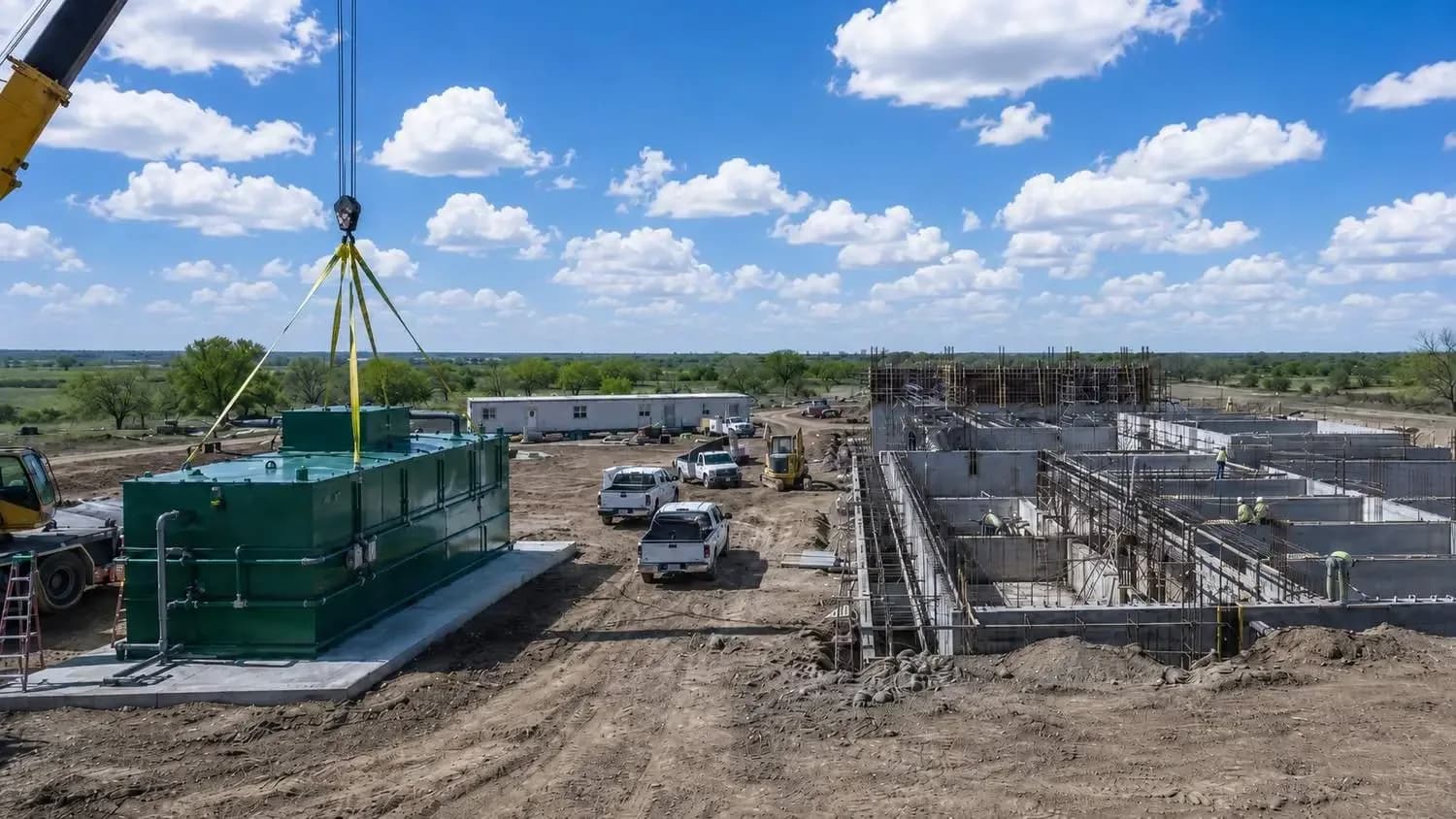
A package treatment plant is a pre-engineered system manufactured off-site and shipped as a complete or modular unit. The most common configurations used in Texas development projects are extended aeration activated sludge, sequencing batch reactor (SBR), and membrane bioreactor (MBR).
Extended aeration is the workhorse. It is well understood by TCEQ reviewers, straightforward to operate, and produces reliable secondary effluent for standard discharge or land application permits. It performs best at consistent flows in the 10,000 to 150,000 GPD range with domestic-dominant wastewater. SBR systems handle variable flows better and can meet tighter nutrient limits with the right configuration. MBR systems produce high-quality effluent suitable for reuse applications but carry higher capital cost and require more operator attention.
Package systems are faster to procure than custom-designed plants, typically 12 to 20 weeks from order to delivery versus the longer timeline for site-specific structural and process design. They carry lower upfront engineering fees. For projects with standard domestic wastewater, moderate flow volumes, and routine discharge or land application requirements, a package system is often the most cost-effective and timeline-efficient path.
What a Custom-Designed Plant Is
A custom-designed plant is engineered for a specific combination of site conditions, flow volume, waste stream characteristics, effluent requirements, and operational capacity. The engineer selects each process component (aeration technology, clarification method, solids handling approach, disinfection system) based on the project’s actual requirements rather than a manufacturer’s standard configuration.
Custom design adds engineering cost and time on the front end. The tradeoff is a system that performs reliably across the project’s actual operating range, meets the specific effluent limits in the permit, and scales to future capacity without core redesign. For projects above 500,000 GPD, custom design is almost always the right answer. For projects with high-strength industrial wastewater, advanced nutrient limits, or non-standard discharge requirements, custom design is often the only answer.
When Package Systems Create Problems
The most common failures with package systems are not operational at startup: they happen earlier, at the permit application stage, and show up operationally years later when flows and loadings diverge from the manufacturer’s design assumptions.
Permit review problems. TCEQ reviews the engineering basis of every permitted facility. A package system submitted with manufacturer specifications but without site-specific process calculations demonstrating that the system will meet the permit’s effluent limits at actual design flow and peak conditions draws technical questions. Applications that arrive without defensible calculations for BOD removal, nitrification, peak hydraulic handling, and sludge production create revision cycles that add months to the permit timeline.
The package system is not the problem. Submitting it without proper engineering documentation is.
Flow and loading mismatches. Package systems are rated for a design flow and a standard domestic loading. A development that adds food service tenants, car washes, or industrial operations after the plant is commissioned changes the loading profile the system was designed for. A system sized for 100,000 GPD of standard domestic wastewater and then asked to process high-strength commercial waste will underperform on effluent quality, generating permit exceedances on a system that was correctly specified for the wrong application.
Expansion limitations. Most package systems are not designed for on-site expansion. Adding a second unit is possible, but the hydraulic routing, solids handling, and control integration were not designed with parallel trains in mind. A custom-designed plant at 300,000 GPD with an expansion pathway engineered in from day one adds a second process train cleanly. A package system at the same scale typically requires a parallel installation with independent controls, separate sludge handling, and increased operator complexity.
Selection Criteria: How to Choose
Five variables drive the package versus custom decision for most Texas development projects.
Flow volume. Under 50,000 GPD with standard domestic wastewater: package system is typically appropriate and cost-effective. 50,000 to 250,000 GPD: evaluate both options based on site conditions and permit requirements. Above 250,000 GPD: custom design is almost always more appropriate, more expandable, and better supported in TCEQ review.
Wastewater characteristics. Standard domestic flow: package system performs well. Any industrial component, high-strength organic loading, elevated nutrient concentrations, or non-domestic waste streams: process engineering is required before equipment selection. Selecting a package system for high-strength waste without characterizing the actual loading is a design error that shows up at the effluent monitoring station.
Discharge or reuse requirements. Standard secondary effluent limits: package extended aeration handles this reliably. Nutrient limits (total nitrogen under 5 mg/L, total phosphorus under 0.5 mg/L): SBR or MBR with engineered nutrient removal required. Reuse quality for irrigation or industrial applications: MBR is typically the right process choice, and the reuse system downstream must be engineered to match.
Site constraints. Limited footprint: MBR provides the most treatment capacity per square foot and may justify the premium. Remote site with limited operator availability: extended aeration’s operational simplicity is a real advantage. Sites in sensitive watersheds with strict effluent requirements: custom design with conservative safety factors in the process calculations reduces permit risk.
Timeline. Package systems deliver faster from procurement to installation. But the schedule advantage disappears if the permit application is deficient and draws revision cycles. A well-documented custom design submitted with complete calculations often moves through TCEQ review faster than a package system submitted without proper engineering support.
Frequently Asked Questions
What is the cost difference between a package WWTP and a custom-designed plant?
Package systems typically cost $18 to $20 per gallon of design capacity in construction, with lower upfront engineering fees. Custom-designed plants in the same size range carry higher engineering costs (typically $50,000 to $150,000 more in design fees depending on complexity) but often deliver better long-term performance and lower operational cost on projects above 100,000 GPD or with non-standard waste streams.
Will TCEQ accept a package system on a permit application?
Yes, TCEQ permits package systems routinely. The requirement is that the engineering submittal demonstrates the system will meet the permit’s effluent limits at actual design flow and peak conditions with calculations, not just manufacturer specifications. Applications that lack site-specific process calculations draw technical comments regardless of whether the system is package or custom.
Can a package system be expanded when the development grows?
Within the manufacturer’s rated capacity for the installed unit, yes. Beyond that, expansion typically means adding a parallel unit, which works but adds operational complexity. Custom-designed plants with phased expansion pathways engineered in from day one expand more efficiently and with better hydraulic integration.
Related Resources
- Building a Private WWTP in Texas: What Developers Need to Know Before They Commit
- How Carrying Costs Are Killing Texas Development Projects (And the Permit Strategy That Fixes It)
- Texas Land Development Application Process
- How to Cut TCEQ Wastewater Permit Timeline from 12 Months to 6-8 Weeks Using Reuse Authorization
Evaluating Package vs. Custom Design for Your Texas Development?
Modern Engineering Solutions works with Texas developers to select and engineer wastewater treatment systems that match the project’s flow profile, permit requirements, and long-term operational needs, without vendor bias toward any particular manufacturer or system type.
We specialize in:
- Package WWTP selection, sizing, and TCEQ permit documentation
- Custom wastewater treatment plant design for flows above 100,000 GPD
- Process selection for high-strength industrial and mixed-use developments
- Phased plant design tied to development absorption schedules
- TCEQ permitting: TPDES, TLAP, and 210E pathway evaluation
Modern Engineering Solutions, McKinney, Texas. Contact: (214) 833-6748 or mod-eng.com
Keep reading
More to read.
Talk to an engineer
Tell us about your project.
An engineer reads it
Not a salesperson. Someone who can tell you whether the pathway is real.
You get a first answer
Your options, the agencies involved and the questions that decide cost and schedule.
You decide
No commitment to have the first call.
Prefer the phone? (214) 833-6748