Quick Answer
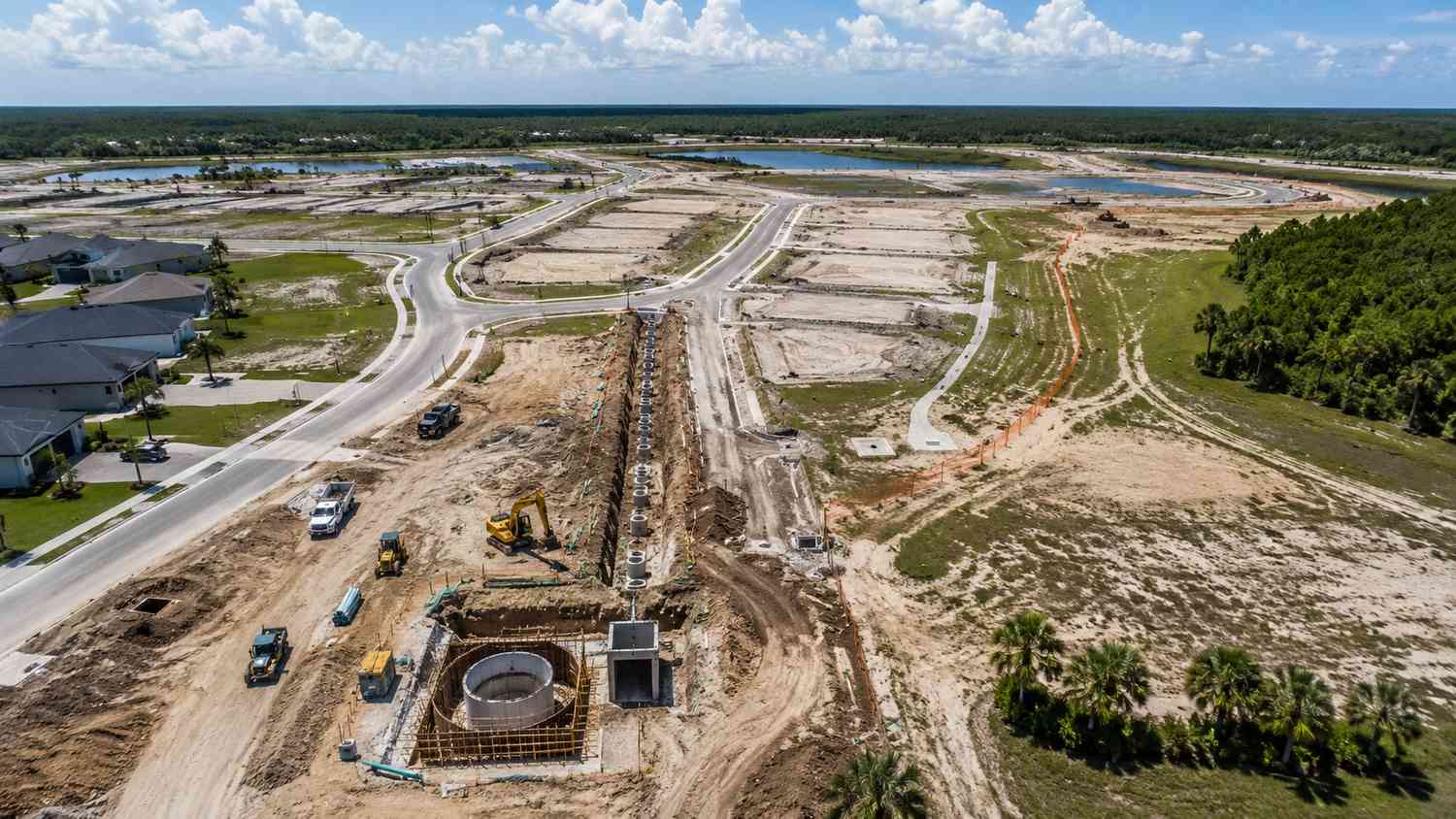
The Florida Department of Environmental Protection administers wastewater system permitting in Florida through its domestic wastewater program, which regulates the construction and operation of wastewater treatment facilities, collection systems, lift stations, force mains, reuse systems, and land application systems. Developers proposing new wastewater infrastructure, extending collection systems into undeveloped areas, modifying existing permitted systems, or installing private treatment facilities where public sewer is not available must obtain FDEP permits before construction begins. Review timelines for straightforward projects typically run three to six months for a complete application. More complex projects involving new treatment facilities, reuse systems, or environmentally sensitive sites can take twelve to twenty-four months or more. The developers who consistently hit their construction start dates in Florida are the ones who start the FDEP permitting process before they close on the land, not after.
What Triggers FDEP Wastewater Permitting in Florida
FDEP wastewater permitting is triggered by any construction, modification, or expansion of domestic wastewater infrastructure that serves the public or that discharges to or affects waters of the state. For a residential developer extending a gravity sewer collection system into a new subdivision and connecting to an existing utility’s treatment plant, the new collection system mains, manholes, lift stations, and force mains all require FDEP construction permits before installation. For a developer proposing a master planned community where no existing utility service is available and a private wastewater treatment facility will be required, the treatment plant itself requires an FDEP construction permit and an operating permit, and the effluent disposal strategy, whether surface discharge, reuse, or land application, requires its own separate authorization.
The practical scope of FDEP permitting authority in the wastewater context is broader than many developers initially assume. A project that proposes to connect to an existing utility’s collection system does not necessarily avoid FDEP permitting obligations. If the connection requires extension of the collection system beyond the utility’s existing permitted infrastructure, those extensions are permit required construction. If the utility’s treatment plant is at or near its permitted capacity and the new development will push flows above the permitted limit, a capacity expansion that requires its own FDEP permit modification may be a prerequisite for the development connection. A developer who does not investigate the utility’s permitted capacity and current loading before assuming service availability is making a feasibility assumption that may not survive contact with reality.
Modifications to existing wastewater infrastructure also trigger FDEP review. A pump station upgrade that increases pumping capacity, a force main replacement that changes the pipe diameter or alignment, a treatment plant modification that adds a new process unit, and a reuse system expansion that adds new storage or distribution infrastructure all require FDEP permits or permit modifications before the work can proceed. Developers acquiring properties with existing wastewater infrastructure should verify the current FDEP permit status of that infrastructure and identify any outstanding compliance requirements, expired permits, or unpermitted modifications before the acquisition closes.
Treatment Capacity and Utility Service Availability
Treatment capacity availability is the most critical wastewater constraint in high growth Florida markets, and it is the constraint that most frequently creates surprise for developers who did not investigate it early in the project planning process. FDEP operating permits for wastewater treatment facilities specify a permitted annual average daily flow that the facility may not exceed without a permit modification authorizing expanded capacity. When a utility’s actual flows approach the permitted limit, the utility may be unable to issue capacity reservations for new development connections, and FDEP may restrict the utility from accepting new flows until capacity is expanded.
For a developer evaluating a Florida site, the relevant questions regarding treatment capacity are not simply whether the utility serves the area but whether the utility has capacity available to serve the proposed project, whether that capacity is confirmed through a formal reservation, and what the utility’s capital improvement plan shows regarding future capacity expansion if current capacity is limited. Obtaining a written capacity availability confirmation from the utility is a standard due diligence step that should occur before earnest money is committed to a Florida development acquisition. A verbal assurance from a utility representative that capacity exists is not a substitute for a written confirmation that specifies the flow allocation being reserved and the conditions under which that reservation is valid.
When utility capacity is not available on the timeline the project requires, developers in Florida have pursued several alternative strategies including negotiating a capacity reservation tied to a specific utility expansion project with defined milestones, participating financially in a utility capacity expansion to accelerate the schedule, pursuing a private wastewater treatment facility as an interim solution pending utility capacity expansion, or exploring whether an adjacent utility with available capacity could extend service to the project site. Each of these alternatives carries its own permitting, financial, and operational implications that require engineering analysis specific to the project circumstances.
FDEP Permitting for Private Wastewater Treatment Facilities
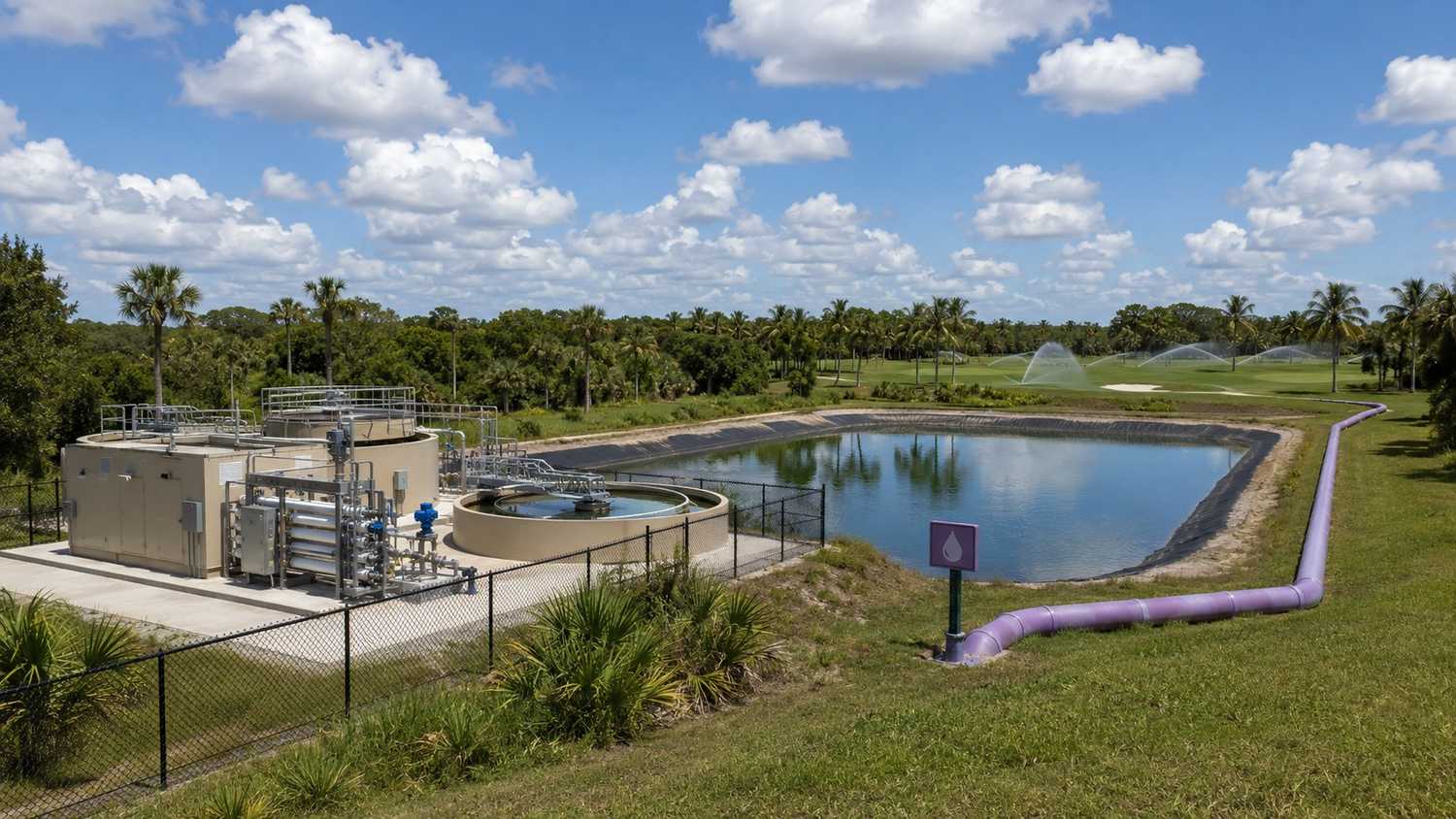
Developers whose Florida projects cannot access public sewer service must evaluate private wastewater treatment as an alternative. A private domestic wastewater treatment facility in Florida requires an FDEP construction permit and, following construction and startup, an FDEP operating permit that governs the ongoing operation and compliance obligations of the facility. The construction permit application requires engineering drawings and specifications prepared by a Florida-licensed professional engineer, design calculations demonstrating that the proposed treatment process is capable of achieving the required effluent quality, documentation of the effluent disposal strategy, environmental constraint evaluation for the site, and demonstration that the facility meets FDEP’s design standards for the applicable facility type and size.
Florida’s dominant effluent disposal strategy for private wastewater treatment facilities is reuse, and FDEP strongly encourages reuse over surface water discharge for new or expanded wastewater systems. Florida has one of the most developed reclaimed water programs in the United States, and the state’s reuse rules under Chapter 62-610 of the Florida Administrative Code establish detailed requirements for reclaimed water treatment standards, distribution system design, setback distances, monitoring, and end use restrictions. A developer proposing a private treatment facility with reuse disposal must design the treatment process to meet the applicable reuse standards, which require secondary treatment and high-level disinfection for most unrestricted access reuse applications, and must identify a sufficient reuse demand and application area to absorb the full effluent volume generated by the development.
Surface water discharge for private wastewater facilities in Florida is subject to more stringent regulatory scrutiny than reuse and requires a National Pollutant Discharge Elimination System permit, referred to as an NPDES permit in Florida, that establishes effluent limits based on the receiving water quality standards for the receiving water body. Florida’s water quality standards for receiving waters, particularly coastal waters and springs, are protective enough that the effluent limits for surface discharge can require treatment performance beyond what standard secondary treatment produces. Advanced treatment including nutrient removal, filtration, and high-level disinfection may be required for surface discharge to sensitive Florida receiving waters, significantly increasing both the capital cost and the operating cost of the treatment facility relative to a reuse alternative.
Collection System Design, Lift Stations, and Force Mains
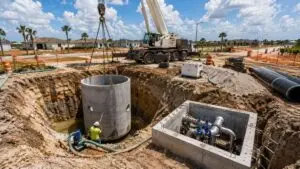
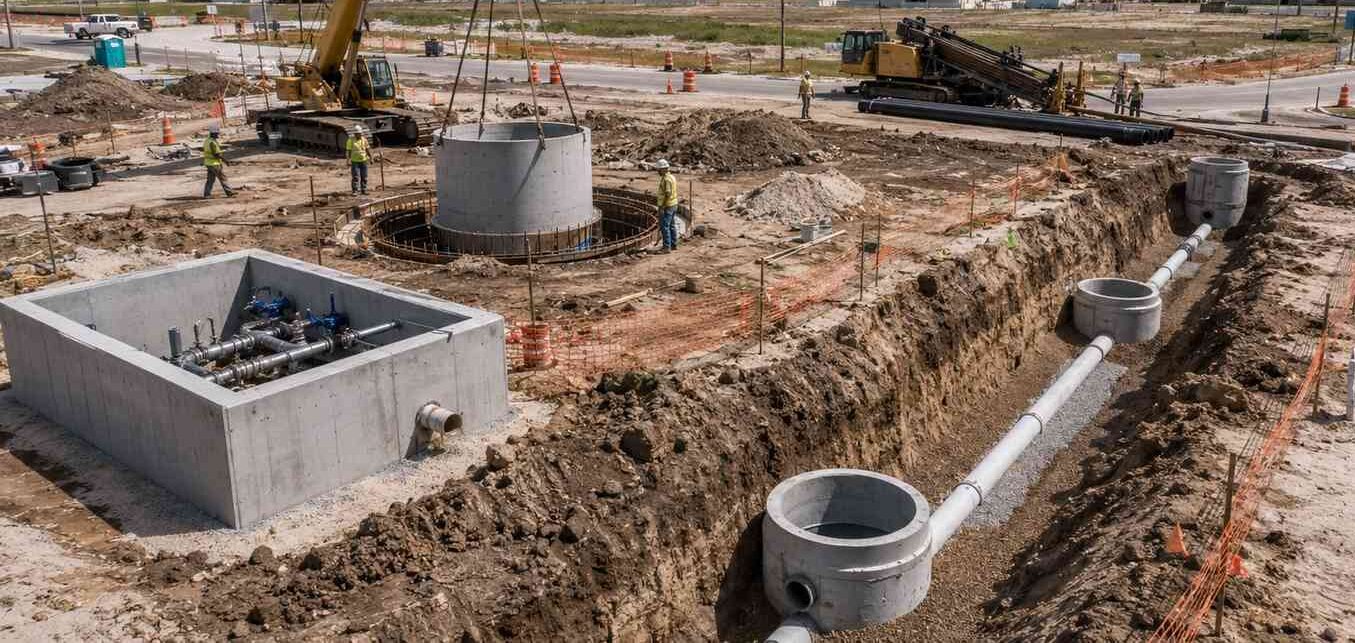
Florida’s flat topography makes gravity only sewer collection impractical for most developments, and the collection system design for a typical Florida project includes a combination of gravity sewers, lift stations, and force mains that must all be permitted through FDEP before construction. FDEP’s design standards for collection systems and lift stations are established in Chapter 62-604 of the Florida Administrative Code and specify requirements for pipe materials, minimum slopes, manhole spacing, lift station wet well sizing, pump redundancy, standby power, and force main design. Meeting these standards is a design discipline that must be integrated into the site civil engineering from the beginning of the design process, not added as a compliance review step after the design is otherwise complete.
Lift station design for Florida developments requires particular attention to pump sizing, wet well volume, and standby power provisions. FDEP requires that lift stations serving more than a threshold number of connections have standby power capability sufficient to operate the station during extended power outages, which in Florida’s hurricane environment is not a hypothetical design scenario. A lift station that loses power during a hurricane and overflows because it has no generator capability is both an environmental compliance problem and a public health event that creates regulatory and legal exposure for the utility and the developer who installed it. Designing adequate standby power into every lift station from the beginning is significantly less expensive than retrofitting it after FDEP cites the facility during an inspection.
Force main design in Florida must account for the corrosive environment created by hydrogen sulfide generation in long transmission mains with slow flow velocities, warm wastewater temperatures, and high organic loading. Pipe material selection, air release valve placement, flushing provisions, and force main sizing to maintain minimum scour velocities are design decisions that directly affect the service life and maintenance cost of the force main and should be made with full awareness of the operating conditions the force main will experience rather than defaulting to minimum code compliance.
Environmental Constraints and Permitting Coordination
Florida’s environmental regulatory framework creates a multi-agency permitting environment for wastewater projects that extends beyond FDEP’s domestic wastewater program. Projects in or near wetlands, floodplains, surface water bodies, aquifer recharge areas, or environmentally sensitive lands may require permits from the Florida Fish and Wildlife Conservation Commission, the Army Corps of Engineers, the relevant Water Management District, and local environmental review programs in addition to FDEP wastewater permits. For developers, the practical implication is that FDEP wastewater permitting does not occur in isolation from these other regulatory processes, and a project timeline that accounts only for FDEP review without identifying and tracking the other permits required to begin construction will produce schedule surprises that delay the project start.
Pre application meetings with FDEP are available and strongly recommended for complex projects, new treatment facility proposals, and projects in environmentally sensitive areas. A pre-application meeting allows the project team to present the proposed project concept, receive preliminary FDEP feedback on the applicable regulatory requirements, identify potential issues that should be addressed in the application package, and develop a realistic estimate of the review timeline before the formal application is filed. The investment of time in a pre-application meeting consistently produces more complete initial applications, fewer requests for additional information during formal review, and shorter overall permitting timelines for projects that use them effectively.
Frequently Asked Questions
How long does FDEP wastewater permitting take for a straightforward residential subdivision connecting to an existing utility in Florida?
For a project that involves only collection system construction connecting to a utility with confirmed available capacity, a complete FDEP application for collection system and lift station construction permits can be reviewed and approved in three to six months. The timeline assumes a complete application submitted without significant deficiencies, no environmental constraints requiring additional review, and no need for public notice or agency coordination beyond the standard FDEP domestic wastewater review. Projects where any of these assumptions do not hold should plan for a longer review timeline, and the project schedule should include contingency for requests for additional information that are common even for straightforward applications.
We are developing a site in Florida where no public sewer is available. What is the fastest path to wastewater permitting for a private treatment facility?
The fastest path begins with a pre application meeting with FDEP to confirm the applicable permitting requirements for your specific site and project type. Following that meeting, a complete construction permit application that includes a well documented engineering report, a clearly defined reuse strategy with identified reuse demand and application area, complete engineering drawings, and all required supporting documentation submitted in a single package without deficiencies will move through FDEP review faster than a piecemeal application that requires multiple rounds of additional information requests. Engaging an engineer with current FDEP domestic wastewater program experience to prepare the application is the most reliable investment in minimizing review timeline for a private facility application.
Do local governments in Florida have their own wastewater permitting requirements in addition to FDEP?
Yes. Many Florida counties and municipalities have local utilities or environmental programs that require local permits, connection agreements, or technical reviews in addition to FDEP permits. Local utility authorities may require capacity reservation agreements, connection fee payments, utility extension agreements, and design review by the utility’s engineering staff before FDEP permits are issued. Some Florida Water Management Districts have additional review authority for projects affecting water resources within their jurisdiction. Mapping all of the permits and approvals required for a specific Florida project, including FDEP, local utility, Water Management District, and any other applicable agency, is a project management step that should occur at the beginning of project planning so that the full permitting timeline is understood before construction start commitments are made.
Related Resources
- Florida’s Exploding Growth vs. Aging Wastewater Infrastructure: What Engineers Are Facing Right Now
- Septic System Abandonment When Connecting to Municipal Sewer
- Florida Department of Environmental Protection Domestic Wastewater Program
- Florida Chapter 62-604 Collection System and Transmission Facility Standards
Planning a Wastewater System for Your Florida Development?
MES is licensed in Florida and works with developers, land acquisition teams, municipalities, and engineering firms to evaluate wastewater options, confirm utility capacity, coordinate FDEP permitting strategy, prepare engineering documentation, and reduce avoidable delays during Florida development.
We specialize in:
- FDEP domestic wastewater construction and operating permit application preparation for Florida development projects
- Utility capacity availability evaluation and capacity reservation coordination for Florida residential and commercial developments
- Private wastewater treatment facility feasibility evaluation and FDEP permitting for Florida sites without public sewer access
- Reuse system design and Chapter 62-610 compliance documentation for Florida wastewater reuse applications
- Collection system, lift station, and force main design meeting FDEP Chapter 62-604 standards for Florida developments
- Pre application coordination with FDEP and multi-agency permitting strategy for complex Florida wastewater projects