
Blog
Seasonal Flow and Snowmelt: Designing Colorado Discharge Permits for Extreme Hydrologic Variation
Colorado discharge permit low flow limits come from 30E3 and 1E3 stream flows, so design for late-season dilution, cold water and snowmelt infiltration.
Colorado discharge permit low flow limits come from a stream's driest weeks, not its snowmelt peak. The Water Quality Control Division normally bases water quality based limits on the 30-day, 1-in-3-year low flow (30E3) for chronic standards and the 1-day, 1-in-3-year low flow (1E3) for acute standards. Your plant must meet those limits every month, through spring infiltration and cold-water nitrification, so design for all three, not for the creek you saw on a site visit.
Why does snowmelt make Colorado discharge permitting harder?
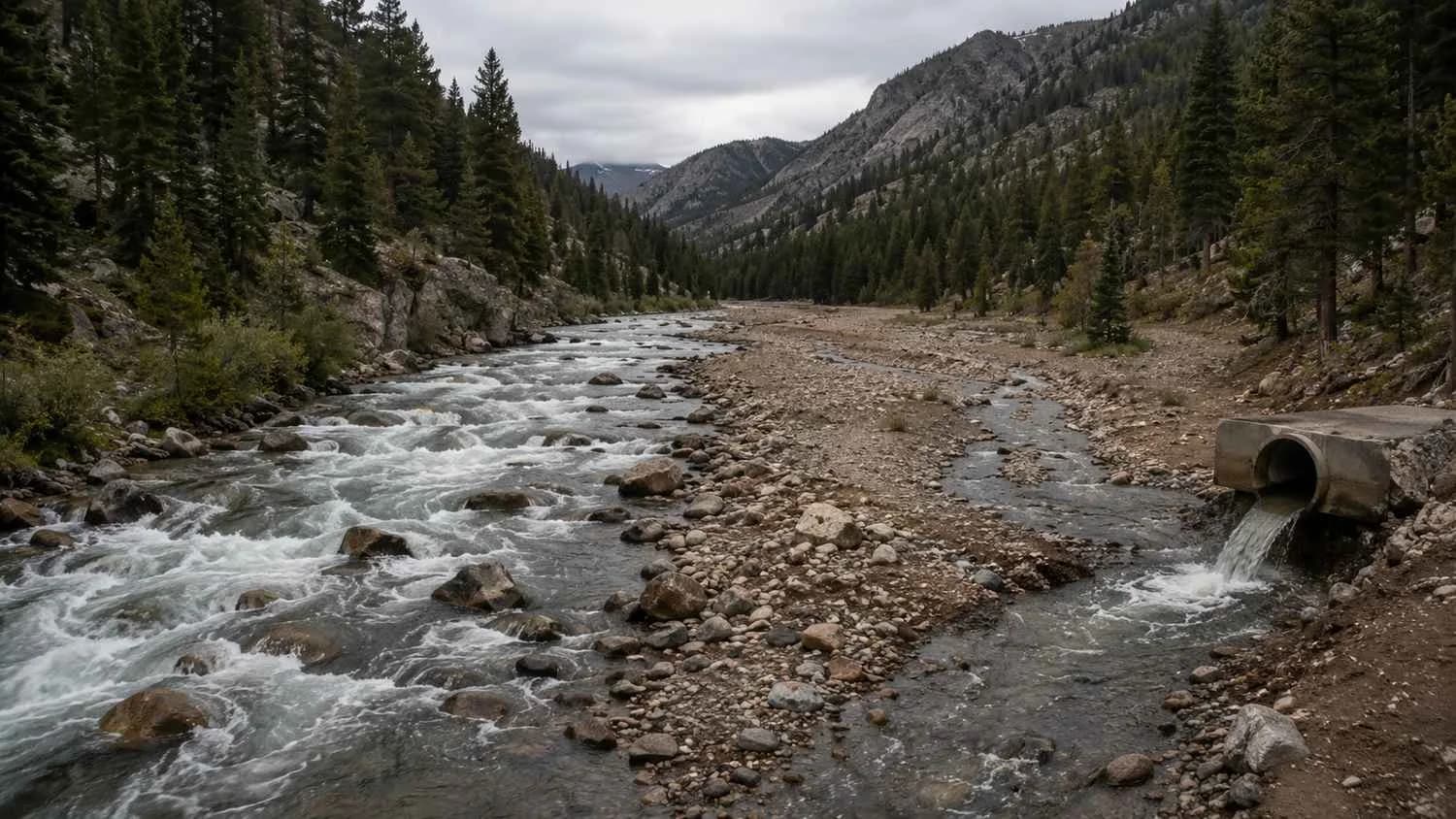
Because the stream you see in June is not the stream your permit is written for.
The USGS page on snowmelt runoff notes that at certain times of year snowmelt can carry most of a river's flow, and that runoff varies by year as well as by season.
So a discharge that is a small share of the creek in runoff can be a large share of it in late summer or winter. Resort towns add a second swing: wastewater loads can peak in ski or tourist season, and neither peak has to line up with high stream flow. Design for the worst combination.
Which low flows does CDPHE use to set permit limits?
Section 31.9(1) of Colorado Regulation 31 (5 CCR 1002-31) names them. Standards apply at all times, and for permit limits the Division normally uses these critical flows:
- Chronic standards: the 30E3, the empirically based 30-day average low flow with an average 1-in-3-year recurrence interval.
- Acute standards: the 1E3, the 1-day low flow with the same 1-in-3-year recurrence.
- Temperature: the 7E3, a 7-day average low flow, with the 1E3 for acute.
- Total phosphorus and total nitrogen: the annual median of daily average flows with a 1-in-5-year recurrence interval.
Low flows come from at least ten years of records; a shorter record is allowed case by case only when ten years is not available (31.9(1)(b)).
Note what is not on the list: the 7Q10. Regulation 31's 1988 statement of basis (31.24) explains why: 1-in-3-year flows give aquatic life time to recover, and the old 7Q10 had no biological basis. If a feasibility study used a 7Q10, an average flow or a June site visit, redo it with the Colorado statistics.
What happens when the creek's low flow is near zero?
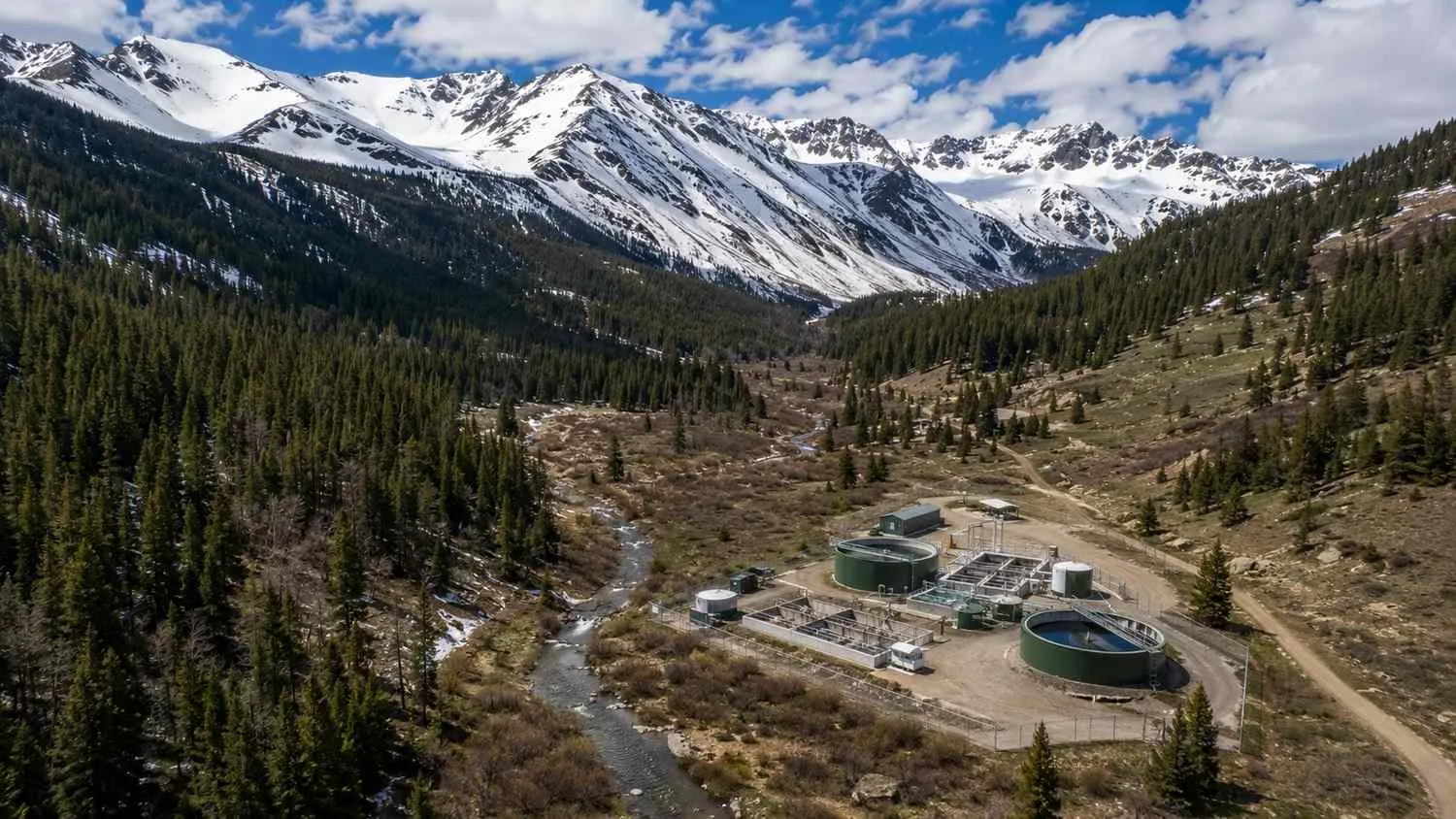
You get little or no dilution, and your limits approach the stream standards.
Under section 31.10(4)(a)(ii), where the 1E3 is zero, acute limits get no dilution. Where the 30E3 is zero, chronic limits get none. When the maximum permitted effluent flow is more than twice the 30E3, limits use the full low flows for dilution instead of a restricted mixing zone, unless the Division finds a stricter approach necessary (31.10(2)(b)).
For new discharges, CDPHE's water quality planning targets guidance recommends a conservative plan: meet water quality standards at the end of the pipe, and 15 percent of the standard for antidegradation parameters. Start there and let low flow data earn you dilution.
Can a Colorado permit limit change with the season?
Some can, because monthly low flows and ammonia standards both move through the year.
For streams with seasonal, rapidly rising or falling hydrographs, the Division uses a monthly 30E3 procedure when the discharger asks (31.9(1)(c)). It assigns 30-day moving harmonic means to the month holding 15 or more of their days and takes the lowest for each month, or the annual 30E3, whichever is greater. So the monthly method can raise dilution in runoff months and never drops below the annual number. For ammonia, low flows may be seasonal, case by case. The rule's 2005 statement of basis (31.44) ties these monthly low flows to monthly effluent limitations.
Ammonia adds its own swing. Its chronic standards in Table II are equations in pH and temperature: colder water raises the value, up to a cap, and higher pH lowers it. Run the analysis month by month. The hardest month is not always the driest.
Why can snowmelt cause a violation when the stream is full?
Because your limits still apply, and snowmelt pushes groundwater into the sewer at the same time.
EPA New England's Guide for Estimating Infiltration and Inflow (2014), written for the Northeast, says infiltration peaks at seasonal high groundwater, which usually follows snowmelt and soil thaw. It recommends at least a year of influent flow data.
Extra water cuts detention time in the biological and clarification steps, and a full creek does not excuse an effluent exceedance. An inflow and infiltration study tells you whether to fix the pipes, add equalization, or size the plant for the extra water.
How does cold water change the nitrification design?
It sets the minimum aerobic solids retention time (SRT), and CDPHE's design criteria set it at the minimum wastewater temperature, not the average.
For suspended growth nitrification, section 7.9.1 of CDPHE's Design Criteria for Domestic Wastewater Treatment Works (WPC-DR-1) sets the minimum aerobic SRT at SF x 3.4 x 1.103^(15 - T), where T is the minimum wastewater temperature in degrees C and the safety factor SF is at least 1.5, higher when effluent ammonia must be below 1 mg/L.
Run the numbers with SF = 1.5. At 15°C the minimum is 5.1 days. At 10°C it is about 8.3 days. At 8°C it is about 10.1 days, nearly twice the 15°C value, which means more basin volume or more mixed liquor.
The criteria also require design for the site's foreseeable wastewater and air temperature ranges and altitude (2.2.3). Get winter influent temperature early. A plant that nitrifies in August and loses it in January has a design problem, not a weather problem.
How do you size a plant for peak season and the quiet months?
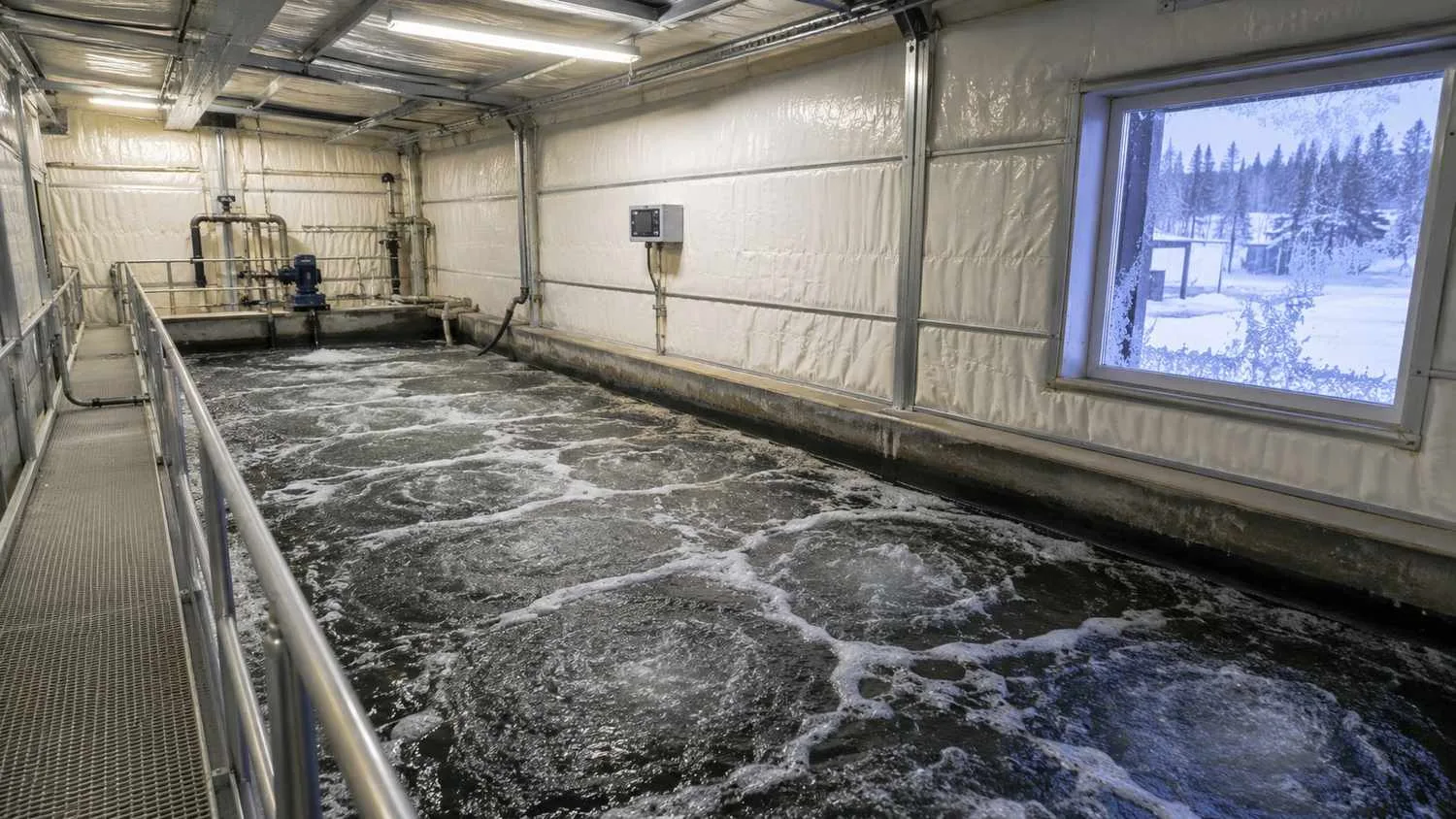
Size the process for peak season loads, then prove it turns down.
WPC-DR-1 bases process calculations on maximum month loading, and on peak season loads where large seasonal variations occur (7.1.1(e)). The design must also cover start-up minimum flow, equipment turndown and units in service (2.1.0). Flow records should span at least three years where available; without them, peaking assumptions must consider infiltration and inflow, special events and seasonal water use (2.1.1).
For a resort town, run at least two cases: the peak season month and the low season month with the coldest water. Multiple trains help with both. Reuse can cut the discharge, but irrigation demand is seasonal, so it needs storage or a second outlet. Weigh reuse versus direct discharge in Colorado before the plant is sized.
Is your Colorado discharge plan ready for seasonal flow?
Answer yes or no. Any no is your next task before design.
- Do you have the 30E3 and 1E3 for your receiving segment from ten or more years of record?
- Do you know whether the 30E3 is zero, and whether your effluent flow exceeds twice the 30E3?
- If the hydrograph is steep, have you asked for monthly 30E3 low flows?
- Have you checked ammonia limits month by month with stream temperature and pH?
- Do you have at least 12 months of influent flow data, including snowmelt season?
- Is the nitrification SRT based on the minimum wastewater temperature, and can the plant turn down for the low season?
Then ask your engineer: which month sets each limit, and which month sets each basin size?
Scope note: This is general education on Regulation 31 (effective 12/31/2024) and WPC-DR-1 (effective June 7, 2022), not a determination for your site. The Division sets the low flows and limits for each discharge.
Frequently asked questions
What is the 30E3 low flow in Colorado?
The empirically based 30-day average low flow with an average 1-in-3-year recurrence interval, normally used for chronic standards (31.9(1)(a)(i)).
Does Colorado use the 7Q10 to set discharge permit limits?
Not normally. Section 31.9(1) names the 30E3, 1E3 and 7E3, plus a 1-in-5-year annual median flow for total phosphorus and total nitrogen.
I'm a developer in Colorado and the creek beside our site looked full when we walked it in June. Why does our engineer say we may get almost no dilution?
A June walk can catch snowmelt runoff. Your limits come from the 30E3 and 1E3, and if those flows are zero the rule gives no dilution. For a new discharge, CDPHE suggests planning to meet standards at the end of the pipe.
I run a small water and sanitation district in a Colorado ski town where winter flows are far above summer. How should we size the treatment plant expansion?
Design the process for peak season loads, as WPC-DR-1 requires for large seasonal swings, and check the low season for turndown. Then check winter twice: nitrification SRT at the coldest wastewater temperature, and ammonia limits at winter low flow.
Can I ask the Division for monthly low flows?
Yes, if the stream has a seasonal, rapidly rising or falling hydrograph (31.9(1)(c)). No month's low flow is set below the annual 30E3.
Related resources
- Antidegradation Policy in Colorado Water Permits: What It Means for New Discharge Permits
- Colorado Water Quality Control Commission Basin Specific Standards: Why the Same Discharge Limit Does Not Apply Statewide
- Domestic Wastewater Treatment Works Design Criteria: The CDPHE Engineering Standards Package Plants Must Meet
- Colorado CDPHE Discharge Permit Process: Timeline, Requirements, and How It Differs from Texas
Planning a discharge to a Colorado snowmelt stream?
Low flow, cold water and spring infiltration all land on the same plant, so work them together before the site and process are fixed. MES is licensed in Colorado, has an office in Golden, and handles the wastewater side from feasibility through construction.
We specialize in:
- Receiving water and low flow reviews
- CDPHE site location and discharge permit applications
- Wastewater treatment plant design
- Inflow and infiltration studies
- Collection systems and lift stations
- Construction administration
Modern Engineering Solutions, McKinney, Texas. Contact: (214) 833-6748 or mod-eng.com
Keep reading
More to read.
Talk to an engineer
Tell us about your project.
An engineer reads it
Not a salesperson. Someone who can tell you whether the pathway is real.
You get a first answer
Your options, the agencies involved and the questions that decide cost and schedule.
You decide
No commitment to have the first call.
Prefer the phone? (214) 833-6748