
Blog
Chapter 210 Reclaimed Water: What Texas Developers Need to Know About Water Reuse
Chapter 210 reclaimed water for Texas developers: Type I and Type II uses, the plant permit you still need, storage, purple pipe and TCEQ approval.
Chapter 210 reclaimed water is treated domestic wastewater that TCEQ lets you use in place of drinking water or raw water, for irrigation, toilet flushing, fire protection and cooling. It does not replace the treatment plant's own permit, and users can refuse the water on any day. Settle the reuse plan before the site plan is fixed, because it claims land, storage and pipe corridors.
What does Chapter 210 actually govern?
The use of reclaimed water, not the treatment plant. It sets who is responsible, what quality each use needs, and how the water is stored, piped, sampled and reported.
30 TAC Chapter 210 holds the general rules in Subchapters A through C. Subchapter E covers industrial reclaimed water (the 210E path) and Subchapter F covers graywater. It names three roles: the producer treats the wastewater, the provider distributes it, and the user puts it to use. One entity can hold more than one (30 TAC §210.3).
Chapter 210 does not apply to treated wastewater that a permit authorizes for disposal by irrigation (§210.1(b)). Irrigation under a Texas Land Application Permit (TLAP) is disposal, not Chapter 210 reuse.
Does a reuse authorization replace the treatment plant's permit?
No. The plant needs its own permit first, and reuse rides on top of it.
As amended effective March 5, 2025, 30 TAC §210.2(e) says a producer must hold a TPDES permit, a TLAP, or a 30 TAC Chapter 321, Subchapter P authorization before it builds and runs the treatment facility. The reuse project itself needs no new or amended discharge permit, except as §210.5 provides (§210.2(d)).
Reuse is also demand-only. The user may refuse delivery at any time, subject to its contract (§210.7), and where the producer is also the user, §210.1(c) requires another way to dispose of the water when there is no demand. The plant still needs a disposal route for wet weeks.
Industrial wastewater has its own path in Subchapter E, but once it holds any domestic wastewater it is commingled (§210.52) and must meet Subchapters A through C, including the quality standards (30 TAC §210.56(a)(1)).
What is the difference between Type I and Type II reclaimed water?
Type I is for uses where people are likely to touch the water. Type II is for uses where contact is unlikely (§210.3). Type I needs cleaner water and more sampling.
The limits are 30-day averages, summarized in EPA's summary of the Texas reuse rules:
- Type I: BOD5 or CBOD5 of 5 mg/L, turbidity of 3 NTU, fecal coliform or E. coli of 20 CFU/100 mL as a geometric mean (no single grab over 75), and enterococci of 4 (no grab over 9)
- Type II, non-pond systems: BOD5 of 20 mg/L or CBOD5 of 15 mg/L, fecal coliform or E. coli of 200 CFU/100 mL as a geometric mean (no single grab over 800), and enterococci of 35 (no grab over 89)
The producer samples Type I water twice a week and Type II water once a week (§210.34). If the plan includes parks, school fields or home lawns, design the plant for Type I.
Which reuse applications fit a Texas development?
Mostly irrigation, plus fire protection, toilet flushing and cooling. 30 TAC §210.32 sorts them:
- Parks, school yards, athletic fields and home lawns. Type I.
- Golf courses. Type I with unrestricted access. Type II when nobody uses the area during irrigation, such as fairways watered at night.
- Landscaping around commercial or industrial complexes. Type II when the public is not present during irrigation.
- Sod farms, tree farms and feed crops, often off site. Type II. Pasture for milking animals is Type I.
- Fire protection and toilet flushing. Type I.
- Cooling tower makeup and construction dust control. Type II.
Type I water can serve any Type II use. Some uses are off the table: food crops eaten raw cannot be spray irrigated (§210.22(b)), and reclaimed water cannot fill swimming pools or hot tubs (§210.24(c)(3)(B)). We talked through the industrial side in a Live Show episode on selling treated wastewater to industry.
How does reuse affect site planning?
It takes land, storage and pipe corridors. Lay them out with the first concept plan, not after the lots are drawn.
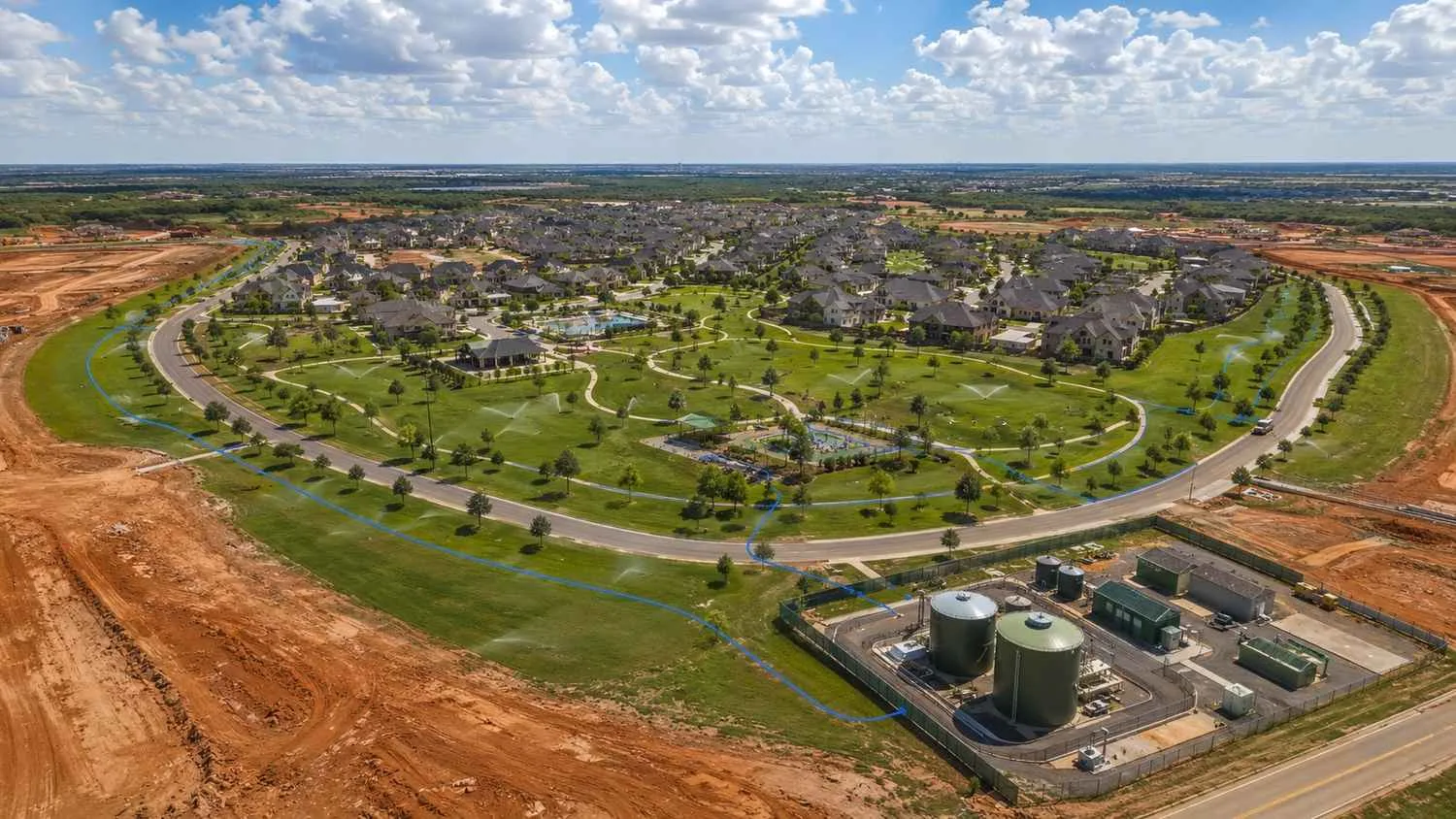
Start with demand. Under 30 TAC §210.24, irrigation demand comes from the vegetation and land area, with a water balance on average monthly rainfall and monthly evapotranspiration. No water goes on saturated or frozen ground.
Then storage. Except for authorized on-channel ponds, storage stays out of the floodway, and initial holding ponds get at least 24 inches of compacted soil or a 40-mil synthetic liner, certified by a Texas professional engineer (30 TAC §210.23). Over the Edwards Aquifer recharge zone the liner rules are stricter, and irrigation plans need Chapter 213 approval before construction (§210.4(d)).
Then pipe. Reclaimed water lines are purple and sit at least nine feet from potable lines unless they meet the Chapter 290 separation rules (30 TAC §210.25).
Under a TLAP, by contrast, storage is sized from a design rainfall year of at least a 25-year return frequency (30 TAC §309.20(b)(3)(B)). An average-year reuse balance shows demand, not the wet-year disposal the plant still needs. A site feasibility study is the time to size both.
What does TCEQ need before reclaimed water reaches a user?
Written approval. Before a provider delivers reclaimed water to anyone else, it notifies TCEQ and gets written approval (30 TAC §210.4(a)).
TCEQ's reclaimed water page names Form TCEQ-20427, with attachments such as a water reuse contract and an operation and maintenance plan. Under §210.4(a)(4), that plan covers cross connections, unauthorized access, monitoring, steps to limit human exposure, maintenance, training and contingencies.
Notification is waived only for a producer's reuse inside its permitted plant's boundary (§210.4(c)). Major changes need approval again, such as converting golf course irrigation to residential irrigation or switching between Type I and Type II (§210.4(e)). Plan the authorization around the full build-out.
After start-up, records stay on site for five years, and volume and quality are reported monthly (§210.36).
Why does reuse matter more for Texas development now?
Because the state water plan counts on it. The TWDB's 2027 State Water Plan, adopted July 23, 2026, projects population growing 53 percent from 2030 to 2080, to 52.3 million, while existing supplies fall about 10 percent. Conservation and reuse make up 43 percent of the plan's strategy supplies in 2080.
For developers and builders, every acre watered with reclaimed water is an acre the potable system does not have to serve.
Is your project ready for a Chapter 210 reuse plan?
If any answer is no, the plan is not ready to drive the site layout.
- Do you know which permit the plant will hold: TPDES, TLAP or Subchapter P?
- Do you know where the water goes on days nobody wants it?
- Is every reuse area listed and marked Type I or Type II?
- Is there a monthly water balance for those areas?
- Are storage, liners and purple pipe corridors on the plan?
- Do you know who is producer, provider and user, and who signs the reuse contract?
Then ask your engineer: which areas carry the system in January, and what happens if the HOA or a tenant stops taking water?
A note on limits: this is general education on 30 TAC Chapter 210 as read in October 2026, not a review of your site. TCEQ decides each authorization, so check the current rule and form instructions before you file.
Frequently asked questions
Can Chapter 210 reclaimed water be used for drinking?
No. The §210.32 uses are non-potable, and §210.25 requires "Reclaimed Water, Do Not Drink" signs, in English and Spanish, at storage areas and hose bibs unless the area is secured.
Does using reclaimed water need a water right?
Sometimes. A Chapter 210 approval does not change the need for one (§210.2(c)). TCEQ says you need a separate water-right authorization if the water enters a state watercourse before it reaches the user.
I'm developing a master-planned community in Central Texas with a private treatment plant. Can the HOA irrigate parks and school fields with reclaimed water?
Yes, as a Type I use, once TCEQ approves the reuse and the plant meets Type I quality. Expect a reuse contract with the HOA, twice-weekly sampling, and a disposal route for days the HOA does not need water. Over the Edwards Aquifer recharge zone, add Chapter 213 plan approval.
I'm a civil engineer in Texas and a tenant in our client's business park runs cooling towers. Can the site's reclaimed water supply them?
Cooling tower makeup is a Type II use, though towers that make significant aerosols next to public areas may get special requirements. Put the tenant's obligations in the reuse contract, and keep a disposal route for the day the tenant stops taking water.
Related resources
- Texas Chapter 210 Reclaimed Water Permits: Type I vs. Type II and When You Need One
- What Is a 210E Authorization and How Can It Save Your Texas Development Project?
- Your Three Wastewater Disposal Options in Texas: Discharge, Reuse, or Land Application
- Water Balance Studies Under 30 TAC §309.20: What They Require and Who Prepares Them
Planning reclaimed water into a Texas development?
The plan turns on the plant's own permit, the Type each area needs, and where the water goes when nobody wants it.
MES engineers can check those against Chapter 210 before the site plan is fixed.
Contact Modern Engineering Solutions in McKinney, Texas, or call (214) 833-6748.
Keep reading
More to read.
Talk to an engineer
Tell us about your project.
An engineer reads it
Not a salesperson. Someone who can tell you whether the pathway is real.
You get a first answer
Your options, the agencies involved and the questions that decide cost and schedule.
You decide
No commitment to have the first call.
Prefer the phone? (214) 833-6748