Quick Answer
Texas developers building outside municipal sewer service have three treated effluent disposal options: TPDES surface discharge to a water of the state, beneficial reuse under 30 TAC Chapter 210 (including the 210E fast-track pathway for qualifying projects), and land application through a Texas Land Application Permit (TLAP). TPDES discharge takes 24 to 36 months and carries public hearing risk. Land application takes 10 to 18 months and avoids receiving stream analysis. The 210E Industrial Reclaimed Water Authorization takes 4 to 10 weeks for projects with any industrial wastewater component. Choosing the right disposal pathway before engineering begins is the single most impactful permitting decision a Texas developer makes.
Option 1: TPDES Surface Discharge
A Texas Pollutant Discharge Elimination System permit authorizes a facility to discharge treated effluent to a water of the state: a named creek, river, tributary, or other surface water body. This is the default pathway most engineers default to, and it carries the highest timeline and opposition risk of the three options.
Regulatory path. TPDES permits for private development WWTPs are issued by TCEQ under 30 TAC Chapter 305. The application requires a complete engineering report, effluent limitation analysis, receiving water assessment, and antidegradation review. For facilities discharging to waters with existing downstream users or environmental designations, the review is more intensive. TCEQ staff review is followed by a public notice period during which third parties (watershed groups, adjacent property owners, downstream utilities) can request a contested case hearing. In environmentally sensitive watersheds, including those near the Edwards Aquifer, the Guadalupe-Blanco River Authority’s jurisdiction, or the San Marcos River corridor, contested case hearings routinely push TPDES timelines past 30 months.
Timeline. 24 to 36 months under standard conditions. Longer in contested watersheds. For a developer carrying $100,000 per month in holding costs, that is $2.4 million to $3.6 million in carrying cost exposure before construction starts.
Best-fit scenarios. Projects with high-strength wastewater that cannot be reused or land-applied. Projects where no reuse land or industrial off-takers are available. Projects large enough that irrigation land requirements would be impractical, and where industrial components are absent. TPDES is often the only option, but it should be confirmed as the only option before committing to it.
Option 2: Beneficial Reuse Under 30 TAC Chapter 210
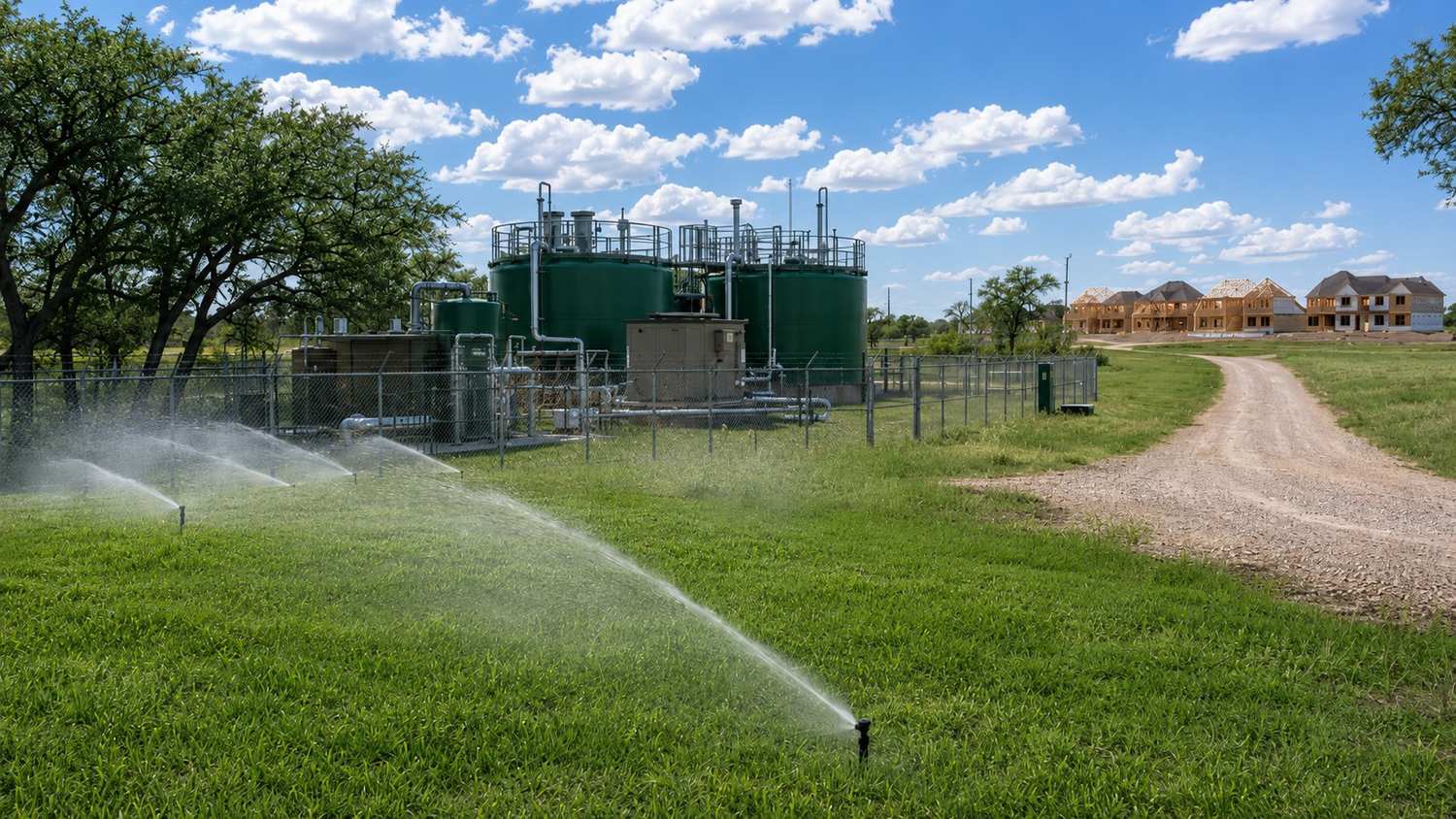
Texas Administrative Code Chapter 210 governs the reuse of reclaimed water for beneficial purposes: irrigation, industrial processes, cooling, fire protection, and other approved applications. Two authorization types are most relevant to Texas developers.
Type I General Authorization covers landscape and agricultural irrigation with treated effluent that meets Class I reclaimed water quality standards, essentially secondary treatment with disinfection. For small-scale applications serving on-site reuse needs, this pathway is often the fastest.
210E Industrial Reclaimed Water Authorization is the fast-track pathway available to projects with any industrial wastewater component. Under 30 TAC §210.53(b)(2), a project qualifies if its wastewater contains any industrial flow commingled with domestic wastewater, as little as 10% of total volume. Per 30 TAC §210.56(a)(3), the 210E serves as both the construction permit and the operating authorization for the facility. No separate wastewater treatment facility permit is required. No public hearing. No third-party referral process. State-level authorization supersedes local jurisdiction.
MES has secured 210E approvals in 4 to 10 weeks during TCEQ’s busiest periods. A 2.0 MGD master-planned development in Caldwell County was permitted in 4 weeks, 23 months faster than a TPDES discharge permit would have taken in that watershed. Engineering costs for a well-prepared 210E application run $15,000 to $35,000. The TCEQ application fee is $100 per §210.60.
Reuse land requirements. For agricultural irrigation using the most common approach, budget approximately 2,000 gallons per day per acre for grass and tree crops in Central Texas. A 300,000 GPD facility requires roughly 150 acres of irrigation area plus a properly sized storage reservoir per 30 TAC §309.20 water balance requirements. Industrial reuse (cooling towers, concrete mixing, industrial process water) can significantly reduce land requirements but must be arranged with confirmed off-takers.
Best-fit scenarios. Any development with a data center, concrete batch plant, light manufacturing, warehouse operations, or food processing component. Projects in sensitive watersheds where TPDES opposition risk is high. Developments adjacent to agricultural land with irrigation demand. Projects with timeline pressure that cannot absorb 24-month permit queues.
Option 3: Land Application Permit (TLAP)
A Texas Land Application Permit authorizes treated effluent to be applied to land rather than discharged to surface water, typically through spray irrigation or subsurface distribution. Effluent is absorbed by soil and vegetation instead of entering a stream or river.
Regulatory path. TLAPs are issued by TCEQ under the TPDES program, but they avoid the receiving water analysis that drives the most time-consuming elements of a standard TPDES discharge permit review. No downstream water quality assessment is required. No receiving stream modeling. No antidegradation review for surface water. TCEQ requires applications to be submitted at least 330 days before the planned operational date.
Timeline. 10 to 18 months on qualifying sites, significantly faster than TPDES discharge and appropriate for projects with domestic-dominant wastewater where the 210E industrial component is not available. The application requires a complete soil investigation, agronomic analysis demonstrating that applied effluent will be taken up by vegetation, hydraulic loading calculations, and a nutrient management plan.
Land requirements. Similar to the 210E irrigation approach. Budget 2,000 gallons per day per acre for standard grass and tree crops in Central Texas. For a 130,000 GPD development, that means approximately 65 acres of dedicated irrigation land. The land can be on-site, adjacent, or off-site with a confirmed reuse agreement, but it must be identified, characterized, and documented in the application before TCEQ will issue the permit.
Best-fit scenarios. Residential and domestic-dominant developments without an industrial component that would qualify for the 210E pathway. Rural developments with adjacent agricultural land available for irrigation. Projects in restricted watersheds where discharge opposition would extend the timeline to 30-plus months. Sites where the developer or an adjacent property owner controls sufficient irrigation land to meet the hydraulic loading requirements.

How to Choose Before You Start Engineering
The disposal pathway decision drives process selection, land requirements, permit timeline, and carrying cost exposure. It should be made with engineering input before a dollar is spent on WWTP design.
The selection framework is straightforward. If the project has any industrial wastewater component, evaluate the 210E pathway first. If the project is domestic-dominant with available irrigation land and no 210E qualification, evaluate TLAP. If neither reuse nor land application is viable at the project scale or site conditions, TPDES discharge is the remaining option with the timeline and opposition risk fully reflected in the project pro forma.
The developers who consistently protect their project economics on Texas private WWTP projects are the ones who evaluate all three disposal options during due diligence, price the permitting timeline into the acquisition model, and select the fastest viable pathway before engineering begins. That evaluation takes two to four weeks. It protects months of carrying cost exposure and eliminates the most common source of permit delay on private Texas developments.
Frequently Asked Questions
Can a project use both a 210E authorization and a TPDES discharge permit?
Yes. Many developers pursue a traditional discharge permit as a backup option after the 210E is operational. This provides a secondary disposal method if industrial users leave or reuse capacity becomes insufficient. The 210E allows you to bypass the discharge permit process for initial operations while maintaining the option to add discharge capability later.
What happens if a reuse partner under a 210E authorization exits the arrangement?
The permit becomes invalid for that portion of flow unless alternative arrangements are made. Reuse users are listed on the authorization, and their exit terminates validity for that flow. This is why developers either own the irrigation land themselves, secure long-term reuse agreements with contractual protections, or pursue a backup discharge permit once the facility is operational.
Is a TLAP faster than a 210E authorization?
No. A 210E authorization for qualifying projects runs 4 to 10 weeks. A TLAP runs 10 to 18 months. TLAP is faster than TPDES discharge but significantly slower than 210E. For projects that qualify for 210E, that pathway should be evaluated before committing to a TLAP or discharge permit.
Related Resources
- What Is a 210E Authorization and How Can It Save Your Texas Development Project
- Land Application Permits in Texas: A Faster Path to Wastewater Approval for Developers
- Building a Private WWTP in Texas: What Developers Need to Know Before They Commit
- How Carrying Costs Are Killing Texas Development Projects (And the Permit Strategy That Fixes It)
Evaluating Wastewater Disposal Options for Your Texas Development?
Modern Engineering Solutions works with Texas developers to evaluate all three disposal pathways, select the fastest viable option for each project, and deliver TCEQ permits without the carrying cost exposure of the wrong permitting strategy.
We specialize in:
- 210E Industrial Reclaimed Water Authorization preparation and TCEQ coordination
- Texas Land Application Permit applications: soil investigation, agronomic analysis, hydraulic loading
- TPDES discharge permit applications for projects where reuse is not viable
- Disposal pathway feasibility analysis during land due diligence
- Reuse plan development: agricultural, landscape, and industrial off-taker coordination
Modern Engineering Solutions, McKinney, Texas. Contact: (214) 833-6748 or mod-eng.com
Share via: