
Blog
Wastewater Capacity in Fort Worth’s ETJ: What Happens When the City Won’t Annex Your Development
Fort Worth ETJ wastewater: the city ties ETJ sewer to annexation, HB 2512 narrowed ETJ release in 2025, and private plants or MUDs fill the gap.
Quick answer
A tract in Fort Worth's ETJ has no right to city sewer, annexation or a place in the city's capital plan. Under the city's annexation policy, an ETJ owner who wants city water or sewer must agree to connect to both and either petition for annexation or sign a pre-annexation agreement, and the council may say no.
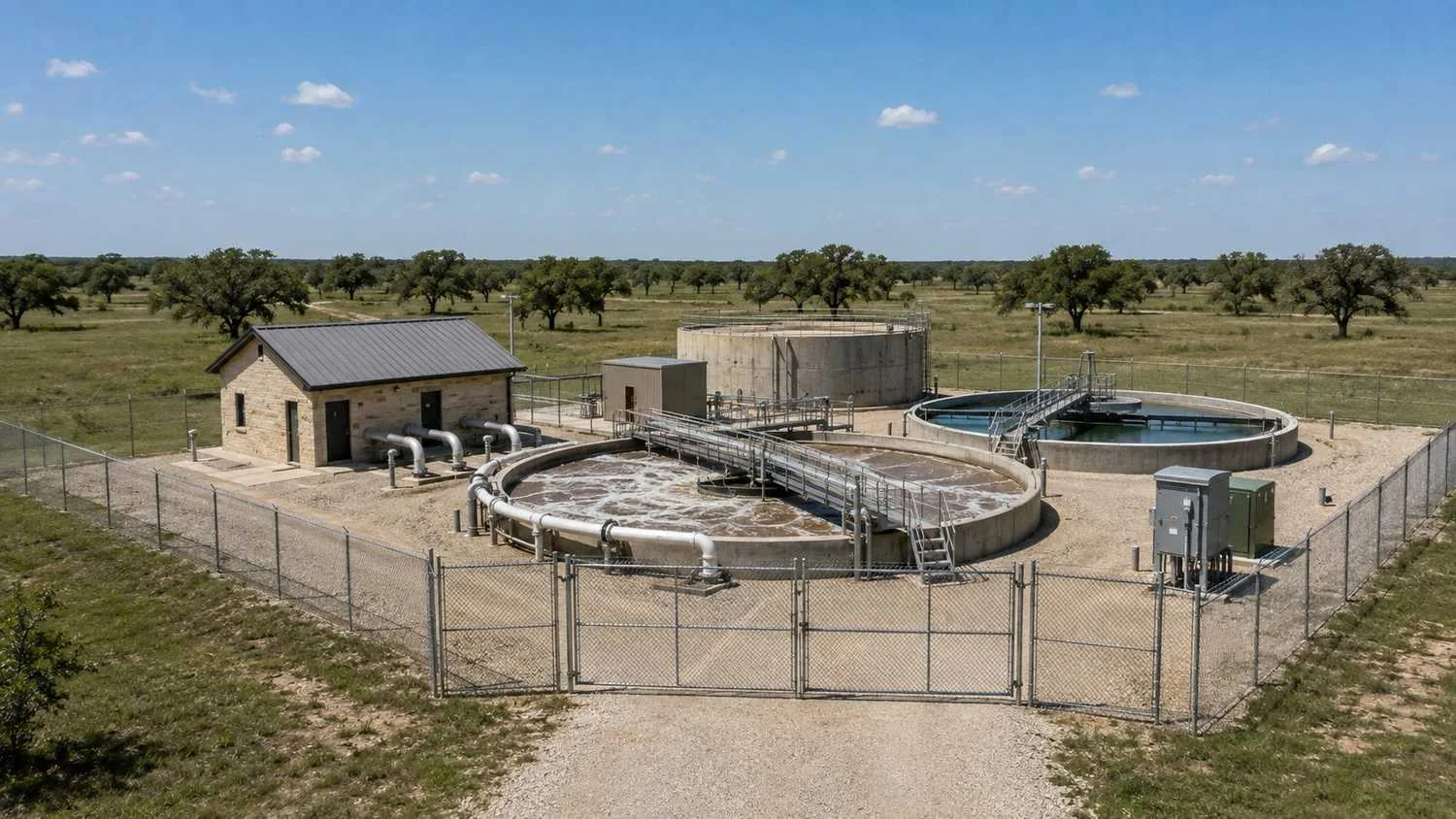
When the city will not serve on your schedule, the Fort Worth ETJ wastewater options are an off-site extension on the city's terms, a private plant under a TCEQ permit, a municipal utility district, and reuse built on one of those. Also check the 2025 change to Fort Worth's ETJ release rules before you plan around leaving the ETJ.
Does ETJ status mean Fort Worth will serve the land?
No. An extraterritorial jurisdiction gives a city certain authority over unincorporated land near its limits, such as subdivision rules. It does not make the land part of the city or entitle it to city services.
Fort Worth sets its own terms for service. Under the city's 2023 annexation policy and program, an owner in the ETJ who requests city water or sewer must agree to connect to both. The owner must also petition for annexation, if state law allows it, or enter a pre-annexation agreement. The City Council may approve or deny either.
Can Fort Worth annex the land, and should you count on it?
Do not count on it without an agreement. House Bill 347, effective May 24, 2019, made annexation consent-based for cities in every county. Annexation now comes from the owners' request or another consent process, not the city's own initiative.
In practice, annexation and service are negotiated together, often with the developer paying for infrastructure the city would otherwise build. Price those terms during due diligence like any other infrastructure cost.
What changed for leaving Fort Worth's ETJ?
Since 2023, owners can petition out of an ETJ, and since September 1, 2025, Fort Worth's ETJ has narrower limits on who can. Senate Bill 2038 added Local Government Code Chapter 42, Subchapter D, effective September 1, 2023. Under it:
- the owners of a majority in value of an area may petition for its release, with signatures gathered within 180 days;
- a valid petition requires the city to release the area immediately;
- if the city does not act by the later of the 45th day or its next meeting after the 30th day, the area is released by operation of law;
- a released area cannot be put back into the ETJ or the city unless its owners ask.
House Bill 2512 amended §42.101 for a city in four or more counties, one of which has 2.1 million people or more and borders a county of 2.6 million or more. The Senate Research Center's analysis says the bill answers Fort Worth's concerns. In that ETJ, a petition cannot release:
- land under an active development agreement with the city under Local Government Code §212.172;
- a lot under 12 acres, unless it is included with other land in the petition;
- a single lot in a platted subdivision of 25 or more lots.
It applies to petitions filed on or after September 1, 2025, and makes the same change for release by election. Release does not bring sewer. It takes the land out of the city's ETJ rules, including the district consent rule below, and it can make city service harder later, since Fort Worth ties ETJ service to annexation.
What should you ask the city before closing?
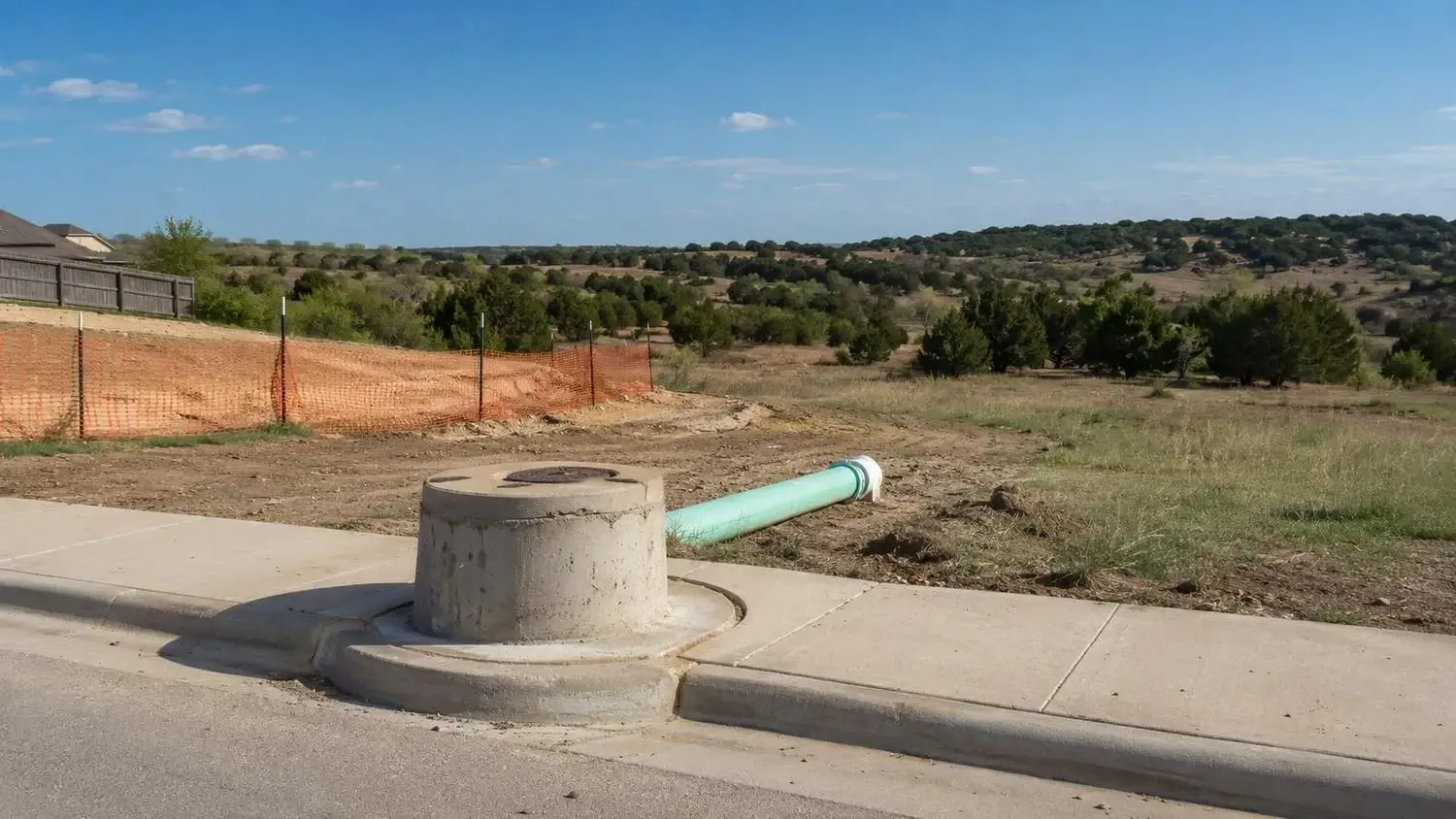
Ask in writing, early enough that the answer can still change the deal. Describe the development program and ask for the nearest connection point with capacity, the condition of the lines in between, and the city's position on annexation or a pre-annexation agreement for that tract.
Expect one of three answers: service is available, service is possible under an agreement with infrastructure costs, or service is not planned on your timeline. The third means planning private infrastructure now.
What does an off-site sewer extension involve?
A route, a grade and easements, each with its own cost and schedule risk. Long gravity runs in rolling terrain can mean deep trunk lines. Where gravity fails, a lift station and force main take over, and someone must own and run them. Map the route and the parcels it crosses during feasibility, and start easement talks alongside design.
When does a private plant make sense?
When an extension is too slow or too costly, and the site has either a stream or the land for disposal. A TPDES permit allows a discharge to a stream that can take it. A Texas Land Application Permit applies effluent to land, and that land comes out of lot yield.
The permit holder must employ or contract licensed operators under 30 TAC §30.350. Decide who owns and runs the plant for its full life, well past the developer's sellout, which is why private plants and districts so often go together.
How does a municipal utility district fit, and does Fort Worth have to consent?
A district can own the plant, issue bonds and tax property in it, but in the ETJ it starts with the city's consent. TCEQ's general guide to water districts (GI-043) explains that a district is created by TCEQ or a county under general law, or by the Legislature under special law, and that tax-backed bonds need voter approval.
For a TCEQ creation, 30 TAC §293.11(a)(2) requires the consent of any city whose ETJ the district is in. If the city refuses, the petitioners must show they followed Local Government Code §42.042. Land outside every city's limits and ETJ is not subject to that consent.
Water Code §54.016, as quoted in a TCEQ executive director filing from April 2026, sets that fallback:
- if the city does not consent within 90 days of a written request, the owners may petition it for the water or sewer service;
- if no agreement is signed within 120 days of that petition, the failure counts as authorization;
- TCEQ may then allow the district if the city cannot reasonably serve, or has not committed to start the facilities within two years and finish them within four and a half.
TCEQ's MUD creation checklist (form TCEQ-20380) adds a market study, a preliminary plan and an engineering report that includes correspondence with utilities within two miles.
Where does reclaimed water fit?
As part of a private plant strategy, not a replacement for its permit. Common area irrigation can take part of the effluent and cut potable demand. But under 30 TAC §210.2(e), a producer of reclaimed water still needs a TPDES permit, a TLAP or a Chapter 321, Subchapter P authorization before it builds the plant. Design reuse into the plant from the start.
Before you close on a Fort Worth ETJ tract, check these. Every answer should be yes:
- Has the city answered your service request in writing?
- If the city will serve, are the annexation or pre-annexation terms priced?
- If you are considering release, have you checked HB 2512's exclusions for your tract?
- Is the extension route mapped, with the parcels that need easements?
- Have you compared a TPDES discharge and a land application permit for the site?
- Is the long-term owner and operator of any private plant decided?
- If a district is in the plan, is the consent request scheduled?
Any no belongs on the agenda with your engineer and land use counsel before closing.
This post is general education on Texas statutes, TCEQ rules and Fort Worth's published policy as of October 2026. It is not legal advice; confirm the current law and city policy with counsel and your engineer.
Frequently asked questions
Does being in Fort Worth's ETJ mean the city must serve my land?
No. The city's policy ties ETJ water and sewer service to connecting to both and to annexation or a pre-annexation agreement, which the council may deny.
We're evaluating a large tract in Fort Worth's ETJ and the city has no plans to serve it. Is the land still developable?
Usually, with private infrastructure: a permitted plant, often with a district to own and fund it. Put the capital, the land the disposal takes and the schedule into the price you offer.
I own an eight-acre lot in Fort Worth's ETJ. Can I petition to have it released?
Not on its own, for a petition filed on or after September 1, 2025. HB 2512 bars release of a lot under 12 acres in that ETJ unless it is included with other land in the petition. Land under an active development agreement cannot be released either.
Does Fort Worth have to consent to a MUD in its ETJ?
TCEQ requires the city's consent for a district in its ETJ. If the city refuses or does not answer, Water Code §54.016 sets a petition process and a path back to TCEQ.
Related resources
- Dallas Subdivision Wastewater Planning: When City Sewer Isn’t an Option in ETJ Growth Areas
- Building a Private WWTP in Texas: What Developers Need to Know Before They Commit
- How to Evaluate Wastewater Utility Options Before You Close on Land (Connect, Build, or Wait)
- Water Supply Planning for Master Planned Communities in Tarrant County: What Developers Get Wrong
Weighing wastewater for a tract in Fort Worth's ETJ?
We confirm what the city will and will not serve, then compare an extension, a private plant and a district before you close.
We specialize in:
- Site feasibility and due diligence
- Off-site sewer extension, lift station and force main design
- Wastewater treatment plant design and TCEQ permitting
- Land application and reuse system design
- Engineering for MUD creation and district facilities
- Construction administration
Modern Engineering Solutions, McKinney, Texas. Contact: (214) 833-6748 or mod-eng.com
Talk to an engineer
Tell us about your project
An engineer reads it
Not a salesperson. Someone who can tell you whether the pathway is real.
You get a first answer
Your options, the agencies involved and the questions that decide cost and schedule.
You decide
No commitment to have the first call.
Prefer the phone? (214) 833-6748