
Blog
Designing Water Systems for Arizona Battery Energy Storage Facilities
Arizona BESS water system design starts with fire flow, onsite storage, hydrants, runoff control and the right fire code official, before the layout is fixed.
Quick answer
An Arizona BESS water system is sized for fire, not for daily use. A battery energy storage site uses little water in operation, but the fire code official can require hydrants, a sustained fire flow, onsite storage and runoff control before issuing a permit. On a remote site with no usable main, that means a tank, a fire pump and a way to refill it.
Settle the fire protection basis with the authority having jurisdiction (AHJ) first. The water system follows from it.
Why does a battery storage site need serious water infrastructure?
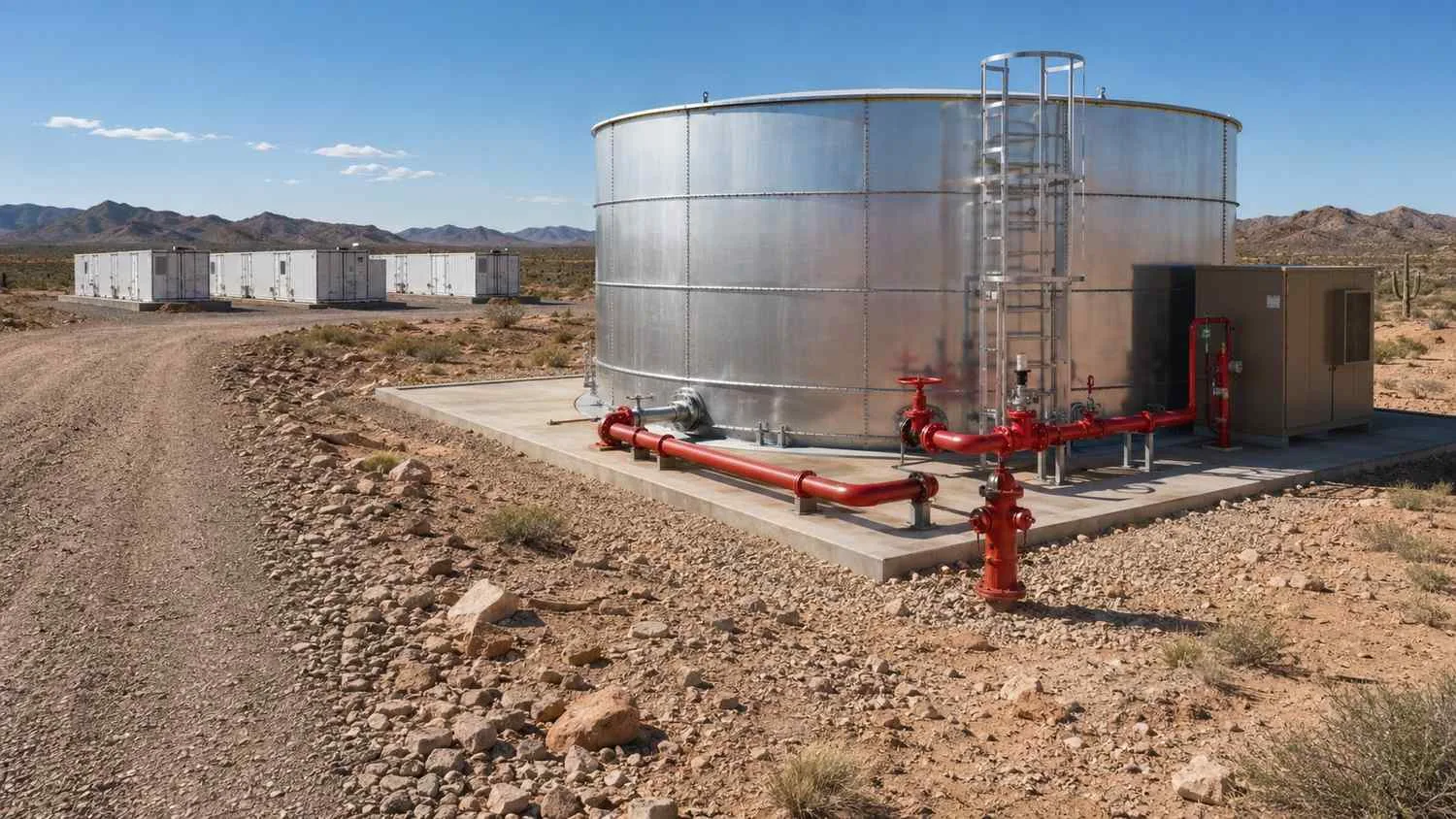
Because the demand comes from fire protection, not from operations. A BESS has no cooling towers or process water. Its water system lets firefighters cool enclosures and protect nearby equipment if a battery fails.
Lithium-ion cells can go into thermal runaway, where one failing cell heats its neighbors and the failure spreads. So the fire code official asks about water at the enclosures, at pressure, for a duration.
On a rural site next to a solar field or a substation, a municipal main may be miles away or too small for fire flow. The gap is closed on site.
Which codes set the fire protection requirements?
The adopted fire code and NFPA 855, as your AHJ reads them. NFPA 855, the Standard for the Installation of Stationary Energy Storage Systems, covers spacing between units, detection, suppression, explosion control, fire testing and emergency planning. Its current edition is 2026.
The edition that governs your project is the one your jurisdiction adopted, which may be older. Where no local fire code applies, Arizona's State Fire Code is the 2018 International Fire Code, adopted by rule in Arizona Administrative Code R4-36-201.
ICC's summary of the 2018 IFC energy storage rules shows that edition covers energy storage in its own Section 1206, written while NFPA 855 was still under development.
Fire test data for the specific product, usually a UL 9540A report, shapes how close units can sit and what the AHJ expects for suppression and water. Ask the battery supplier for it early.
Who is the authority having jurisdiction in Arizona?
It depends on where the site sits. Inside a city or town, it is usually the local fire marshal. In unincorporated areas it may be a fire district or the county.
Where no local fire code is adopted, the Office of the State Fire Marshal's plan review covers construction of all occupancy types except residential dwellings of fewer than five units.
Confirm the AHJ in writing and book a pre-application meeting before the fire protection design is final. Its reading of the code and its fire flow assumptions set your tank size.
How much fire water does a BESS site need?
There is no single number. The fire flow rate and duration come from the fire protection design and the AHJ's review. The inputs are storage capacity, battery chemistry, enclosure layout, spacing, the suppression approach and exposure to nearby structures.
Once the rate and duration are set, storage is arithmetic: NFPA's guidance on fire protection water tanks sizes capacity as the demand flow times the required duration. At 1,500 gallons per minute for two hours, the fire reserve is 180,000 gallons. At 2,000 gallons per minute for two hours, it is 240,000 gallons.
That water has to arrive at pressure at the farthest hydrant in the worst case. The tank, the pump and the piping are sized together for that condition.
What does an onsite storage system include?
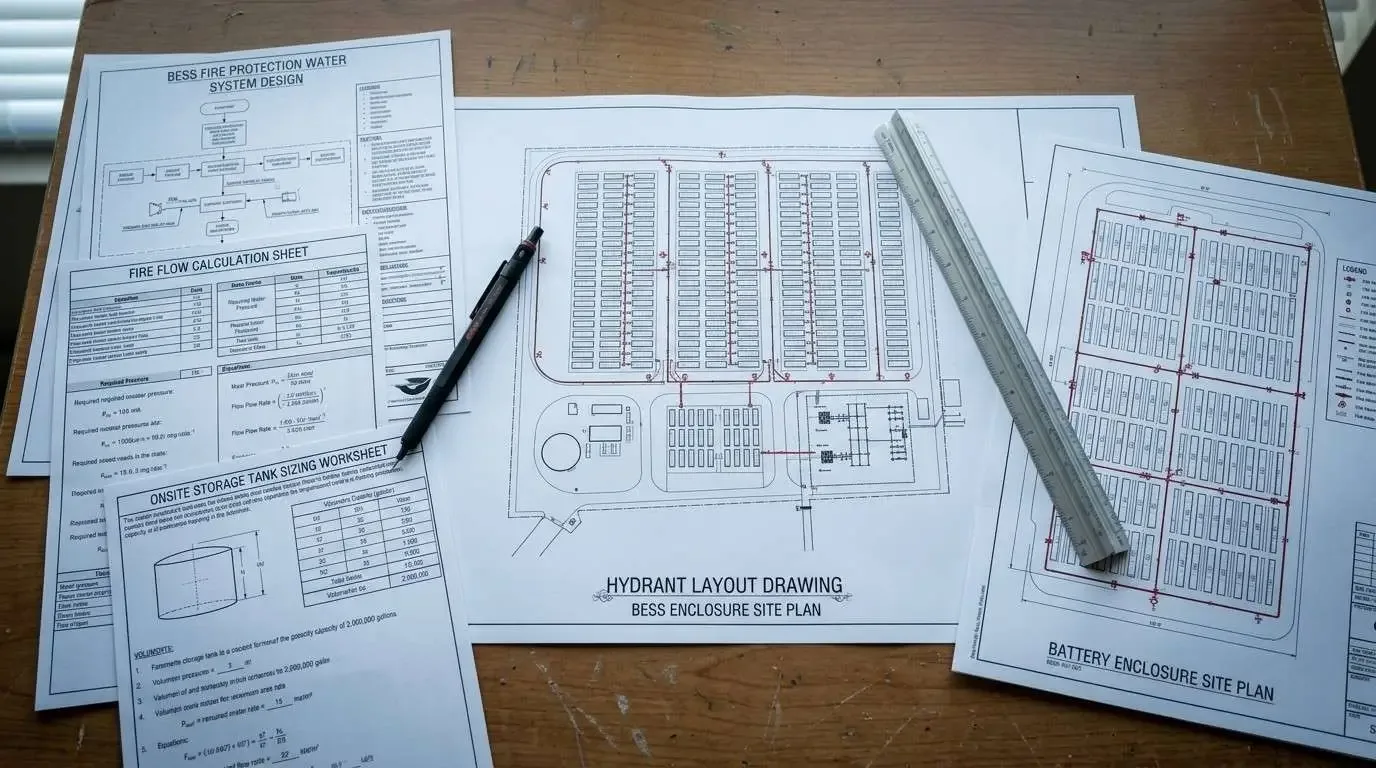
A tank, a fire pump and a main that reaches every hydrant. Tanks are often aboveground steel, or buried concrete or fiberglass. NFPA 22 covers the tanks, NFPA 20 the fire pumps and NFPA 24 the private fire service mains.
The tank needs a foundation sized for its full weight, a fill connection, and access for inspection and cleaning without taking fire protection out of service. Reserve that pad area early in the battery storage site civil layout, before the enclosure rows fill the site.
Plan the refill, too. After a fire, a test or maintenance, the tank must be refilled within a time the AHJ accepts. The common sources are an onsite well, a hauled-water agreement with a local utility, or a service line sized for the fill rate.
A new well starts with the Arizona Department of Water Resources. Under ADWR's well permitting, a Notice of Intent to Drill is filed before drilling outside an Active Management Area, and a non-exempt well inside one needs a well permit. Check likely yield first.
How should the site handle stormwater and fire water runoff?
Design for monsoon storms and for runoff from a fire, separately. The National Weather Service treats June 15 to September 30 as the monsoon season, with short, intense thunderstorms. Grading has to keep water away from enclosures and keep access roads passable.
Firefighting water that has touched battery units can carry contaminants. Whether and how much to contain is for the AHJ and your environmental reviewer to settle. A containment area also needs a way to drain clean stormwater in normal weather without releasing contaminated water in an emergency.
Construction that disturbs one acre or more, or is part of a larger plan that will, needs coverage under ADEQ's 2025 Construction General Permit (AZG2025-001) where it discharges to a protected surface water or a municipal storm sewer. Check separately whether any industrial stormwater permit applies once the facility operates.
What do access roads and hydrant coverage depend on?
Fire apparatus access and hydrant spacing come from the adopted fire code. In the International Fire Code, Section 503 covers fire apparatus access roads and Section 507.5 covers fire hydrant systems. Appendix C, on hydrant locations and distribution, applies only where the jurisdiction adopted it. Arizona's State Fire Code adopts it.
Where the State Fire Marshal reviews, its guidance sets a baseline. The State Fire Marshal's fire flow and hydrant guidance caps hydrant spacing at 500 feet, sets a 1,500 gpm minimum with two hours of storage for buildings other than one- and two-family homes, and applies NFPA 1142 without public water. Its fire department access guidance calls for roads at least 20 feet wide, 13 feet 6 inches clear, with an all-weather surface.
Gravel roads still need that width and the bearing capacity for fire apparatus. The hydrant layout drives the water distribution design, because the mains must deliver the required flow to adjacent hydrants at once without excessive pressure loss.
NFPA 855 calls for an emergency response plan. Rural departments may have little battery fire experience, so write it with them, showing the water supply, connection points and enclosure layout.
Is your site ready for a fire protection water design?
Any "no" is the next task before the layout is fixed.
- Is the AHJ confirmed in writing?
- Do you know which fire code and NFPA 855 editions it applies?
- Do you have the battery supplier's UL 9540A fire test report?
- Has the AHJ accepted a fire flow rate and duration?
- Is there a refill source with a known permit path?
- Has the AHJ weighed in on fire water runoff containment?
Take the "no" answers to your fire protection engineer and civil engineer together.
This article is general education from the public sources linked above. Adopted editions and agency practice change, and each AHJ makes the final call on its own sites.
Frequently asked questions
Which edition of NFPA 855 applies to my project?
The one your jurisdiction adopted or accepts, not necessarily the newest 2026 edition. Where the State Fire Code governs, the base rules are Section 1206 of the 2018 International Fire Code. Ask the AHJ.
Our Arizona BESS project is rural, with no municipal water service for several miles. What are our water supply options for fire protection?
Onsite storage with a fire pump is the usual base, refilled from an onsite well filed with ADWR, a hauled-water agreement with a local utility, or a long service line. Compare them during feasibility.
I'm developing a battery storage site on unincorporated county land in Arizona. How do I know whether the county, a fire district or the State Fire Marshal reviews our fire protection design?
Ask whether a fire district or the county has adopted a fire code that covers the parcel. If none applies, the Office of the State Fire Marshal reviews construction against the State Fire Code. Get it in writing.
Does the onsite fire water tank need an ADEQ drinking water permit?
Usually not on its own. Under EPA's definition of a public water system, the system provides water for human consumption to at least 15 connections or 25 people. A fire-only tank does not, but drinking water for staff is a separate question to confirm with ADEQ.
What permit does a restroom or operations building on septic need?
An on-site wastewater permit. ADEQ's Type 4 general aquifer protection permits cover small on-site systems, and many counties issue them under ADEQ's delegation to county agencies. Check which agency handles your county.
Related resources
- Water Scarcity Engineering in Arizona: How Developers Are Planning for a Drier Future
- ADEQ Permitting for Wastewater Systems in Arizona: What Developers Need to Know Before Breaking Ground
- Fire Flow Analysis: Engineering Solutions for Municipal Water Distribution Systems
- Water engineering in Arizona
Planning water for an Arizona BESS site?
We help energy developers turn the AHJ's fire protection basis into a water system the site can build, test and refill. MES is licensed in Arizona.
We specialize in:
- Fire protection water supply and onsite storage design
- Water distribution and hydrant layout
- Site civil design, grading and drainage
- Stormwater management and construction permit support
- Battery storage site civil and county permitting
- Construction administration
Modern Engineering Solutions, McKinney, Texas. Contact: (214) 833-6748 or mod-eng.com
Talk to an engineer
Tell us about your project
An engineer reads it
Not a salesperson. Someone who can tell you whether the pathway is real.
You get a first answer
Your options, the agencies involved and the questions that decide cost and schedule.
You decide
No commitment to have the first call.
Prefer the phone? (214) 833-6748