
Blog
Water Reuse in Florida: How the State’s Progressive Rules Are Shaping Infrastructure Design
Water reuse in Florida runs on FDEP's Chapter 62-610 rules, which set treatment, purple pipe, setback and storage limits that shape a site plan from the start.
Quick answer
Water reuse in Florida is governed mainly by FDEP's Chapter 62-610 rules, and they shape the site plan as much as the treatment plant. Public access reuse needs filtration and high-level disinfection. Purple pipe has its own color, labeling and separation rules. Storage ponds carry setbacks, and the system needs storage or a backup for wet weather. Reserve the space early.
Why does Florida push reuse over discharge?
Because state law now asks surface water dischargers to end nonbeneficial discharge. Under section 403.064(16), Florida Statutes, a domestic wastewater utility with a surface water discharge must submit for FDEP approval a plan for eliminating nonbeneficial surface water discharge by January 1, 2032. Some small and rural facilities are exempt.
The same subsection reaches new projects. FDEP may not approve a new or expanded surface water discharge unless the applicant's plan meets one of the statute's conditions.
The water supply side pulls the same way. Water management districts can require reclaimed water in place of part of a withdrawal. Our post on consumptive use permits and reclaimed water credits covers that side.
What treatment does public access reuse require?
Secondary treatment, filtration and high-level disinfection. Part III of Chapter 62-610 covers public access systems: residential lawns, parks, schools, golf courses and similar areas. Rule 62-610.460, F.A.C. requires filtration for suspended solids control and no more than 5.0 mg/L of suspended solids before disinfection.
The filter needs chemical feed facilities for coagulants or polymers. They may sit idle if the plant meets the limit without chemicals.
High-level disinfection is defined in Rule 62-600.440(6). Under Rule 62-600.440, F.A.C., over a 30-day period 75% of fecal coliform values must be below detection limits, and no single sample may exceed 25 per 100 mL.
Restricted access uses, such as some agricultural irrigation and rapid infiltration basins, fall under other parts of Chapter 62-610 with lower treatment levels. Confirm the part that fits your end use before you size the plant.
What are the purple pipe rules?
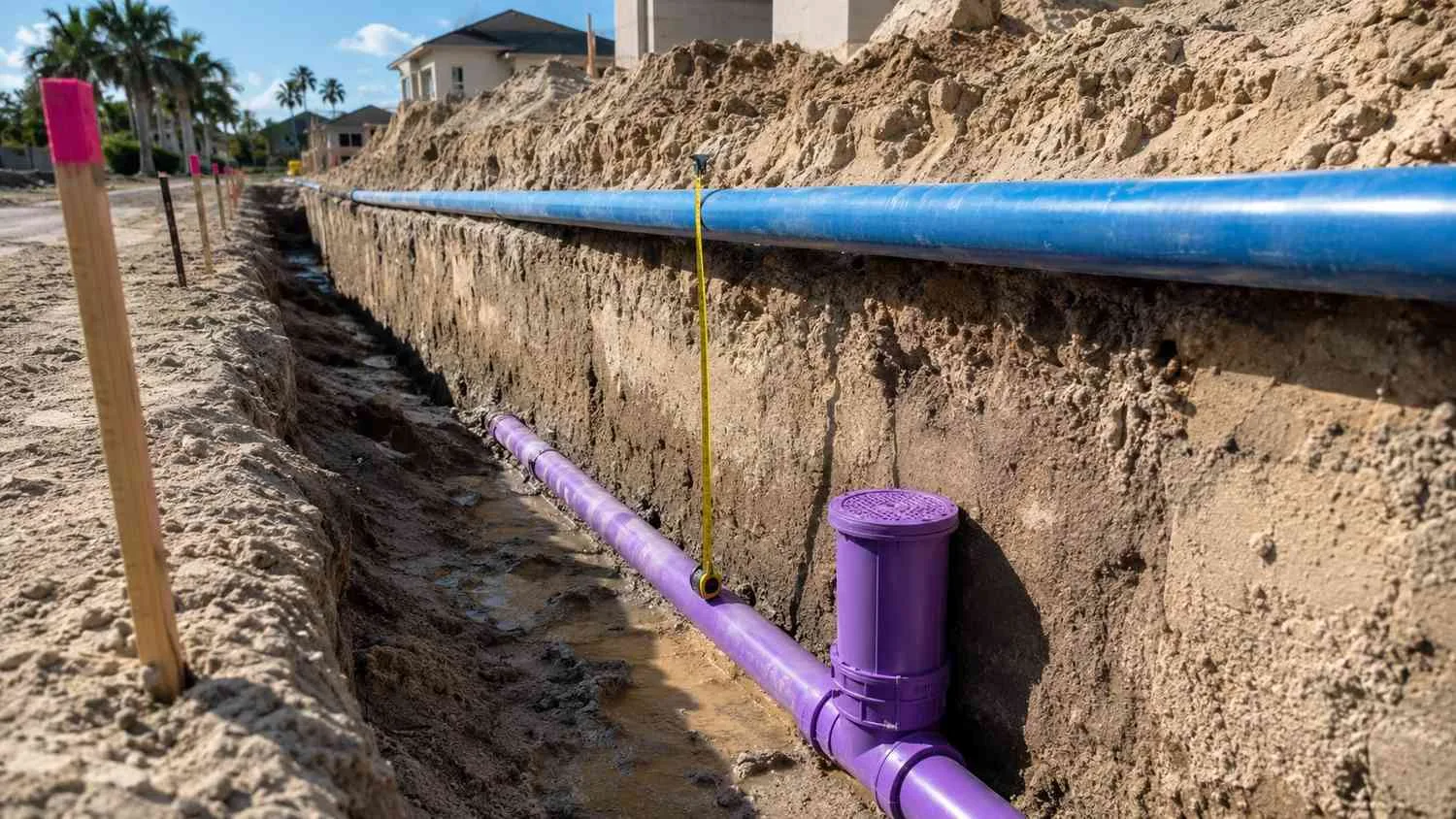
Color, labels and separation, all in Rule 62-610.469. Rule 62-610.469, F.A.C. sets the distribution system requirements.
- Color. Underground plastic reclaimed water pipe is Pantone Purple 522C. Metal and concrete pipe is colored or marked with purple as the predominant color. This applies to systems with permit applications filed on or after January 1, 1996. On private property it is recommended, not required.
- Labels. Valves and outlets carry a "Do not drink" warning in English and Spanish with the international symbol. Hose bibbs go in locked or labeled boxes.
- Separation. Keep 3 feet horizontal, outside to outside, from potable mains and sewers. Less is allowed if the reclaimed line sits at least 18 inches below the potable line, is encased in concrete, or has equivalent protection. These separations apply within rights-of-way and are recommended on the properties served. Crossings follow Chapter 62-604.
- Cross-connections. None are allowed, and the potable system needs an accepted cross-connection control and inspection program.
Separation is a corridor question. Three parallel pipes, plus storm and dry utilities, need trench room and easement width. Lay that out before the street sections are fixed.
What setbacks apply to reuse sites and storage ponds?
Mostly to potable water wells, and they are narrower than many people assume. Rule 62-610.471, F.A.C. sets them.
- 75 feet from the edge of the wetted area of a public access site to a potable water supply well.
- 75 feet from a reclaimed water transmission facility to a public water supply well or a potable surface water intake.
- 200 feet from an unlined storage pond to a potable water supply well or intake, reducible to no less than 75 feet with a demonstration in the engineering report.
- No setback to surface waters, developed areas or nonpotable wells.
- Low trajectory nozzles or similar aerosol controls within 100 feet of outdoor public eating, drinking and bathing facilities.
These setbacks apply to new or expanded facilities, not permit renewals. On a site with private wells, the storage pond location is often what moves.
How much storage does a reuse system need?
At least three days of the reuse flow that has no alternative outlet, plus a plan for wet weather. Under Rule 62-610.464, F.A.C., minimum system storage is three times the portion of average daily flow without another permitted reuse or disposal system.
The rule also requires system storage or a limited wet weather discharge authorization for wet weather. Florida's rainy season is when irrigation demand drops and plant flow does not.
A separate reject storage system holds water that misses the reclaimed standard. Its minimum is one day of flow, at the lesser of the plant's average daily design flow or the reuse system's permitted flow, unless another permitted system can take it.
Three days is a floor. A monthly water balance against real irrigation demand sets the working volume. Our post on sizing a reuse storage reservoir walks through that method in Texas terms.
What about potable reuse?
Florida now has rules for it. FDEP's Chapter 62-565, F.A.C., Potable Reuse, took effect February 26, 2025, under authority in section 403.064. It covers advanced treatment facilities and potable reuse systems for utilities. Most private developments will deal with non-potable reuse under Chapter 62-610.
Is your Florida site plan ready for reclaimed water?
If any answer is no, the reuse system may not fit the plan you have.
- Do you know which part of Chapter 62-610 your end use falls under?
- Does the treatment train include filtration and high-level disinfection for public access uses?
- Have you mapped every potable well within 200 feet of a proposed storage pond?
- Do the street sections hold 3 feet of separation between reclaimed, potable and sewer lines?
- Have you sized storage from a monthly water balance, not just the three-day minimum?
- Is there a reject storage system or another permitted outlet for off-spec water?
- Do you have a wet weather plan: storage, a backup system or a wet weather discharge authorization?
This article is general education on public Florida rules as of October 2026. FDEP decides each permit on the engineering report and site conditions, and local utilities can add their own standards.
Frequently asked questions
What is Chapter 62-610?
FDEP's rule for reuse of reclaimed water and land application. It sets treatment, storage, setback, distribution and monitoring requirements by type of use.
Is purple pipe required inside homes and private lots?
Not under Rule 62-610.469. Color coding on private property is recommended but not required. Local utilities may require it.
Can an existing lake or stormwater pond be used for reclaimed water storage?
Rule 62-610.464 allows existing or proposed lakes or ponds for storage if FDEP rules are met and stormwater function is not impaired.
I'm developing a golf community in Florida with private wells on neighboring lots. What setback will drive our storage pond location?
Start with 200 feet from an unlined storage pond to any potable water supply well. The engineering report can justify less, but not below 75 feet. A lined pond or another site may be simpler.
Our small plant discharges to a creek and the county wants us to look at reuse. Where do we start?
Start with demand: who could take the water, how much and in which months. Then check whether the plant can meet filtration and high-level disinfection. Then size storage and a wet weather outlet.
Related resources
- FDEP Permitting for Wastewater Systems in Florida: A Practical Guide for Developers
- Florida Numeric Nutrient Criteria: How the State's Nutrient Limits Reshape Treatment Plant Sizing Versus Texas or Colorado
- Florida's Red Tide and Water Quality Crisis: What It Means for Coastal Wastewater Engineers
- Water engineering in Florida
Planning reclaimed water on a Florida project?
We lay out the reuse system with the site plan: treatment, storage, setbacks and purple pipe corridors. Tell us about your project.
We specialize in:
- Reclaimed water distribution and storage design
- Wastewater treatment plant planning and design
- Water balance and irrigation demand analysis
- FDEP wastewater and reuse permit applications
- Site civil engineering for land development
- Construction administration
Modern Engineering Solutions, McKinney, Texas. Contact: (214) 833-6748 or mod-eng.com
Talk to an engineer
Tell us about your project
An engineer reads it
Not a salesperson. Someone who can tell you whether the pathway is real.
You get a first answer
Your options, the agencies involved and the questions that decide cost and schedule.
You decide
No commitment to have the first call.
Prefer the phone? (214) 833-6748