
Blog
Water Scarcity Engineering in Arizona: How Developers Are Planning for a Drier Future
Water scarcity engineering in Arizona starts with a 100-year assured water supply, the Phoenix groundwater limits, Colorado River shortage and reclaimed water.
Quick answer
Water scarcity engineering in Arizona starts with proving water before you plan lots. Inside an Active Management Area, a subdivision needs a 100-year assured water supply before plat approval or a public report. Groundwater alone no longer supports new determinations in much of the Phoenix area, and Colorado River deliveries are in shortage. Reclaimed water and water service from a designated provider carry more of the load.
What does Arizona require before you can sell subdivided lots?
Inside an Active Management Area (AMA), a certificate of assured water supply or a commitment from a designated provider. Under A.R.S. §45-576, a subdivider must get a certificate from the Arizona Department of Water Resources (ADWR) before presenting the plat. The alternative is a written service commitment from a city, town or private water company that ADWR has designated as having an assured water supply.
The certificate is the gate for everything after it. A city, town or county may not approve the plat without one of the two. The Arizona Department of Real Estate may not issue the public report that lets you sell lots.
The standard is long. An assured water supply means water continuously available for at least 100 years, of adequate quality, consistent with the AMA's management plan and goal, and backed by the financial capability to build the facilities.
Where are the Active Management Areas?
Around the state's largest groundwater users, and the list is growing. The Groundwater Management Act of 1980 created the first AMAs, including Phoenix, Tucson, Prescott and Pinal. The Act also lets the ADWR director designate new ones.
In 2024, ADWR designated the Willcox Groundwater Basin an AMA, announced in a December 20, 2024 release from the Governor's office. Check ADWR's current AMA list for any site outside the metro areas.
Can you still build on groundwater in the Phoenix area?
Not on a new groundwater-only assured water supply determination in the modeled Phoenix AMA sub-basins. In June 2023 the Governor's office released ADWR's 100-year Phoenix AMA groundwater model. It projected that about 4% of groundwater demand in the region would go unmet without further action.
ADWR's Phoenix AMA groundwater supply updates page says the model, as updated in 2024, does not support issuing assured water supply determinations based on groundwater. Certificates already issued are not affected.
That shifts new projects toward designated providers and new supplies. A site served by a city, town or water company with its own designation does not need its own groundwater certificate. A site that would have relied on its own wells needs another path.
One new path is the Ag-to-Urban program, passed in 2025. ADWR issues Groundwater Savings Credits when high water use farmland converts to housing, and a developer can include them in a certificate application. The Governor's office announced the first Groundwater Savings Credits in December 2025.
How does the Colorado River shortage affect a project?
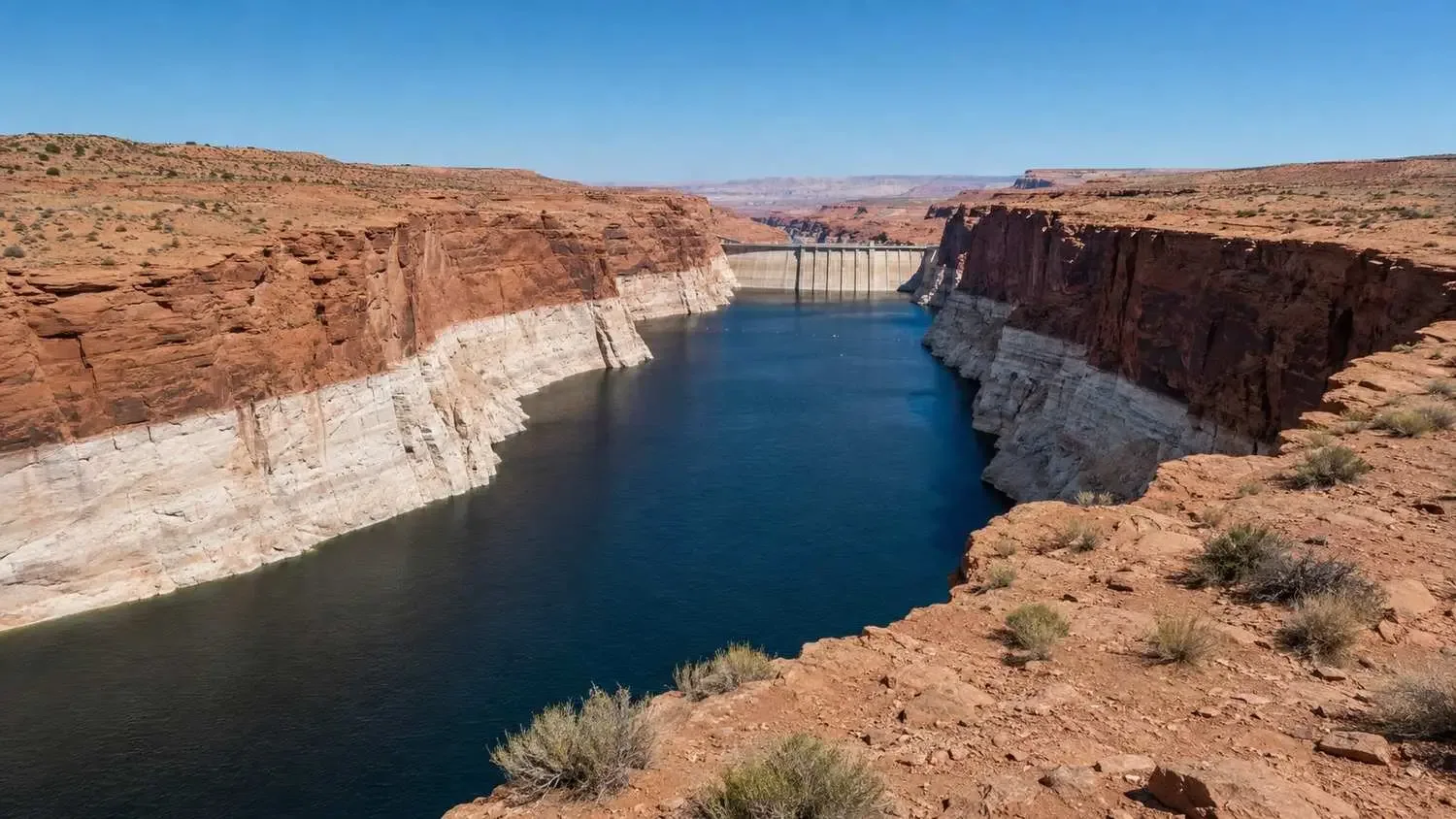
Indirectly, through the utility that serves you. Reclamation's August 2025 24-Month Study projected Lake Mead below 1,075 feet on January 1, 2026. Under the 2007 Interim Guidelines, that puts Lake Mead in a Level 1 (Tier 1) shortage condition for calendar year 2026.
For a developer, the question is the provider's portfolio. Ask how much of its supply is Colorado River water, what it has banked or stored underground, and what its drought plan says about new connections.
What changes outside the Active Management Areas?
The test becomes adequacy and disclosure, unless the county has made it mandatory. Under A.R.S. §45-108, a subdivider outside an AMA submits water supply plans to ADWR, which reports whether the supply is adequate for 100 years.
If ADWR finds the supply inadequate, the subdivision can still go forward in most places. But under A.R.S. §32-2181(F), the promotional material and sales contracts must display ADWR's report. A county can adopt a mandatory adequacy rule under A.R.S. §11-823, and its cities and towns then must follow it too.
Disclosure is not supply. A new well that tests well at startup still has to hold up over the life of the project. Water level trends in nearby wells tell you more than one pump test.
How does reclaimed water fit into an Arizona water plan?
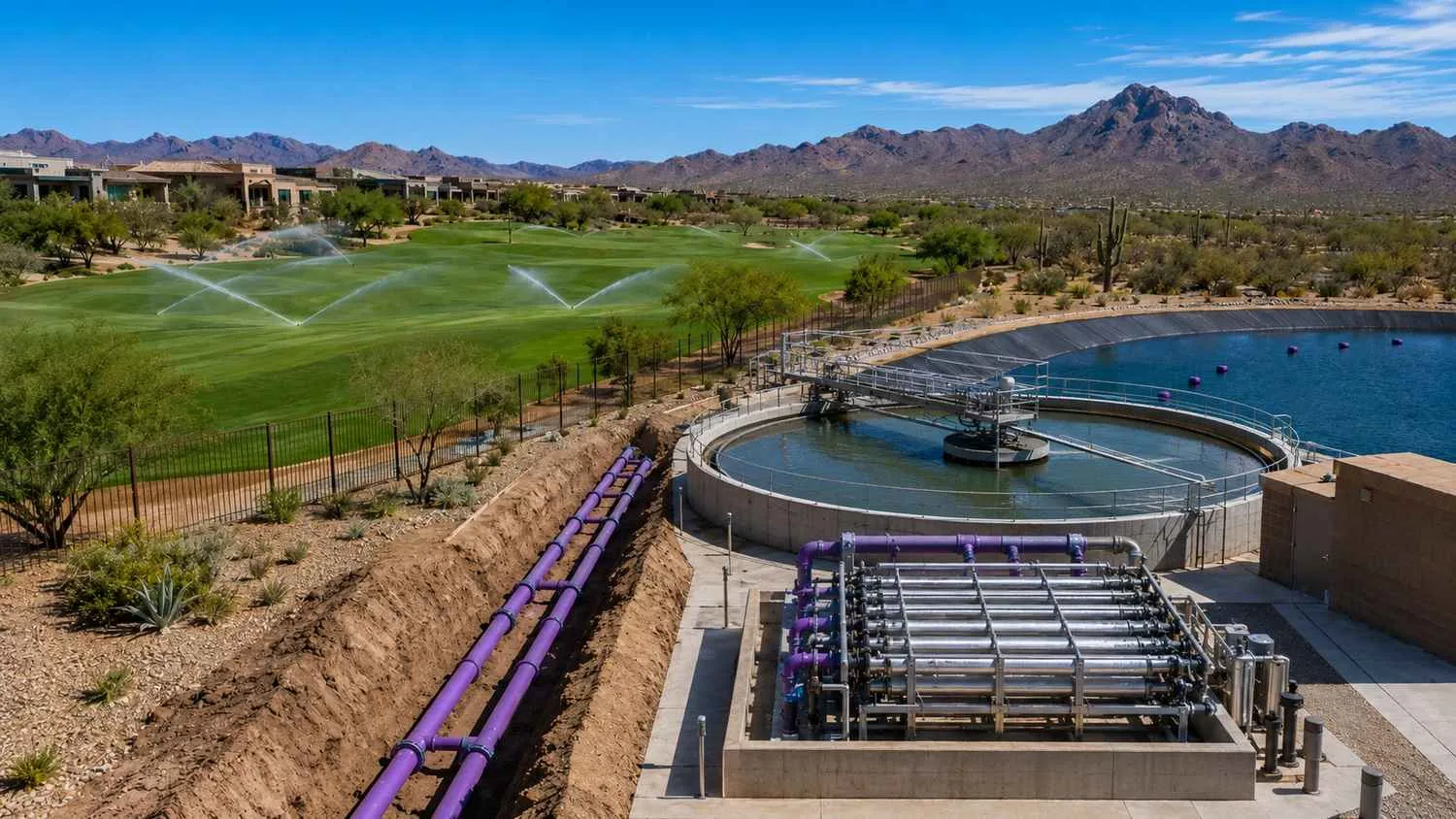
It is the one supply that grows with the project. Every new home adds wastewater flow. Treated to the right class, it can serve landscape irrigation, golf, cooling and other non-potable demand that would otherwise draw on potable supply.
ADEQ sets the classes. Class A+ under A.A.C. R18-11-303 requires secondary treatment, filtration, nitrogen removal and disinfection. It sets a filtered turbidity of 2 NTU or less as a 24-hour average, no detectable fecal coliform in four of the last seven daily samples, and total nitrogen under 10 mg/L as a five-sample geometric mean.
Class A+ is not required for every direct reuse, but it may be used for any of them. Designing for it keeps the most end uses open. ADEQ permits the treatment plant itself separately.
Why is the wastewater plant a water supply decision in Arizona?
Because the treatment level decides whether the effluent is a disposal problem or a supply. A plant that only meets disposal standards sends its water away. A plant built for Class A+ creates water the project can put back to use.
That choice belongs in the first water budget, not after entitlement. A monthly water balance shows how much reclaimed water the project makes, where it can go and how much potable supply is left to prove.
Is your Arizona site ready for a water supply decision?
If any answer is no, the water supply is still a risk on this site.
- Is the site inside an AMA, including any designated since 2024?
- Is it served by a designated provider that will commit to serve the project in writing?
- If not, does a non-groundwater supply exist for a certificate, such as credits, renewable supply or a provider extension?
- Outside an AMA, have you checked ADWR's adequacy history for the area and the county's adequacy rule?
- Have you reviewed water level trends for wells near the site?
- Have you planned the wastewater plant's treatment class with reuse in mind?
This article is general education on public Arizona statutes, rules and agency releases as of October 2026. ADWR and ADEQ decide each application, and water law questions also need a water rights attorney.
Frequently asked questions
What is a certificate of assured water supply?
An ADWR certificate showing a subdivision has water for at least 100 years, as A.R.S. §45-576 and ADWR's rules require inside an AMA.
Do I need a certificate if a city will serve my project?
Not if the city is a designated provider and gives a written commitment of service. That commitment takes the certificate's place for plat approval and the public report.
Does Arizona allow potable reuse?
Yes, for utilities. ADEQ's Advanced Water Purification rules, its direct potable reuse program, took effect March 4, 2025. Most private developments will use reclaimed water for non-potable uses under ADEQ's reclaimed water rules.
We're looking at farmland in the West Valley for a subdivision and the seller says the wells are strong. Is that enough for an assured water supply?
Probably not. New determinations based on groundwater are not supported in the modeled Phoenix AMA sub-basins. Look at service from a designated provider or credits under the Ag-to-Urban program before you close.
I'm a developer in rural Cochise County planning lots on new wells. What water rules apply to us?
Check first whether the site is inside the Willcox AMA, designated in 2024. If it is, assured water supply rules apply. If not, ADWR's adequacy report applies, and any inadequate finding must be shown to buyers unless the county has made adequacy mandatory.
Related resources
- ADEQ Permitting for Wastewater Systems in Arizona: What Developers Need to Know Before Breaking Ground
- Designing Water Systems for Arizona Battery Energy Storage Facilities
- Plan of Reuse vs. Direct Discharge: Strategic Wastewater Disposal Decisions in Colorado
- Water engineering in Arizona
Proving water for an Arizona development?
We work through the supply options, build the water balance and design the water and reuse systems behind your application. Tell us about your site.
We specialize in:
- Water supply and wastewater due diligence
- Water balance and demand analysis
- Water distribution and storage design
- Wastewater treatment and reclaimed water system design
- Site civil engineering for land development
- Construction administration
Modern Engineering Solutions, McKinney, Texas. Contact: (214) 833-6748 or mod-eng.com
Talk to an engineer
Tell us about your project
An engineer reads it
Not a salesperson. Someone who can tell you whether the pathway is real.
You get a first answer
Your options, the agencies involved and the questions that decide cost and schedule.
You decide
No commitment to have the first call.
Prefer the phone? (214) 833-6748