
Blog
ADEQ Permitting for Wastewater Systems in Arizona: What Developers Need to Know Before Breaking Ground
ADEQ wastewater permitting in Arizona turns on design flow and where sewage goes, from 4.01 sewer permits to individual APPs and reclaimed water permits.
Quick answer
ADEQ wastewater permitting in Arizona depends on where your sewage goes, and the core permit is an Aquifer Protection Permit (APP), general or individual. A sewer extension (the 4.01 permit) or an onsite system under 24,000 gallons per day runs on a general permit with a construction authorization before you dig, while a central or larger plant needs an individual APP.
An interim state law stretches general permits to some onsite systems under 75,000 gallons per day, and reclaimed water reuse adds permits of its own.
Which ADEQ permit does an Arizona wastewater system need?
It depends on whether you treat wastewater on your own site or send it to someone else's plant.
A.R.S. § 49-241 requires an Aquifer Protection Permit (APP) for a facility that discharges, unless an exemption applies, and its list includes sewage treatment facilities and on-site wastewater facilities. The permit is either general or individual:
- Sewer extension. A manhole, a lift station or force main serving more than one dwelling, or pipe downstream of the point where design flow reaches 3,000 gallons per day triggers the 4.01 general permit for sewage collection systems (A.A.C. R18-9-E301).
- Onsite system. Under R18-9-A309(A)(10), a combined design flow under 3,000 gallons per day uses the 4.02 to 4.22 general permits, and 3,000 to less than 24,000 uses 4.23. The rule sends 24,000 or more to an individual permit, but until ADEQ's revised onsite rules take effect, A.R.S. § 49-245(E) lets a facility from 3,000 to under 75,000 use a general permit if its installer and service provider are certified by the technology's manufacturer. ADEQ was still revising those rules in 2026, so check whether they have taken effect.
- Treatment plant. A plant that does not fit a Type 4 general permit needs an individual APP.
- Discharge to a water of the United States. Add an AZPDES permit under A.R.S. § 49-255.01.
Who issues the approval varies by county. Maricopa County's construction permitting guidance says ADEQ delegated water and sewer infrastructure permitting there to the county, while ADEQ keeps the APPs for central treatment plants. Not sure you need an APP at all? R18-9-106 lets you request a written determination of applicability, and gives ADEQ 45 days to answer.
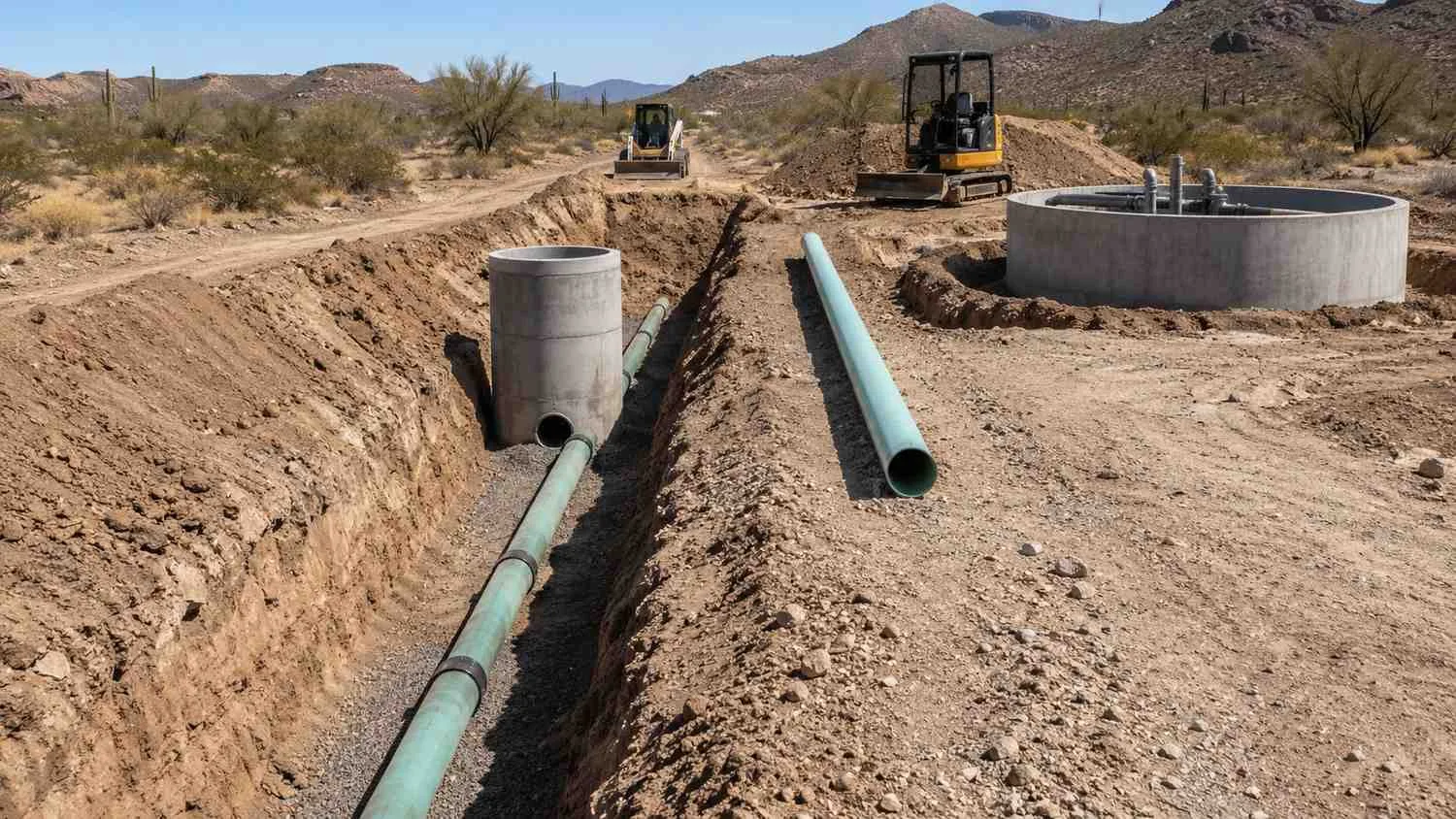
Should you connect to public sewer or install a private treatment system?
Connect if the utility has the capacity and will sign for it. A sewer extension runs on a general permit, and R18-9-109 exempts general permits from public participation. An individual plant permit goes to public notice, with 30 days for written comments.
The capacity check is built into the 4.01 notice. Under R18-9-E301(C), the owner of the plant that will treat your flow signs an ADEQ form stating that the added volume will not exceed the flow or effluent limits in its permit, and the owner of any separately owned downstream sewer signs too.
A line on a utility map is not an answer. Ask the utility in writing, and settle it during site feasibility and due diligence, before you close on the land.
If public sewer is out of reach, design flow sets the permit path, and then you are choosing between a package plant and a custom-designed plant.
What does ADEQ need in an Aquifer Protection Permit application?
The application must prove two things. The plant uses the best available demonstrated control technology (BADCT) and will not cause an aquifer water quality standard to be violated at the point of compliance.
R18-9-A201 also asks for evidence of zoning compliance and, for a sewage treatment plant, documentation that it conforms with the Certified Areawide Water Quality Management Plan. Arizona's rule definitions in R18-5-301 tie that plan to Section 208 of the Clean Water Act, so a new plant missing from the 208 plan is a problem to fix before you submit.
The technical package under R18-9-A202 covers a map of wells within a half mile, a site plan, design documents, the BADCT case, points of compliance, a contingency plan, a hydrogeologic study, proposed limits and monitoring, and closure.
For a new plant, R18-9-B204 requires secondary treatment (BOD5 under 30 mg/l or CBOD5 under 25, and TSS under 30 mg/l, as 30-day averages), total nitrogen under 10 mg/l (five-month rolling geometric mean), and stricter pathogen limits at 250,000 gallons per day and up, where seasonal high groundwater is within 20 feet, or where karstic or fractured bedrock reaches the surface.
Site the plant early. R18-9-B201 sets setbacks from noise and odor producing components to the nearest property line of an adjacent dwelling, workplace or private property. At 24,000 to less than 100,000 gallons per day, that is 350 feet, or 50 feet with full noise, odor and aesthetic controls.
On schedule, A.R.S. § 41-1075 lets the agency make one written request covering all the information it needs during substantive review, more only if you agree in writing, and the clock stops until you answer. A complete first submittal is your biggest lever, and R18-9-A201(D) gives you a pre-application conference on request.
How does reclaimed water change the permit path?
Reuse adds its own permit layer. The plant delivers reclaimed water only as its individual APP allows, and every reuse needs recycled water permit coverage for its class.
That split comes from R18-9-B702. Type 2 recycled water general permits cover direct reuse by class, A+ through C (R18-9-B704 to R18-9-B708).
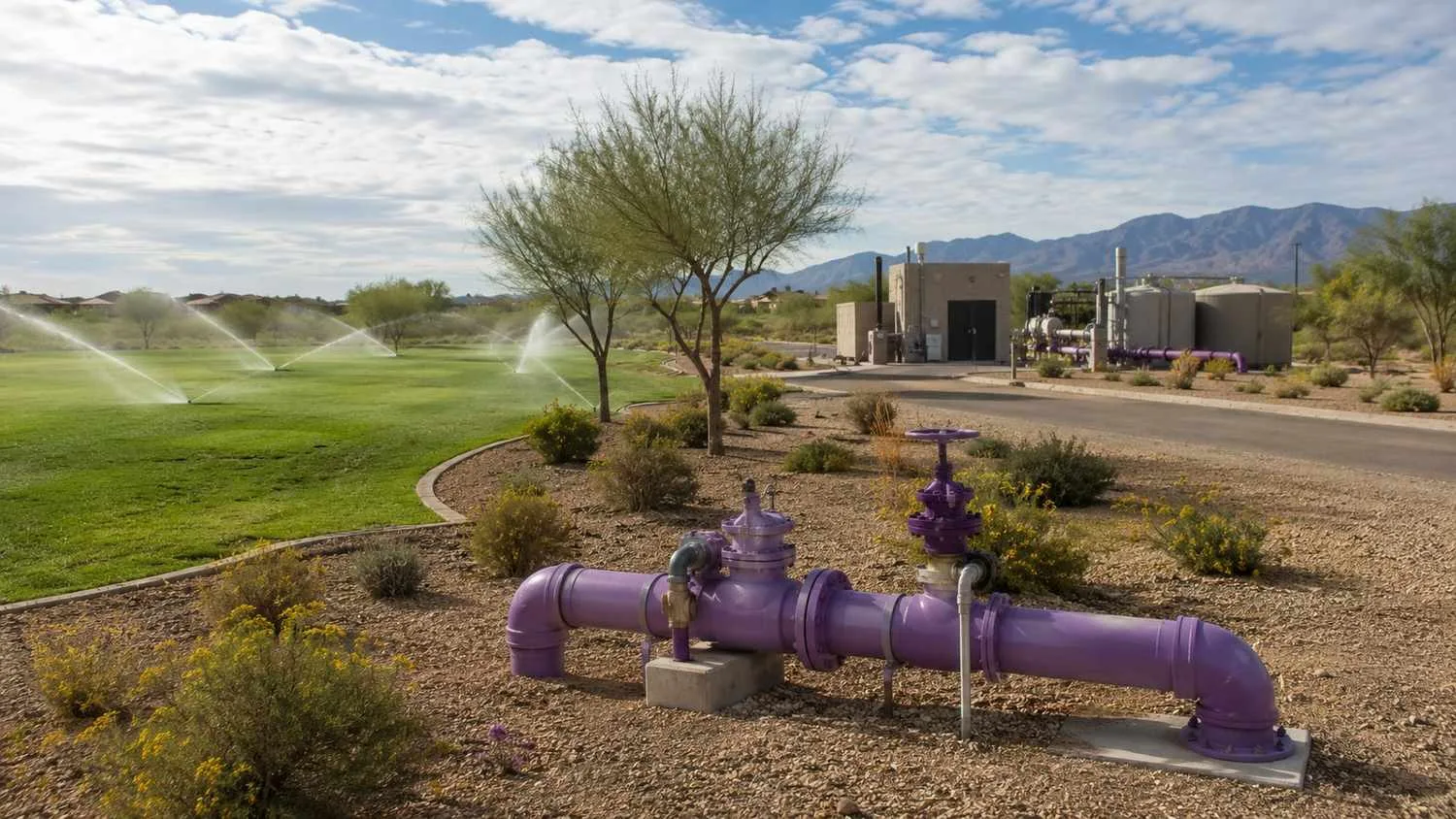
The end use sets the class. Under 18 A.A.C. 11, Article 3 and its Table A, Class B is secondary treatment and disinfection, Class A adds filtration, and the plus classes add nitrogen removal. Residential and open access landscape irrigation need Class A; golf course irrigation needs Class B or better.
Pick the end uses before you size the plant. If common area irrigation is likely, design for Class A filtration from day one rather than retrofit it. R18-9-B702 also limits runoff from reuse sites, requires purple pipe or tape on lines 8 inches and smaller, and keeps pipelines 50 feet from drinking water wells unless built to its alternate standard.
What construction and compliance steps follow the permit?
You build to the authorization, prove what you built, and then carry the monitoring for the life of the facility.
Under R18-9-A301, a 4.01 sewer cannot be built before its Construction Authorization or carry flow before its Discharge Authorization. That second step needs a sealed Engineer's Certificate of Completion and passing field tests under R18-9-E301(E).
An individual APP carries alert levels, limits and monitoring for as long as the plant runs. Under R18-9-A211, raising the design flow of a plant permitted at 500,000 gallons per day or less by 10 percent or more is a significant amendment. Permit future phases up front, start amendments early, or consider multiple small package plants across a phased development.
Is your project ready for an ADEQ submittal?
If you can answer yes to all six, start the package. Any no is your next task.
- Do you know each phase's design flow, from the rule's unit design flows?
- Do you have the utility's written capacity answer, or a decision to build your own treatment?
- Do you know whether each reuse is a Class A or Class B use?
- Does the plant site meet the R18-9-B201 setbacks?
- Is the plant in the 208 plan, or do you know how to get it there?
- Do you know which agency issues each approval in your county?
Limits. This is general education on Arizona statutes and the rules in 18 A.A.C. 9 as of October 2026, not a permit determination for your site. County delegation and site conditions change the answer, so confirm the path with ADEQ, your county and your engineer.
Frequently asked questions
Does a septic system in Arizona need an ADEQ permit?
Yes. Onsite systems are discharging facilities under A.R.S. § 49-241, and most run on Type 4 general permits. In Maricopa County, the county issues them.
What is an ADEQ 4.01 general permit?
It is the general APP for new sewage collection systems, issued in two steps: a Construction Authorization before you build and a Discharge Authorization before the line carries flow.
I'm developing a 300-lot subdivision outside Tucson with no sewer nearby. Do I need an individual Aquifer Protection Permit for a package plant?
Run the design flow first. At 75,000 gallons per day or more, the plant needs an individual APP. Below that, ask ADEQ early whether a Type 4 or interim A.R.S. § 49-245(E) general permit fits. On the individual path, settle the sewer 4.01 permit, the 208 plan and the setbacks before you fix the lot layout.
I'm a civil engineer in Phoenix extending a sewer main to a new commercial pad. Can the contractor start before the construction authorization is issued?
No. R18-9-A301 bars construction until the Construction Authorization is issued. Confirm which agency reviews 4.01 plans for your site, since Maricopa County says ADEQ delegated sewer infrastructure permitting there to the county.
Related resources
- Water Scarcity Engineering in Arizona: How Developers Are Planning for a Drier Future
- Lift Stations and Collection Systems: What the Plant Needs Upstream to Function Properly
- Understanding Lift Stations: A Walkthrough of Force Main and Pump Sizing Calculations
- Wastewater engineering in Arizona
Planning an Arizona project that needs ADEQ wastewater permits?
The permit path is easiest to settle during due diligence, before the site plan is fixed. We handle the wastewater side in Arizona from feasibility through construction. Talk with an engineer about your Arizona site.
We specialize in:
- Site feasibility and wastewater due diligence
- Collection systems and lift stations
- Package wastewater treatment plants
- Reclaimed water systems
- State and county permit submittals
- Construction administration
Modern Engineering Solutions, McKinney, Texas. Contact: (214) 833-6748 or mod-eng.com
Talk to an engineer
Tell us about your project
An engineer reads it
Not a salesperson. Someone who can tell you whether the pathway is real.
You get a first answer
Your options, the agencies involved and the questions that decide cost and schedule.
You decide
No commitment to have the first call.
Prefer the phone? (214) 833-6748