
Blog
Permit Modification vs. Renewal vs. Amendment: When You Need to Change Your Discharge Permit
Permit modification vs renewal vs amendment in Texas: what each TCEQ action covers, when to file it, and why a flow increase is a major amendment.
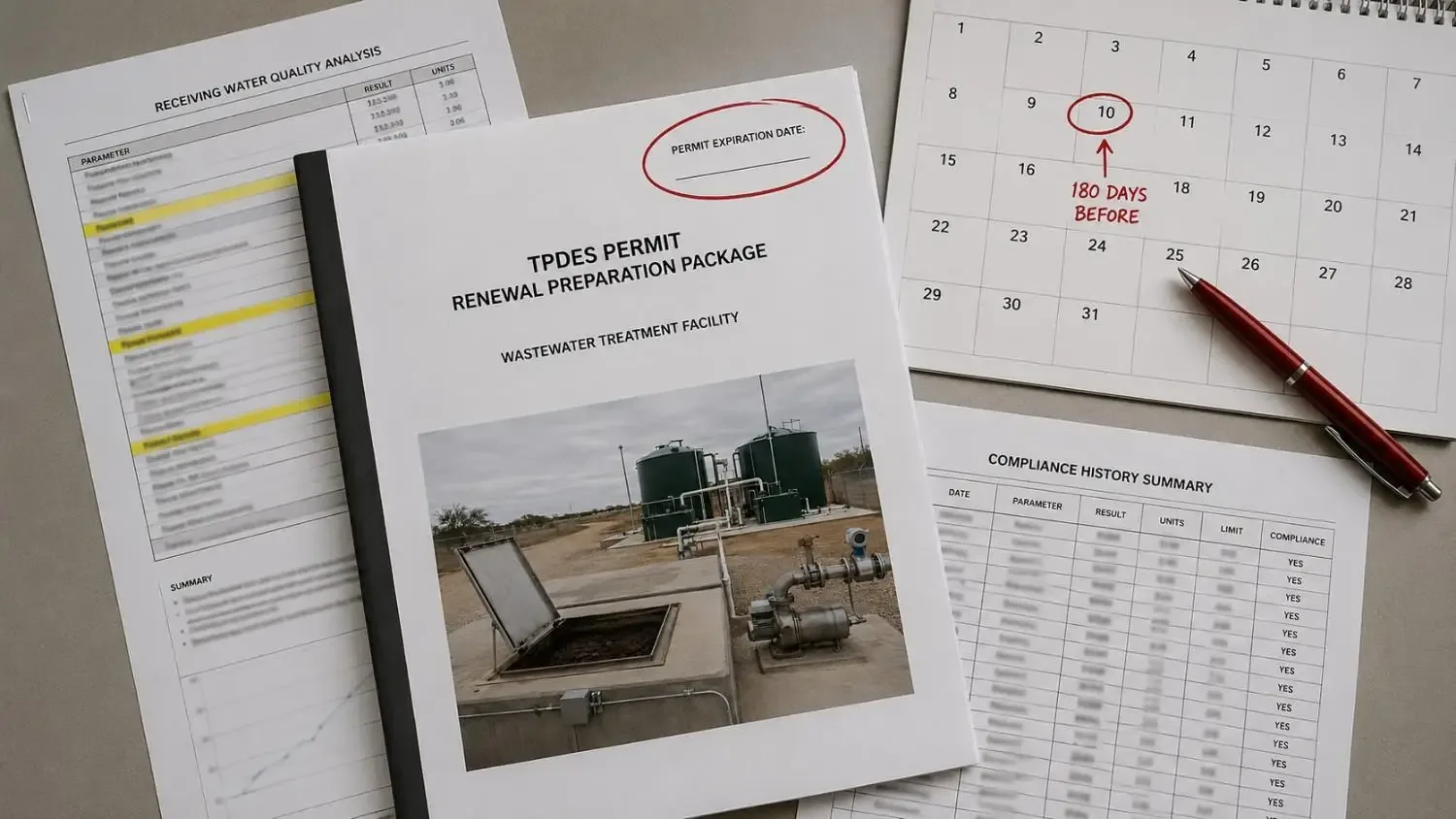
Permit modification vs. renewal vs. amendment comes down to what you are asking TCEQ to do. A renewal carries your discharge permit's terms into a new term of up to five years, filed at least 180 days before the permit expires. An amendment changes a term, condition or limit, and any increase in permitted flow is a major amendment. A minor modification covers a short, closed list of small fixes. Pick the wrong one and you can end up refiling.
What is the difference between a permit modification, renewal and amendment?
A renewal extends the permit as written. An amendment changes it. A minor modification makes one of seven small changes the rules list by name.
- Renewal. Under 30 TAC §305.65, Renewal, it requests the same requirements and conditions as the expiring permit.
- Major amendment. 30 TAC §305.62, Amendments, defines it as a change to a substantive term, provision, requirement or limiting parameter.
- Minor amendment. Improves or maintains the permitted quality or method of disposal, with no significant increase in quantity and no material change in the pattern or place of discharge.
- Minor modification. A TPDES-only list of small changes, such as fixing a typo or deleting a dead outfall.
Watch the vocabulary outside Texas. EPA's NPDES rules call a mid-term change a "modification" in 40 CFR §122.62. Texas calls most of those changes amendments.
When do you need a permit renewal?
Before every permit term runs out. File at least 180 days before the expiration date.
Under 30 TAC §305.127, a TPDES permit term cannot exceed five years. Section 305.65 sets the 180-day deadline. TCEQ can allow a later date, but never past expiration.
File before the permit expires and it stays in force until the commission's action on the renewal is final. Miss expiration and there is nothing left to renew. TCEQ's instructions for the domestic wastewater permit application (TCEQ-10053) say the permit is terminated and the application is processed as a new facility. A renewal returned as deficient after expiration leaves the plant operating without a permit. File early so there is time to fix deficiencies.
A renewal is still a review. TCEQ can make changes for good cause, such as a change in the standards behind your limits; see how TCEQ sets effluent limits. Compliance history counts too: if the last five years raise doubt about meeting a material term, the commission must offer a chance to request a contested case hearing. Phases not built within five years of authorization need a construction schedule and a case for keeping them, or TCEQ may recommend removing them.
When does a change need a permit amendment?
Whenever you change a term, condition or provision of the permit, other than a transfer or one of the listed minor modifications. Most expansions are major amendments.
That is the rule in §305.62(a). The application lists every requested change and the reason for it. TCEQ's instructions say these need a major amendment:
- Any increase in permitted flow.
- A different effluent disposal site, or moving or enlarging a land application site.
- Adding beneficial land application of biosolids next to the plant.
Moving the discharge point or route may need one too. Smaller changes, such as changing how you meet the buffer zone requirement, are minor amendments.
Timing matters. The instructions ask for amendment applications at least 330 days before the construction or new permit terms take effect; our post on why Texas wastewater permits take longer than developers expect explains that clock. While the amendment is pending, §305.62(g) keeps the existing permit in effect. You operate under the permit you have, flow limit included.
What counts as a minor modification?
Only the seven changes in §305.62(c)(3). Anything else is an amendment.
A TPDES minor modification may only:
- correct typographical errors;
- require more frequent monitoring or reporting;
- move an interim compliance date by 120 days or less;
- change a new source's construction schedule;
- delete an outfall whose discharge has ended, if other outfalls stay within limits;
- conform the permit to listed Chapter 305 standard conditions;
- add the enforceable conditions of an approved POTW pretreatment program.
Under 30 TAC §39.551, notice is a mailing to city and county officials, with comments due at least ten days later.
Can you combine an amendment with a renewal?
Yes. And if your renewal asks for changes, it has to be filed as an amendment.
Section 305.65 says a renewal that in fact requests changes is filed as an amendment instead. Going the other way, §305.62(h) lets a major amendment also count as a renewal if you ask. The administrative report in the TCEQ-10053 domestic wastewater permit application offers major or minor amendment with or without renewal, renewal without changes, and minor modification. Ask about a combined filing when expiration falls inside the amendment's lead time.
What if the plant changes owners?
That is a transfer, not an amendment. It needs TCEQ's approval, applied for at least 30 days before the transfer date.
Under 30 TAC §305.64, a corporate name change alone needs no transfer if the Secretary of State can verify it. A buyer who wants a bigger plant also needs an amendment. See our post on TPDES permit transfers during a property sale.
How does public notice differ between them?
It scales with the change.
- Major amendment. Published notice of receipt within 30 days of administrative completeness, mailed notice to adjacent and downstream landowners, and a newspaper notice of the preliminary decision. TCEQ's domestic wastewater permitting steps add a Public Involvement Plan form.
- Renewal. Published notices of receipt and of the preliminary decision, but no mailing to adjacent or downstream landowners.
- Minor amendment. Mailed notice of the application and preliminary decision to local officials and listed agencies, with at least a 30-day comment period.
- Minor modification. Mailed notice to city and county officials, ten days or more to comment.
Are you ready to file the right application?
You are ready when every item below is a yes or does not apply.
- Is the permit's expiration date more than 180 days away?
- Have you listed every change you want, with the reason for each?
- Have you checked each change against the minor modification list?
- If a change raises flow, moves the discharge or changes a disposal site, have you planned for a major amendment?
- Does your schedule allow 330 days between filing an amendment and the change?
- Do any unbuilt phases have a construction schedule?
- If ownership is changing, is a transfer application planned 30 days ahead?
Pass means every answer is yes or not applicable. Any no is a gap to close before you file.
Questions for your engineer: Which changes are substantive? Should the amendment also renew the permit? What will the technical report ask for?
A note on limits: this is general education on TCEQ rules and domestic wastewater application instructions as checked in October 2026, not legal advice. TCEQ decides how each application is classified, and nothing here predicts an outcome or a date.
Frequently asked questions
How far ahead do I file a TPDES permit renewal?
At least 180 days before the permit expires. TCEQ can allow a later date, but never after expiration.
Does a flow increase need a major amendment?
Yes. TCEQ's application instructions say any requested increase in permitted flow does.
I run a small utility district in Texas and our TPDES permit expires in eight months. Are we already late on the renewal?
No. Eight months is about 240 days, so you are ahead of the 180-day deadline, but not by much. Start now. A deficient application returned after expiration leaves the plant without a permit.
I'm a Texas developer adding a phase that raises flow to our private plant by 40 percent, and the permit expires next year. Can the renewal cover it?
Not a plain renewal. A flow increase is a major amendment, though you can ask TCEQ to treat it as a renewal too under §305.62(h). Count back at least 330 days from the start of construction on the expansion.
What if we start up new capacity before the amendment is issued?
The existing permit and its terms still govern until the commission acts. Schedule startup around the issued amendment, not the filing date.
Related resources
- Private Wastewater Treatment Plants in Texas: When Developers Need Their Own TPDES Permit
- Municipal TPDES Individual Permits: What Texas Cities and Utility Providers Need to Know
- Ongoing Compliance After Permit Approval: What a Developer-Operator Needs to Track
- What Engineers Submit to TCEQ and Why Your Application Gets Rejected
Expanding a plant or facing a permit renewal?
MES sorts out which permit action your change needs, prepares the engineering behind the application, and builds TCEQ's lead time into your schedule.
Modern Engineering Solutions, McKinney, Texas. Call (214) 833-6748 or contact our team.
Keep reading
More to read.
Talk to an engineer
Tell us about your project.
An engineer reads it
Not a salesperson. Someone who can tell you whether the pathway is real.
You get a first answer
Your options, the agencies involved and the questions that decide cost and schedule.
You decide
No commitment to have the first call.
Prefer the phone? (214) 833-6748