

Blog
How to Read a TCEQ Effluent Limit Table: What the Numbers Actually Mean for Your Development
Learn to read a TCEQ effluent limit table: the flow cap, the four limit columns, CBOD5, ammonia, E. coli and the monitoring your plant must report.
A TCEQ effluent limit table is the page of your TPDES wastewater permit that sets how much treated wastewater your plant can discharge, how clean it must be and how often you must prove it. Read it in three passes: the flow line, the four limit columns, then the monitoring columns. Those numbers pick your treatment process and your operating routine for the life of the plant.
What is on a TCEQ effluent limit table?
One row per parameter, four limit columns, then the monitoring requirements.
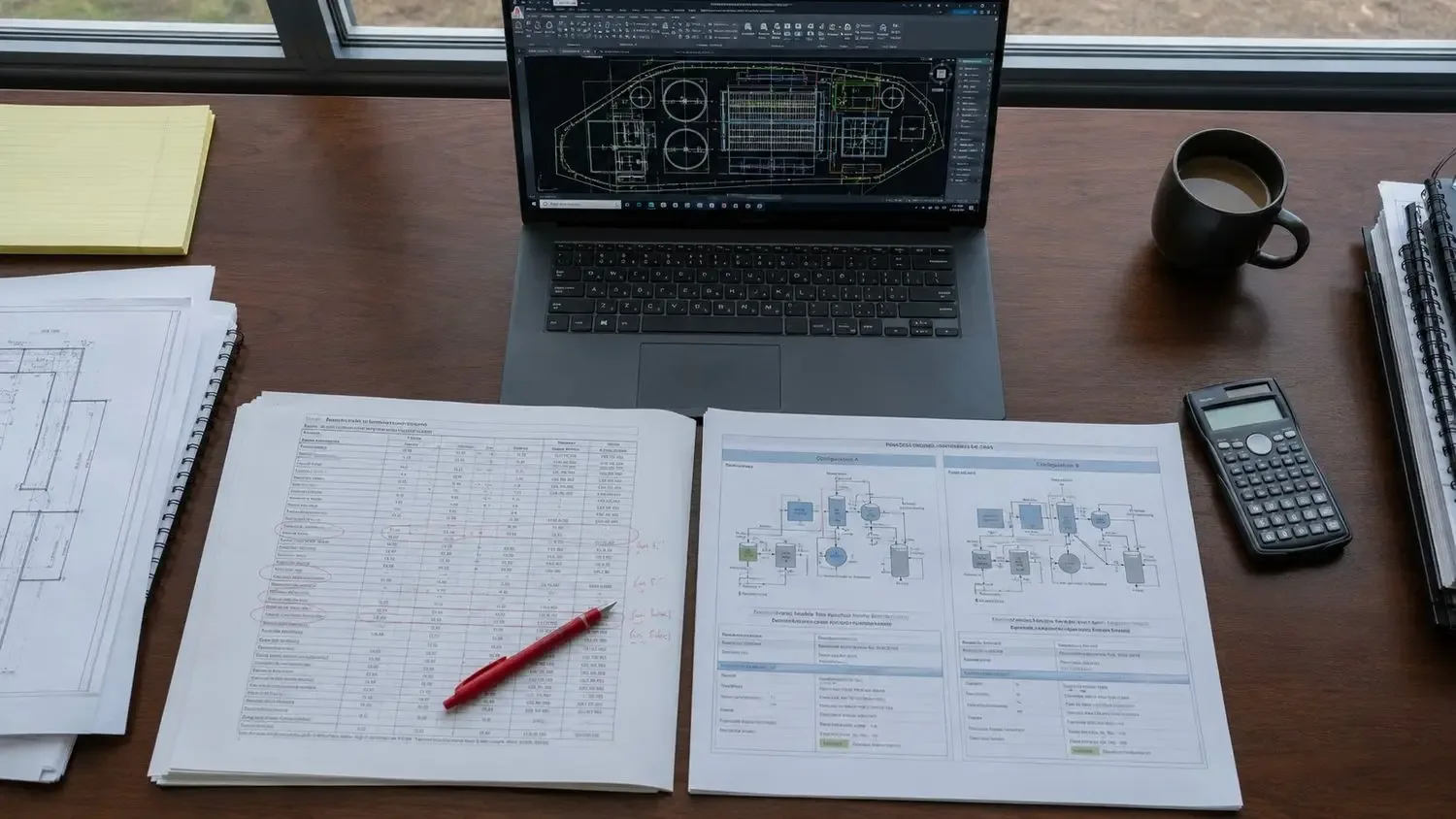
In a TCEQ domestic permit the page is titled "Effluent Limitations and Monitoring Requirements." A sentence above the table sets the flow cap. The rows cover flow, CBOD5 or BOD5, total suspended solids (TSS), ammonia nitrogen where the stream needs it, and E. coli. The limit columns read Daily Avg, 7-day Avg, Daily Max and Single Grab, in mg/l, with a lbs/day loading in parentheses beside the daily average. The last columns give the sampling frequency and sample type. Below the table sit the chlorine residual, the pH range, the sampling location and the dissolved oxygen minimum.
A phased permit gets one page per phase, such as Interim I, Interim II and Final, each with its own flow and limits. One recent TCEQ draft for a subdivision plant had no ammonia limit in the interim phases, then added 3.0 mg/l ammonia and switched to CBOD5 in the Final phase. Read the first page and the last.
What does the flow line actually cap?
The daily average flow in million gallons per day (MGD) and the 2-hour peak in gallons per minute. Annual average flow is reserved for major plants permitted at 1 MGD or more.
Daily average flow is the average of the month's daily flow readings. The 2-hour peak is the highest flow sustained for two hours. The permit's chlorine contact time is measured at peak flow, so the peak number reaches straight into your disinfection design.
The flow cap also starts a clock. Under 30 TAC §305.126(a), once flow reaches 75 percent of the permitted average for three consecutive months, the permittee must start engineering and financial planning for expansion. At 90 percent for three consecutive months, it must obtain TCEQ authorization to build the added capacity.
For developers and builders phasing a community, the permitted flow and phase breaks should come from a real build-out schedule. Projecting flow for a phased development is where that starts.
What do the four limit columns mean?
Each column covers a different time span, and you must meet all four at once.
- Daily Avg is the average of all samples in a calendar month, from at least four measurements. Despite the name, it is a monthly number.
- 7-day Avg covers one calendar week, Sunday through Saturday.
- Daily Max is the highest result on any single day in the month.
- Single Grab caps any one grab sample, which TCEQ defines as a sample collected in less than 15 minutes.
The number in parentheses is flow in MGD times concentration in mg/l times 8.34. A 0.10 MGD plant with a 10 mg/l limit carries about 8.3 lbs/day. It is computed at full permitted flow, so it bites when flow and concentration run high together.
What do the BOD, TSS and ammonia numbers say about your plant?
They set the treatment level, and the treatment level picks the process. An ammonia limit means a nitrifying plant.
The floor is basic secondary treatment in 30 TAC §309.1(b): BOD5 and TSS at 20 mg/l (30-day average), 30 (7-day), 45 (daily maximum) and 65 (single grab), a 2.0 mg/l dissolved oxygen minimum, and pH 6.0 to 9.0. Subsection (e) allows tighter limits where the stream needs them. Two recent TCEQ drafts carry 10 mg/l CBOD5, 15 mg/l TSS and 3 mg/l ammonia.
With an ammonia limit, §309.1(c) writes oxygen demand as CBOD5. EPA's NPDES Permit Writers' Manual explains that the CBOD5 test leaves out nitrogenous demand, so nitrification does not skew compliance.
EPA's fact sheet on biological nutrient removal says nitrifying bacteria turn ammonia into nitrate under aerobic conditions and are sensitive to their environment. They also slow in the cold: rates roughly double for every 8 to 10 °C rise. Winter is your design case. A total nitrogen limit adds denitrification, which needs an anoxic zone. Each new row means more basin, more air and more operator attention.
How do the E. coli, chlorine, oxygen and pH lines work?
They check disinfection and water condition at the outfall. Several are single-sample limits, so one bad sample counts.
Under 30 TAC §309.3(h), the monthly E. coli limit is the geometric mean for the stream's strictest contact recreation category, and the daily maximum is that category's single sample value. For primary contact recreation 1, 30 TAC §307.7(b)(1)(A)(i) sets 126 and 399 per 100 ml. Some permits go lower.
Chlorine appears as a condition. Recent TCEQ drafts require a residual of 1.0 to 4.0 mg/l after at least 20 minutes of detention at peak flow. That meets §309.3(g)(2): residual (mg/l) times detention (minutes) must reach 20, with at least 20 minutes and 0.5 mg/l. Switching to UV or another method needs the executive director's prior approval.
Dissolved oxygen is a minimum. The secondary floor is 2.0 mg/l, but permits often set it higher; recent drafts carried 4.0 and 6.0 mg/l. A plant that meets CBOD5 easily can still miss 6.0 without post-aeration. pH must stay between 6.0 and 9.0. Nitrification consumes alkalinity, so a nitrifying plant on low-alkalinity water can drift toward 6.0 and may need alkalinity feed.
What does the monitoring frequency column commit you to?
A sampling schedule, an accredited lab and a monthly report, whether or not you discharge.
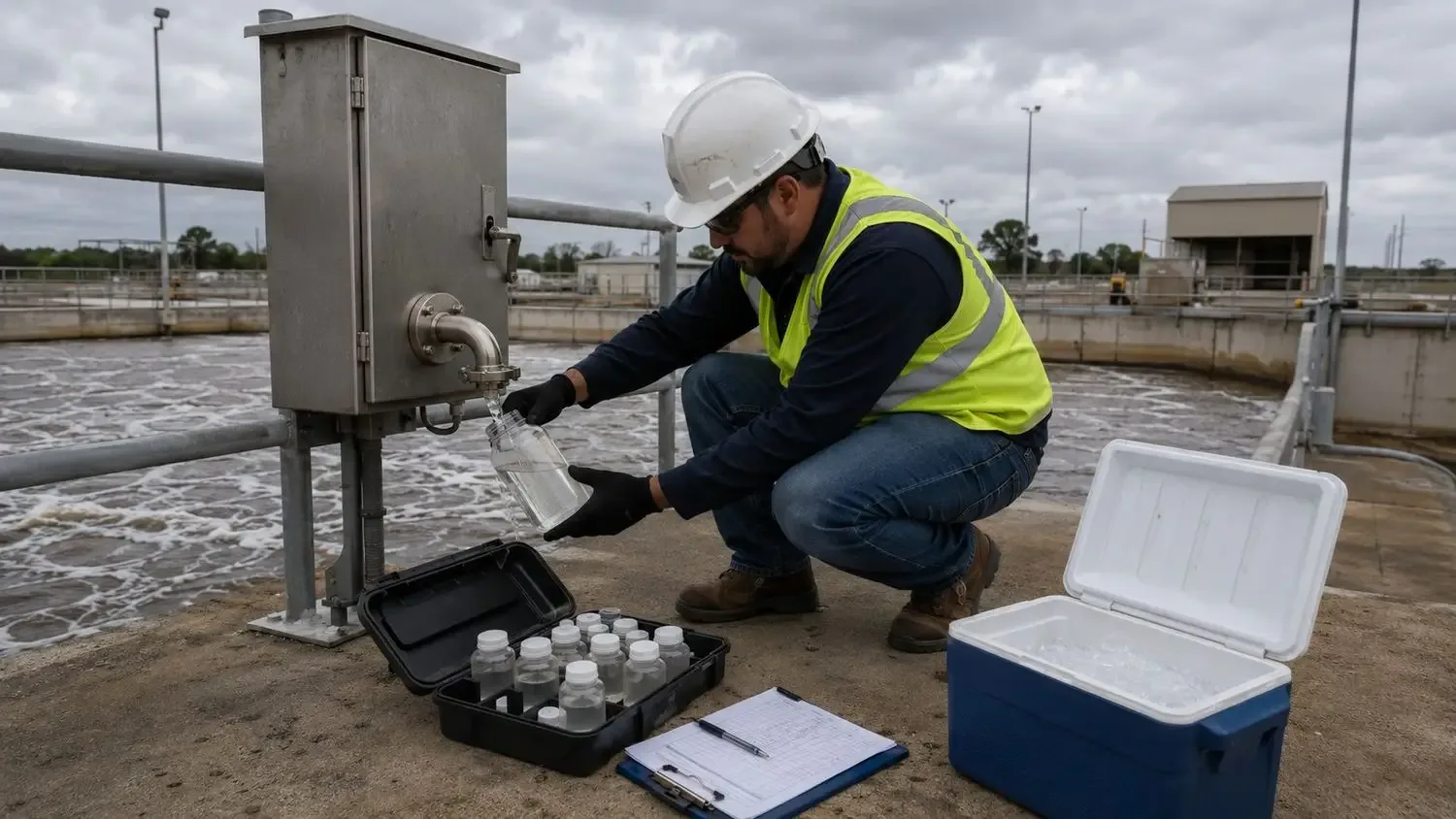
The permit sets frequency and sample type. Where it is silent, 30 TAC §319.5 points to the defaults in §319.9. A composite sample combines at least three portions over 24 hours, proportional to flow. Lab results must meet the accreditation rules in 30 TAC Chapter 25.
Results are due by the 20th of the following month under 30 TAC §319.7(d), even with no discharge. TCEQ's NetDMR requirement puts them online unless you hold a waiver.
Is your draft permit table ready to design against?
Run these six checks. If any answer is no, the table is not yet a design basis.
- Does each phase's flow match the demand you expect when that phase starts?
- Does the build-out schedule stay under the 75 percent trigger long enough to permit and build the next phase?
- Does the process meet every column, including the single grab, in winter?
- Where a phase has an ammonia or total nitrogen limit, does its design nitrify, and denitrify for total nitrogen?
- Do disinfection and aeration meet the chlorine window and oxygen minimum at peak flow?
- Are the sampler, accredited lab and NetDMR access ready before the first discharge?
A note on limits: this is general education on how TCEQ domestic permits are usually laid out, checked against the rules in October 2026. Your permit text and its Statement of Basis control, and design decisions belong with the engineer of record.
Frequently asked questions
What does 10/15/3 mean on a TCEQ permit?
The 30-day average limits in mg/l: 10 for CBOD5, 15 for TSS and 3 for ammonia nitrogen. The other columns sit higher.
Is the single grab limit the same as the daily maximum?
No. The daily maximum is the highest result on any one day. The single grab caps any individual grab sample. Both apply.
Where does TCEQ explain why a limit was set?
In the Statement of Basis/Technical Summary filed with the draft permit. It names the stream segment and its uses and says whether limits came from stream standards, a wasteload allocation or a TMDL.
Can the limits in a draft TCEQ permit be negotiated or changed?
Not by negotiation; only on a technical basis, raised before issuance, in technical review or the public comment period. Changing a limit in an issued permit takes a permit amendment under 30 TAC §305.62.
I'm a Texas developer with a draft TPDES permit for a small package plant, and my E. coli limit is 63, not 126. Why is mine tighter?
Most likely a bacteria TMDL covers your watershed. In a recent draft, TCEQ set the wasteload allocation at half the geometric mean criterion and wrote 63 per 100 ml into the permit. Your Statement of Basis should say so.
I run a utility district plant near Austin, and our flow has stayed above 75 percent of the permitted flow for three months. What does TCEQ expect from us now?
Start engineering and financial planning for expansion, per §305.126(a). At 90 percent for three consecutive months, you need TCEQ authorization to build. The executive director can waive the 75 percent step in some cases.
Related resources
- How TCEQ Sets Effluent Limits: Understanding Receiving Water Quality Standards and Permit Conditions
- Ongoing Compliance After Permit Approval: What a Developer-Operator Needs to Track
- Package WWTP vs. Custom-Designed Plant: Which One Fits Your Project?
- Texas Wastewater Permitting Guide For Developer
Turning a draft TCEQ permit into a plant design?
Modern Engineering Solutions reads draft permits line by line and turns the limits into a treatment process, a phasing plan and a monitoring routine your operator can run.
Modern Engineering Solutions, McKinney, Texas. Contact: (214) 833-6748.
Keep reading
More to read
- Knowing When to Fold: How Kiosk Operators Can Spot a Stalled Permit and Redeploy Before More Design Hours Are Spent
- Still Fixing Your Team's Drawings? How Engineering Leaders Stop Heroic Engineering and Get Their Time Back
- When does a Texas development need a municipal utility district (MUD), and what comes before the TCEQ petition?
Talk to an engineer
Tell us about your project
An engineer reads it
Not a salesperson. Someone who can tell you whether the pathway is real.
You get a first answer
Your options, the agencies involved and the questions that decide cost and schedule.
You decide
No commitment to have the first call.
Prefer the phone? (214) 833-6748