
Blog
HDPE Pipe: The Superior Choice for Small Pipeline Installation
HDPE pipe suits small water lines and force mains with fused joints and no corrosion, but check its bore, thermal movement and fusion quality.
For water lines and force mains 12 inches and smaller, HDPE pipe is often the better choice. Its fused joints have no gaskets to leak, it does not corrode in hot soil, and small sizes come in coils that cut the number of field joints. It is not automatic. The thick wall shrinks the bore, the pipe moves with temperature, and every joint is only as good as the crew that fused it.
What is HDPE pipe, and how is it joined?
HDPE pipe is high-density polyethylene pipe. For water lines and force mains it is pressure pipe, sized by outside diameter and wall ratio and joined mostly by heat fusion instead of gaskets.
For drinking water, AWWA C901 covers service pipe and tubing from 3/4 inch through 3 inches, and AWWA C906 covers pipe from 4 inches through 65 inches, as PPI's list of potable water standards gives them. Solid-wall PE also goes into gravity sewer and storm drains, which this article does not cover.
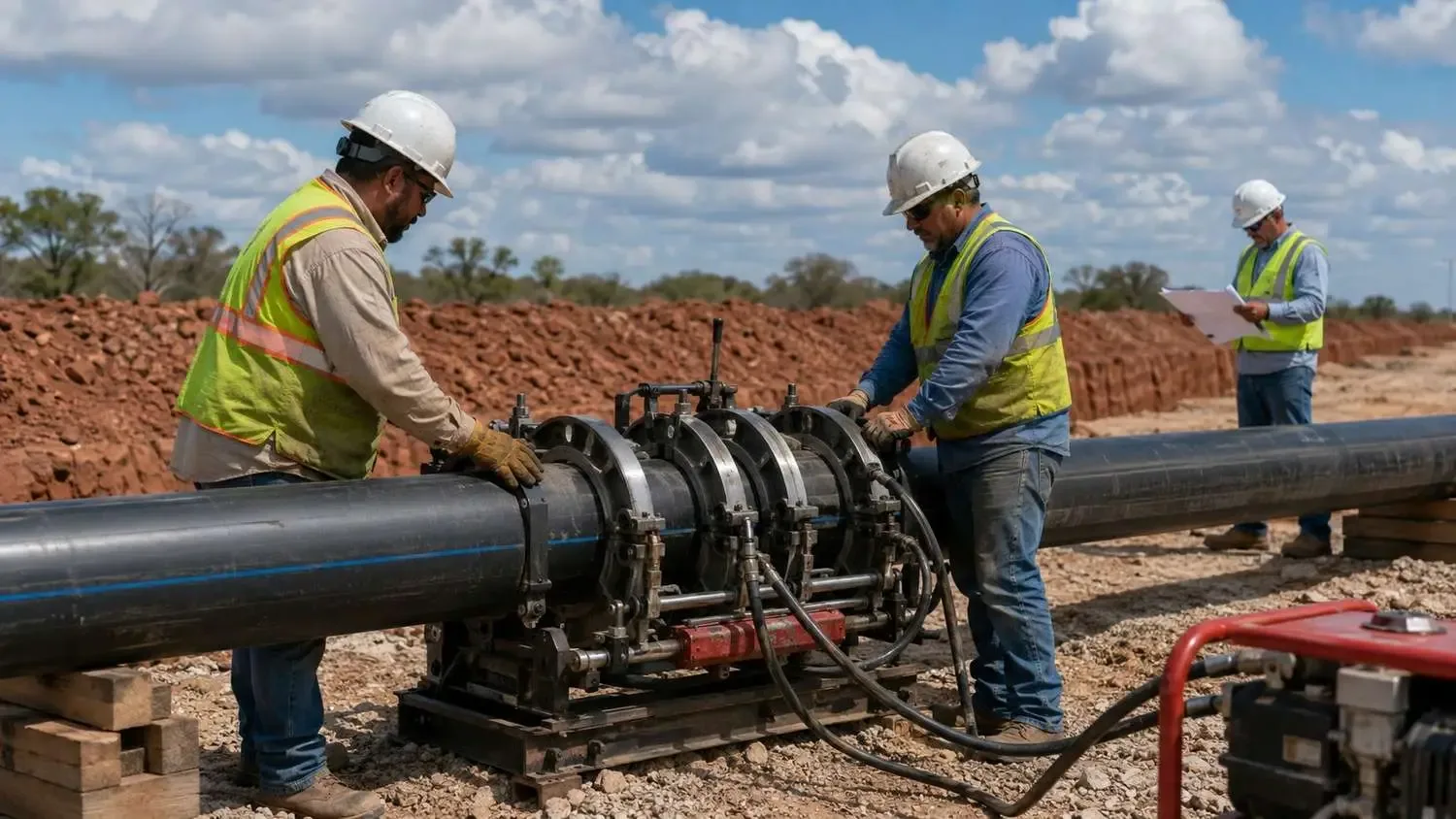
In butt fusion, the crew squares and lines up the pipe ends, heats them on a plate at about 400 to 450°F, presses them together and holds pressure while the joint cools. PPI's technical note on butt fusion says a properly made joint is as strong as or stronger than the pipe. The catch is "properly made." Too much pressure or too little heat leaves a cold joint, and the real joint plane cannot be seen without cutting the pipe.
Why does HDPE work so well on small pipelines?
Fewer joints, no gaskets, and long runs built at grade instead of in the trench.
The PPI Handbook of Polyethylene Pipe notes that PE pipe is coiled in sizes up through 6 inches, and that fused pipe can be joined into long runs above ground, then laid in the trench or pulled in by directional drilling. That means far fewer field joints and less time with people in the excavation.
The handbook's installation chapter treats fused, electrofused, flanged and MJ adapter joints as fully restrained, with no thrust blocks, and sets allowable leakage for fused PE at zero under an ASTM F2164 test.
How does HDPE handle corrosive soil?
It does not corrode, which is the best reason to look at it when the soil report says "hot."
PE does not conduct electricity, so the handbook calls it immune to the electrochemical corrosion that salts, acids and bases drive, and not susceptible to stray current electrolysis. Ductile iron in the same ground needs a corrosion plan. DIPRA's Design Decision Model for ductile iron corrosion control scores resistivity, chlorides, moisture, groundwater, pH, sulfides and redox potential, then sets protection such as polyethylene encasement or a zinc coating. That works, but it is one more system to design and inspect.
One caution: in soil contaminated with fuels or solvents, the handbook warns that any pipe or gasketed joint can let contaminants permeate into the water.
How do pressure class and DR work for HDPE?
The lower the DR, the thicker the wall and the higher the pressure class.
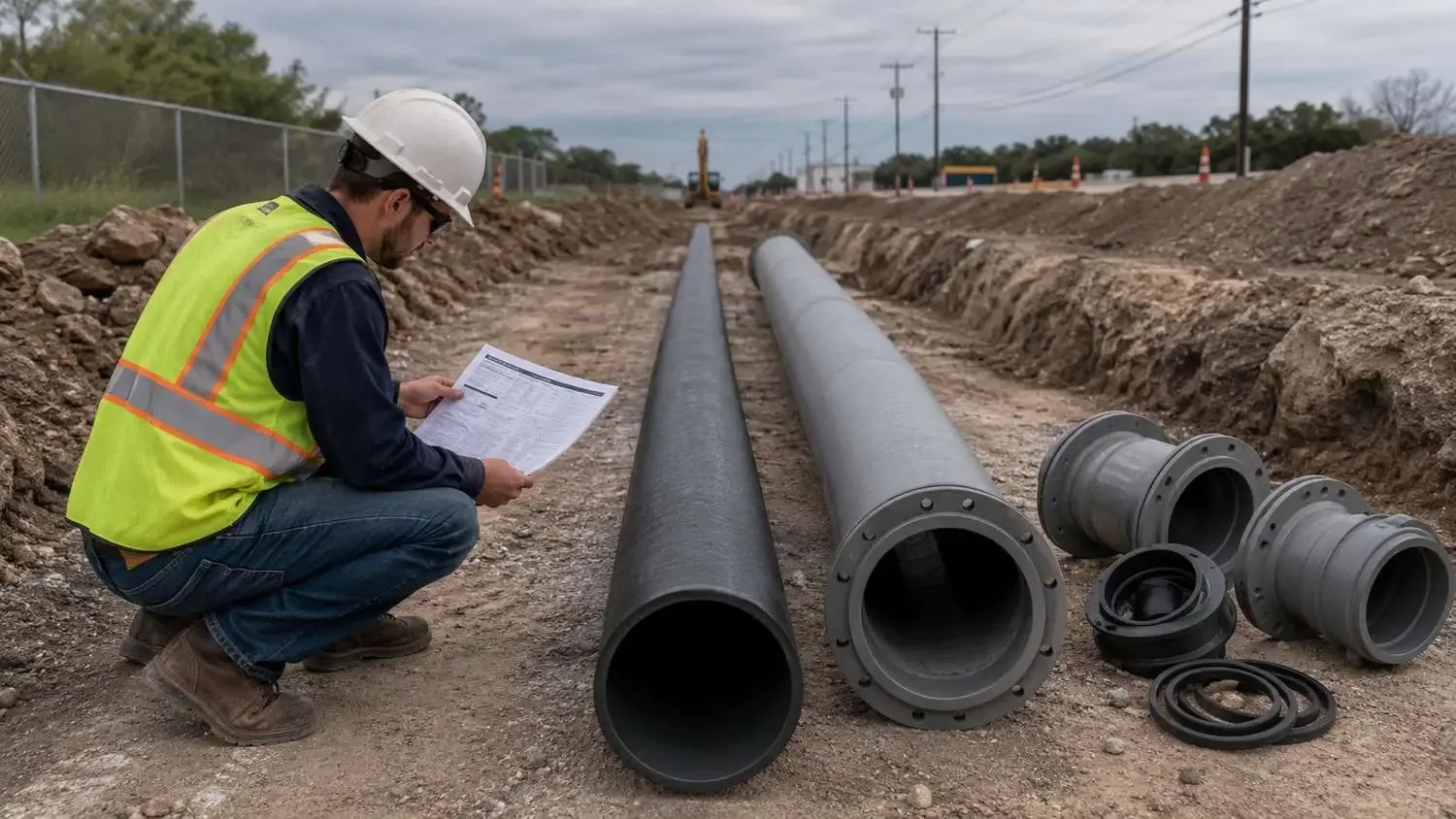
DR is the outside diameter divided by the minimum wall thickness. The handbook rates pressure as 2 times the hydrostatic design stress divided by (DR minus 1). PE4710 has a hydrostatic design stress of 1,000 psi, per PPI's PE4710 safety factor sheet, so at 73°F DR 17 rates 125 psi, DR 13.5 160 psi and DR 11 200 psi.
Surge is where HDPE earns its keep on a force main. Because PE is much less stiff than metal pipe, the same sudden velocity change makes a much smaller pressure spike. AWWA lets working pressure plus surge reach 1.5 times the pressure class for recurring surge, like pump starts and stops, and 2.0 times for occasional surge, like a power failure. A DR 11 pipe at its full 200 psi can take a sudden 7 ft/s velocity change, recurring, without derating.
In Texas, TCEQ's force main design rule, 30 TAC §217.67, requires surge control in subsection (c) and, in subsection (i), calculations of pipe strength at the end of a 50-year design life while it cycles on and off. PE is very fatigue resistant, but the calculation still goes in the report.
Where is HDPE the right answer?
Small mains, force mains, hot soil, trenchless crossings and hard trenches.
- Lines from 4 to 12 inches. Long runs gain the most, and pipe material is an early call in water distribution design for Texas land development.
- Force mains. Surge tolerance and restrained joints feed straight into the force main and pump sizing calculations.
- Corrosive ground. High chlorides, low pH or low resistivity.
- Trenchless work. Directional drilling, pipe bursting and sliplining pull the pipe in as one piece.
- Rocky or unstable trenches. Fusing at grade cuts the time people spend in the hole.
Where does HDPE fall short?
Bore size, thermal movement, transitions and crew quality.
Smaller bore. A DR 11 wall is at least one-eleventh of the outside diameter on each side, so by the handbook's flow formula the bore is only about 81% of the OD. PPI's sheet warns that matching other materials' inside diameter to HDPE gives wrong answers. Run head loss on the actual bore.
Thermal movement. PE moves roughly 1 inch for every 10°F of change in 100 feet of unrestrained pipe. Let it settle to operating temperature before the final tie-in.
Transitions. Pressurized PE shortens slightly, enough to pull apart unrestrained bell and spigot joints on PVC or ductile iron. Restrain them or set an in-line anchor.
Heat and disinfectant. Ratings are set at 73°F and drop as temperature rises. PPI's TN-44 on disinfectant resistance projects life from water temperature, disinfectant residual, pH and pressure. Warmer water lowers the projection, though its 78°F example still clears 100 years. Specify a PE4710 CC3 compound, the rating C906-21 requires.
The crew. Fusion needs a trained operator, and PE is invisible to a metal detector, so tracer wire goes in the trench. For utilities and municipalities that will own the line, fusion records and working tracer wire matter for decades.
Is HDPE approved for drinking water in Texas?
Yes, when it meets the AWWA standard and carries the NSF listings TCEQ requires.
TCEQ's water distribution rule, 30 TAC §290.44(a), requires current AWWA standards. Section 290.44(a)(1) requires new pipe to conform to ANSI/NSF Standard 61, and (a)(2) requires plastic pipe to bear the NSF-pw seal and have an ASTM design pressure rating of at least 150 psi or a standard dimension ratio of 26 or less. On that wording, DR 17 pipe rated 125 psi qualifies on its ratio. Confirm it with the reviewer anyway.
Is your HDPE spec ready for bid?
Nine yeses mean the spec is ready for review, and any no is a gap to close first.
- Does it name PE4710 and AWWA C901 or C906?
- For drinking water, does it require NSF 61, the NSF-pw seal and a CC3 compound?
- Is the DR checked against working pressure plus surge at the real water temperature?
- Does the hydraulic model use the actual inside diameter?
- Does it say IPS or DIPS sizing, matched to the fittings?
- Does it require ASTM F2620 fusion by ASTM F3190 qualified operators, with records?
- Are transitions to PVC or ductile iron restrained?
- Is tracer wire shown on the main and services?
- Is the leak test ASTM F2164?
Worth asking your engineer: what surge does the lift station actually make, and does the future owner's standard allow HDPE at all?
A note on limits: this is general education, current as of October 2026. Ratings come from the standards and the manufacturer's data for the exact product, and the engineer of record and the reviewing agency decide what applies.
Frequently asked questions
Is HDPE pipe better than PVC?
For long runs, trenchless crossings and surge-heavy force mains, often yes. For a short, straight, low-pressure line in benign soil, PVC is often simpler.
How long does HDPE pipe last?
The PPI handbook gives the industry estimate as 50 to 100 years when the system is designed, installed and operated properly.
I'm developing a subdivision in North Texas, the geotech report calls the soil corrosive, and the city detail shows ductile iron for the 8-inch main. Can I ask to use HDPE?
You can ask. TCEQ's rule allows plastic pipe that meets AWWA standards, NSF 61, the NSF-pw seal and its pressure or ratio limit, but if the city will own the main, its standards decide. Bring the soil report, the surge check and your transition restraint details.
I manage a small rural water system in Texas and need to replace a leaking 4-inch line under a creek and a county road. Should we look at directional drilling with HDPE?
Yes. Fused HDPE pulls in as one restrained string, a standard choice for directional drilling. Restrain the tie-ins to your PVC and keep tracer wire with it.
Related resources
- Reactive Clay Soils and Buried Utility Design: Engineering Water and Sewer Lines on Eagle Ford and Austin Chalk Formations
- Force Main Corrosion in Florida's Coastal Environment: Design Strategies That Last
- New Water Main Disinfection and Test Water Discharge: How to Coordinate AWWA Standards with TCEQ Rules
- Importance of Managing Water Loss in Rural Areas
Picking pipe for a small water line or force main?
We design water lines, force mains and lift stations for developments and utilities, and we pick the pipe for the soil, the pressure and the crew that will build it.
Modern Engineering Solutions, McKinney, Texas, with offices in Golden, Colorado and San Jose, California. 525+ projects completed.
Talk with an engineer about your pipeline or call (214) 833-6748.
Keep reading
More to read.
Talk to an engineer
Tell us about your project.
An engineer reads it
Not a salesperson. Someone who can tell you whether the pathway is real.
You get a first answer
Your options, the agencies involved and the questions that decide cost and schedule.
You decide
No commitment to have the first call.
Prefer the phone? (214) 833-6748