
Blog
Lift Station Design in Houston’s High Groundwater Zones: Why Standard Specs Fail in Clay-Heavy Soils
Houston lift station design has to resist flotation, shrink-swell clay and flooding, so check the TCEQ rules and these site conditions before you design.
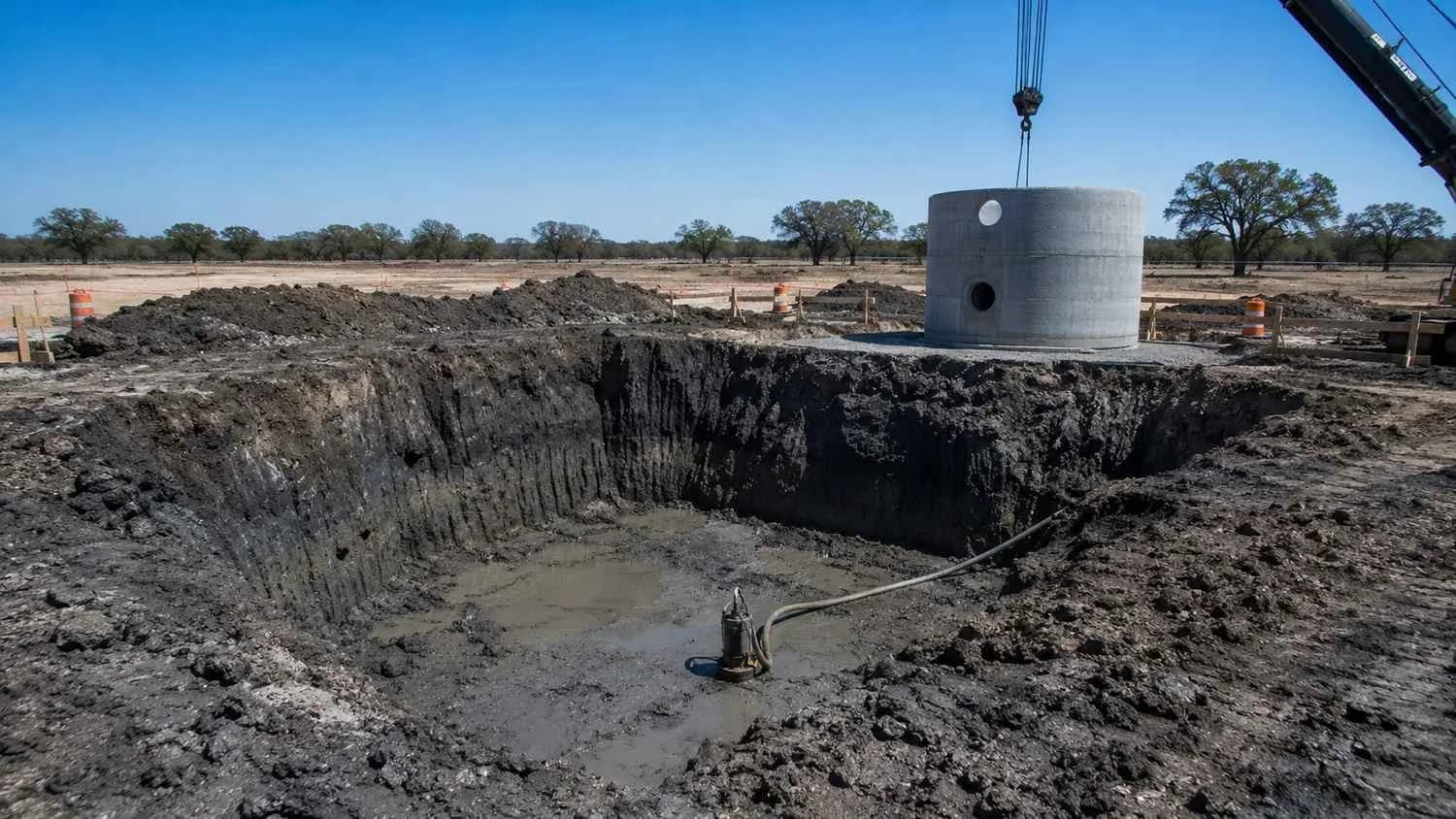
Houston lift station design has to start from the site's borings, not a standard detail. Where groundwater is high and the soil is shrink-swell clay, an empty wet well wants to float, the excavation needs dewatering and real shoring, and rigid pipe connections crack as the clay moves. Specs drawn for drier, sandier ground skip those checks, and that is where they fail.
Why do standard lift station specs fail in Houston clay?
Because they assume ground that drains and stays put. Houston-area clay does neither.
The USDA's official description of the Lake Charles soil series, extensive in Southeast Texas mainly between the Colorado and Trinity Rivers, describes very deep, very slowly permeable clay on coastal prairie with slopes mostly under 1 percent. Dry, it cracks up to 2 inches wide and a foot or more deep. Wet, the cracks close and water barely moves.
Design starts with borings below the planned wet well bottom and piezometers to set the design water level. In clay this tight, water in an open boring can take a long time to reach its true level, so "no water encountered" on a log is not a design groundwater level. That is the first step in Texas pump and lift station design.
How do you keep an empty wet well from floating?
Check it empty, with water at the highest level you can defend, and make its weight and anchorage beat the uplift.
Uplift equals the weight of the water displaced. A wet well 10 feet in outside diameter, with its base 25 feet below grade and groundwater at grade, displaces about 1,960 cubic feet of water: roughly 122,000 pounds pushing up. Wastewater inside helps only while it is there; pumped down for a repair or empty during construction, the structure may float.
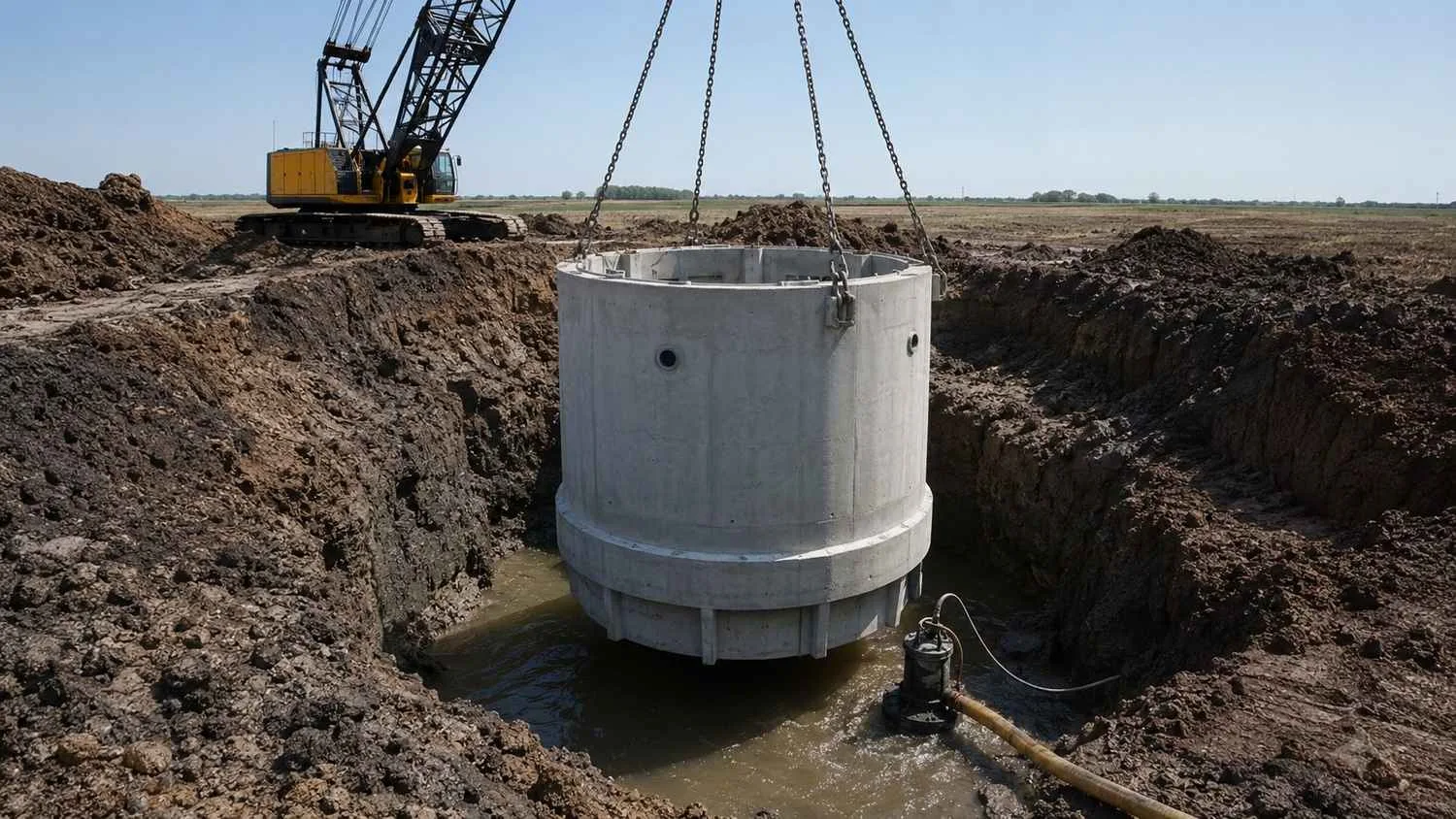
The Recommended Standards for Wastewater Facilities, 2014 edition, known as the Ten States Standards (a northern states' guide, not a Texas rule), require buoyancy of pumping stations to be considered where high groundwater is expected (Section 42.24). TCEQ's lift station sections, 30 TAC 217.59 through 217.63, set no flotation safety factor. The margin is the engineer's call, unless your utility sets one.
Resist uplift with dead weight, added concrete, a base slab extended past the walls so soil bears on it, or anchors. Count that soil at its submerged unit weight. Do not lean on side friction in clay that cracks open in a dry spell.
Two cases get missed. During construction, before the top slab and backfill are on, the structure is at its lightest, so dewatering must run until it can hold itself down. During a flood, 30 TAC 217.59(c) requires the station to withstand and operate through a 100-year event, and water above grade adds uplift.
What does saturated clay do to the excavation?
It weakens the trench walls and makes dewatering part of the design, not a bidder's guess.
OSHA's excavation rules, 29 CFR 1926 Subpart P, require a protective system in any excavation 5 feet or deeper unless it is entirely in stable rock (1926.652(a)(1)). Under Appendix A, no soil is Type A if it is fissured, and submerged soil or soil with water freely seeping out is Type C, the least stable. Section 1926.651(h) bars work where water is accumulating unless precautions are taken.
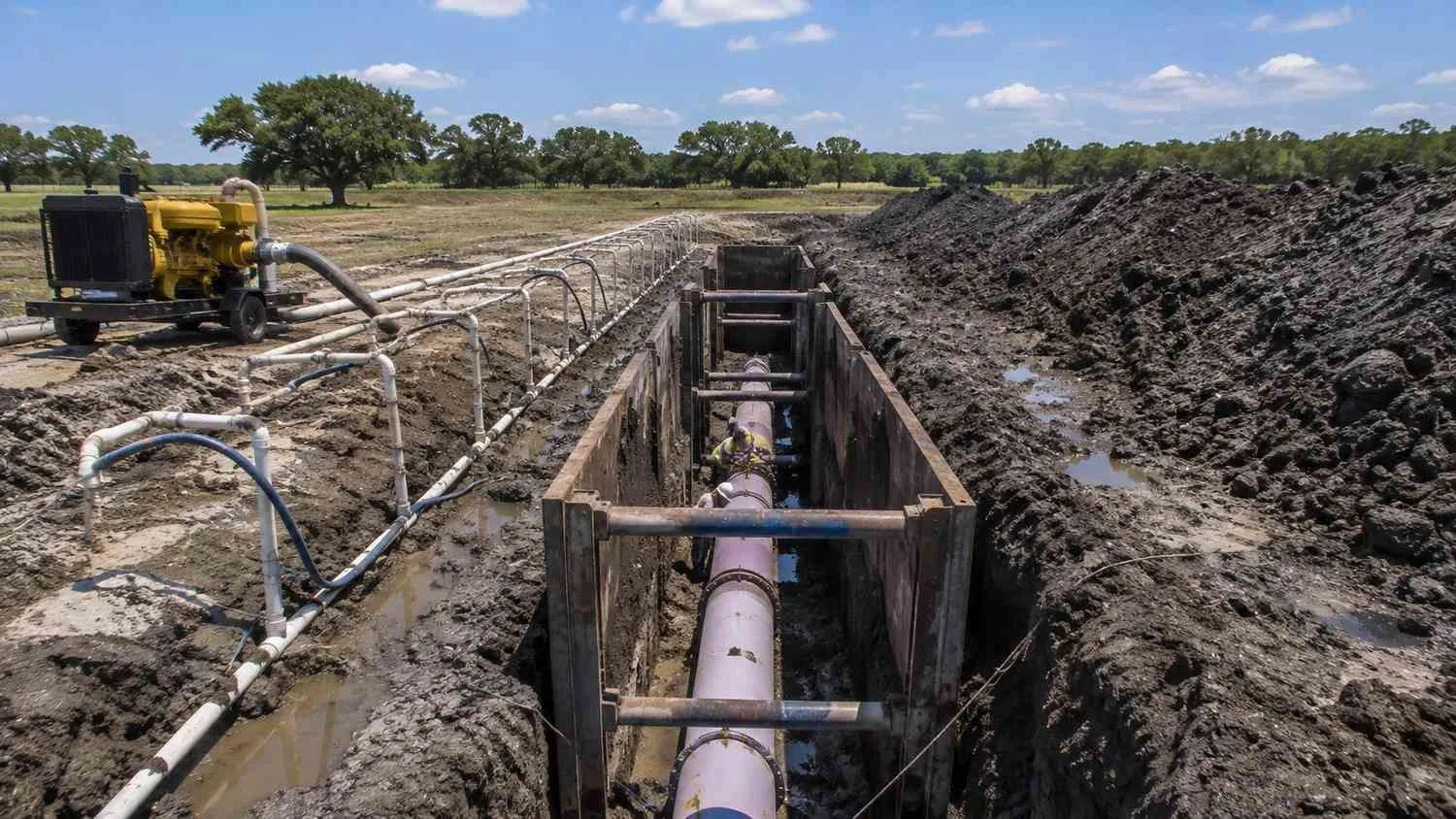
On a political subdivision's project with trench excavation deeper than 5 feet, Texas Health and Safety Code Section 756.023 requires the bid documents to include any geotechnical information the owner obtained for the contractor's trench safety design. Specify the dewatering approach, the water level it must hold and when it may stop.
How should pipes connect to a wet well in shrink-swell clay?
With connections that flex and still seal, because the wet well and the pipe move differently.
TCEQ's rule on lift station pipes, 30 TAC 217.62(c)(2), requires wall penetrations that allow pipe flexure while keeping out infiltration and exfiltration. A pipe grouted rigidly into the wall is the detail that cracks first. The pipe embedment rule, 30 TAC 217.54(a)(3), bars large clods and organic matter from bedding and initial backfill, so excavated clay in clods cannot go back around the pipe. Our post on buried water and sewer lines in reactive clay covers the pipe side.
How do you control hydrogen sulfide and odor at the station?
Keep detention time short, keep the force main moving, and build with materials that can take the gas that forms anyway.
EPA's CMOM guide for collection systems lists pump stations, sewers with long detention times and force main discharge points among the places hydrogen sulfide forms. On moist surfaces it becomes sulfuric acid, which corrodes concrete and ferrous metals. Long runs on flat ground and low flows in early phases add detention time.
30 TAC 217.67 requires force main detention time calculations, a 4-inch minimum force main except at grinder pump stations, at least 3.0 feet per second with one pump running at a two-pump station, and an air release valve at every high point. The force main must also be designed to abate anticipated odor, and under 217.59(d) the owner must keep the station from becoming an odor nuisance. Near homes, that can mean carbon filters on the wet well vent.
In the wet well, 30 TAC 217.60 requires control settings that discourage septic conditions, watertight and gastight walls, and motor controls protected from wet well gases. The Ten States Standards ask for materials suited to hydrogen sulfide (Section 42.25), which in practice usually means a lining or coating above the low water line and corrosion-resistant hardware.
What do TCEQ rules require for flooding, power and access?
Operation through a 100-year flood, truck access in a 25-year, 24-hour rain, and spill protection that lasts through the longest recent outage.
- Flood: the station and all its equipment must withstand and operate during a 100-year flood, including wave action (217.59(c)).
- Access: truck access in all weather, including a 25-year, 24-hour rainfall, on a road at least 12 feet wide (217.59(a)).
- Power: whatever prevents a spill in an outage must work at least as long as the longest outage in the electric utility's last 60 months of records, or 20 minutes, whichever is longer (30 TAC 217.63(g)). Portable generators count only with a tested quick-connect or transfer switch and a licensed operator on call around the clock.
In a regional storm, a shared portable generator may already be at another station, which argues for an on-site one. For developers and builders, the station tract, its access road and its flood elevation belong on the first concept plan.
Is your Houston site ready for lift station design?
Six yeses mean it is ready. Any no is the next thing to get.
- Do you have borings below the planned wet well bottom at the station site?
- Do you have piezometer readings to set the design groundwater level?
- Has the flotation check been run with the wet well empty, at that level and at each construction stage?
- Do you know the 100-year flood elevation at the station tract and its access road?
- Do you have 60 months of power outage records from the electric utility?
- Do you have the accepting utility's lift station standards in writing?
Ask your engineer: What design water level did you use, and why? Which construction stage is closest to floating?
A note on limits: this is general education from TCEQ's Chapter 217, OSHA's excavation rules and the 2014 Ten States Standards as of October 2026. Your geotechnical report, your utility's standards and TCEQ's review govern, and no article can predict a review outcome or schedule.
Frequently asked questions
Does TCEQ require a buoyancy calculation for a lift station?
Not for a conventional lift station. Among lift stations, Chapter 217 asks for buoyancy calculations only on those in pressure sewer systems (30 TAC 217.97(d)(4)). The Ten States Standards call for a check where groundwater is high, and a utility or reviewer may ask for one.
Do small lift stations need the same checks?
Yes. Uplift depends on the structure's size and the water level, not on how many homes it serves. A station with peak flow under 120 gallons per minute must also use submersible grinder pumps (30 TAC 217.61(j)).
I'm developing a 250-lot subdivision southwest of Houston, and the utility district will own the lift station. What should I get before design starts?
Borings with piezometers, the district's lift station standards in writing, the 100-year flood elevation at the tract, and 60 months of outage records from the electric utility, which TCEQ requires in the engineering report (217.63(e)).
I'm a contractor bidding a lift station near Houston, and the plans show a wet well about 20 feet deep in clay. What should I look for in the bid documents?
The geotechnical report, the design groundwater level, a dewatering spec that says when pumping may stop, and how the structure resists flotation while it is being built.
Related resources
- Harris County Flood Control Requirements and Your Wastewater System: How Detention Design Affects Treatment Plant Siting
- Post Hurricane Infrastructure Recovery: How Houston Developers Can Build Flood Resilient Water and Wastewater Systems
- Understanding Lift Stations: A Walkthrough of Force Main and Pump Sizing Calculations
- Lift Station Design for Florida’s Flat Topography: Challenges Every Developer Should Understand
Designing a lift station on Houston clay?
We start from the borings and the design water level, then size, ballast and detail the station to TCEQ rules and your utility's standards.
Modern Engineering Solutions, McKinney, Texas.
Talk to an engineer about your site or call (214) 833-6748.
Keep reading
More to read.
Talk to an engineer
Tell us about your project.
An engineer reads it
Not a salesperson. Someone who can tell you whether the pathway is real.
You get a first answer
Your options, the agencies involved and the questions that decide cost and schedule.
You decide
No commitment to have the first call.
Prefer the phone? (214) 833-6748