
Blog
Post Hurricane Infrastructure Recovery: How Houston Developers Can Build Flood Resilient Water and Wastewater Systems
Post hurricane infrastructure recovery in Houston means water and wastewater systems that stay above the flood, stay powered and meet TCEQ outage rules.
Quick answer
Post hurricane infrastructure recovery in Houston goes better when the next system is built to keep running, not just to be repaired. For a developer, that means water and wastewater facilities that stay above the flood, stay powered through a long outage, and stay reachable by the operator.
Texas already sets some of this by rule. Water systems in Harris and Fort Bend Counties must plan to hold 35 psi through a 24-hour outage. Lift stations must operate through a 100-year flood. The rest is design judgment, and it costs least before construction.
What did Harvey show about rainfall in this region?
That the design storm can be far smaller than the real one. The National Hurricane Center's report on Hurricane Harvey records 36 to 48 inches of rain in the Houston metro area in 2017. The highest storm total, 60.58 inches, fell near Nederland in Jefferson County.
A floodplain map shows the flood with a 1 percent or 0.2 percent annual chance, not the largest storm a site can see. The map is where design starts, not where it ends. For critical facilities, test the site against a larger event than the minimum rule asks for.
Is resilience really the developer's problem?
Yes, until the utility district or city accepts the system, and often after. A lift station that floods or a plant that loses power during a storm leaves homes without service and can cause a sewer overflow. The developer, or the district or HOA that takes over, answers for both.
Designing resilience in from the start costs less than retrofitting after the first failure, and the retrofit usually happens under an outage, a complaint or an enforcement deadline.
What does Texas require of water systems for long power outages?
An approved emergency preparedness plan, with a higher pressure floor in Harris and Fort Bend Counties. Under Texas Water Code §§13.1394 and 13.1395, as TCEQ's emergency preparedness plan page explains, affected water utilities must plan to keep minimum pressure through an extended power outage lasting 24 hours. TCEQ's rule at 30 TAC §290.39(o) requires an affected utility that is a public water system to adopt the plan, submit it to TCEQ and carry it out.
- Harris and Fort Bend Counties: 35 psi
- All other counties: 20 psi
- A new system in Harris or Fort Bend County that began after November 1, 2011 must have an approved plan before it serves customers
For a new subdivision, this shapes the water plant from day one: generator size and fuel, elevated storage, or an emergency interconnect with a neighboring system. Settle the plan before the plant is designed, not after it is built.
How high do wells and water plants need to sit?
Wellheads two feet above the flood, and plants on ground not subject to flooding. TCEQ's groundwater source rule, 30 TAC §290.41(c)(3)(K), requires wellheads and well vents at least two feet above the highest known watermark or the 100-year flood elevation, if available, or protection by levees.
The water treatment rule, 30 TAC §290.42(a), requires the plant and its pumping units to be in well-drained areas not subject to flooding. For a Houston-area plant, set electrical gear, chemical storage and generator above the same elevation you would trust for the wellhead.
What must a lift station survive?
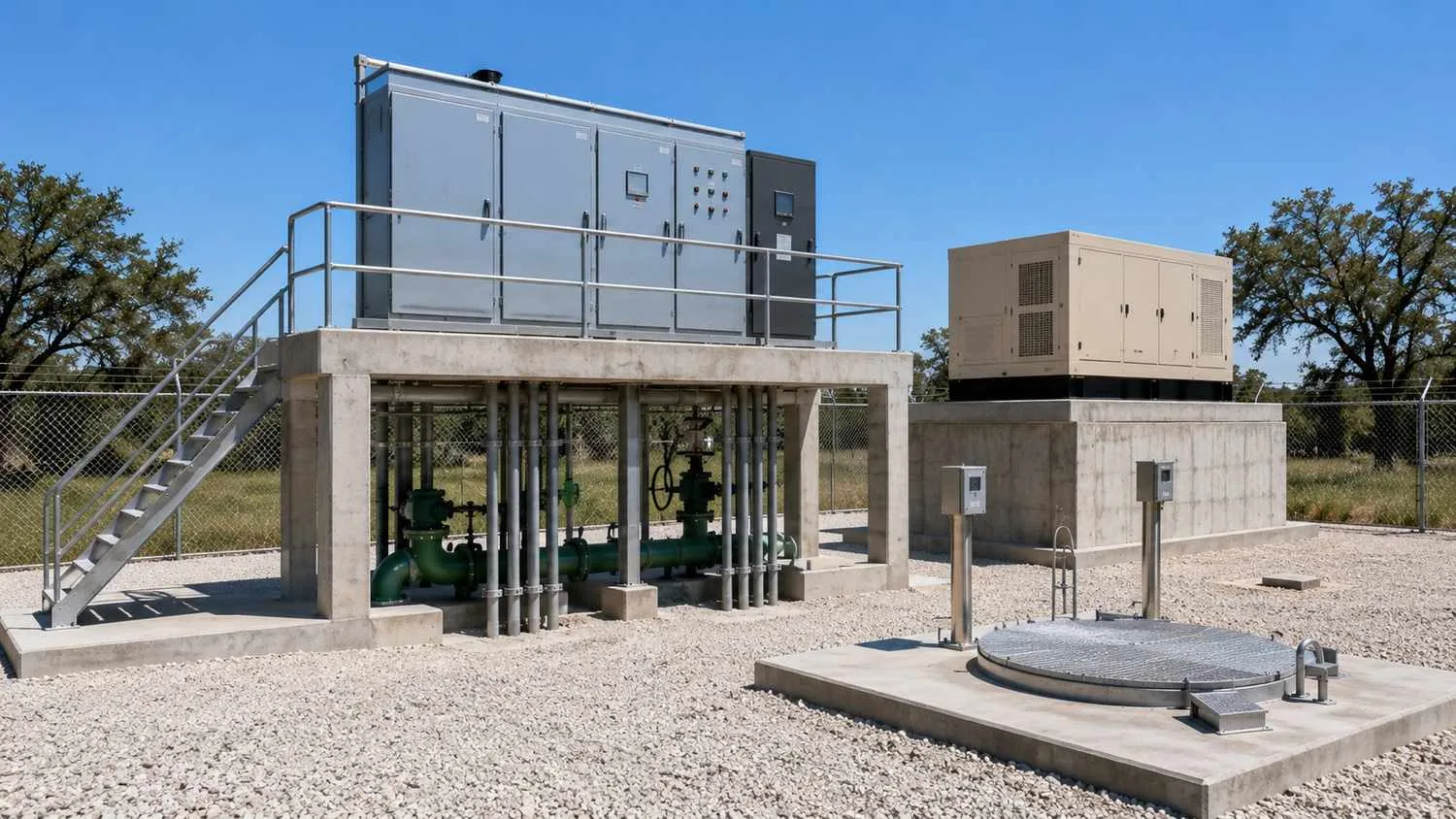
A 100-year flood, while still running, with truck access in a 25-year storm. TCEQ's lift station site rule, 30 TAC §217.59, requires the station to withstand and operate during a 100-year flood event, including wave action. The site must be reachable by truck in all weather, including a 25-year, 24-hour rainfall, on a road at least 12 feet wide.
Operating through the flood means more than a high wet well rim. The control panel, motor starters, telemetry and generator all have to sit above the flood. The structure also needs a flotation check at flood water levels, not just at normal groundwater.
Backup power for lift stations and plants has its own TCEQ rules. Our post on emergency bypass and backup power requirements covers them.
Where can a wastewater plant go on a flood-prone tract?
Outside the 100-year floodplain, or protected from it. Under the TCEQ siting rule, 30 TAC §309.13(a), a treatment plant unit may not sit in the 100-year floodplain unless it is protected from inundation and damage in that flood. Section 309.13(b) also keeps plant units out of wetlands.
Harris County sets a stricter test for critical facilities, which it defines as facilities essential to preserving life and property. Its floodplain management regulations, effective July 9, 2019, ask that they be built outside the 0.2 percent (500-year) floodplain where possible. Where not, the lowest floor must be three feet above the 0.2 percent elevation or 24 inches above the adjacent road crown, whichever is higher. Ask the county early whether it will treat your plant as one.
A floodplain study early in site planning tells you which corner of the tract can carry the plant before the lot layout is fixed.
Why does inflow and infiltration matter in a storm?
Because stormwater that gets into the sewer takes capacity the homes need. Leaky manholes, open cleanouts and bad joints let rain and floodwater into the collection system. In a hurricane, that extra flow can overwhelm lift stations and the plant even though no more sewage is being made.
On new work, specify sealed and raised manhole lids in low areas and test the lines before acceptance. On an older system, find and fix the worst sections first, as our post on I&I analysis describes.
What should recovery after a storm include?
A rebuild that fixes the cause, not just the damage. After a failure, use this check before replacing anything. Every answer should be yes:
- Is every electrical and control component now above the highest water seen, with margin?
- Can backup power run the critical load for the longest outage you now expect, with fuel on site or a delivery plan that works when roads are closed?
- Can a truck reach each lift station and plant in a 25-year storm?
- Does the water system's emergency preparedness plan still match the rebuilt plant?
- Has the inflow that overloaded the system been traced and repaired?
- Do the operator's call lists, spare parts and portable pumps reflect what failed?
This is general education based on TCEQ rules and NOAA's Harvey report as of October 2026. City, county and utility district standards add to these rules and differ by jurisdiction. Your engineer sets the design flood and power criteria for each site.
Frequently asked questions
Do Harris County water systems really need 35 psi during an outage?
Yes. TCEQ's emergency preparedness plan page sets 35 psi for affected utilities in Harris and Fort Bend Counties and 20 psi elsewhere, for an extended outage lasting 24 hours.
Does a lift station have to keep running during a flood, or just survive it?
Run. Section 217.59(c) says the station must withstand and operate during a 100-year flood event, including wave action.
Is a site outside the mapped floodplain safe from these concerns?
Not necessarily. A map shows a flood with a set annual chance, not the largest storm the site can see, and Harvey put 36 to 48 inches on metro Houston. Test critical facilities against a site-specific flood risk, not only the map.
I'm developing a subdivision in Fort Bend County with its own water plant. What do I need in place before the first homes get water?
For a new system there that began after November 1, 2011, an approved emergency preparedness plan before it serves customers, under TCEQ's program. Build the generator, storage or interconnect it relies on into the plant design.
I'm on a Houston-area utility district board and our lift station flooded in the last storm. Should we rebuild it the same way?
No. Find out what failed first: controls, power, access or flotation. Rebuild so the station meets §217.59 with its electrical gear above the flood, and update the backup power plan for the outage you actually had.
Related resources
- Harris County Flood Control Requirements and Your Wastewater System: How Detention Design Affects Treatment Plant Siting
- Lift Station Design in Houston’s High Groundwater Zones: Why Standard Specs Fail in Clay-Heavy Soils
- Municipal Utility Districts in Houston Suburbs: When to Form One and When to Use a Developer-Owned Treatment Plant Instead
- Lift Stations and Collection Systems: What the Plant Needs Upstream to Function Properly
Rebuilding or designing Houston-area water and wastewater after a storm?
We set the flood and power criteria for each facility, then design the plant, lift stations and collection system to keep running through the next one.
We specialize in:
- Lift station and force main design
- Water plant and well design
- Wastewater treatment plant design and permitting
- Floodplain studies and FEMA submittals
- Collection system and inflow and infiltration studies
- Construction administration
Modern Engineering Solutions, McKinney, Texas. Contact: (214) 833-6748 or mod-eng.com
Talk to an engineer
Tell us about your project
An engineer reads it
Not a salesperson. Someone who can tell you whether the pathway is real.
You get a first answer
Your options, the agencies involved and the questions that decide cost and schedule.
You decide
No commitment to have the first call.
Prefer the phone? (214) 833-6748