
Blog
Wastewater Engineering for McKinney Master Planned Communities: Sizing Treatment Systems for Phased Buildouts
McKinney master planned community wastewater planning starts with who treats the flow, then sizes sewers, lift stations and permit phases for full buildout.
Quick answer
Wastewater engineering for a McKinney master planned community starts with who treats the flow. Inside the city's certificated service area, the North Texas Municipal Water District treats it and the city's design manual allows no other plant, so you are phasing collection, lift stations and capacity timing. Outside that area a private plant can phase through TCEQ's interim and final permit phases. Either way, plan for full buildout.
Can a McKinney master planned community build its own treatment plant?
Not inside the city's CCN. Section 5.5 of McKinney's Engineering Design Manual (Revision 7, May 2026) says water and wastewater treatment for the city and its certificate of convenience and necessity (CCN) is provided by NTMWD. Other treatment facilities are not authorized within the city's CCN, except a septic system serving one home.
The Unified Development Code also limits septic systems to lots of 1.5 acres or more, where sewer is not feasible and the Director of Engineering approves. That rules out septic for a master planned community.
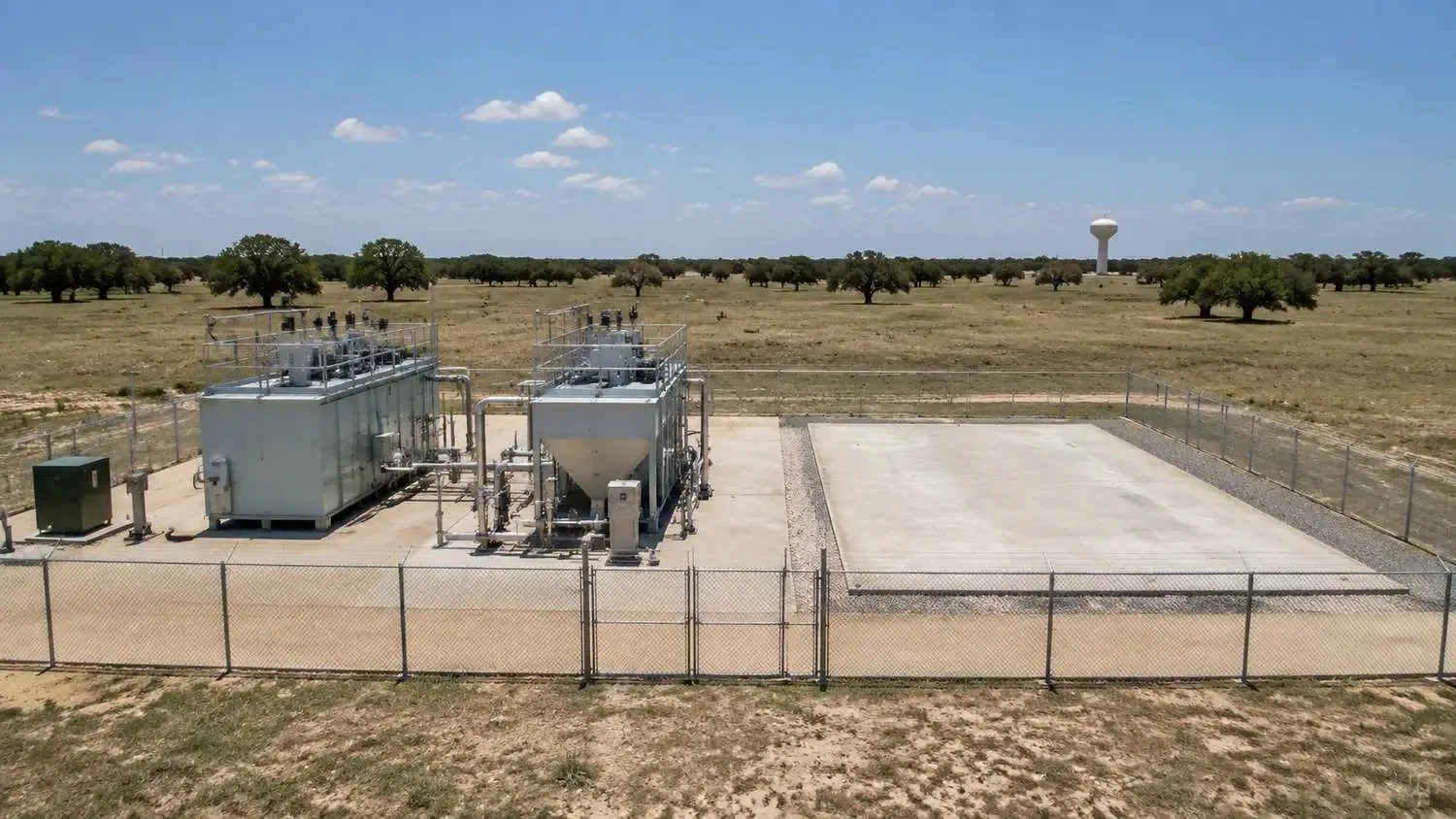
Land outside the city's CCN, served by another provider or by none, is a different question. There a private plant needs a TCEQ permit and has to survive regionalization review. TCEQ's regionalization policy asks applicants to contact permitted plants and collection systems within three miles and, where one can take the flow, to compare the cost of connecting against building and running a new plant.
How should flow projections handle phases?
Phase by phase, then cumulatively, with peaks stated. McKinney's manual asks residential submittals for unit counts and acreage, and bases average daily flow on 100 gallons per capita per day. Flow calculations must state the average dry weather flow and its peaking factor.
Collection systems must carry the peak wet weather flow from the entire service area, including offsite areas. For a master planned community, that means the trunk sewer for phase one is sized for every upstream phase and every neighbor that drains through it, not just the first phase's lots.
For a private plant, 30 TAC §217.32 sets the design basis. Below 1.0 million gallons per day, the design flow is the table's average annual flow times a factor of at least 1.5. Without site data, peak flow is the design flow times at least 4.0. Early phases with few connections are where that peak factor matters most.
How does McKinney handle phased lift stations and force mains?
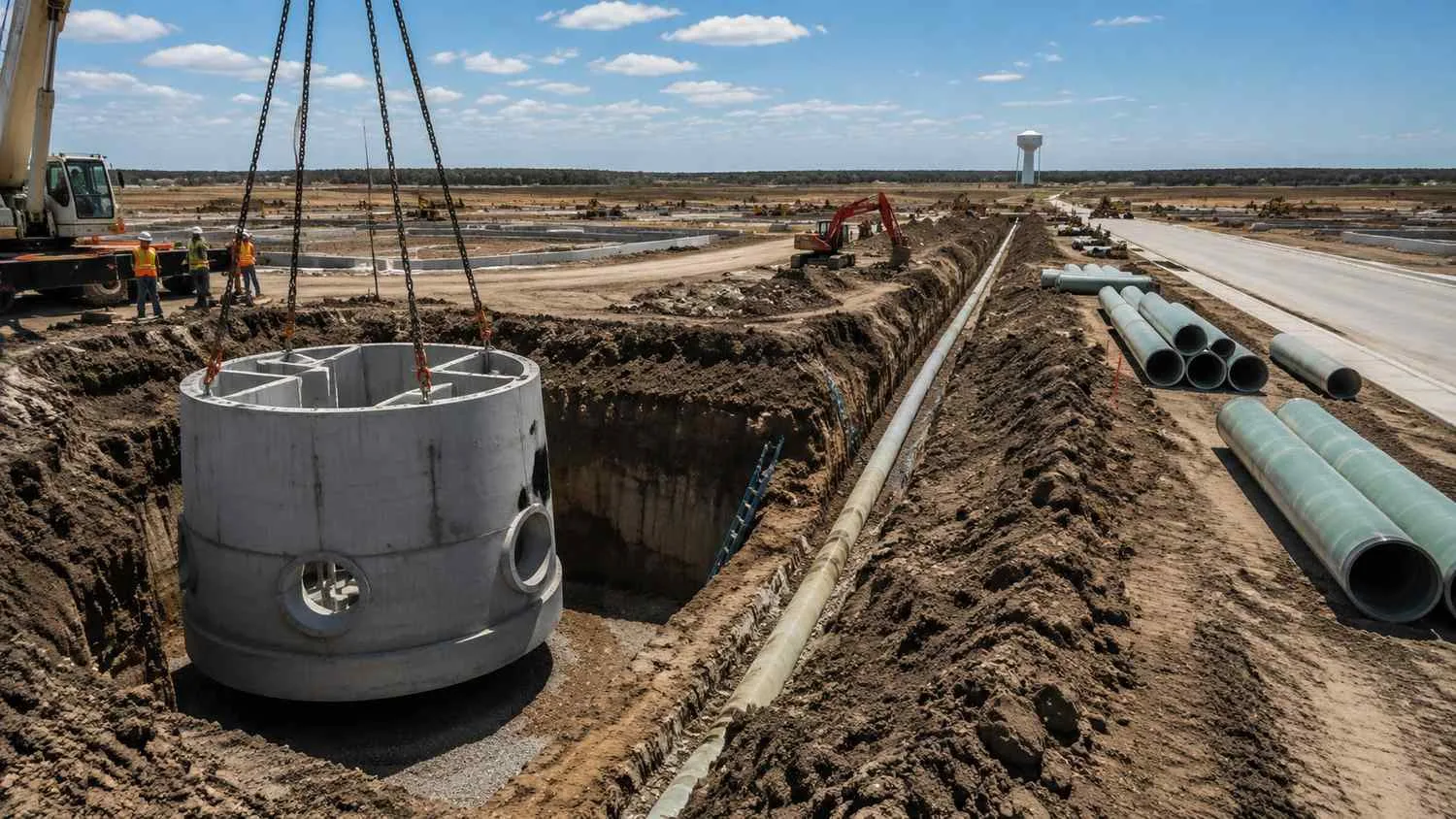
The default is the whole basin; a partial build needs approval. The manual allows a lift station only after every other way to move the flow has been investigated. A station's firm pumping capacity must exceed the wet weather peak flow of the entire drainage basin. Where the basin is much larger than the development, the Director of Engineering can approve a station sized for part of it with the ability to expand.
Every station needs at least two pumps and must handle wet weather peak flow with one out of service, and each pump must run at no less than 60 percent efficiency at its operating point. That efficiency floor is one more reason to size the first pumps for the first phases.
Watch the force main. The manual recommends at least 3 feet per second and sets a floor of 2.5 feet per second with only the smallest pump running. A force main sized for ultimate flow can miss that floor at phase-one flows, which is why the manual also allows a force main designed for part of the basin with room to expand. Here is how force main and pump sizing calculations work.
When do phased public improvements have to be built?
Before you cross half the tract. Section 301E of the code says no property may be subdivided or phased to avoid required public improvements. For phased construction, all required public improvements must be built before filing the final plat that, with earlier final plats, covers more than 50 percent of the parent tract's gross developable land area.
A facilities agreement under Section 302A can defer, delay or share the cost of improvements, and the city may participate in lift stations and oversized utilities that serve more than your subdivision. Build that agreement into the phasing plan, not after it.
How does a private plant phase its permit?
Through interim and final phases in one permit. TCEQ's domestic wastewater technical report (form TCEQ-10054) asks for the design flow, 2-hour peak flow and construction dates of an Interim I, Interim II and Final phase. Applicants must justify the need for any phase not yet permitted.
Growth then triggers planning. Under 30 TAC §305.126, when flow reaches 75 percent of the permitted flow for three consecutive months, the permittee must start engineering and financial planning for expansion. At 90 percent, it must obtain authorization to build. A package plant sized for the first phase can carry early flow while the next phase is designed.
Reuse fits here too. Treated effluent can irrigate parks and common areas under 30 TAC §210.32, which treats residential irrigation as Type I use and restricted-access irrigation, such as a golf course at night, as Type II. Size storage for each phase's effluent and irrigation demand.
Does the regional system phase too?
Yes, and its timeline matters to yours. NTMWD's Sister Grove Regional Water Resource Recovery Facility was built for growth in the northern part of its regional system. NTMWD says it is permitted for 64 million gallons per day of annual average flow, with Phase I at 16 million gallons per day and construction of Phase II, to 32, under way since September 2025.
Your community's later phases depend on the city's mains and on regional capacity behind them. Ask the city early which capital projects your buildout relies on.
Who should own the system at buildout?
Decide before phase one. Inside the city, public water and sewer improvements are dedicated to McKinney and accepted by the Director of Engineering after final inspection.
Outside it, a municipal utility district can own the system, but under Texas Water Code Section 54.016 land in a city's limits or extraterritorial jurisdiction cannot be included in a district without the city's written consent. If a district is on the table, see our MUD developer partnership approach.
Is your wastewater plan ready for phase one?
Ready means every answer below is yes.
- Do you know whether the land is inside McKinney's CCN or another provider's?
- Are flows projected phase by phase and cumulatively, with peaking factors stated?
- Is the trunk sewer sized for the whole basin, including offsite areas?
- If a lift station is needed, is it justified against every gravity alternative?
- Does the force main hold 2.5 feet per second with the smallest pump at phase-one flow?
- Does the phasing plan account for the 50 percent improvements rule, or a facilities agreement?
- For a private plant, are the interim and final phases defined, with regionalization contacts made?
A note on limits: this is general education from McKinney's Engineering Design Manual Revision 7, its Unified Development Code, TCEQ rules and forms, and NTMWD's public pages as of October 2026. Service boundaries and capacity are site specific, so confirm them with the city and the provider.
Frequently asked questions
Can we start on a package plant and connect to city sewer later?
Not inside McKinney's CCN, where the manual does not authorize the plant at all. Outside it, a temporary plant is a common bridge, but plan the connection route, the plant's decommissioning and the permit amendment from the start.
I'm developing a 600-acre community in McKinney's ETJ, and the nearest city main is two miles away. Can TCEQ refuse a permit for our own plant?
It can deny or alter a permit based on need and the availability of regional systems under Texas Water Code §26.0282. TCEQ says a system within three miles is not an automatic denial, but you will need service requests, the replies and a cost comparison.
How far out should the first wastewater plan look?
To full buildout. The trunk sewers, lift station sites and permit phases set in year one decide how cheaply phase ten connects.
I'm a land planner laying out phase one of a McKinney community with a low corner that will not drain to the trunk. Will the city approve a lift station?
Only if the Director of Engineering agrees after you show that every gravity alternative was investigated. Expect to submit a preliminary design report with a basin map, and to keep the station at least 150 feet from homes and 100 feet from residential lots.
Related resources
- McKinney Utility Availability Study: What Developers Need Before Submitting a Plat in Collin County's Fastest Growing City
- NTMWD Connection vs. Private Treatment: The McKinney Developer's Guide to Choosing the Right Wastewater Path
- Flow Rate Projections: How to Size a Wastewater Treatment Plant for Your Development Without Over-Building
- Impact Fees and CIP Timing: Why Phasing Costs Blindside Developers When the Capital Improvement Plan Schedule Does Not Match Their Build Out
Phasing wastewater for a Collin County master planned community?
We map who serves the land, project flows for every phase, and size the sewers, lift stations and permits so phase one does not box in phase ten.
We specialize in:
- Wastewater collection and trunk sewer design
- Lift station and force main design
- Package wastewater treatment plant design
- TCEQ wastewater permitting, including TPDES and TLAP
- Reclaimed water system planning under Chapter 210
- Site feasibility and utility due diligence
Modern Engineering Solutions, McKinney, Texas. Contact: (214) 833-6748 or mod-eng.com
Talk to an engineer
Tell us about your project
An engineer reads it
Not a salesperson. Someone who can tell you whether the pathway is real.
You get a first answer
Your options, the agencies involved and the questions that decide cost and schedule.
You decide
No commitment to have the first call.
Prefer the phone? (214) 833-6748