Quick Answer
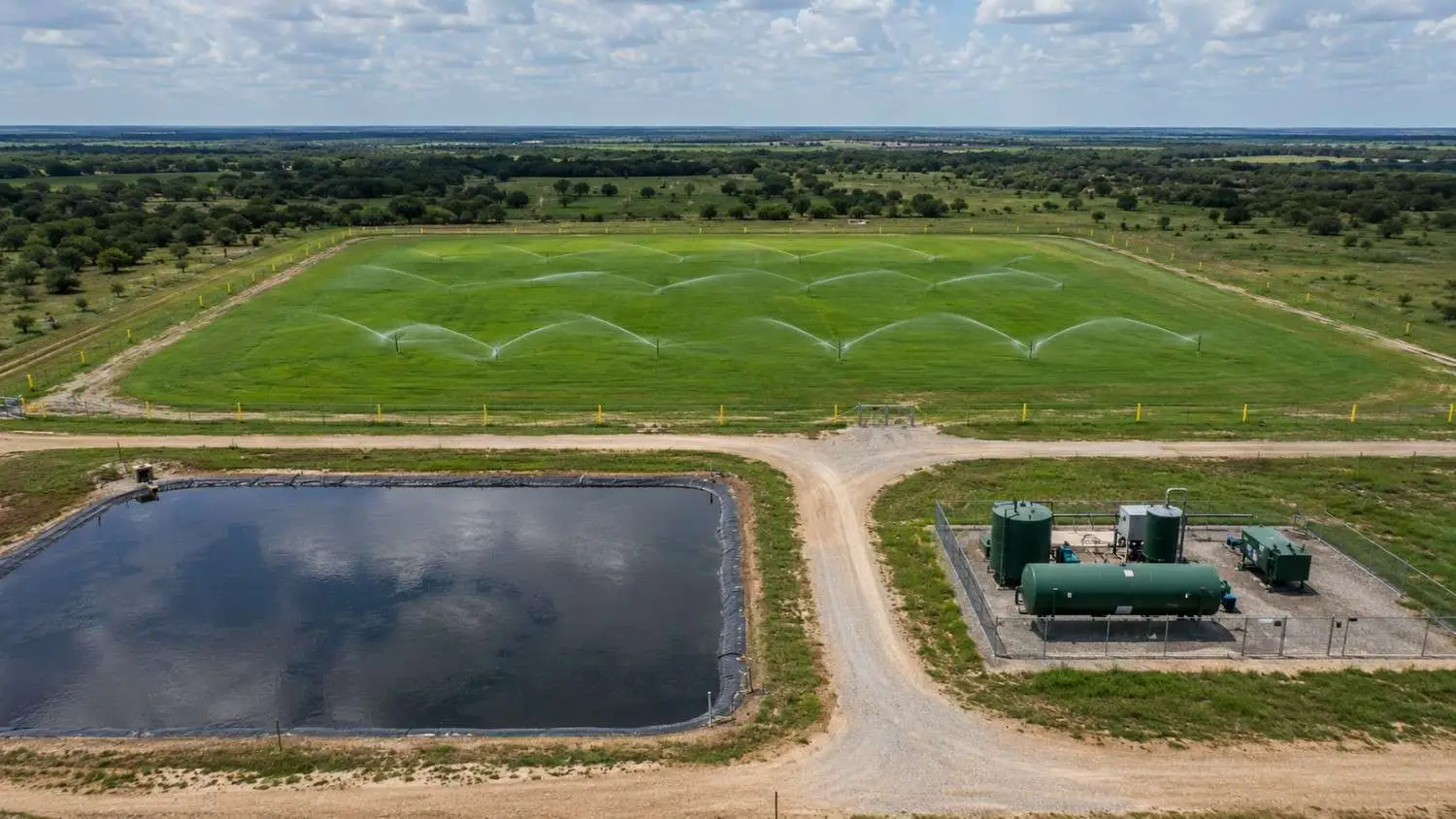
A Texas Land Application Permit authorizes treated wastewater to be managed on land rather than discharged to a creek, river, or other surface water. TCEQ issues TLAPs under the TPDES program for projects where treated effluent can be applied through spray irrigation, subsurface drip systems, subsurface area drip dispersal systems (SADDS), or evaporation ponds. Each method works differently, requires different site conditions, uses different land areas, carries different treatment standards, and creates different operational obligations. Choosing the wrong method early based on a general preference rather than a site-specific engineering evaluation adds months to the permit timeline, forces site plan revisions, or creates unexpected construction costs that could have been avoided with an honest feasibility assessment before the application was written.
What a TLAP Actually Does
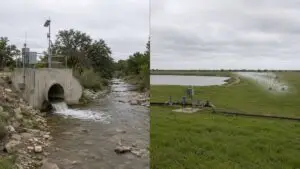
A Texas Land Application Permit authorizes a specific facility to apply treated wastewater to a specific land area through a specific approved method. The permit does not authorize discharge to a surface water body. Effluent is distributed to the land application area where it is absorbed by soil, taken up by vegetation, or evaporated without reaching a named creek, drainage ditch connected to a waterway, or other receiving stream.
Because there is no surface water discharge, TCEQ’s review does not require a receiving water quality analysis, antidegradation review, or downstream impact assessment. That removal significantly shortens the technical review compared to a TPDES discharge permit. TCEQ requires applications to be submitted at least 330 days before the planned operational date for TLAP facilities, and well-prepared applications on qualifying sites have been approved in 10 to 18 months: substantially faster than the 24 to 36-month track for discharge permits at similar facilities.
What TCEQ does review in a TLAP application is the land application method, the soil conditions at the application site, the hydraulic loading rate calculations, the agronomic analysis for nutrient management, the water balance under 30 TAC §309.20, the storage capacity, and the treatment system’s ability to produce effluent appropriate for the proposed application method. Each of these requires site-specific engineering, not generic assumptions.
Spray Irrigation
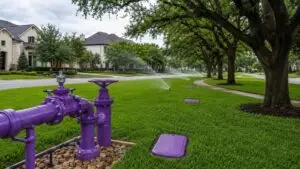
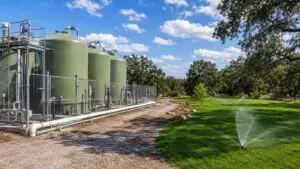
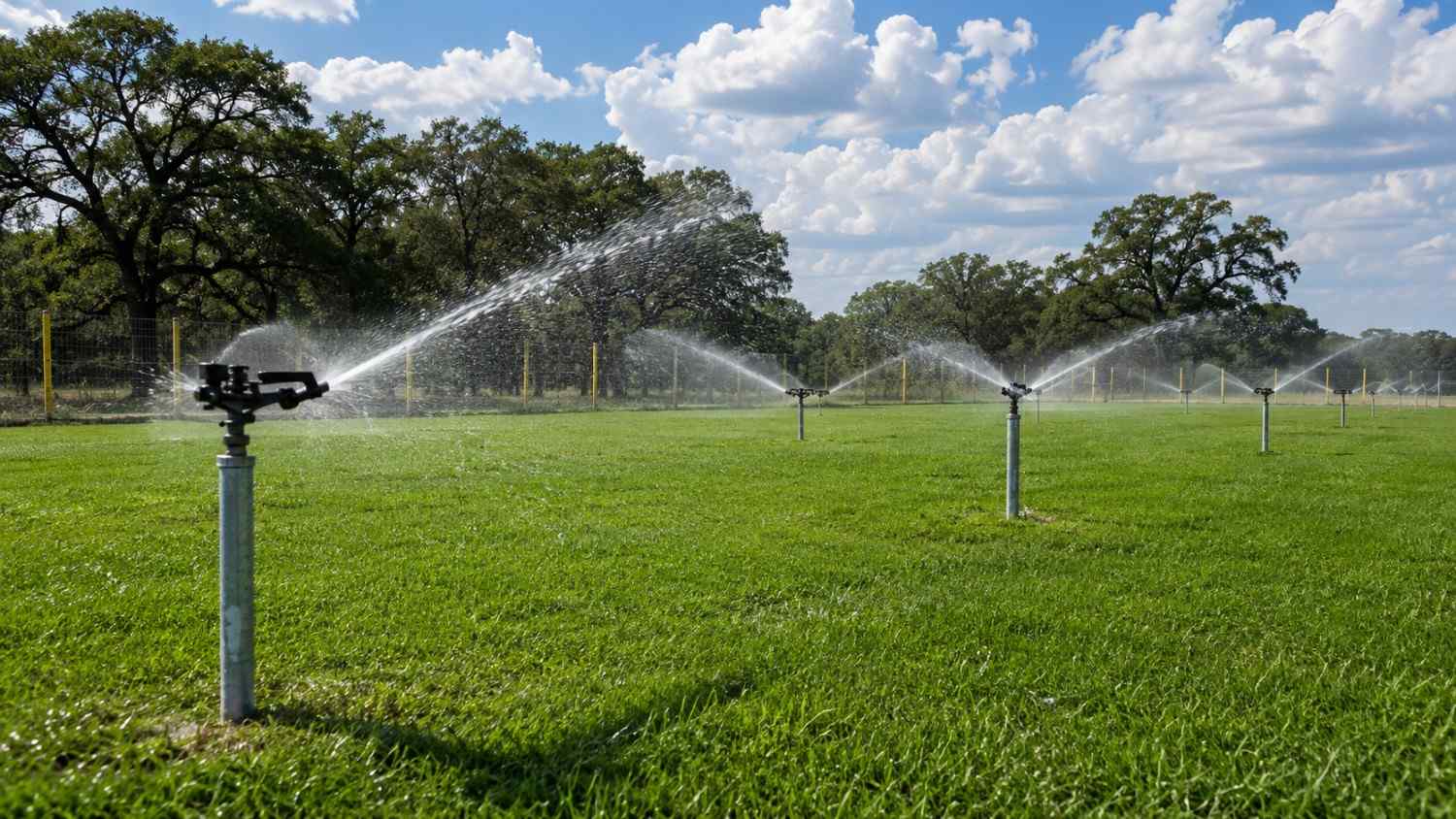
Spray irrigation distributes treated effluent over the land application area through spray nozzles mounted on risers, traveling guns, or center pivot systems. The effluent contacts the soil surface and vegetation, where it is absorbed and evapotranspirated.
Spray irrigation is the most widely used TLAP method in Texas. It is well understood by TCEQ reviewers, applicable to a range of site conditions, and produces effective disposal of secondary-treated domestic wastewater at standard hydraulic loading rates. For agricultural irrigation in Central Texas, the standard planning rate is approximately 2,000 gallons per day per acre for grass and tree crops. A 300,000 GPD facility requires roughly 150 acres of confirmed spray irrigation area plus a properly sized storage reservoir per 30 TAC §309.20.
The primary constraint on spray irrigation is public access control. TCEQ requires that spray irrigation areas with public access be restricted during and immediately after application to prevent human contact with spray. This is straightforward for agricultural fields and golf course roughs but requires planning for common areas in residential developments. Setback requirements from property lines, water supply wells, public roads, and occupied structures are defined in the TCEQ rules and must be documented in the permit application. Wind drift controls and buffer zones apply at sites where spray during operations could reach adjacent properties or public areas.
Spray irrigation does not work on steep slopes, where ponding or runoff would occur, or on sites with shallow groundwater that cannot accommodate the proposed hydraulic loading without creating a groundwater mounding problem. Sites with expansive clay soils that do not drain readily between applications require more conservative loading rates and larger land areas for the same daily volume.
Subsurface Drip Irrigation
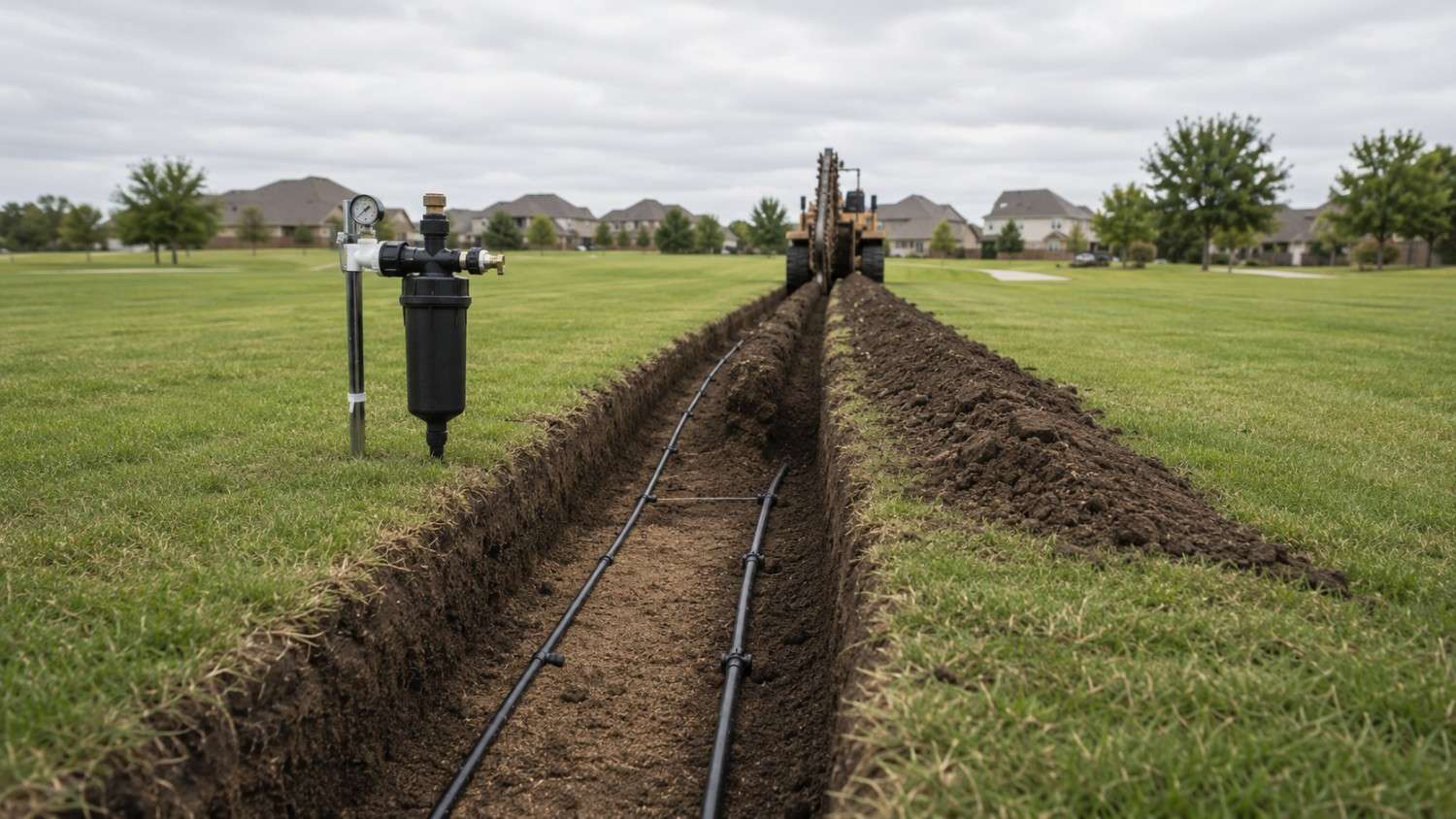
Subsurface drip irrigation delivers treated effluent below the soil surface through low pressure emitter tubing installed at a defined depth in the root zone. Effluent is applied uniformly and slowly, allowing direct root uptake and soil absorption without surface contact.
Subsurface drip eliminates the public access and spray drift concerns associated with above-ground spray irrigation, making it well-suited for residential common areas, amenity spaces, golf course greens and fairways, and other areas where unrestricted public access is expected or where spray drift would be objectionable or non-compliant.
The engineering constraints for subsurface drip are different from spray. The emitter tubing must be installed at the correct depth for the soil type and the root zone of the planned vegetation. The tubing is susceptible to root intrusion over time, which requires periodic maintenance and eventual replacement. The system requires filter equipment to prevent emitter clogging and a pressure management system to ensure uniform application across the field. These operational requirements are more complex than spray irrigation and need to be factored into the O&M plan and cost estimate.
Hydraulic loading rates for subsurface drip systems are calculated based on the soil’s permeability and the root zone depth, and may be higher or lower than spray irrigation rates depending on site conditions. TCEQ reviews the hydraulic loading analysis for subsurface drip as part of the permit application, and the loading rate must be supported by soil investigation data, not general soil survey maps.
Subsurface Area Drip Dispersal Systems
A SADDS (Subsurface Area Drip Dispersal System) is a specific type of subsurface application used for smaller-scale facilities where the treated effluent volume is low enough that distributed application over a managed area can achieve disposal without a large open irrigation field.
SADDS systems are commonly used for individual facilities, rural commercial sites, and small-scale residential developments where the daily flow is modest (typically below 30,000 to 50,000 GPD depending on site conditions) and where a large spray field is impractical or the site does not have the acreage for conventional spray irrigation at the required hydraulic loading rate.
The site requirements for a SADDS system are specific. The application area must have sufficient soil depth and permeability to accept the applied volume without saturation or surface breakout. Minimum setbacks from property lines, water supply wells, and surface water features apply and are more restrictive than for larger spray irrigation systems at agricultural use sites. The depth to seasonal high groundwater must provide adequate vertical separation from the application zone. Sites with limiting layers (claypan, caliche, or bedrock at shallow depths) require a more conservative hydraulic loading analysis or may not support a SADDS system at all.
SADDS are reviewed under TCEQ’s on-site sewage facility framework for very small systems or under the TLAP framework for systems above specified flow thresholds. The applicable pathway depends on the specific flow volume and site classification and should be confirmed with the engineer before the design approach is selected.
Evaporation Ponds
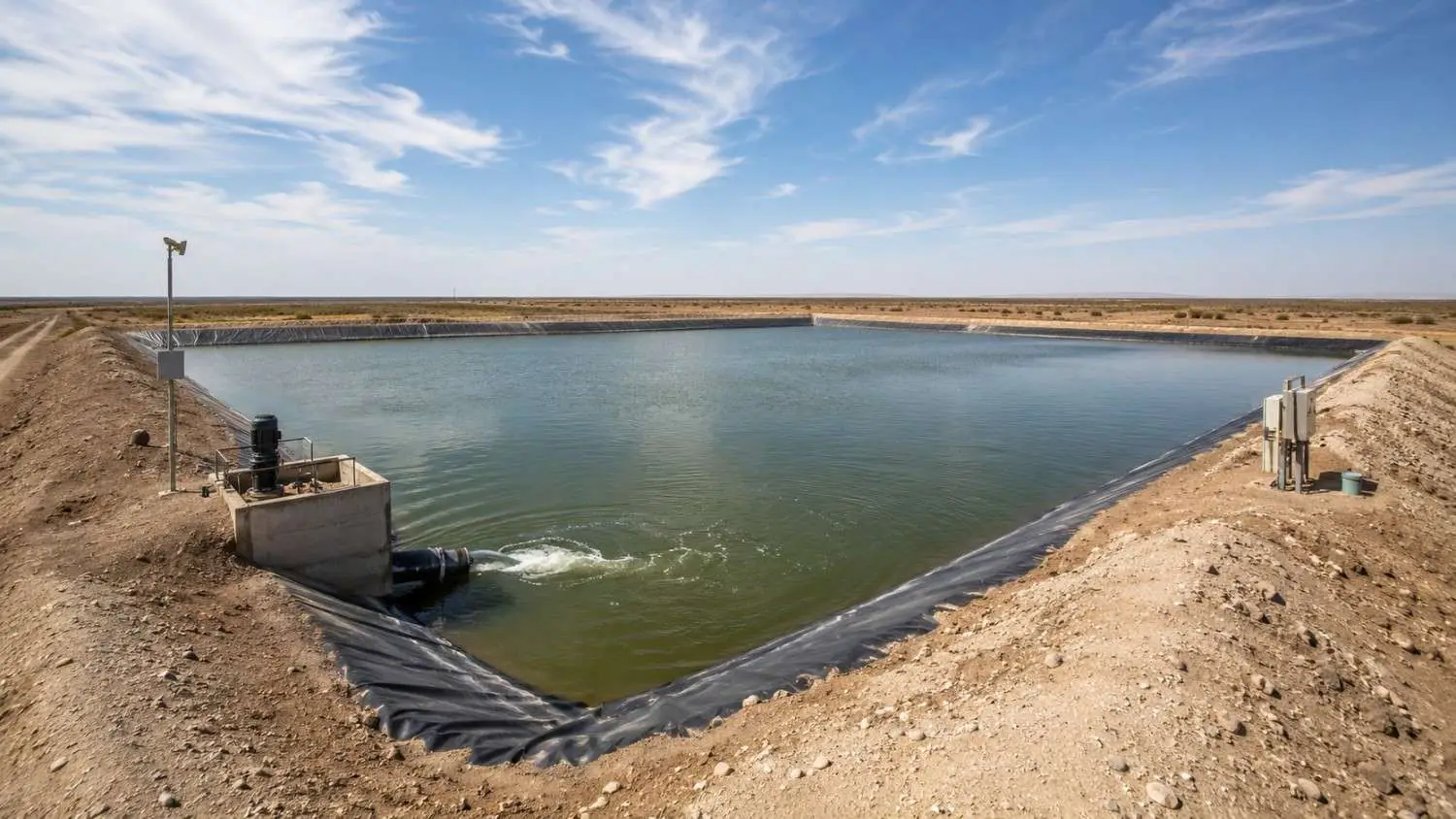
Evaporation ponds store treated effluent and allow water to leave the system through surface evaporation rather than soil application. Effluent accumulates in the pond and is reduced in volume by evaporation, with dissolved solids concentrating over time.
Evaporation ponds work best in regions of Texas with high evaporation rates and low precipitation. Arid West Texas and the Permian Basin region are the primary areas where evaporation ponds are commonly used as a primary disposal method. In Central Texas, East Texas, and the Gulf Coast region, annual evaporation rates are lower and precipitation is higher, which means pond volume grows faster than evaporation can reduce it during wet periods and the pond must be sized for worst-case storage accumulation.
TCEQ reviews evaporation pond designs against a site water balance that accounts for monthly inflow from the treatment plant, monthly precipitation on the pond surface, monthly evaporation, and the pond’s berm elevation to confirm that the pond will not overflow during the worst-case wet weather period in the 25-year precipitation record. Ponds designed without worst-case precipitation data are consistently undersized, which generates permit deficiency notices and may require pond expansion or additional disposal capacity after permitting.
Evaporation ponds require liner systems to prevent groundwater contamination. The liner specification depends on the effluent quality and the site’s proximity to water supply wells or sensitive aquifer recharge zones. Ponds located within the Edwards Aquifer recharge or contributing zones face stricter liner requirements under TCEQ rules.
How to Choose Before the Permit Application Is Written
The selection between spray irrigation, subsurface drip, SADDS, and evaporation ponds should be made based on four factors evaluated site-specifically before the permit application framework is established.
Site acreage and soil conditions determine what is feasible at the parcel. A site with 200 acres of pasture adjacent to a 100,000 GPD development in a rural Central Texas county is a strong spray irrigation candidate. A golf course community with an irrigation demand for fairways and roughs can absorb its treated effluent through subsurface drip without a separate application field. A small rural commercial site generating 15,000 GPD in West Texas may be best served by an evaporation pond where evaporation rates are high. A site with limited acreage, constrained by neighboring properties, that generates 25,000 GPD may be the right candidate for SADDS. For sizing guidance, see flow rate projections and WWTP sizing.
Public access and land use at the application area determines whether spray is appropriate or whether subsurface application is required. Development programs that include common areas with unrestricted resident or visitor access need a method that does not create spray contact exposure.
Operational capacity of the owner or operator determines the complexity of system the facility can reliably maintain. Subsurface drip and SADDS systems have more operational maintenance requirements than spray irrigation, which in turn has more than an evaporation pond. A remote rural facility with infrequent on-site visits is better served by a simpler system with fewer mechanical components to maintain. For more on long-term compliance obligations, see ongoing compliance after permit approval.
Regulatory timeline and application readiness determine when the TLAP application can realistically be submitted. All four methods require site characterization data (soil investigation, topographic survey, proximity to wells and water features) that must be collected before the application is written. Projects that start the site investigation early have the information needed to make the method selection correctly and submit a complete application that does not generate deficiency cycles.
Frequently Asked Questions
Does a TLAP require a water balance study?
Yes. All TLAP facilities require a water balance analysis per 30 TAC §309.20 using worst-case 25-year precipitation data to demonstrate that the land application system can manage all treated effluent throughout the year without runoff reaching a water of the state. The water balance requirement applies to all application methods including spray irrigation, subsurface drip, and evaporation ponds. Applications submitted without a complete water balance study receive deficiency notices. See Water Balance Studies Under 30 TAC §309.20 for full detail on what is required.
Can spray irrigation and subsurface drip be combined in the same TLAP?
Yes. Some sites use a combination of application methods to manage effluent across different land use zones. A development might use subsurface drip for the residential common areas and spray irrigation for adjacent agricultural acreage. Both methods can be permitted under a single TLAP as long as each method’s requirements are satisfied in the application. For examples of how MES has structured combined reuse systems, see the Gateway Water Reclamation Facility project.
What treatment level is required before land application in Texas?
Secondary treatment (consistent BOD and TSS removal) with disinfection is the baseline for most TLAP applications. Depending on the application method, the proximity to public access areas, and the receiving soil conditions, additional treatment requirements including nutrient management or pathogen reduction may apply. Subsurface drip and SADDS systems typically require secondary treatment with disinfection. For a comparison of treatment requirements across permit pathways, see Your Three Wastewater Disposal Options in Texas.
Related Resources
- Your Three Wastewater Disposal Options in Texas: Discharge, Reuse, or Land Application
- Water Balance Studies Under 30 TAC §309.20: What They Require and Who Prepares Them
- Building a Private WWTP in Texas: What Developers Need to Know Before They Commit
- How Carrying Costs Are Killing Texas Development Projects and the Permit Strategy That Fixes It
Evaluating a Texas Land Application Permit for Your Development or Municipal Facility?
Modern Engineering Solutions works with Texas developers and municipalities to evaluate TLAP feasibility, select the right application method for the site, and prepare complete TCEQ applications that move through review without deficiency cycles.
We specialize in:
- TLAP feasibility evaluation and application method selection for Texas rural and development sites
- Spray irrigation, subsurface drip, SADDS, and evaporation pond system design and TCEQ application preparation
- Water balance studies per 30 TAC §309.20 using worst-case 25-year precipitation data
- Site characterization including soil investigation, hydraulic loading analysis, and agronomic evaluation
- TCEQ coordination and complete permit application preparation for Texas land application projects
Modern Engineering Solutions, McKinney, Texas. Contact: (214) 833-6748 or mod-eng.com