
Blog
Construction General Permit TXR150000: What Texas Developers Need to Know Before Moving Dirt
Construction General Permit TXR150000 covers Texas sites disturbing an acre or more, so know who files the NOI, what the SWP3 needs and when coverage ends.
Before you disturb an acre or more of Texas soil, you need coverage under TCEQ's Construction General Permit TXR150000. That starts with a written stormwater pollution prevention plan (SWP3), then a posted site notice for sites under five acres, or an electronic Notice of Intent and a site notice for larger ones. Coverage lasts until the site is stabilized and you formally close it out.
What is Construction General Permit TXR150000?
It is TCEQ's Texas Pollutant Discharge Elimination System (TPDES) general permit for stormwater from construction sites. The current version took effect March 5, 2023 and expires March 5, 2028.
It covers runoff from clearing, grading and excavating, and from support activities within a mile of the site, such as staging, borrow areas and batch plants serving only this project. Inspectors check you against the 2023 TXR150000 permit, and TCEQ's construction stormwater page has the current forms.
Does your project need coverage?
Yes, if it disturbs one acre or more, or less than an acre that is part of a larger common plan of development or sale that will disturb an acre or more.
Count disturbed land, not the building footprint: parking, utility trenches, stockpiles and staging all count. A subdivision built in phases is still one plan. Projects inside a larger plan can be treated separately when they sit a quarter mile or more apart with undisturbed ground between them.
Do you file an NOI or post a site notice?
That depends on size. A large site, five acres or more counting the common plan, needs a Notice of Intent (NOI) from each primary operator. A small site, one acre to under five, posts a signed site notice instead.
On a large site, primary operators file the NOI electronically through TCEQ's ePermits system in STEERS. Each operator posts a site notice (Form TCEQ-20961 for primary operators, TCEQ-20962 for secondary). Two days before work starts, the primary operator sends a copy of the signed NOI to any secondary operator and to the operator of the municipal separate storm sewer system (MS4) that receives the runoff.
On a small site, nobody files an NOI unless TCEQ asks. Operators implement the SWP3 before starting, and at least two days ahead they post a signed Small Construction Site Notice (Form TCEQ-20963) and send a copy to the MS4 operator. The MS4 operator is the public body, such as a city or county, whose storm sewer takes your runoff; here is how Phase II MS4 permits work for small Texas cities.
How soon can grading start after you file?
With an electronic NOI, coverage starts when TCEQ confirms receipt. The seven-day lead time people quote applies only to paper NOIs filed under an electronic reporting waiver.
Paper filers send the NOI at least seven days ahead and are provisionally covered 48 hours after the postmark. Since the MS4 copy of the signed NOI is due two days before work starts, file at least that early. A late NOI is allowed, but TCEQ can still take enforcement action for work done before coverage. Sites under the Edwards Aquifer rules in 30 TAC Chapter 213 also wait on those requirements.
Who is the operator, the owner or the contractor?
Often both, in different roles.
A primary operator controls the plans and specifications, or directs the day-to-day work the plan requires. A secondary operator, often the owner, only hires contractors or approves plan changes. A secondary operator skips the NOI when a primary operator has filed, but still posts its own notice and copies the MS4 operator. Coverage does not transfer: a new primary operator files its own NOI at least 10 days before taking over. For developers and builders, settle these roles in the contracts before anyone mobilizes.
What has to be in the SWP3?
A site-specific plan, written before you get coverage and in use before any soil is disturbed.
Part III sets the minimum: the work sequence, pollutants, disturbed acreage, soil data and a site map showing drainage before and after grading, phasing, controls, surface waters within a mile downstream, discharge points and vehicle exits. On a large site, the NOI certifies the plan meets local erosion control requirements, so build it from the grading and drainage sheets the city reviews. That is routine civil engineering for Texas land development.
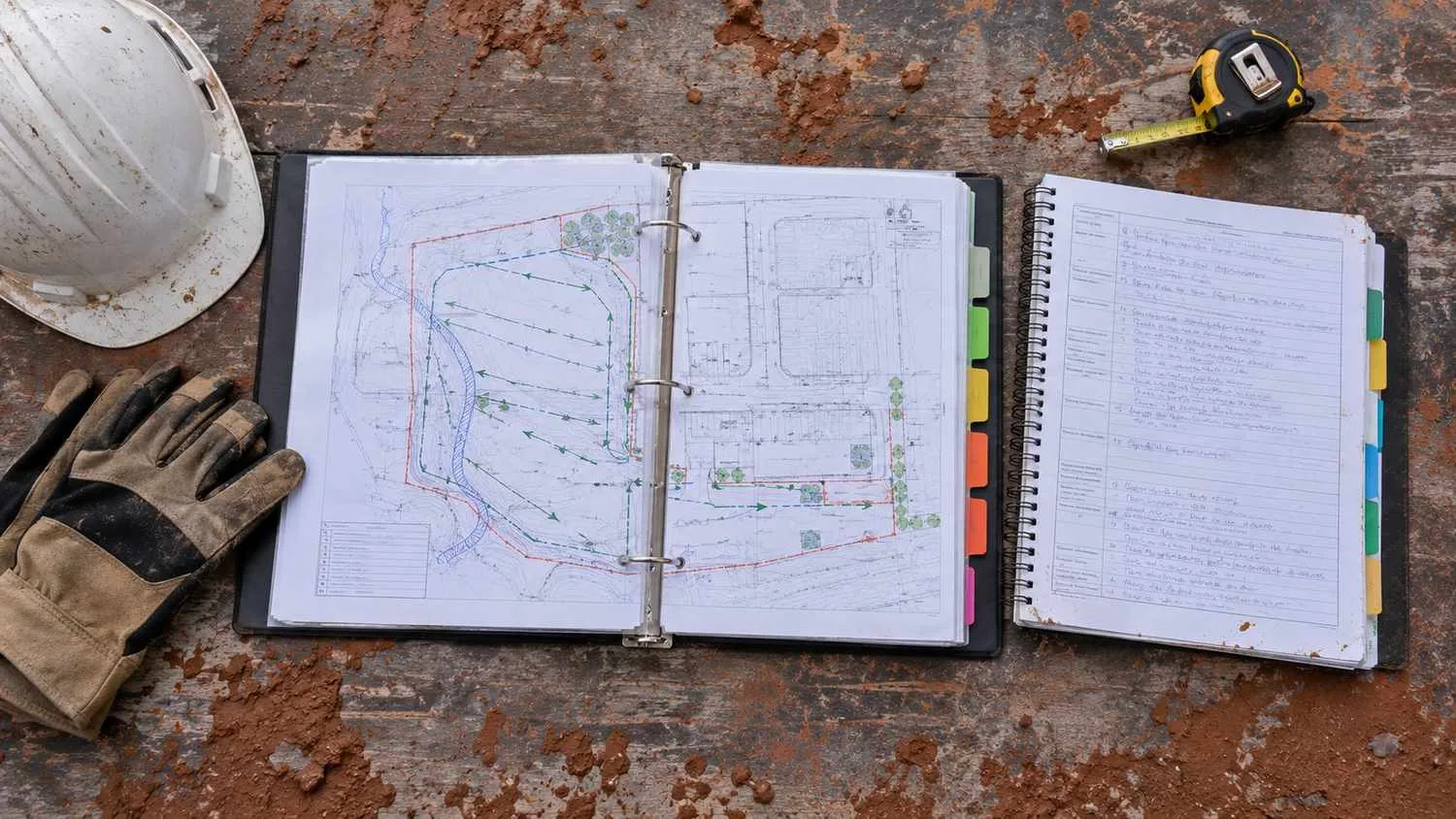
Keep the SWP3 on site, or post where it is. Update it within seven days of a design change, a new operator or an inspection showing it is not working.
Which erosion and sediment controls does the permit require?
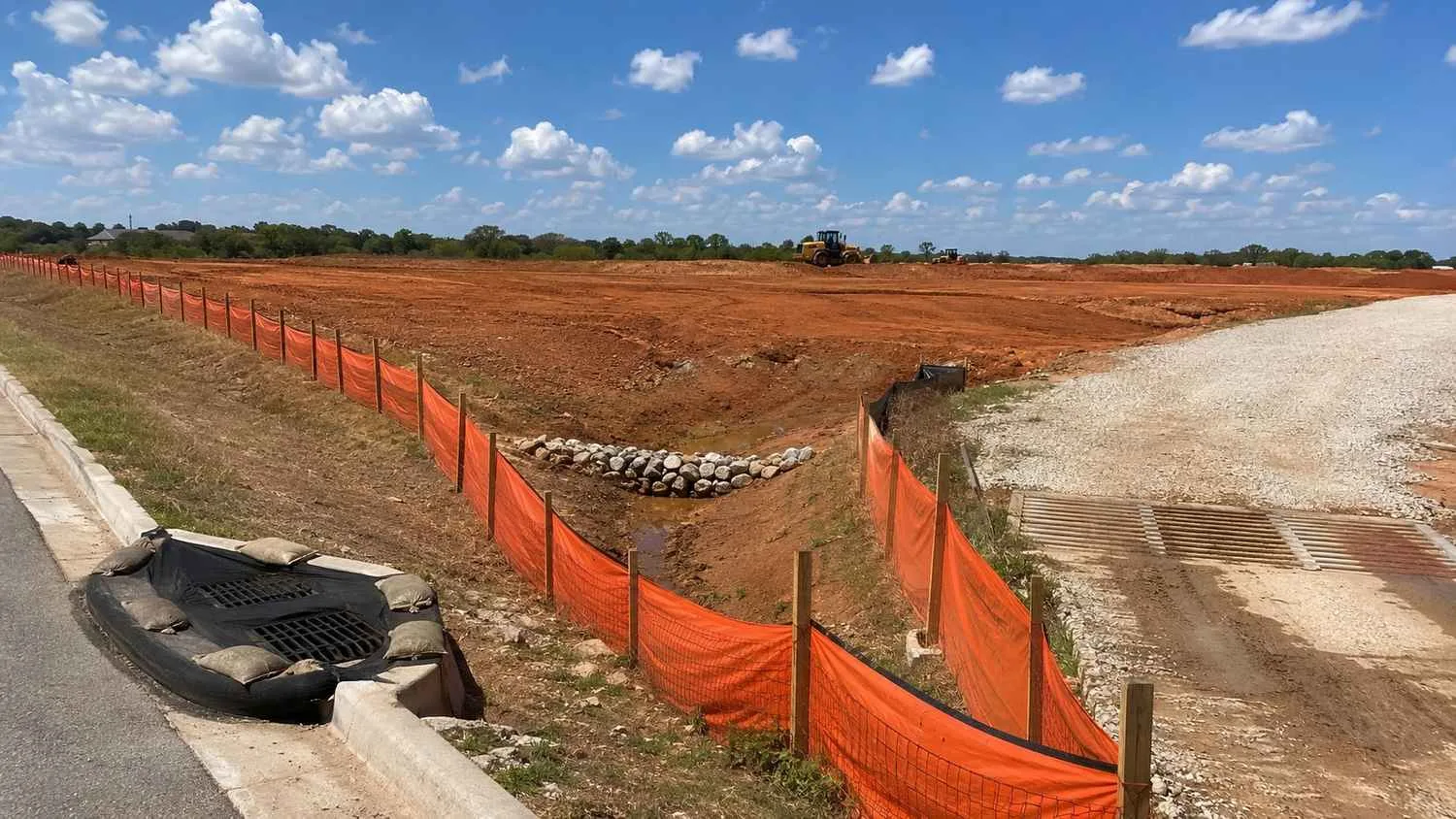
Controls fitted to your site, plus a few minimums. Silt fence, vegetative buffer strips or an equivalent control must line every downslope boundary.
Where one drainage location serves 10 or more acres disturbed at a time, a sediment basin is required where feasible. It must hold the runoff from a 2-year, 24-hour storm for each disturbed acre drained, or 3,600 cubic feet per acre when that calculation cannot be done. If a basin is not feasible, document why and use equivalent controls.
When work in an area stops for good, or will stop for more than 14 days, start stabilizing by the end of the next work day and finish within 14 calendar days, with exceptions for frozen or arid conditions.
Vehicle exits need controls that minimize sediment tracked off site.
How often must you inspect the site?
At least once every 14 calendar days and within 24 hours after a storm of 0.5 inches or more. The alternative is every seven calendar days, rain or not, if the SWP3 says so.
Stabilized areas drop to monthly. Each inspection needs a report within 24 hours noting erosion, failed or missing controls and any noncompliance. A clean report must certify that the site complies. Plan revisions from an inspection are due within seven calendar days.
When does your coverage end?
When the site reaches final stabilization and you close it out. Finishing the building does not end it.
Final stabilization means uniform perennial vegetation at 70% or more of the native background cover on unpaved areas, or permanent measures such as riprap. NOI filers submit a notice of termination within 30 days of final stabilization and copy the MS4 operator; the permit applies until TCEQ approves it. Small sites and secondary operators remove the site notice, complete its removal section and send a copy to the MS4 operator within 30 days. Keep the plan, reports and NOI data for three years after coverage ends.
What happens if you move dirt without coverage?
You are discharging without authorization, and filing later does not erase that period.
The permit makes any broken condition, even a missing site notice or skipped inspection, a violation of the Clean Water Act and Texas Water Code, with penalties under Water Code Chapter 7.
Are you ready to move dirt?
You are ready when all six answers are yes.
- Have you totaled every acre you will disturb, including staging, stockpiles and the rest of the common plan?
- Do you know whether the site is small or large, and which filing applies?
- Is every operator named, with its role and its SWP3 tasks?
- Is the SWP3 written, site map included, and does it meet the local erosion control rules?
- Will the MS4 operator have your NOI or site notice at least two days before work starts?
- Is an inspector assigned, with a 14-day or 7-day schedule in the plan?
Settle any no before the grading crew mobilizes.
Questions for your engineer and contractor: Who signs the NOI? Which inspection schedule fits the season? Does any drainage area reach 10 disturbed acres?
A note on limits: this is general education from the 2023 TXR150000 permit as of October 2026. TCEQ is renewing it, so check the version in effect when you file, plus your city's rules. TCEQ's page also says applications for construction tied to a data center are on hold under a Governor's directive.
Frequently asked questions
Is an SWP3 the same as a SWPPP?
Yes. TCEQ's permit calls the stormwater pollution prevention plan an SWP3; SWPPP is common shorthand for the same plan.
Does a small construction site need an SWP3?
Yes, unless it qualifies for the low erosion potential option or a low rainfall erosivity waiver. Small sites skip the NOI, not the plan.
I'm developing a 40-lot subdivision outside Dallas and selling lots to two homebuilders as we go. Who is responsible for stormwater on the lots we sell?
Each homebuilder becomes a new operator for the lots it controls. You stay responsible for common controls and discharges, and you amend your SWP3 to remove the lots you sold.
I'm the general contractor on a 12-acre commercial site in Texas and the owner already filed an NOI. Do I need my own coverage?
Yes, if you direct the day-to-day work the SWP3 requires. That makes you a primary operator, and each one files an NOI. You can share the owner's SWP3 if it says who handles each requirement.
Related resources
- TPDES General Permit vs. Individual Permit for Construction Discharges: When the Standard Permit Is Not Enough
- Stormwater and Utility Coordination in McKinney's High Growth Subdivisions: Avoiding the Common Redesign Trap
- Texas Land Development Application Process
- Erosion and Sedimentation Control at the Discharge Point: What Inspectors Check When Test Water Hits Open Ground
Getting a Texas site ready to move dirt?
We prepare the SWP3 and erosion control plan alongside your grading and drainage design, so the permit, the plans and the contractor's schedule match.
Talk to Modern Engineering Solutions about your site, or call (214) 833-6748.
Keep reading
More to read.
Talk to an engineer
Tell us about your project.
An engineer reads it
Not a salesperson. Someone who can tell you whether the pathway is real.
You get a first answer
Your options, the agencies involved and the questions that decide cost and schedule.
You decide
No commitment to have the first call.
Prefer the phone? (214) 833-6748