

Executive brief
Your Drive-Thru Opening Pipeline Is Slower Than Your Pro Forma Assumes. Here Is the Actual Reason.
Ask a Director of Development at a fast-growing drive-thru brand what causes schedule variance in the opening pipeline, and you will hear the same answer: slow cities, problem franchisees, permitting delays.
That answer is not wrong. It is downstream of the real cause.
Chipotle's CFO said in early 2024 that build times had stretched from about 15 to 16 months to 21 to 22 months, citing permitting, inspection and utility installation delays (Restaurant Dive, February 2024). Chipotle's latest 10-K, filed February 2026, still says its construction timeline has gotten longer, in part because of "backlogs and long wait times" for permits and utility hookups.
The sites that slip are slipping because the engineer is meeting the city for the first time on your prototype. The conditional use permit nobody flagged, the design review package that reset the clock, the utility application that should have started six weeks earlier: each one is a surprise an engineer who has stamped dozens of the same building type has already absorbed.
The variance in your pipeline is not a project management problem. It is an engineering sourcing problem that shows up as a project management problem.
Here are the three delay types. All preventable. None of them show up in the permit portal.
The CUP Trap: The Hearing Nobody Scheduled Before the Lease Went Hard
The most common version: the site is commercially zoned, the lease executes, the engineer submits for a building permit, and the city flags that drive-thru use needs a Conditional Use Permit. A CUP brings public notice, a planning commission hearing and, in some cities, a council vote. Cities' own published estimates run from about three months (Wauwatosa, WI) to two to five months (Woodland, CA), and California law allows up to six months after an application is complete. All of it lands on top of the permit schedule you were tracking.
A hearing can also fail. In December 2024, the Richardson, TX city council denied a 7 Brew special use permit after its plan commission had recommended approval (Community Impact).
Salinas, CA went further: it required a full Planned Unit Development submittal before it would accept a building permit application at all, and no review clock started until the PUD was approved. A third version is CUP research done mid-review: on one Florida submittal, use codes were still being pulled during the building department's review. That research belongs before the LOI expires.
Diagnostic question: Before your LOI date expires, does your engineering team know whether drive-thru use needs a CUP in that specific city? Not the state. That city.
Two Clocks, One Opening Date: The Utility Track Your Permit Tracker Cannot See
Your civil permit and your utility service application run through different agencies on different clocks, and the permit has no view of the utility side. If they do not start together, the utility track becomes the critical path to your opening date, and you find out when the permit is approved and the GC is waiting on power.
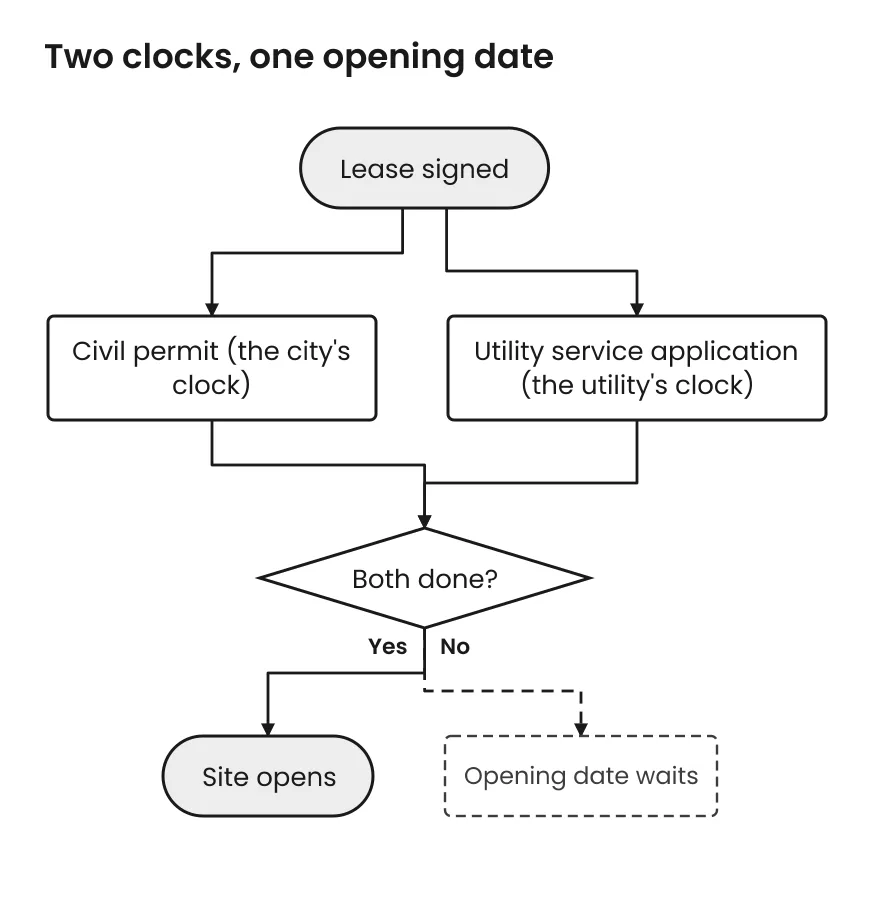
Duke Energy in Lake Wales, FL and the Indio Water Authority in Indio, CA each issued their own rounds of comments on utility service connections after the civil submittals were already in review. Neither appears in the permit portal, and both added weeks to opening dates the tracker showed as on schedule.
California adds a second parallel track in counties with design review authority. An engineer who does not know this submits for a building permit and waits. An engineer who knows it starts both tracks on the same day.
Diagnostic question: On your last 10 permitted sites, how many had the utility service application filed within one week of the civil permit submittal? If it is fewer than seven, your utility track, not your permit, is setting your opening dates.
Jurisdiction Variance: The Gap Nobody Puts on the Pro Forma
Small to mid-sized Texas cities such as Odessa, Bryan, Sulphur Springs, Rockdale and Hillsboro consistently run about 3 to 5 weeks from first submittal to permit on a standard pad, with predictable comment cycles.
Houston punishes incomplete submittals. Resubmittals through its ProjectDox portal must answer every reviewer comment, or the plans come back to the applicant (Houston Permitting Center). Houston also requires a legal form survey from a licensed surveyor at the first structural inspection to confirm building placement, a step few teams schedule.
Sacramento County required six simultaneous submittals to add colored elevations, a materials board, a 3D colored perspective, a parking count table and a landscaping plan for its Design Review Authority before the permits could advance. None of it was flagged at pre-application, and the comment package reset the clock on all six sites at once.
Holiday, FL required a meeting with its Planning Department before final approval, after every other department had approved the plans, because the scope removed parking.
Diagnostic question: For each state in your pipeline, do you have a written record of what each city asked for on this building type? If not, your knowledge resets every time a franchise partner hires a new local engineer.
What a Slipped Opening Costs Per Site
The engineer who has been through these problems absorbs the cost of discovery. The engineer meeting them for the first time charges you for the education, and you pay it twice: in lease carry and in sales that have not started.
The formula: delay cost per site = months delayed × (monthly lease carry + monthly sales deferred). MES's benchmark for carry on a retail endcap is $8,000 to $15,000 a month. Dutch Bros reported a systemwide average unit volume of $2.16 million (SEC 8-K, Q1 2026), about $180,000 a month in deferred sales for every month a shop does not open. A six-week slip is $11,000 to $21,000 of carry per site; across a 50-site rollout, that is $0.55 million to $1.05 million in carry alone.
The brands that open on schedule are not getting through permitting faster. They hire engineers who have already paid the discovery cost, and they ask one question before signing: how many sites of this building type has this engineer stamped in this state?
Modern Engineering Solutions has delivered 525+ projects and is licensed in 9 states (TX, CO, CA, OK, NV, AZ, FL, KS, NM), with 165+ small-footprint sites behind it. First permit submittal in 1 to 2 weeks, 24-hour turnaround on city comment responses and per-site lump-sum pricing.
If you want to run this diagnostic against your current pipeline, I am available for a direct conversation.
Michael Groselle, P.E. | CEO, Modern Engineering Solutions | mike@mod-eng.com | (214) 833-6748
Talk to an engineer
Tell us about your project
An engineer reads it
Not a salesperson. Someone who can tell you whether the pathway is real.
You get a first answer
Your options, the agencies involved and the questions that decide cost and schedule.
You decide
No commitment to have the first call.
Prefer the phone? (214) 833-6748