
Blog
Unlocking The Power of the Rural Water Assistance Fund for Your Community
The Rural Water Assistance Fund lends to small rural Texas water and sewer utilities; see who qualifies, what it funds and why it has no open call now.
The Rural Water Assistance Fund (RWAF) is a Texas Water Development Board (TWDB) loan program for small rural water and sewer utilities. It can pay for wells, lines, plants, water rights and consolidation, plus the planning and design behind them. The catch: TWDB is not taking RWAF applications on their own right now. Today the way in runs through TWDB's other programs, with your eligibility and water loss paperwork in order.
What is the Rural Water Assistance Fund?
It is a special fund in the state treasury that TWDB uses to lend to rural political subdivisions for water and water quality projects. The Legislature created it in 2001 because rural systems spread small populations over large service areas.
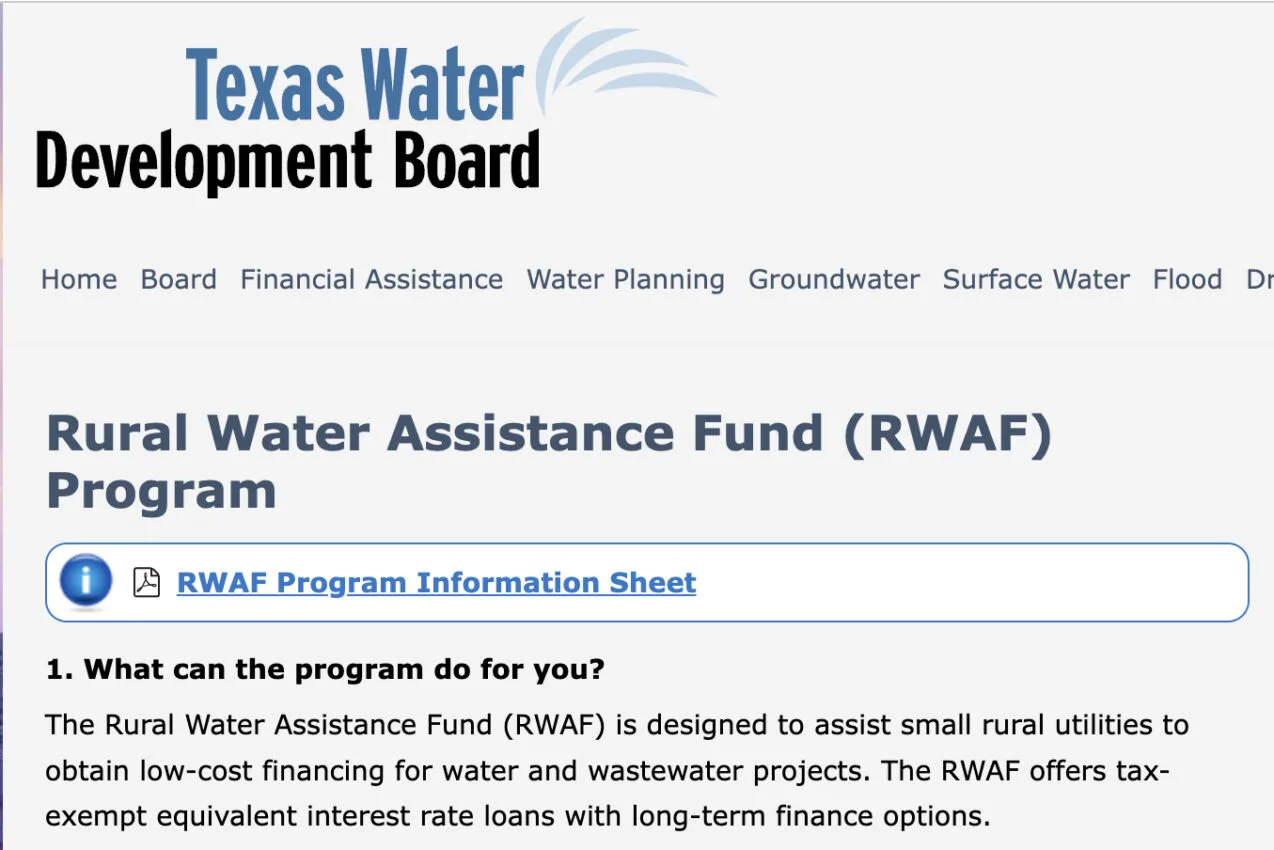
The law is Texas Water Code Chapter 15, Subchapter R. Section 15.994 authorizes low-interest loans, and also zero-interest loans, negative-interest loans, loan forgiveness and grants under criteria the board sets. Whether funding, grants included, is available depends on appropriations, board approval and available funds, per TWDB's RWAF program sheet (January 2025).
Is the RWAF accepting applications right now?
Not as a standalone program. TWDB's RWAF program page says it is not currently accepting applications, and the program sheet says there is no open solicitation.
Money still moves into it. The Legislature created the Texas Water Fund in 2023 through Senate Bill 28 and Senate Joint Resolution 75, and Water Code Section 15.502 lets the fund transfer money to the RWAF. TWDB's Texas Water Fund page says that fund cannot make loans or grants directly; it works through existing programs.
The program sheet says Texas Water Fund money has been allocated to the RWAF for water loss mitigation and for high-risk projects that applied through other TWDB programs. In short, you apply to an open TWDB program, and RWAF money may end up in the package. For news of a future round, TWDB points to its financial assistance mailing list.
Who qualifies as a rural political subdivision?
Small rural utilities and local governments that meet Texas Water Code Section 15.001(14). Population and the nearest urban area decide it.
- A nonprofit water supply or sewer service corporation under Water Code Chapter 67, or a district or authority, with no part of its service area in an urban area of more than 50,000 people.
- A city of 10,000 or fewer people with no part of its service area in an urban area of 50,000 or more, or a city located wholly in a county with no urban area over 50,000.
- A county with no urban area over 50,000.
- Another water supply corporation, district, city, county or political subdivision that shows the board it is rural, or that the project area is wholly rural.
Joint applications with a federal agency, a state agency or another rural political subdivision are allowed. Under Section 15.996, a nonprofit water supply or sewer service corporation can borrow on a promissory note and an attorney's opinion of its authority, without hiring bond counsel or a financial advisor.
What projects can RWAF money pay for?
Most capital work a small system needs, plus planning, design and permitting costs. Section 15.994 lists:
- Water and sewer infrastructure, wholesale or retail
- Desalination, well fields, and groundwater and surface water rights
- Onsite or wetland wastewater treatment
- Interim construction financing
- State or regional water plan projects
- Buying another utility or system
- Service to economically distressed areas
- Buying service from a neighbor, or consolidating and regionalizing systems
TWDB's program page adds sewer treatment plants, collection systems and nonpoint source pollution abatement. Check the consolidation item before you design a new plant. If a neighbor has capacity, buying service is an eligible project in its own right.
What are the RWAF loan terms?
The program sheet lists long-term fixed rates based on TWDB's cost of funds, 20- to 30-year repayment, tax exemption for project supplies, and no current maximum funding limit, subject to availability and board approval.
Under TWDB's RWAF rules, 31 TAC Chapter 365, a loan averaging more than 20 years needs a schedule from your engineer of the major components and their useful lives, and the debt's average weighted maturity cannot exceed 120 percent of the project's average useful life (Section 365.6). So a project heavy in buried pipe supports a longer term than one heavy in pumps and controls, which wear out sooner.
TWDB sets the fixed rate five business days before you adopt the ordinance or resolution authorizing your bonds, and no more than 45 days before the expected closing (Section 365.5).
What does TWDB require before it lends?
Proof you qualify, a preapplication conference and planning documents.
- A preapplication conference with TWDB staff to confirm eligibility (Section 365.21). Your Regional Project Implementation Team is the contact.
- Preliminary engineering feasibility, a preliminary environmental review, water conservation plans and resolved financial conditions before closing. A Texas professional engineer seals the feasibility report under TWDB's rule, 31 TAC §363.13.
- For a water supply project, consistency with the current state water plan.
- Water Use Survey responses on file for the last three years.
- A water conservation and drought contingency plan if you receive more than $500,000.
- U.S. iron and steel requirements.
If USDA Rural Development has already obligated money that would duplicate TWDB funding for the same project, or you canceled such an obligation, TWDB will not send your application to its board unless you show good cause (Section 365.24). The program page now lists the pre-design option in Section 365.23 as a previous option, so ask before planning around it.
How does water loss affect an RWAF loan?
It can decide whether you are eligible and how you spend part of the money.
Under TWDB's water loss audit rule, 31 TAC §358.6, a utility with an outstanding TWDB loan files a water loss audit every year by May 1. Since January 1, 2025, an applicant's latest audit must be validated before the board considers its request. Without a complete audit on file, a utility cannot get RWAF money for a water supply project.
Real loss thresholds are 30 gallons per connection per day for systems with 32 or more connections per mile and 57 for systems with fewer; apparent loss has its own allowed level for each utility. If total water loss meets or exceeds the threshold, part of any TWDB assistance for a water supply project must go to reducing it, unless the board waives that because the utility is already mitigating.
If you are over the line, build mitigation into the scope early. A detailed water loss analysis separates real losses, like leaks, from apparent losses, like meter and billing errors.
Is your system ready for the next round of RWAF funding?
A no on any of the first three stops you, so fix those first.
- Do you meet the rural political subdivision definition on population and service area?
- If you provide drinking water, is your latest water loss audit filed and validated?
- Are three years of Water Use Survey responses on file?
- Do you have a sealed preliminary engineering feasibility report covering purpose, population, alternatives, the existing system and maps?
- Is a water supply project consistent with the state water plan?
- Are your conservation and drought contingency plans adopted or ready?
- Is the work free of any duplicate USDA Rural Development obligation?
Then ask your engineer and TWDB staff which open program fits, whether water loss puts mitigation in scope, and what term the useful life schedule supports. More on how we work with small systems is on our pages for utilities and municipalities and project funding.
A note on limits: this is general education from public sources, current as of October 2026. RWAF status, funding and terms change with appropriations and board action, so confirm with TWDB before you plan a project around them.
Frequently asked questions
Is the RWAF only for drinking water projects?
No. It also covers water quality projects, including sewer infrastructure, wastewater collection and treatment, and onsite or wetland wastewater treatment.
Can a water supply corporation borrow from the RWAF?
Yes, if it is a nonprofit corporation under Water Code Chapter 67 and no part of its service area lies in an urban area of more than 50,000 people.
I manage a nonprofit water supply corporation in rural Texas, and our last audit shows real loss above the TWDB threshold. Will that keep us from getting a loan?
Not by itself. Under 31 TAC §358.6, part of any TWDB water supply assistance would go to mitigating water loss, unless the board waives that because you are already mitigating. A missing, incomplete or unvalidated audit is what blocks funding.
I'm the city administrator for a small Texas town, and USDA Rural Development has already committed money to our sewer plant. Can we also go to TWDB for the same project?
Not for duplicate funding. Unless you show good cause, TWDB will not take an application to its board when a USDA obligation would duplicate its funding for the same project. Raise it at the preapplication conference.
Related resources
- Unlocking the Potential of the Drinking Water State Revolving Fund (DWSRF) for Your Rural Water Community
- Unlocking Funding Opportunities: The Texas Water Development Board’s Clean Water State Revolving Fund (CWSRF) Loan Program
- Making the Most of the Economically Distressed Areas Program (EDAP) for Your Rural Water and Sewer System
- Revitalize Your Community with the USDA Water & Waste Disposal Loan & Grant Program in Texas
Is your rural water or sewer project ready for TWDB funding?
Send us your latest water loss audit, your system map and the project you have in mind. We will help you work out which TWDB program fits and what the feasibility report needs to show.
Modern Engineering Solutions, McKinney, Texas, with offices in Golden, Colorado and San Jose, California. 525+ projects completed.
Talk to an engineer about your funding plan or call (214) 833-6748.
Keep reading
More to read.
Talk to an engineer
Tell us about your project.
An engineer reads it
Not a salesperson. Someone who can tell you whether the pathway is real.
You get a first answer
Your options, the agencies involved and the questions that decide cost and schedule.
You decide
No commitment to have the first call.
Prefer the phone? (214) 833-6748