
Blog
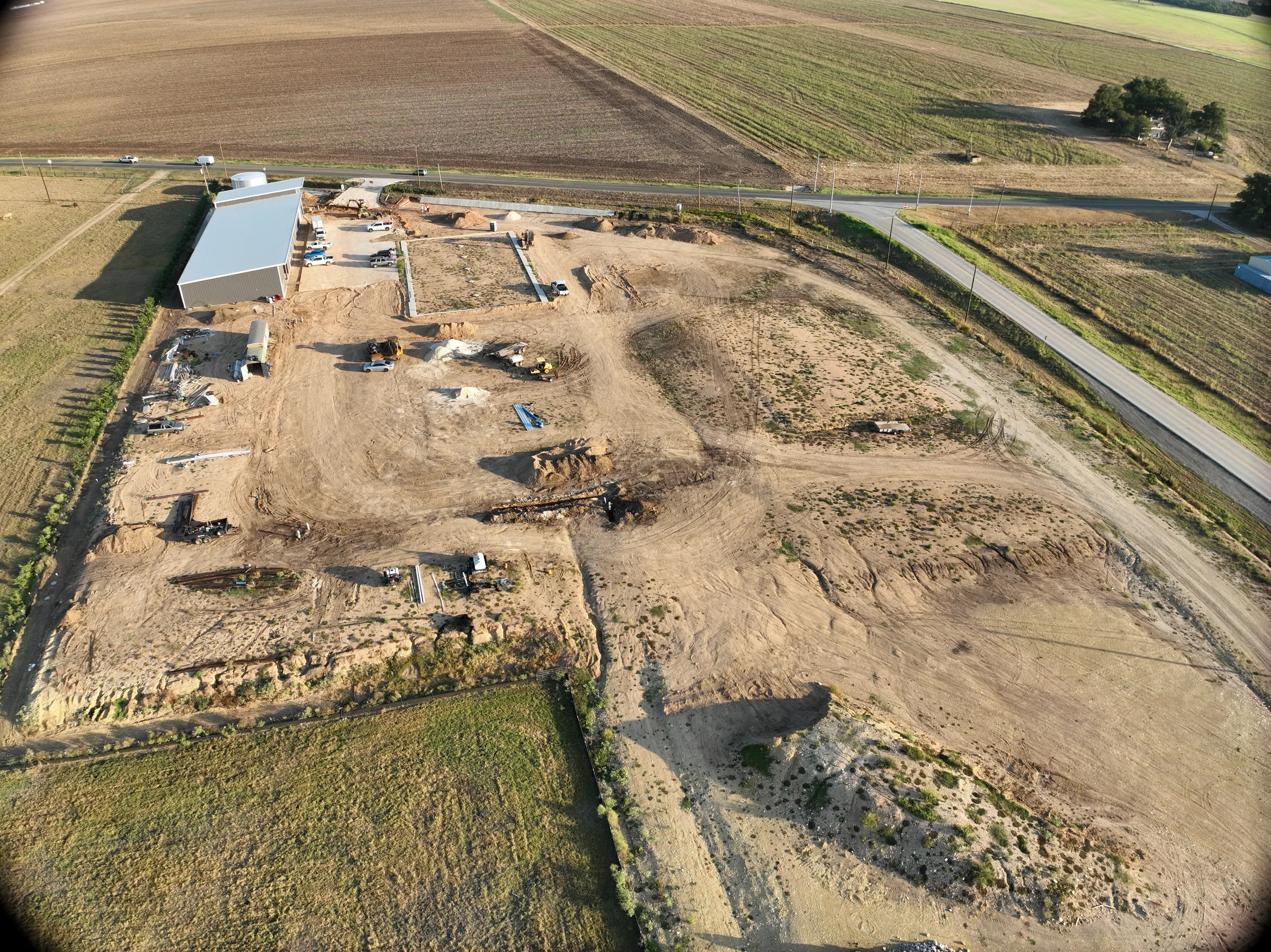
What variables do you see on the site that would impact the design of the leach field?
Leach field design starts with soil texture, groundwater depth, restrictive layers and slope, because any one of them can rule out a disposal method.
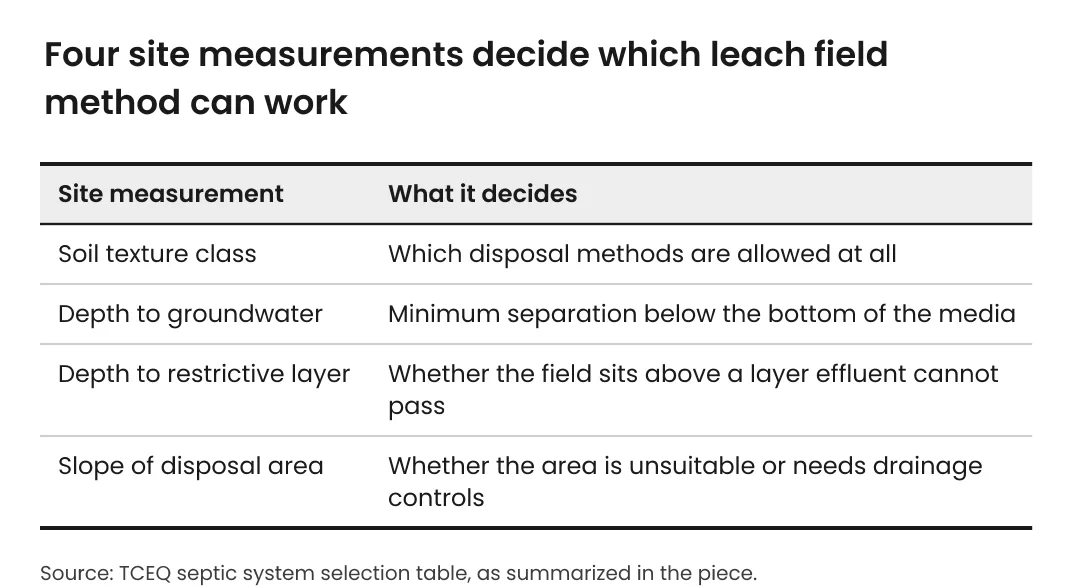
Four site measurements drive a leach field design in Texas: the soil texture class, the depth to groundwater, the depth to a restrictive layer, and the slope of the disposal area. TCEQ's septic system selection table reads all four before a drainfield is sized, and any one of them can rule a disposal method out.
Which site measurements decide whether a leach field works?
Soil texture, groundwater depth, restrictive layer depth and slope decide it, and each disposal method is judged against all four. Before an on-site sewage facility can be constructed, installed, altered, extended or repaired, the site has to be evaluated by a licensed site evaluator or a licensed professional engineer.
TCEQ's septic system selection table (opens in a new tab) takes the results of that evaluation and marks each treatment and disposal pairing suitable or unsuitable.
The table reads soil texture or fractured rock as Class Ia, Class Ib, II or III, Class IV, or fractured rock, and it takes the most restrictive class along the media. That single classification drives the rest of the table.
How does soil texture change the field design?
Texture decides which disposal methods are allowed at all, and one restrictive class is enough to remove a standard trench field. An absorptive drainfield with a septic tank is unsuitable in Class Ia soil, unsuitable in Class IV soil and unsuitable in fractured rock. It is suitable in Class Ib, II or III soil.
That is where the design splits. In Class IV soil, TCEQ's table still shows lined evapotranspiration beds and drip irrigation as suitable. A leaching chamber is not.
Where the soil will not take a trench field, the design moves to a method that stores the effluent for evaporation or applies it in small doses across a wider area.
A lined evapotranspiration bed puts an impervious liner between the excavated surface and the constructed disposal system. Drip irrigation uses small diameter pressurized lines with pressure reducing emitters spaced at a maximum of 30 inches.
How deep does groundwater have to be under the field?
Two feet is the usual minimum separation to groundwater, measured from the bottom of the media. The absorptive drainfield and leaching chamber rows both call for it with a septic tank. Drip irrigation on secondary treatment drops the requirement to one foot.
Depth to groundwater is a field measurement taken at the disposal area. A shallow water table removes methods from the table before anyone sizes a drainfield.
Where no porous media exists, TCEQ measures from the bottom of the excavation or the pipe, whichever is less.
What counts as a restrictive layer, and why does it stop a field?
A restrictive horizon is a layer the effluent cannot move down through, so the field has to sit above it with the separation the rules require. An absorptive drainfield and a leaching chamber both need two feet to it.
A pumped effluent drainfield on a septic tank reduces that to one foot, drip on secondary treatment reduces it to six inches, and a mound requires one and a half feet.
There is one relief in the table. An absorptive drainfield may be used where a rock horizon sits at least six inches above the bottom of the excavation.
How does slope limit where the field can go?
Slope can make an area unsuitable for a disposal method outright, and a nearly flat drainfield area triggers drainage controls. Where the slope in the drainfield area is greater than 30% or is complex, the table calls the area unsuitable for that disposal method.
A pumped effluent drainfield can only go where the slope is 2.0% or less, and a mound only where the slope is less than 10%.
At the other end, all on-site sewage facilities require surface drainage controls where the slope is less than 2%.
What else on the site changes the field design?
Treatment level and flood hazard both change what the table allows. Secondary treatment is a proprietary aerobic treatment unit or a standard intermittent sand filter, and it must be designed by a professional engineer or professional sanitarian.
It opens rows where the separation distances shrink and where a disposal method the septic tank row rules out becomes available.
If the on-site sewage facility sits within a flood hazard, TCEQ points to §285.31(c)(2) for special planning requirements on the layout.
Which method clears the table decides the field's footprint. The footprint then has to fit the usable open ground on your site plan, and that is the point where a plan problem becomes a design problem.
When should the site evaluation happen in a land deal?
Before the earnest money goes hard, because the evaluation's result decides whether the tract can be served at all. A developer who learns the soil class and the separation depths after closing has already bought the constraint. That is the order we work in with the developers and builders we serve.
Two questions are worth answering in writing before you close: which disposal methods the site's soil class allows, and how much usable ground the chosen method needs. Both come out of the site evaluation.
What should a developer check before signing a leach field design?
Work through this list before the design goes to pricing. Each item is a yes or a no, not a maybe.
- The site evaluation is signed by a licensed site evaluator or a licensed professional engineer.
- The most restrictive soil class along the media is written down.
- The depth to groundwater is measured at the disposal area.
- The depth to the restrictive horizon is recorded.
- The slope of the drainfield area is surveyed.
- The proposed disposal method appears as suitable for that soil class in TCEQ's table.
- The method's separation to groundwater and to the restrictive horizon is met.
- The flood hazard status of the field area is checked.
- The field footprint fits the usable open ground on the site plan.
The design is ready to price only when every item is yes. One no means the disposal method or the layout changes before anyone draws a plan.
Three questions for your engineer: which disposal methods does my soil class allow, what separation does each one need, and how much ground does the method you recommend take?
This article is general education on how TCEQ's on-site sewage facility table reads a Texas site. It is not a site-specific design and it does not say what your tract will be approved for. Your evaluator's field data and your engineer's design decide that.
Frequently asked questions
Who decides whether a leach field will work on my site?
A licensed site evaluator or a licensed professional engineer evaluates the site first. That evaluation sets the soil class, the groundwater separation and the depth to a restrictive layer, and those decide which disposal methods the table allows.
How deep does groundwater have to be under a drainfield?
Two feet below the bottom of the media for most disposal methods. Drip irrigation on secondary treatment drops it to one foot, and where no porous media exists the measurement runs from the bottom of the excavation or the pipe.
Can a leach field go on a steep slope?
Often it cannot. Where the drainfield slope is greater than 30% or is complex, the table calls the area unsuitable for that disposal method, and a pumped effluent drainfield is limited to slopes of 2.0% or less.
What happens if my soil is Class IV?
An absorptive drainfield with a septic tank is unsuitable in Class IV soil. Lined evapotranspiration beds and drip irrigation are still suitable, and surface application works with secondary or non-standard treatment.
Does secondary treatment make a tight soil work?
It widens the options. With secondary treatment, an absorptive drainfield becomes suitable in Class Ia soil and in fractured rock when disinfection is used, and drip irrigation with a filter needs one foot to groundwater and six inches to a restrictive horizon.
What if the drainfield area is in a flood zone?
TCEQ points to §285.31(c)(2) for special planning requirements when the on-site sewage facility sits within a flood hazard. Your evaluator should flag it before the design starts.
Related resources
- Who designs on-site sewage (septic) systems for commercial properties in Texas?
- Which civil engineers design site plans and utilities for drive-thru coffee shops in Texas?
Buying a Texas tract that has to use a leach field?
MES is a civil engineering design firm headquartered in McKinney, Texas, working in site civil and wastewater engineering. We read a site evaluation against the disposal methods your soil class allows, so the layout and the field footprint are settled before the design is priced.
Ask for the first step: pre-acquisition utility screen. A written answer on CCN status, capacity, discharge location and rights, pathway, cost range and permit calendar (15 business days). Ask for it here.
Keep reading
More to read
What we do
On this page
- Which site measurements decide whether a leach field works?
- How does soil texture change the field design?
- How deep does groundwater have to be under the field?
- What counts as a restrictive layer, and why does it stop a field?
- How does slope limit where the field can go?
- What else on the site changes the field design?
- When should the site evaluation happen in a land deal?
- What should a developer check before signing a leach field design?
- Frequently asked questions
- Related resources
- Buying a Texas tract that has to use a leach field?
Planning a project?
Plan for your next deadlineTalk to an engineer
Tell us about your project
An engineer reads it
Not a salesperson. Someone who can tell you whether the pathway is real.
You get a first answer
Your options, the agencies involved and the questions that decide cost and schedule.
You decide
No commitment to have the first call.
Prefer the phone? (214) 833-6748