Quick Answer
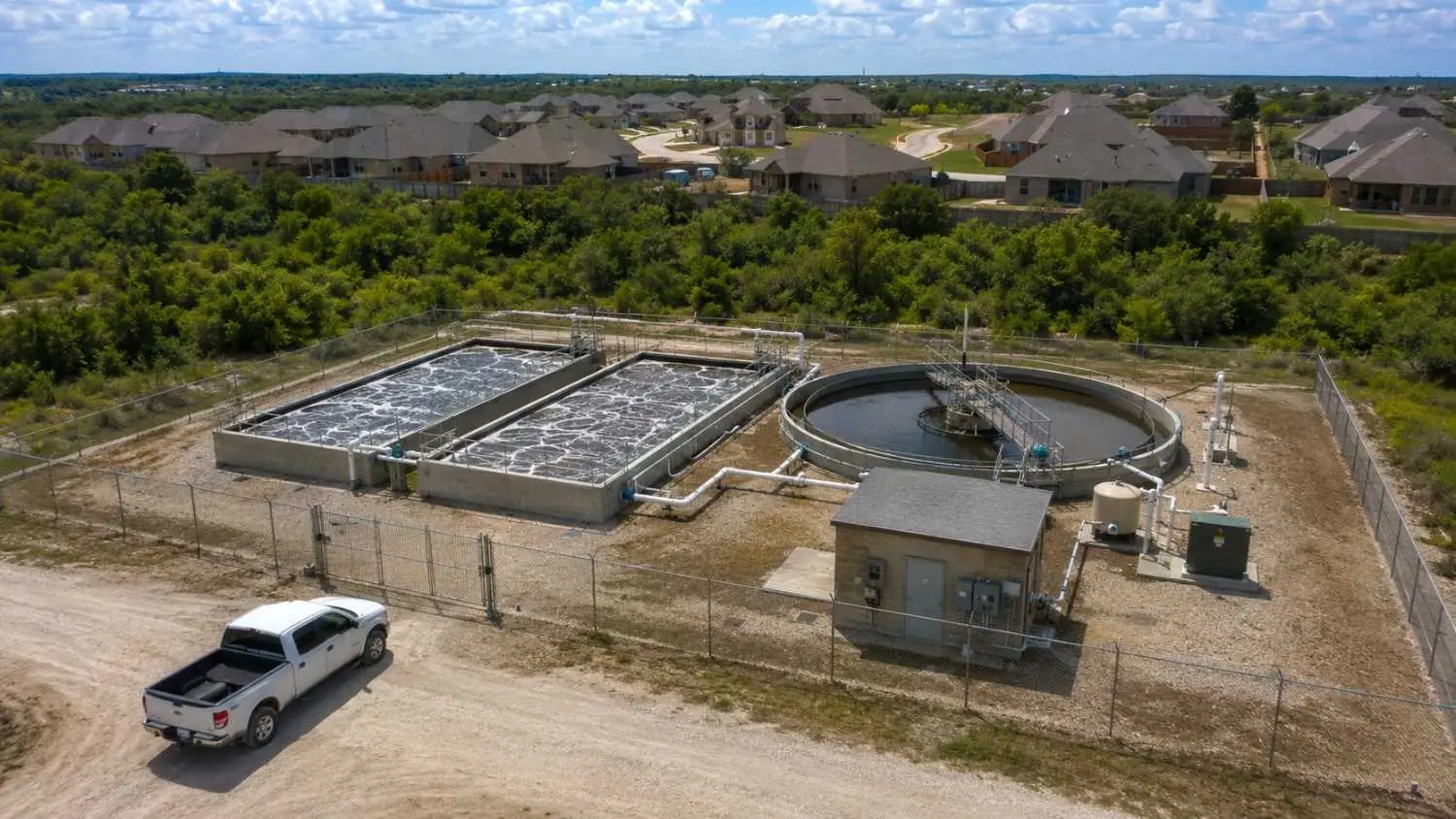
Sizing a package wastewater treatment plant for a Texas development requires calculating the design flow from the actual development program, applying the appropriate peak factors, selecting a treatment process matched to the permit requirements and operating context, confirming that the size supports the TCEQ application, and planning for phasing and future capacity. The design flow is the permitted number: it drives the treatment capacity, the equipment selection, the construction cost at $18 to $20 per gallon, and the reuse land or storage requirements downstream. TCEQ reviews the engineering basis of the design as part of the permit application, so the sizing is not just an equipment decision. It is the technical foundation of the permitting case. Getting it wrong costs time and money that a straightforward engineering process would have prevented.
Step 1: Calculate Design Flow From the Development Program
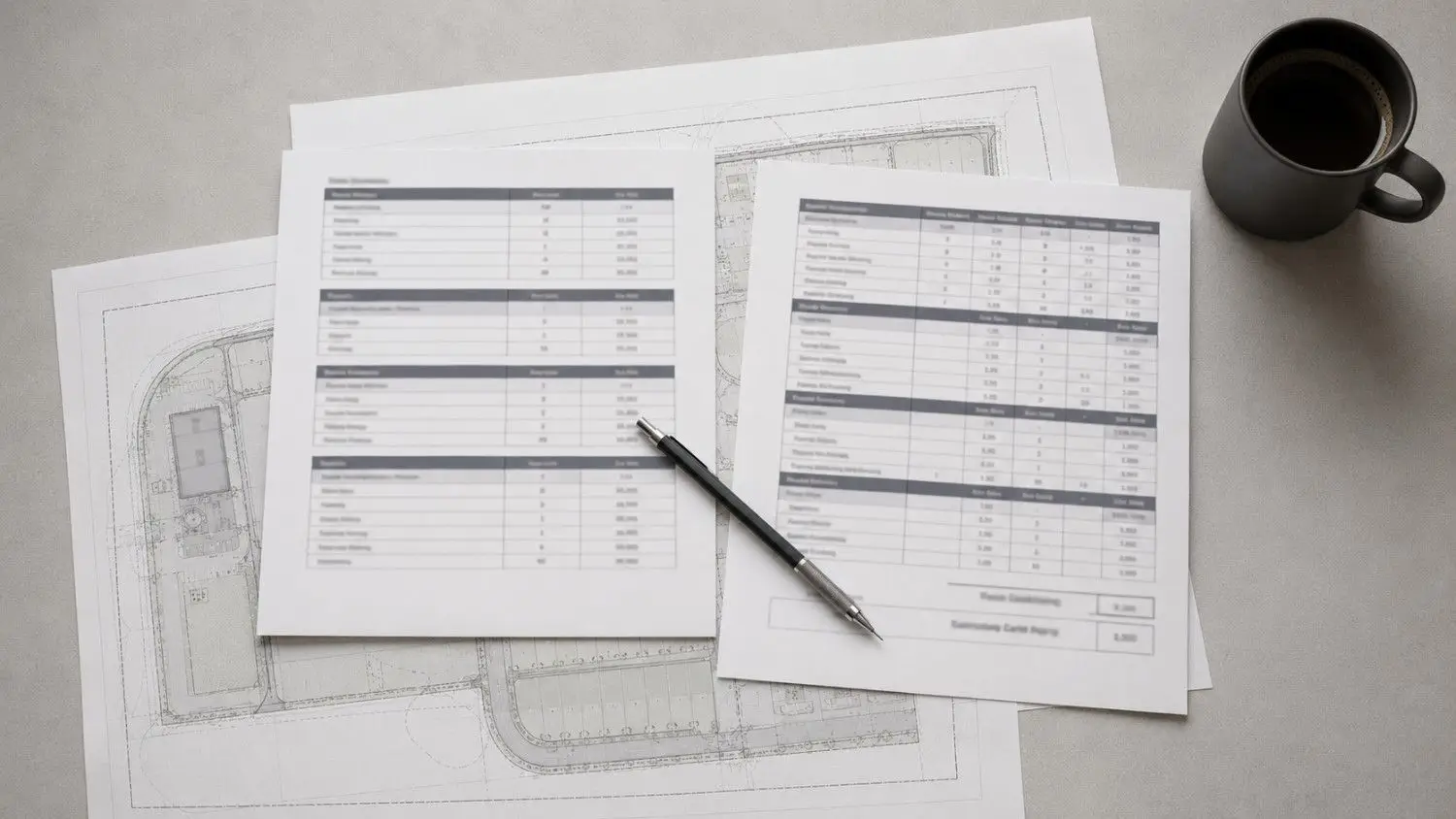
The design flow for a package WWTP is derived from the development program: the mix of land uses, occupancy types, unit counts, and square footages that defines what the project is. This is where most developers make their first sizing error, because they either use a generic estimate that does not reflect the actual program or they model the development at current occupancy rather than at the buildout conditions the treatment plant must be designed to serve.
TCEQ evaluates flow projections against recognized generation rates. For residential development, the standard planning figure for single-family homes in Texas is 100 to 120 gallons per day per bedroom, with 250 to 300 gallons per day per equivalent dwelling unit as a common design assumption. For multifamily development, the per-unit flow rate is lower because household size is smaller, typically 150 to 200 gallons per day per unit for apartments. Commercial development generates wastewater based on fixture count, occupancy density, and operational hours: a restaurant generates significantly more wastewater per square foot than a general office building.
For a 200-lot single-family residential subdivision with 3-bedroom homes using a 300 GPD per dwelling unit planning figure, the average daily flow is 60,000 GPD. For a mixed-use development with 150 apartments at 175 GPD per unit and 30,000 square feet of restaurant space at a plausible 3,500 GPD per 1,000 square feet, the residential contribution is 26,250 GPD and the restaurant contribution adds 105,000 GPD, for a combined average daily flow of approximately 131,000 GPD. The restaurant contribution changed the sizing materially. That is why the flow projection must reflect what is actually being built, not a simplified residential equivalent assumption.
For industrial or commercial tenants whose wastewater includes process flows, the flow calculation must include both domestic wastewater from employees and process wastewater from operations. A warehouse with 200 employees generates approximately 7,000 to 10,000 GPD of domestic flow. A food processing tenant at the same facility may add 30,000 to 50,000 GPD of process flow depending on operations. Both streams must be included in the design flow. For more on how flow calculations affect the full project, see flow rate projections and WWTP sizing.
Step 2: Apply Peak Factors to Get From Average Flow to Design Flow
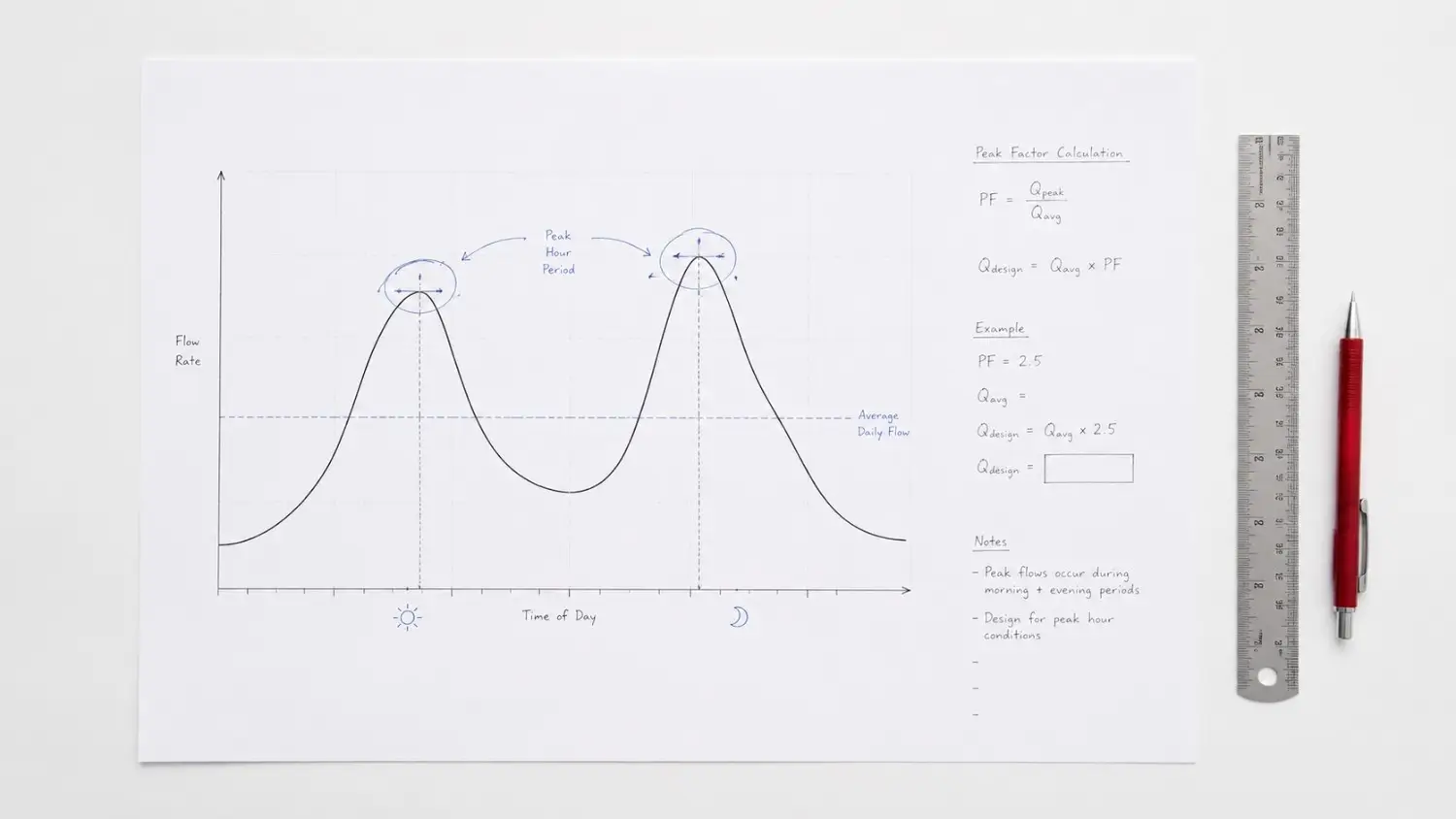
The average daily flow is not the design flow. Wastewater flow from any development is not constant throughout the day. Morning and evening peaks, weekend versus weekday patterns, and seasonal fluctuations all produce instantaneous flows that significantly exceed the daily average. A treatment plant sized only for average daily flow will be hydraulically overwhelmed during peak demand periods and will underperform on effluent quality when the biological process is flooded with peak instantaneous flows it was not designed to handle.
TCEQ and industry standards expect peak flow analysis in the design documentation submitted with a permit application. A peaking factor of 2.5 to 4.0 times the average daily flow is a typical planning range for residential development. For residential subdivisions under 1 MGD average flow where peak hour demand creates significant variability, a peaking factor at the higher end of this range is conservative and defensible. For larger facilities or development types with more predictable and uniform flow patterns, a lower factor may be justified with supporting data.
The design flow that appears in the TCEQ permit application and on the plant equipment specifications should reflect the peak daily flow the treatment system must process without exceedance of effluent limits, not the average. For a residential subdivision with a 60,000 GPD average daily flow and a 3.0 peaking factor, the design flow submitted to TCEQ is 180,000 GPD. The plant is specified, permitted, and procured at that capacity.
Step 3: Select the Treatment Process Based on Permit Requirements and Operations
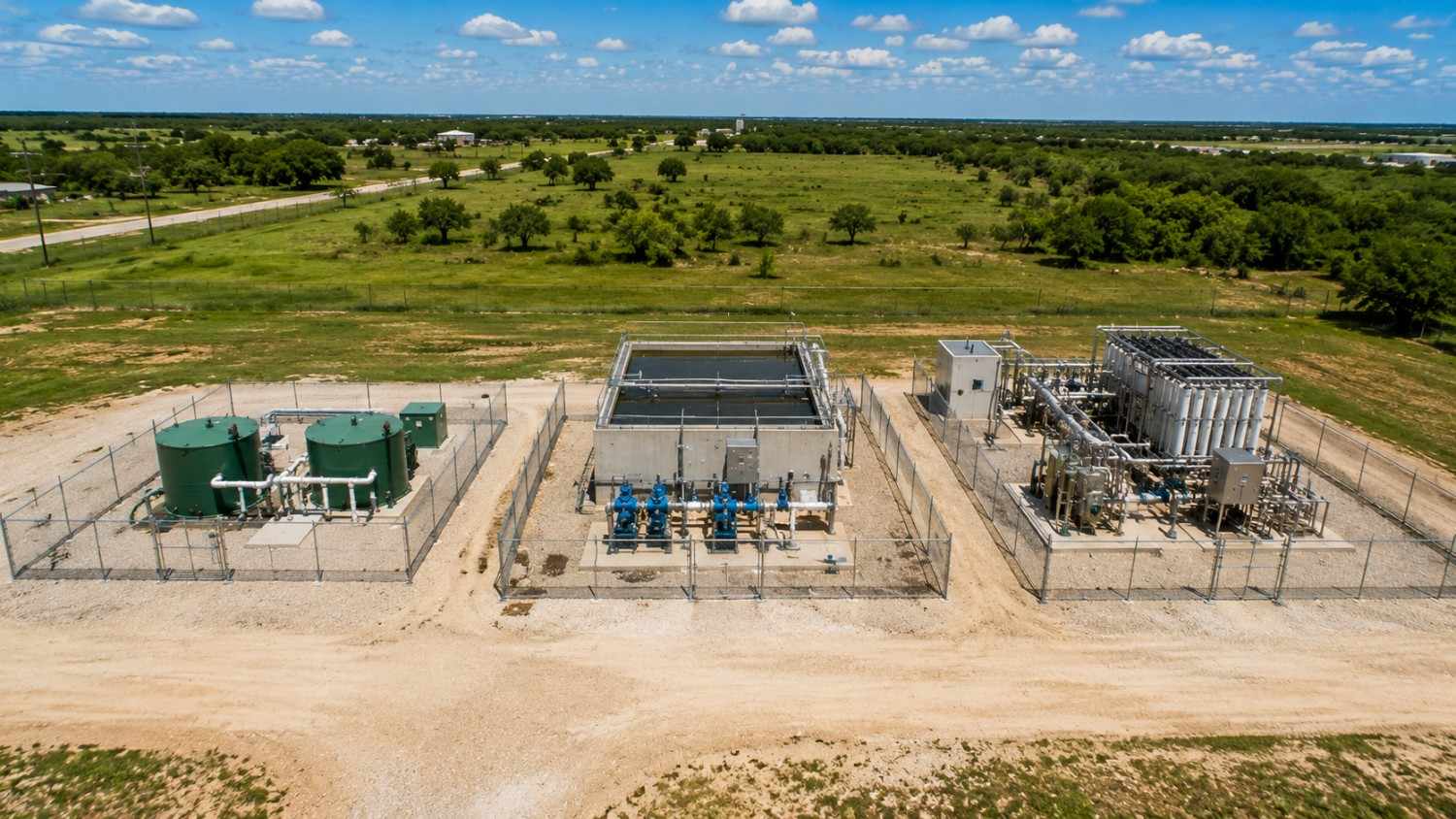
The right treatment process for a Texas package WWTP depends on three factors: what effluent quality the permit requires, what the operator can realistically manage, and what flow range the plant will operate over its expected life.
Extended aeration is the most common process for domestic development-scale package plants in Texas. It is well understood by TCEQ reviewers, produces reliable secondary effluent at BOD and TSS concentrations in the 10 to 20 mg/L range, and can be operated by a contracted certified operator visiting the site periodically without continuous staffing. For permits requiring standard secondary treatment limits (typical of most domestic TPDES permits and 210E authorizations) extended aeration is the straightforward and cost-effective process choice for facilities in the 10,000 to 150,000 GPD range.
Sequencing batch reactors handle variable flows more effectively than continuous extended aeration systems and can meet tighter nutrient limits with appropriate configuration. SBRs are appropriate when the development has significant flow variability between phases, when nitrogen or phosphorus limits are included in the permit, or when the average flow is expected to ramp up significantly over a multi-year buildout period. They are operationally more complex than extended aeration and require operator familiarity with the sequencing cycle.
Membrane bioreactors produce effluent quality at 5 mg/L BOD or below and are appropriate for projects where tight effluent limits are required by the permit (typically when discharge is to a sensitive receiving stream or when the reuse application demands higher quality treatment than secondary treatment can reliably achieve). MBR systems have significantly higher capital and operating costs than extended aeration and require regular membrane maintenance that must be factored into the operating budget.
The treatment process selection is not independent of the permit. A TCEQ permit with a 20 mg/L BOD monthly average limit is designed around a process that can reliably achieve that limit under actual operating conditions. A vendor-specified system submitted to TCEQ with manufacturer specifications but without site-specific process calculations demonstrating that the system will meet the permit’s effluent limits under peak flow and minimum temperature conditions will generate technical questions from the reviewer that delay issuance.
Step 4: Plan for Phasing, Redundancy, and Future Expansion
A 200-unit development that will be built in two 100-unit phases over four years does not need to build full treatment capacity on day one. Phasing a package plant allows the developer to match capital expenditure to actual demand rather than committing to full buildout capacity before the first phase has generated any revenue. TCEQ permits can be applied for at the full buildout design flow while the initial equipment installation is sized for Phase 1 flow. When Phase 2 commences, the plant is expanded within the already-permitted capacity.
The phasing strategy must be reflected in the permit application and the initial plant design. Attempting to expand a package plant after the fact, without a permit amendment and equipment pre-engineered for expansion, creates both a regulatory problem and a construction challenge. Pre-engineering the phased expansion at the time of initial design (confirming that the aeration basin can be expanded, the clarifier can be supplemented, and the blower capacity can be increased) is significantly less expensive than redesigning an undersized plant when Phase 2 demand exceeds capacity.
Redundancy is a TCEQ and operational requirement, not an optional upgrade. Package plants must have redundant pumping in the lift station, redundant blowers in the aeration system, and standby power or other emergency provisions appropriate for the facility size. A plant that lacks redundancy will fail compliance requirements during the next equipment breakdown. Planning redundancy into the initial design rather than treating it as an add-on after the core equipment is specified is part of producing a submittal that moves through TCEQ review without unnecessary back-and-forth. For more on how TCEQ reviews power reliability requirements, see TCEQ’s Power Reliability Requirements: Generator vs. Dual Feed Design.
Step 5: Connect the Plant Size to the Permitting Pathway
The permitted design flow determines more than the equipment specification. It determines the permitting pathway available to the project, the reuse infrastructure required if a 210E or TLAP pathway is used, the storage reservoir sizing obligation under 30 TAC §309.20, and the certified operator classification required under TCEQ’s operator licensing program.
For a 210E Industrial Reclaimed Water Authorization on a qualifying development, the design flow drives the reuse land requirement. At approximately 2,000 GPD per acre for agricultural irrigation in Central Texas, a 300,000 GPD facility requires approximately 150 acres of confirmed reuse land plus a properly sized storage reservoir designed using worst-case 25-year precipitation data. A developer who calculates the design flow incorrectly and comes in at 200,000 GPD instead of 300,000 GPD will have either an undersized treatment plant or a reuse system built for the wrong volume: both of which create operational and compliance problems after startup.
The construction cost at $18 to $20 per gallon of design capacity provides the financial basis for the capital budget. A 130,000 GPD facility costs $2.34 million to $2.6 million in construction at current Texas market pricing. A 300,000 GPD facility runs $5.4 million to $6.0 million. Engineering and permitting add 15 to 25 percent. The design flow drives all of it, which is why getting that number right at the front of the project is the most consequential engineering decision the developer makes before anything else is committed. For how these costs affect your pro forma, see How Wastewater Infrastructure Affects Your Pro Forma.
Frequently Asked Questions
What happens if TCEQ determines that the design flow submitted in the permit application is too low for the actual development?
TCEQ reviews the flow projections and supporting basis during technical review. If the submitted flow basis is inconsistent with the development program, does not account for recognized generation rates for the occupancy types, or uses assumptions that are not defensible against standard engineering references, TCEQ will issue a technical deficiency notice requesting a revised calculation. A revised flow that is higher than the originally submitted figure may require revisions to the treatment plant specifications, the reuse or storage infrastructure, and potentially the effluent limit analysis. All of this adds weeks to the review timeline. A flow projection prepared with current engineering standards and matched to the actual development program on the first submittal avoids this cycle. For more on what complete TCEQ submittals require, see What Engineers Submit to TCEQ and Why Applications Get Rejected.
Should the design flow be based on current occupancy or full buildout?
The design flow submitted to TCEQ and used for equipment sizing should reflect the full buildout condition the plant is intended to serve. If the project will be phased, the permit should be applied for at the full buildout capacity, with the initial equipment installation documented as Phase 1. Designing and permitting at current or anticipated early occupancy and planning to amend later creates a constraint: the plant will be operating at or near permitted capacity before Phase 2 begins, and the amendment process takes time during which capacity constraints can limit the development’s ability to grow.
Is an extended aeration package plant always the right choice for a Texas residential development?
Extended aeration is the right choice for most domestic residential package plants under 150,000 GPD where the permit requires standard secondary treatment limits. For projects with significant commercial or industrial flow contributions, high-strength waste, tight nutrient limits, or flow variability that exceeds what extended aeration handles reliably, other processes should be evaluated against the specific permit requirements. The process selection should follow the permit analysis, not precede it. For a side-by-side comparison of package versus custom-designed plants, see Package WWTP vs. Custom-Designed Plant: Which One Fits Your Project.
Related Resources
- Package WWTP vs. Custom-Designed Plant: Which One Fits Your Project
- Building a Private WWTP in Texas: What Developers Need to Know Before They Commit
- How Carrying Costs Are Killing Texas Development Projects and the Permit Strategy That Fixes It
- How to Read a TCEQ Effluent Limit Table: What the Numbers Actually Mean for Your Development
Need Package WWTP Sizing and TCEQ Permit Support for Your Texas Development?
Modern Engineering Solutions works with Texas developers to calculate design flows, select the right treatment process, and prepare complete TCEQ permit applications that move through review without deficiency cycles.
We specialize in:
- Design flow calculation and TCEQ-ready flow basis documentation for Texas package WWTP projects
- Treatment process selection and comparison for extended aeration, SBR, and MBR systems
- Phased plant design that matches capital expenditure to development absorption schedules
- Package WWTP sizing from permit application through construction document preparation
- TCEQ permit application support including process calculations, design basis documentation, and technical review response
Modern Engineering Solutions, McKinney, Texas. Contact: (214) 833-6748 or mod-eng.com