
Blog
Texas Land Application Permits Explained: Spray Irrigation, Subsurface Drip, and Evaporation Ponds
How a Texas land application permit works for spray irrigation, subsurface drip, SADDS and evaporation ponds, and how to pick the method for your site.
Quick answer
A Texas land application permit (TLAP) is the TCEQ permit for a domestic wastewater plant that disposes of treated effluent on land instead of discharging it to water in the state. Spray irrigation, subsurface drip and evaporation ponds all fit under it, and each needs different land, soils and operation. A subsurface area drip dispersal system (SADDS) is a separate permit under its own rule chapter, so pick the method from site data before the application is written.
What does a Texas land application permit authorize?
It authorizes disposal on a defined land area, never a discharge to a creek. TCEQ's domestic wastewater permits page draws the line. A plant that discharges treated effluent into water in the state needs a Texas Pollutant Discharge Elimination System (TPDES) permit. A plant that disposes of it by surface irrigation, evaporation, drainfields or subsurface application needs a TLAP.
That difference shapes the review. A TPDES permit is written around the receiving stream. A TLAP is written around the land: the area, soils, crop, storage and water balance. Most of those rules sit in 30 TAC §309.20, land application of sewage effluent.
TCEQ's permitting process guidance asks for a complete new or amended application at least 330 days before the proposed discharge begins. For a TLAP, read that as the day effluent first goes to the field.
What does every TLAP irrigation design have to show?
Every irrigation design rests on a water balance and a nitrogen balance. Section 309.20(b)(3)(A) requires a water balance study as part of the application rate analysis. It uses average yearly rainfall with the monthly distribution from past records, plus the crop's evapotranspiration month by month.
Three more rules in the same section set the size of the system:
- Storage is sized on a design rainfall year with a return frequency of at least 25 years (§309.20(b)(3)(B)).
- Yearly loading cannot add more nitrogen than the crop needs, plus a 20 percent allowance for volatilization (§309.20(b)(3)(C)).
- On land the public can reach, effluent must be treated to the equivalent of secondary standards (§309.20(b)(1)).
The cover crop must be harvested at least once a year, and applied effluent kept between pH 6.0 and 9.0 (§309.20(b)(5)). Our post on water balance studies under 30 TAC §309.20 walks through the inputs.
When does spray irrigation fit a Texas site?
Spray fits open land that the public does not use and that drains between applications. Effluent goes out through sprinklers on risers, traveling guns or pivots, then soaks in or is taken up by the crop.
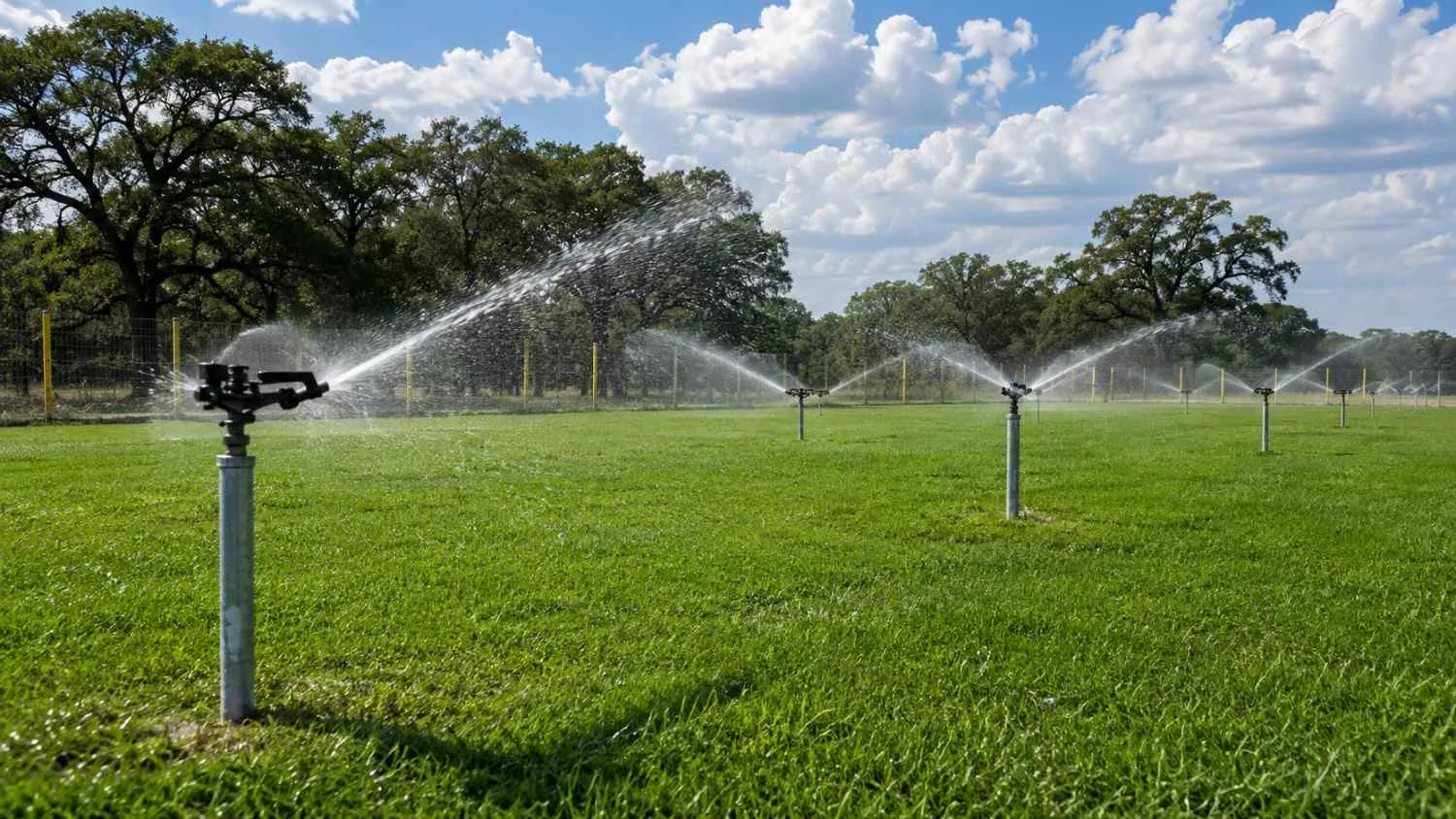
The acreage comes out of the water balance and the nitrogen limit, not a rule of thumb. Slow-draining clay, steep slopes and shallow groundwater all push the loading rate down and the land area up. Runoff to a creek defeats the purpose of the permit.
Siting limits in 30 TAC §309.13 cover plant units and irrigated land. Both stay 500 feet from a public water well or spring, a potable water storage tank and a surface water treatment plant (§309.13(c)). Plant units also stay out of wetlands and, unless protected, the 100-year floodplain.
Residential common areas are land the public can reach, so spray there needs secondary-equivalent effluent and tight control of drift. That is where drip comes in.
When does subsurface drip make more sense than spray?
Drip makes sense where people will use the land or where spray drift is a problem. Emitter tubing sits in the root zone and puts effluent below the surface, so there is no spray to touch or drift. TCEQ issues TLAPs for subsurface drip irrigation fields.
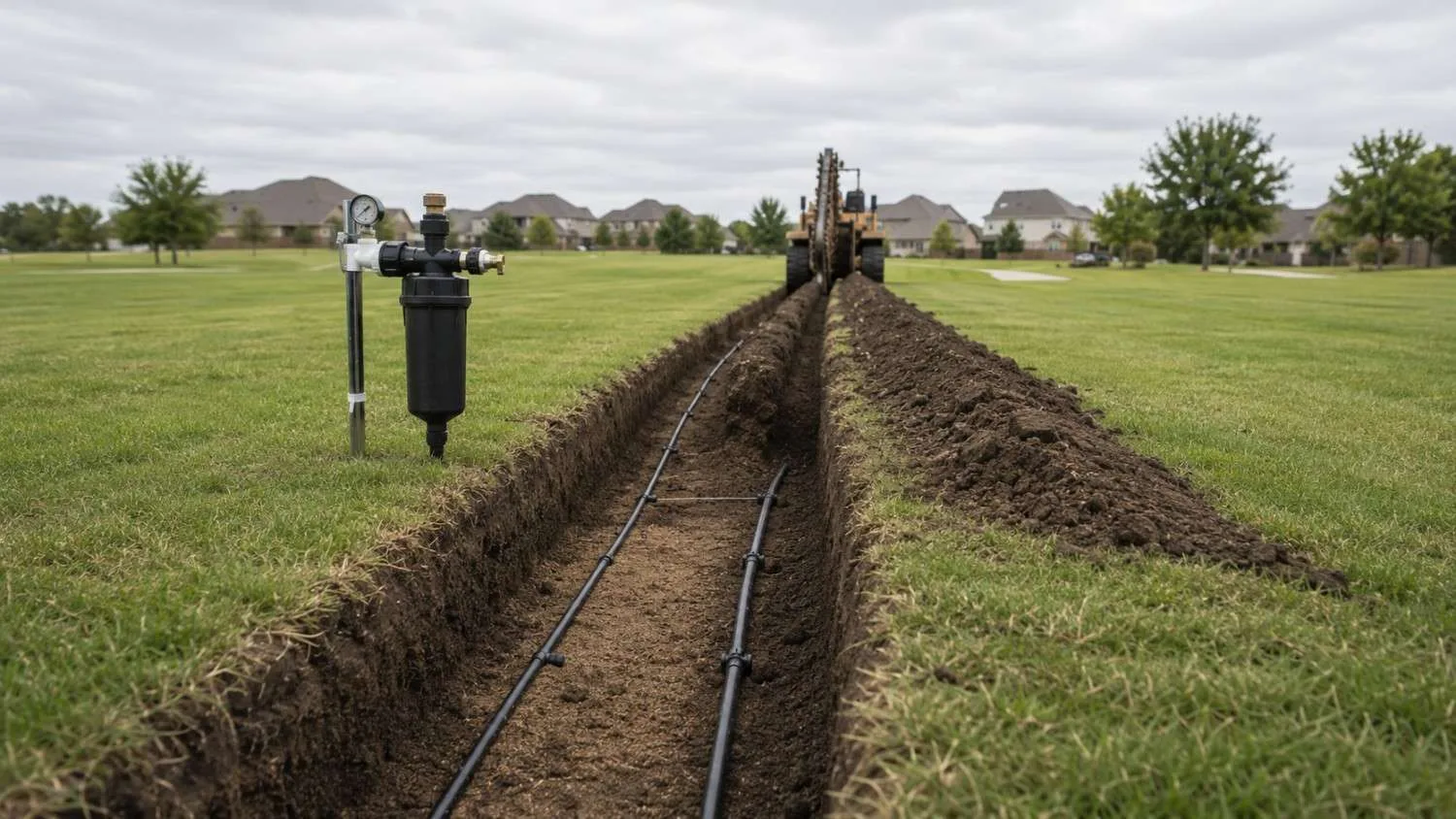
The tradeoff is operation. Drip needs filtration to keep emitters from clogging, pressure control for even application, field flushing and a plan for root intrusion. Those tasks belong in the operation and maintenance plan from day one, not after startup.
The loading rate has to come from soil data at the field. The rule allows USDA soil surveys where they exist (§309.20(a)(3)), but a drip field lives or dies on what the borings show at emitter depth.
Is a SADDS the same thing as subsurface drip under a TLAP?
No. A SADDS is a defined system with its own statute and rule chapter. Texas Water Code chapter 32 defines a subsurface area drip dispersal system as one that injects processed waste no deeper than 48 inches and spreads it so soil and root absorption rates are not exceeded. Section 32.051 says no one may operate one without a TCEQ permit.
The design and siting rules are in 30 TAC Chapter 222. Under §222.3(b), the chapter does not cover on-site sewage facilities under Chapter 285, or subsurface drip irrigation systems that do not meet the SADDS definition.
Flow decides the first fork. An on-site sewage facility is limited to 5,000 gallons of waste a day under Health and Safety Code §366.002(7). Above that, a drip design is either a TLAP drip field or a Chapter 222 SADDS, and your engineer should settle which before design starts.
Where do evaporation ponds work in Texas?
Evaporation ponds work where yearly evaporation clearly beats rainfall, which generally points to the drier western part of the state. Effluent stays in the pond and leaves as vapor, so dissolved solids concentrate over time.
The pond needs its own monthly balance: plant flow and rain on the pond against evaporation, with freeboard left in a wet year. In a humid region the volume outruns evaporation and the pond gets large fast.
Groundwater is the other constraint. Under §309.13(d), a wastewater facility surface impoundment over a major or minor aquifer recharge zone needs three feet of material with a hydraulic conductivity of 0.0000001 cm/sec or less below it. A 40-mil synthetic liner with leak detection may substitute.
The Edwards Aquifer adds its own rule. 30 TAC §213.6(b) prohibits land application systems that rely on percolation on the recharge zone, and reviews evaporation and irrigation there case by case, with at least secondary treatment. See our post on Edwards Aquifer recharge zone development.
How do you choose the method before the application is written?
Match the method to the site data, the land use and the people who will run it. Answer these before anyone drafts the technical report. Any "no" is a gap to close first.
- Do you have borings and infiltration data for the actual application area?
- Do you have a monthly water balance, with storage sized on a 25-year design rainfall year?
- Does the nitrogen loading fit the crop?
- Have you mapped wells, springs, potable tanks, wetlands and the floodplain against §309.13?
- Will the public use the application area, and does the treatment level match?
- Have you checked for an aquifer recharge zone, including the Edwards?
- For drip, is it a TLAP drip field or a Chapter 222 SADDS?
- Can the operator run what you picked, including filters, flushing and the yearly harvest?
Then bring your wastewater engineer four facts: flow by phase, the land you control, who uses it, and how often someone will be on site.
This article is general education on Texas rules as read in October 2026. Each permit is site specific and TCEQ decides each application, so confirm the current rule text and any permit special provisions for your project.
Frequently asked questions
What treatment level does land application need in Texas?
On land the public can reach, secondary-equivalent treatment comes first (§309.20(b)(1)). Primary effluent can go only to systems that meet every condition in §309.20(b)(2), such as no discharge to surface water and the owner's direct control of treatment, application and farming on the site. Each permit then sets its own limits.
Is a TLAP faster than a TPDES discharge permit?
The technical review is often narrower, because there is no receiving stream to protect. TCEQ publishes no guaranteed timeline for either. Plan from the 330-day submittal guidance, not a hoped-for approval date.
I'm developing a subdivision in the Texas Hill Country with no sewer nearby. Can I spray treated effluent on the HOA open space, or do I need drip?
Spray is possible, but residents make it public-access land, so the effluent must meet the secondary-equivalent standard and drift still needs managing. Drip avoids both. Check the Edwards recharge zone first, since §213.6(b) bans percolation systems there and reviews irrigation case by case.
I run a small West Texas RV park that is expanding, and I want an evaporation pond instead of a discharge. What should I check first?
Start with the pond's monthly balance against local evaporation in a wet year, then groundwater. Over a major or minor aquifer recharge zone, §309.13(d) requires three feet of low-permeability material or a 40-mil liner with leak detection. Check the §309.13(c) setbacks too.
Related resources
- Land Application Permits in Texas: A Faster Path to Wastewater Approval for Developers
- Industrial TPDES vs. TLAP: Which Wastewater Permit Path Fits Your Texas Facility?
- How to Size a Wastewater Storage Reservoir for a Texas Reuse Project
- Building a Private WWTP in Texas: What Developers Need to Know Before They Commit
Weighing spray, drip or a pond for a Texas site?
We start with the soils, the water balance and the land use, then pick the method that fits before the TLAP application is written.
We specialize in:
- TCEQ wastewater permit applications, TLAP and TPDES
- Land application site evaluation and water balance studies
- Spray, drip and storage pond design
- Package and custom wastewater treatment plant design
- Site civil engineering for land development
- Construction administration
Modern Engineering Solutions, McKinney, Texas. Contact: (214) 833-6748 or mod-eng.com
Talk to an engineer
Tell us about your project
An engineer reads it
Not a salesperson. Someone who can tell you whether the pathway is real.
You get a first answer
Your options, the agencies involved and the questions that decide cost and schedule.
You decide
No commitment to have the first call.
Prefer the phone? (214) 833-6748