
Blog
BioLargo's aqueous electrostatic concentrator for PFAS: what the bench data shows
BioLargo's aqueous electrostatic concentrator pulls PFAS from water; here is what EPA bench tests showed and what to check before piloting it.
Quick answer
BioLargo's aqueous electrostatic concentrator (AEC) uses electric current and an anion exchange membrane to pull PFAS out of water into a small concentrate stream, and EPA-funded bench tests showed over 99 percent removal of PFOA and PFOS. That is bench data on two PFAS in synthetic water, and the concentrate still needs a home. Treat it as a pilot candidate beside carbon, ion exchange and reverse osmosis, not a proven fix.
What are PFAS, and why do water systems have to deal with them now?
PFAS are long-lasting chemicals. EPA set enforceable drinking water limits for six of them in 2024, and those rules are still moving.
EPA's PFAS explainer (opens in a new tab) says thousands exist, they break down very slowly, many are found in people's blood, and exposure to some may be linked to harmful health effects.
EPA's 2024 PFAS drinking water rule (opens in a new tab) set maximum contaminant levels (MCLs) of 4.0 parts per trillion (ppt) for PFOA and PFOS, 10 ppt each for PFHxS, PFNA and HFPO-DA (GenX), and a hazard index for mixtures of those three plus PFBS. Compliance is a running annual average, with initial monitoring by 2027 and the MCLs by 2029.
In May 2025, EPA proposed keeping the PFOA and PFOS limits while letting a system request two more years, to 2031, and proposed rescinding the limits for PFHxS, PFNA, GenX and the hazard index. Check EPA's PFAS drinking water page (opens in a new tab) for the current status before you design.
How does BioLargo's aqueous electrostatic concentrator work?
Current drives PFAS across an anion exchange membrane into a separate concentrate chamber. Treated water leaves the feed side.
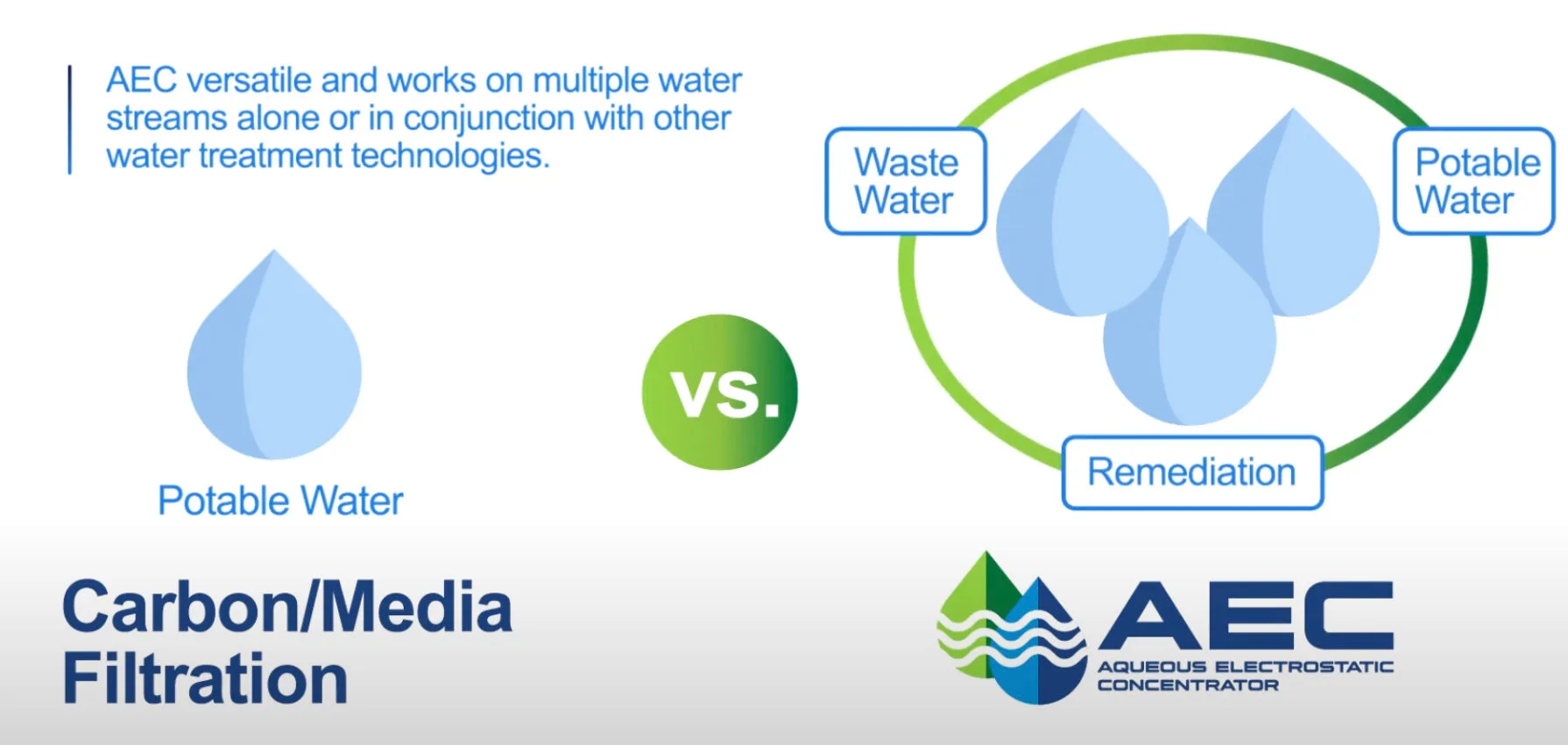
Image: BioLargo.
EPA's Phase I final report on the AEC (opens in a new tab) describes three chambers: feed, anion exchange membrane (AEM) and cation exchange membrane. PFAS leave the feed through the AEM and are held in the AEM chamber. Changing that chamber's purge rate sets how concentrated the stream gets.
It is tempting to picture a magnet that grabs only PFAS. The report says otherwise: salt removal tracked PFAS removal, total current predicted PFAS removal, and a feed with less salt needed less current. Our read: other negative ions such as chloride and sulfate share the current, so source water chemistry drives the power draw.
BioLargo's team discussed the AEC on our WEFTEC series episode on aqueous electrostatic concentrators. This post checks it against the public record.
How well does the AEC remove PFAS?
Very well for PFOA and PFOS at bench scale: over 99 percent removed from the feed stream. We found no published field or full-scale results.
The Phase I bench work ran in 2019 in Oak Ridge, Tennessee, on synthetic water: deionized water and sodium chloride spiked with PFOA and PFOS at 2 to 100 parts per billion, 500 to 25,000 times the 4.0 ppt limit.
Flow-through runs were set for a theoretical concentration factor of up to 35 times. The report expected a 1 to 5 gallon per minute field pilot next. Only PFOA and PFOS were tested, so it has no results for short-chain PFAS, PFHxS, PFNA or GenX.
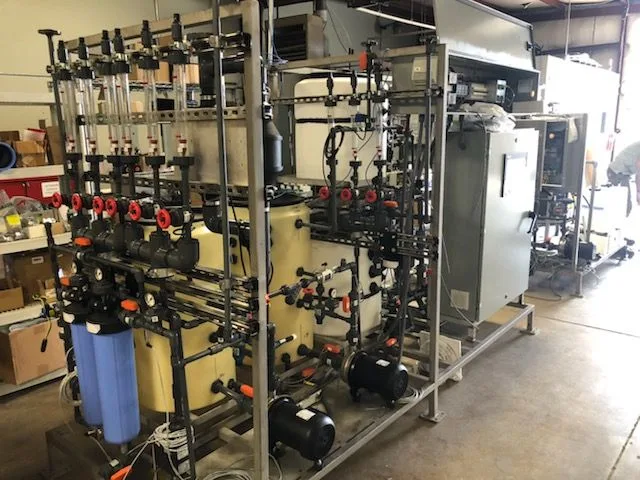
Image: BioLargo.
BioLargo's AEC product page (opens in a new tab) claims over 99 percent removal in one place and more than 99.9 percent in another, plus less waste than carbon and a small footprint. Those are company claims without cited test data.
Does an EPA SBIR award mean the AEC is proven?
No. EPA paid for a Phase I feasibility test. That is not an endorsement.
EPA's project abstract (opens in a new tab) lists a Small Business Innovation Research (SBIR) Phase I project testing the AEC as a pretreatment for industrial wastewater, with the concentrate then treated by carbon or other processes. EPA notes that these conclusions are the investigator's and were not reviewed by the agency. The EPA record we found covers Phase I only.
How does the AEC compare with carbon, ion exchange and reverse osmosis?
Those three have EPA research behind them at drinking water scale. BioLargo told EPA the AEC can work together with carbon, and its pitch is a smaller waste stream, the weak spot of reverse osmosis.
EPA's 2018 research summary on PFAS treatment technologies (opens in a new tab) says:
- Granular activated carbon (GAC) removes PFAS well in flow-through filters, but short-chain PFAS such as PFBS and PFBA do not adsorb as well.
- Anion exchange resin removes all of the PFAS for a time set by the resin, bed depth, flow rate and water quality. Used once, it makes no regeneration waste stream, but the spent resin still needs destruction or disposal.
- Nanofiltration and reverse osmosis are typically more than 90 percent effective, including on shorter chain PFAS, but about 20 percent of the feed leaves as a high-strength concentrate.
The AEC's 35-times factor is the report's ratio of feed flow to concentrate chamber flow, so the concentrate ran about 3 percent of feed flow, against about 20 percent for reverse osmosis. It is a theoretical bench setting, not a field result.
What happens to the PFAS once it is concentrated?
It still has to be destroyed or disposed of. Concentrating shrinks the volume. It does not make PFAS go away.
The Phase I report had a surprise: after treatment, neither membrane chamber held PFOA or PFOS above 30 ppt. The authors suggested they may have been chemically modified or decomposed and were testing for a mechanism. BioLargo's product page says the AEC deposits PFAS onto its membranes. Until a mass balance closes, where the PFAS went is an open question and destruction is unproven.
EPA's interim guidance on destroying and disposing of PFAS (opens in a new tab), updated in 2026, covers thermal destruction, landfills and underground injection, including wastes from water treatment. It is non-binding. Name a receiver for your residuals before you pick a process.
What does TCEQ require before a Texas system uses a new PFAS process?
Data. Texas reviews an innovative process one system at a time, backed by pilot or full-scale results.
Under TCEQ's water treatment rule, 30 TAC §290.42(g) (opens in a new tab), innovative or alternate processes are considered individually as exceptions under §290.39(l). The engineer must provide pilot data, or data from similar full-scale operations, showing the plant will meet the Subchapter F drinking water standards. Pilot data has to represent the operating conditions expected through the year, and TCEQ may require an approved pilot protocol and a one-year manufacturer's performance warranty.
So bench data alone is not enough. Our post on water treatment technologies for rural communities walks through the same pilot path for other new processes.
How should a utility check an emerging PFAS technology?
Answer yes or no. A no on any of the first four means it is not ready for your system.
- Do you have PFAS results by compound for every source, from more than one season?
- Has the vendor shown data on water like yours, for the PFAS you actually have?
- Does that data come from a field unit or an independent lab, not only the vendor?
- Do you know who will take the concentrate or spent media?
- Can your operator run and service the process?
- Does your schedule have room for a pilot?
Then ask your engineer and the vendor where every pound of PFAS ends up, and how the process compares with GAC or resin on your water in its worst season.
A note on limits: this is general education from public sources as of October 2026, using BioLargo's 2019 bench data as reported to EPA. Your engineer and TCEQ have the final word.
Frequently asked questions
What does AEC stand for in PFAS treatment?
Aqueous Electrostatic Concentrator, BioLargo's electrically driven membrane process for concentrating PFAS.
Does the AEC destroy PFAS?
Not proven. It concentrates PFAS. The Phase I authors thought PFOA and PFOS may have been modified or decomposed, but had not confirmed how.
What is the EPA limit for PFOA and PFOS in drinking water?
4.0 ppt each, as a running annual average. EPA's May 2025 proposal keeps those limits and would let a system request until 2031 to comply.
Our first PFOS samples came back above 4 ppt. Should we pilot the AEC or go to carbon or ion exchange?
Compare both on your water. One sample above 4.0 ppt is not a violation, since compliance is a running annual average, but it is a signal to plan. The AEC has only bench data, so if you pilot it, test GAC or resin beside it.
Could a concentrator like the AEC treat a city's wastewater effluent?
BioLargo pitched it to EPA for industrial wastewater, but the Phase I tests used synthetic salt water, and we found no public data on municipal effluent. Saltier water would likely take more current. Start by measuring which PFAS are in your influent and effluent, then look for the sources.
Related resources
- PFAS Monitoring Requirements Entering State Discharge Permits: How Emerging PFAS Rules Are Starting to Change Wastewater Compliance
- Why Electrocoagulation Matters for Rural Water and Sewer Providers
- Optimizing Small Water Treatment Plants Tips and Tricks for Rural Providers
- Future Proofing Wastewater Systems for Rural Communities | WEFTEC SERIES 2 | EP 5
Sorting out PFAS treatment for your water system?
Send us your PFAS results by compound, your source water data and what your operators run today, and we will help you compare proven and emerging options and the TCEQ path before you commit. Talk to an engineer about PFAS treatment.
Keep reading
More to read
What we do
On this page
- Quick answer
- What are PFAS, and why do water systems have to deal with them now?
- How does BioLargo's aqueous electrostatic concentrator work?
- How well does the AEC remove PFAS?
- Does an EPA SBIR award mean the AEC is proven?
- How does the AEC compare with carbon, ion exchange and reverse osmosis?
- What happens to the PFAS once it is concentrated?
- What does TCEQ require before a Texas system uses a new PFAS process?
- How should a utility check an emerging PFAS technology?
- Frequently asked questions
- Related resources
- Sorting out PFAS treatment for your water system?
Planning a project?
Talk to an engineerTalk to an engineer
Tell us about your project
An engineer reads it
Not a salesperson. Someone who can tell you whether the pathway is real.
You get a first answer
Your options, the agencies involved and the questions that decide cost and schedule.
You decide
No commitment to have the first call.
Prefer the phone? (214) 833-6748