
Blog
PFAS Monitoring Requirements Entering State Discharge Permits: How Emerging PFAS Rules Are Starting to Change Wastewater Compliance
PFAS monitoring requirements usually reach a discharge permit before any limit, so here is what EPA recommends, what states do and how to prepare.
PFAS monitoring requirements usually reach a wastewater discharge permit before any PFAS limit does. Regulators want data first, so the first condition is often sampling, a source investigation or a request for information. Colorado has written that sequence into policy, and EPA has recommended PFAS monitoring to state permitting authorities since December 2022.
Why does PFAS show up in a permit as monitoring before limits?
Because a permit writer generally needs data on what a facility actually discharges before setting a defensible limit. Monitoring builds that record.
Colorado's PFAS Narrative Policy, Policy 20-1, shows the sequence. Adopted in 2020 and renewed in 2025, it lets the state require PFAS monitoring through the permit application, a permit term, or the permit's duty to provide information. Results at or above the policy's reporting levels can bring continued monitoring and a source investigation. Numeric limits come after a reasonable potential analysis, and the state may postpone limits for domestic plants for the first permit term.
The federal standard permit conditions include a duty to provide information under 40 CFR 122.41(h), so a PFAS request can arrive mid-term, not only at renewal.
What has EPA recommended for PFAS in NPDES permits?
Quarterly monitoring for 40 PFAS at likely sources, using EPA Method 1633, plus pretreatment work at publicly owned treatment works (POTWs). These are recommendations, not a national rule.
EPA's December 2022 memo, "Addressing PFAS Discharges in NPDES Permits and Through the Pretreatment Program and Monitoring Programs," went to all NPDES permitting authorities and replaced earlier guidance aimed only at federally issued permits. EPA staff walked through it in a 2023 EPA webinar on PFAS monitoring strategies for NPDES and pretreatment programs. The recommendations include:
- Monitoring for direct dischargers in listed categories, including organic chemicals and plastics, metal finishing, landfills, pulp and paper, textile mills and airports.
- A POTW inventory of industrial users that may discharge PFAS, including those that are not significant industrial users, then sampling of those users and the collection system.
- Notifying affected public water suppliers.
- Best management practices, such as product substitution and limiting PFAS firefighting foam to emergencies.
In April 2025, EPA announced it would develop effluent limitations guidelines for PFAS manufacturers and metal finishers. Until those are final, permit writers work facility by facility.
Which states are putting PFAS into discharge permits?
Each state decides. Texas, Colorado, Florida and Arizona all run their own authorized NPDES permit programs, so PFAS conditions depend on the state agency, not one national schedule.
That authority is listed in EPA's NPDES state program authority table. In Colorado, Policy 20-1 aims first at facilities likely to discharge PFAS and applies its tools to protect drinking water: discharges to waters classified as Water Supply, discharges upstream of one, and certain groundwater. Source investigations are likely at municipal plants with pretreatment programs and at large industrial facilities.
Michigan's IPP PFAS Initiative, launched in 2018, required all 95 municipal plants with industrial pretreatment programs to find industrial users that could be PFOS or PFOA sources, sample the probable ones, and require source reduction where sources were confirmed.
For utilities and municipalities that own a plant, the condition lands on the POTW permit and flows down to industrial users through pretreatment. In Texas, Florida or Arizona, read every draft permit and agency letter for PFAS language.
What lab method should PFAS samples use?
EPA Method 1633 or 1633A, which covers 40 PFAS. Neither is in 40 CFR Part 136 yet, so the permit itself has to name the method.
EPA released the final Method 1633 in January 2024 and a revision, 1633A, in December 2024. EPA's PFAS methods page says 1633A covers wastewater, biosolids, landfill leachate and other matrices. EPA proposed adding 1633A and Method 1621 to Part 136 in December 2024, and they are not nationally required for compliance monitoring until that rule is final. Under 40 CFR 122.44(i)(1)(iv)(B), monitoring then follows the test procedure the permit specifies.
Method 1621 measures adsorbable organic fluorine. It shows organofluorines are present, not which ones, so treat it as a screen alongside 1633.
How do you keep PFAS samples from being contaminated?
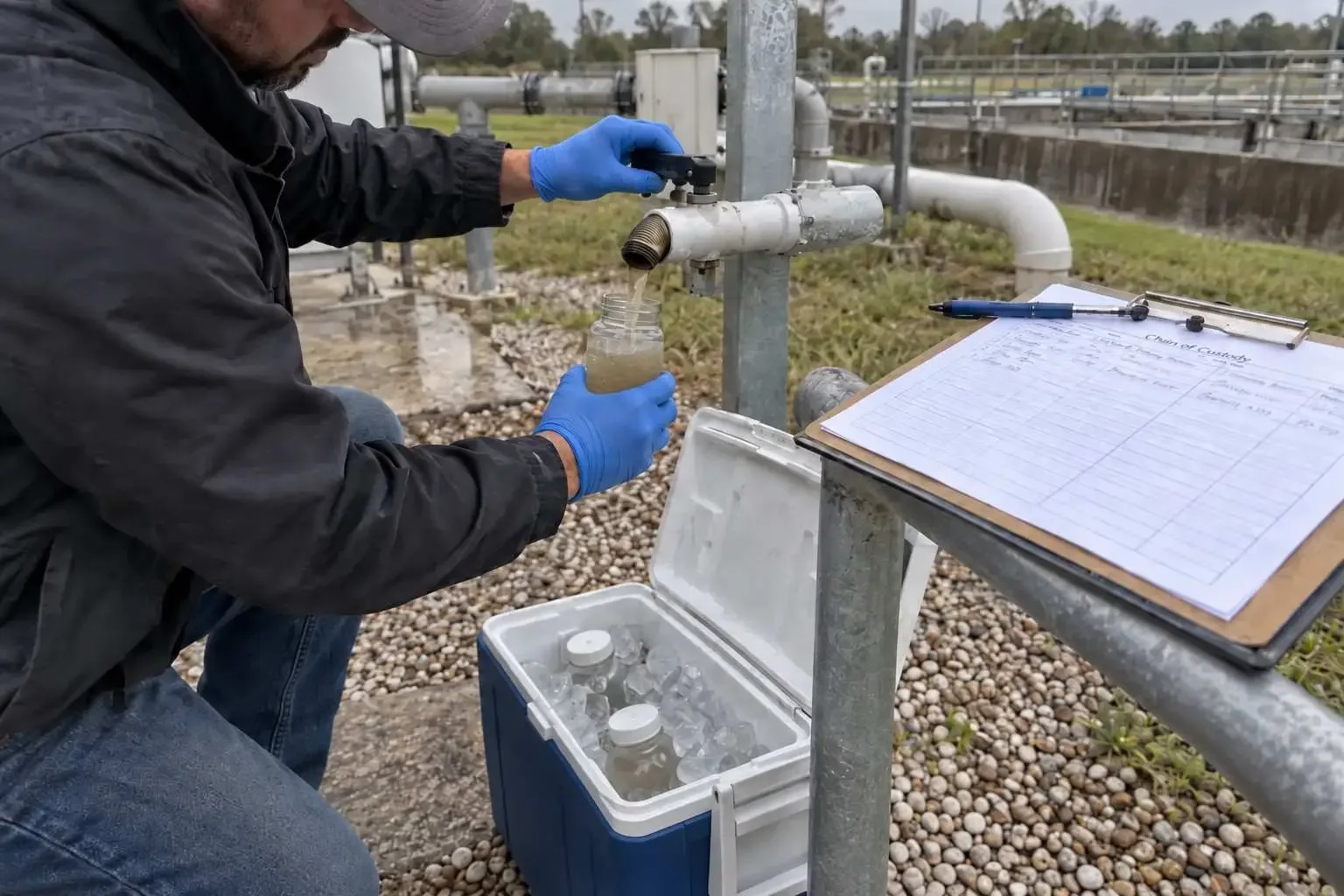
Plan the sampling kit as carefully as the sample point. PFAS are in common field gear and detection limits are very low, so a careless kit can produce a false hit.
EPA's frequent questions on PFAS methods for NPDES permits set out the basics:
- HDPE sample bottles with linerless caps.
- No PTFE, FEP, PVDF or ETFE materials, and no glass containers or tools, because PFAS stick to glass.
- No composite samples for compliance monitoring, which EPA strongly discourages, citing Method 1633A.
- Field blanks, plus equipment blanks for reused gear, at a frequency set in the sampling and analysis plan.
- Nitrile gloves and ballpoint pens, not latex gloves, permanent markers or waterproof clothing.
Keep the chain of custody and blank results with the data. They are how you defend an odd result.
Why test biosolids for PFAS?
Because PFAS do not stay in the liquid stream. They have been found in both treated wastewater and biosolids, which matters if land application is your disposal path.
Colorado's Biosolids-PFAS Interim Strategy has required monitoring by biosolids preparers since January 1, 2023. Under the 2026 update, PFOS at or above 50 µg/kg triggers a preliminary source investigation, and the state may then require a source reduction plan for non-domestic sources. The state notes that 50 µg/kg is not a risk-based threshold. It now runs through 2026.
EPA released a draft risk assessment for PFOA and PFOS in sewage sludge in January 2025, then draft guidance on reducing PFOA and PFOS risk in biosolids in July 2026, open for 60 days of comment after Federal Register publication.
Should you start with source control or treatment?
Source control. EPA's recommendations and the state programs above put finding sources first, and PFAS treatment at a wastewater plant is a large commitment.
Colorado's policy lists industrial user inventories and evaluating source control options as parts of a source investigation. Michigan pursues reductions through pollutant minimization plans, tank and equipment cleanouts, product replacement and pretreatment at the source. Policy 20-1 credits source control with significant PFAS reductions in other states, particularly Michigan. For an industrial user, that is a pretreatment permit question first.
If the data still point to treatment, Policy 20-1 names reverse osmosis, granular activated carbon and anion exchange, most working better after turbidity removal. Some leave a PFAS waste stream for an authorized disposal site. A PFAS treatment design evaluation built on real influent and effluent data beats one rushed after a limit has a deadline.
Is your facility ready for a PFAS monitoring requirement?
Run this check before your next renewal or information request. A no on any item is the first thing to fix.
- Do you know whether your discharge reaches a drinking water supply, directly or downstream?
- Do you have a current list of industrial users, including small ones, that could use PFAS?
- Have you confirmed a lab that runs Method 1633 or 1633A on your sample types?
- Is there a written sampling plan that covers containers, materials to avoid and blanks?
- Do you know where your biosolids go, and whether that state tests them for PFAS?
- Has someone read your last draft permit and any agency letters for PFAS language?
Then ask your engineer: where could PFAS enter our system, and what will we do if the first results come back high?
This article is general education from public sources available in October 2026. PFAS rules are still changing, and your permit, your state agency and your engineer govern your facility.
Frequently asked questions
Does a PFAS monitoring requirement mean a limit is coming?
Not automatically. Under Colorado's policy, limits follow the data and a reasonable potential analysis. Elsewhere it is the agency's call.
Is Method 1633 required for PFAS testing?
Not nationally yet. EPA recommends 1633 or 1633A, and until one is in Part 136, the permit names the test procedure.
Can PFAS monitoring be required before permit renewal?
Yes. The duty to provide information lets the agency request data mid-term, and Colorado's policy names that route for PFAS.
I run a city wastewater plant in Colorado with a pretreatment program, and we discharge upstream of a water supply segment. What PFAS conditions should I expect?
Monitoring first. If results reach the policy's reporting levels, expect a source investigation, possibly with an industrial user inventory, since Policy 20-1 calls one likely at municipal plants with pretreatment programs. Any limits depend on your data, and the state can postpone limits for a domestic plant's first permit term.
I manage a manufacturing plant in Texas that discharges to a city sewer, and the city sent us a PFAS questionnaire. What should we do before we answer it?
Treat it as the industrial user inventory EPA recommends for POTWs. Answer from purchase and process records, including any PFAS firefighting foam on site, and ask the city what sampling may follow.
Related resources
- Colorado's Wastewater Discharge Permit Rules: What Communities Need to Know
- Colorado Biosolids Management Regulations: How CDPHE Land Application Rules Differ from Texas for Private Plant Operators
- Self-Monitoring and Reporting Requirements for Texas Significant Industrial Users
- Permit Modification vs. Renewal vs. Amendment: When You Need to Change Your Discharge Permit
Facing a PFAS condition in your next discharge permit?
A PFAS condition is easier to meet when the source list and the sampling plan exist before the first result.
MES engineers can review your permit, pretreatment program and biosolids path with you and set up the monitoring plan before the agency asks for data.
Modern Engineering Solutions, McKinney, Texas. Call (214) 833-6748 or contact our team.
Keep reading
More to read.
Talk to an engineer
Tell us about your project.
An engineer reads it
Not a salesperson. Someone who can tell you whether the pathway is real.
You get a first answer
Your options, the agencies involved and the questions that decide cost and schedule.
You decide
No commitment to have the first call.
Prefer the phone? (214) 833-6748