
Blog
Lift Stations and Collection Systems: What the Plant Needs Upstream to Function Properly
Lift stations and collection systems that feed a private Texas plant must meet TCEQ's Chapter 217 rules for pumps, force mains and power failure backup.
Quick answer
A treatment plant only works as well as the lift stations and collection systems that feed it. In Texas, TCEQ's 30 TAC Chapter 217 sets the minimums: at least two pumps per lift station, peak flow capacity with the largest pump out of service, minimum force main velocities and spill protection during power failures. The plant's permit covers none of it.
How does flow get from the development to the plant?
By gravity wherever the ground allows, and by pumping where it does not. Gravity mains carry wastewater downhill from the building connections with no power and no operator. A site that drains by gravity all the way to the plant has the simplest system it can have. Most Texas sites cannot, because topography, lot layout and plant siting get in the way.
Where gravity runs out, a lift station takes over. Wastewater collects in a wet well, and pumps switch on with the water level to push it through a pressurized force main to a higher point or to the plant.
Under TCEQ's gravity pipe design rule, 30 TAC §217.53, a gravity pipe is at least 6 inches in diameter and sloped for at least 2.0 feet per second flowing full. A force main is at least 4 inches unless it serves grinder pumps (§217.67).
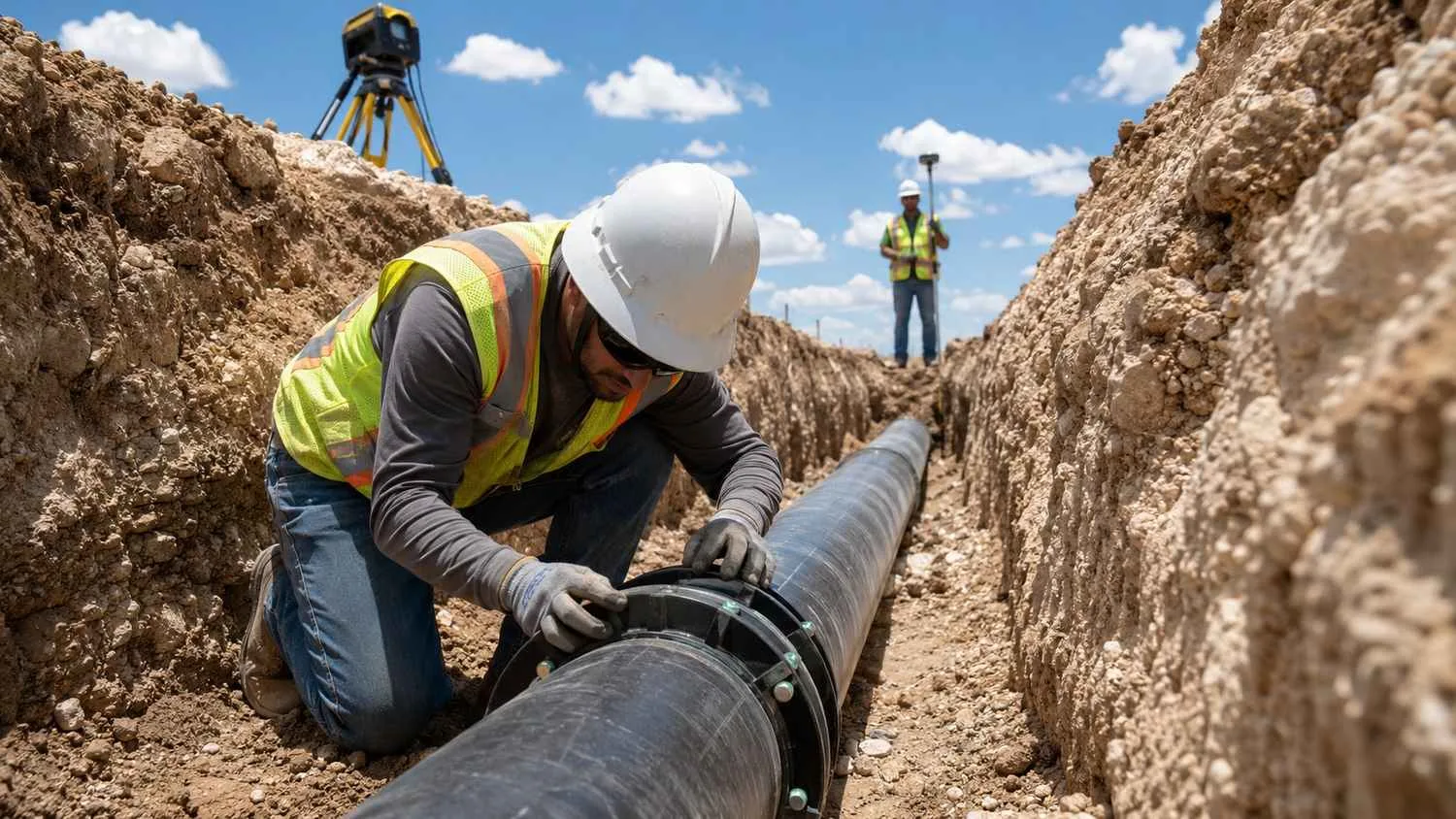
What does TCEQ require of a lift station?
At least two pumps, with enough capacity for the peak flow with the largest pump out of service. That is TCEQ's lift station pump rule, 30 TAC §217.61. Chapter 217 defines peak flow as the highest two-hour flow expected under any operating condition, wet weather included.
A single-pump station saves capital cost on paper and does not meet the rule. Find that out during layout, not during review. Other details shape the station early:
- Pumps run automatically on wet well level, with a float switch or similar backup to any electronic level control (§217.60).
- A station with a peak flow under 120 gallons per minute must use submersible pumps with grinders (§217.61).
- The station sits in a right-of-way or permanent easement, behind an intruder-resistant fence, on a road at least 12 feet wide that a truck can use in a 25-year, 24-hour rain (§217.59).
- Its equipment must withstand and keep operating in a 100-year flood (§217.59).
What happens at a lift station when the power goes out?
The design must keep wastewater from spilling, at the station or anywhere upstream. TCEQ's lift station emergency rule, 30 TAC §217.63, also requires an alarm for power outages, pump failures and high water, sent to a continuously monitored location.
The backup must last at least as long as the longest outage in the electric utility's last 60 months of written records, or 20 minutes, whichever is longer. Generators, gravity relief sewers and bypass pumps count. Storage or spill containment cannot be the only measure. The plant faces a similar question, covered in our post on backup power requirements for package plants.
How should a force main be sized?
For velocity first, and the Texas minimum depends on the number of pumps. TCEQ's force main design rule, 30 TAC §217.67, sets these:
- Two pumps: at least 3.0 feet per second with one pump running.
- Three or more pumps: at least 2.0 feet per second with only the smallest pump running, plus 5.0 feet per second of flushing velocity twice a day.
- Above 6.0 feet per second: the engineering report must certify the pipe can take the surge of a sudden pump failure.
Too large a pipe falls below the minimum, and solids settle, odors build and the line clogs. Too small a pipe raises head loss, so the pumps deliver less flow than planned. The rule also puts air release valves at high points and isolation valves no more than 2,000 feet apart, which affects the route.
Does the plant's permit cover the lift station and collection system?
No. The permit and the design approval are separate tracks. The TPDES or land application permit authorizes the discharge and sets effluent limits. Chapter 217 governs the design of the plant and the collection system. Our Texas wastewater permitting guide covers the permit side.
Under TCEQ's submittal rule, 30 TAC §217.6, the owner sends TCEQ a sealed summary transmittal letter for each collection system project and each plant project, certifying substantial compliance with Chapter 217. If TCEQ does not call the project in for review within 30 business days, it is approved, with conditions. If it does, the owner has 30 days to send full plans and an engineering report.
Two cases change where the plans go. A city that TCEQ has given review authority reviews collection systems inside its jurisdiction (§217.8). Over the Edwards Aquifer recharge zone, TCEQ's wastewater system design requirements page calls for full plans instead of a summary letter.
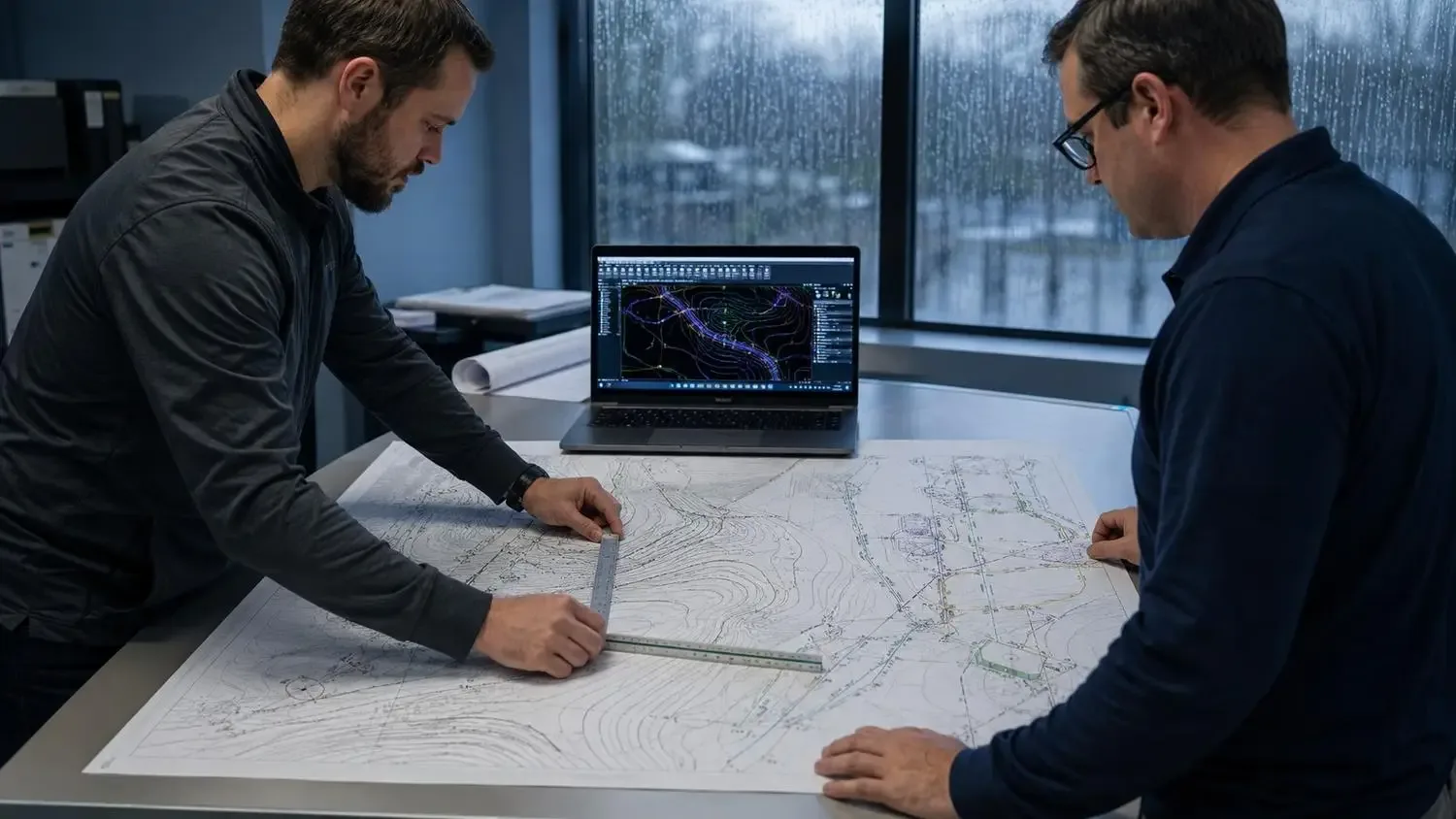
How do civil and utility design have to be coordinated?
The site plan and the utility plan must solve for the same layout at the same time. Lift station locations come before the grading plan is final. The wet well depth follows the incoming sewer's invert, which follows pad elevations and road grades. Change the pads later and you change the wet well and possibly the pumps.
The force main route goes on the civil plan before other utilities are placed. Chapter 217 keeps sewer pipes nine feet from water lines wherever possible. And the plant's elevation sets much of the head the pumps must overcome, so move the plant after pump selection and you select pumps again.
All of this is cheap to fix on paper and expensive after concrete is poured.
How can you check the upstream design is ready for submittal?
Answer each item yes or no. Any "no" is a design question to settle before the summary transmittal letter goes out.
- Is the plant site fixed, with its elevation known?
- Were pad elevations and road grades set with the sewer designer's input?
- Does each lift station have two or more pumps, with peak flow capacity with the largest out of service?
- Does each force main meet the velocity minimum for its number of pumps?
- Do you have the electric utility's outage records for each station site?
- Do you know whether a city review or the Edwards Aquifer rules change where the plans go?
Then ask your engineer which items are open and what each does to the schedule.
Limits: this is general education on Chapter 217 as it reads in October 2026, last amended in December 2015 and readopted after reviews in 2019 and 2024. TCEQ staff outlined planned changes in October 2025 covering force main pressure, pipe slopes and pump cycles, so check the rule in force when you submit.
Frequently asked questions
Does a TCEQ wastewater permit cover the lift station and collection system?
No. The permit authorizes the discharge. Collection systems and lift stations go through Chapter 217's design submittal, or a city's review where TCEQ has granted the city that authority.
What velocity should a force main be designed for in Texas?
At least 3.0 feet per second with one pump running at a two-pump station. With three or more pumps, at least 2.0 feet per second with the smallest pump running, plus twice-daily flushing at 5.0 feet per second.
I'm a project manager on a Texas subdivision where the plant site sits uphill from most of the lots. What should I lock down before grading is final?
The plant site and its elevation, the lift station locations and the force main route. Those set the wet well depths and the head the pumps must overcome. Have the sewer designer review the pad elevations, and request the utility's outage records early.
I'm a civil engineer in Texas designing a lift station for a commercial pad with a peak flow under 100 gallons per minute. Do the Chapter 217 rules still apply?
Yes, unless it is a single grinder pump serving one connection. Under 120 gallons per minute of peak flow, the rule requires submersible grinder pumps, and the two-pump, alarm and power failure rules still apply.
Related resources
- Understanding Lift Stations: A Walkthrough of Force Main and Pump Sizing Calculations
- What should a civil engineering firm verify before handing a wastewater lift station design to a specialist?
- Building a Private WWTP in Texas: What Developers Need to Know Before They Commit
- Flow Rate Projections: How to Size a Wastewater Treatment Plant for Your Development Without Over-Building
Planning lift stations around a new treatment plant?
We design the collection system, lift stations and plant as one layout, so the grading, the pumps and the design submittal all work from the same numbers.
We specialize in:
- Lift station and force main design for Texas developments
- Gravity collection system layout
- Chapter 217 design submittals to TCEQ
- Private wastewater treatment plant design
- TPDES and land application permit applications
- Civil site and utility coordination
Modern Engineering Solutions, McKinney, Texas. Contact: (214) 833-6748 or mod-eng.com
Talk to an engineer
Tell us about your project
An engineer reads it
Not a salesperson. Someone who can tell you whether the pathway is real.
You get a first answer
Your options, the agencies involved and the questions that decide cost and schedule.
You decide
No commitment to have the first call.
Prefer the phone? (214) 833-6748