
Blog
FOG Pretreatment Programs for Texas Restaurants and Food Service Facilities
Most restaurant buildouts treat the grease interceptor as a plumbing line item. See what a Texas FOG program actually requires before the kitchen opens.
Quick Answer
FOG stands for fats, oils, and grease, the byproduct of food preparation and cooking that causes serious problems in a sanitary sewer system when it’s discharged without control. Grease cools and solidifies as it moves through pipes, building up on pipe walls until it blocks flow entirely, which is why Texas POTWs and local utilities require food service facilities to install and maintain grease interceptors under a formal FOG pretreatment program. That program typically includes a properly sized grease interceptor, defined kitchen plumbing connections, regular cleaning on a set schedule, waste hauling manifests documenting where the grease actually goes, maintenance logs, and periodic inspections the utility can perform without notice. New restaurants, tenant improvements, shared kitchens, and multi-tenant buildings all fall under these requirements, and the design decisions that determine whether a facility complies easily or struggles with it, interceptor sizing, plumbing layout, drain separation, are made well before the kitchen ever opens. Reviewing FOG requirements during kitchen layout and lease negotiation, rather than after construction documents are final, is what keeps a food service project on schedule.
Why Grease Causes Real Problems in a Sewer System
Fats, oils, and grease behave very differently once they leave a hot kitchen and enter a pipe running at ambient temperature. Grease that’s liquid at cooking temperature cools as it travels through the plumbing, solidifies against pipe walls, and gradually narrows the pipe’s usable diameter with every additional discharge. Over time this buildup causes sewer blockages, and a blockage in a sanitary sewer line doesn’t just back up into the facility that caused it. It can back up into neighboring properties, and in more serious cases it causes a sanitary sewer overflow, where wastewater bypasses the system entirely and discharges to the ground surface or a waterway.
Beyond the blockage risk itself, grease buildup drives odor complaints from nearby tenants and neighbors, creates ongoing maintenance problems for the utility that has to clear it, and causes real collection system damage over years of accumulation if it’s never addressed. For the utility managing all of this, a food service facility discharging uncontrolled grease is a direct, recurring cost, which is exactly why Texas POTWs and local utilities treat FOG control as a required program rather than a suggestion, and why FOG violations carry real enforcement exposure for the facility responsible.
How a FOG Pretreatment Program Actually Works
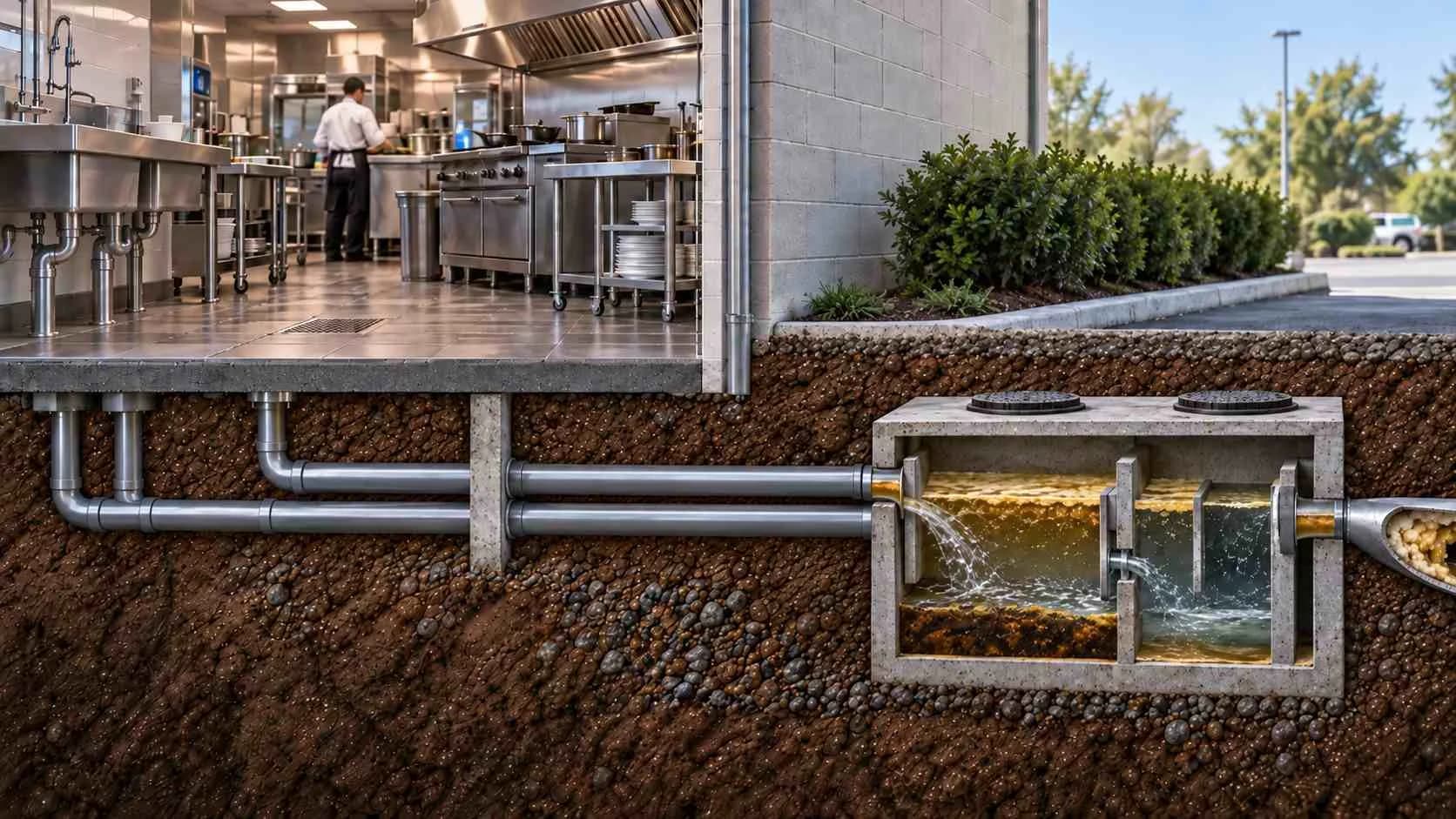
A FOG program centers on the grease interceptor, a plumbing device installed between the kitchen’s grease generating fixtures and the sanitary sewer connection that captures fats, oils, and grease before they reach the sewer line. Grease interceptor requirements typically specify minimum sizing based on the kitchen’s fixture count and flow, and grease trap sizing follows formulas set by the local plumbing code or the utility’s own FOG ordinance, factoring in the number and type of connected fixtures, expected flow rate, and retention time needed for the grease to separate out.
Fixture connections matter as much as the interceptor itself. Which sinks, dishwashers, and floor drains actually route through the interceptor, and which don’t, determines whether the system captures the grease it’s supposed to or lets it bypass entirely. Kitchen plumbing design has to account for this from the start, since retrofitting fixture connections after a kitchen is built out is far more disruptive than specifying it correctly the first time.
Ongoing compliance runs through a handful of standard mechanisms. Sampling or inspection points give the utility a place to verify the interceptor is functioning as designed. Cleaning schedules, set either by the utility’s ordinance or by the interceptor’s own design capacity, determine how often accumulated grease has to be pumped out before it starts bypassing into the sewer. Waste hauling manifests document that the grease removed during cleaning was actually transported and disposed of properly, and maintenance logs create the paper trail a facility needs to demonstrate ongoing compliance. Local ordinance requirements set the specific rules for a given city, and inspections, sometimes scheduled and sometimes unannounced, are how the utility confirms a facility is actually following its own program rather than just having the equipment installed. Enforcement procedures kick in when a facility fails an inspection or is linked to a blockage or overflow, and those procedures can range from a notice of violation to fines to more frequent mandatory inspections going forward.
Who This Applies To, and Where Responsibility Falls
FOG requirements apply broadly across food service, and the specific compliance obligations shift depending on the type of facility and the lease structure behind it. New restaurants face this as a standard part of permitting before opening. Tenant improvements in an existing building have to work within whatever grease interceptor infrastructure the building already has, or add new infrastructure if the existing system wasn’t sized for the incoming tenant’s kitchen. Shared kitchens and food halls raise a specific complication, since multiple food service operators may be discharging into a single interceptor system, which means sizing has to account for combined load rather than any single tenant’s kitchen alone. Grocery stores with prepared food operations, commissaries, school cafeterias, and hotels all fall under the same basic FOG framework even though food service isn’t necessarily their primary business.
Landlord versus tenant responsibility is where a lot of confusion happens in practice. In most commercial leases, the tenant is responsible for FOG compliance within their own space, including interceptor maintenance and cleaning, but the landlord typically owns the building’s plumbing infrastructure and any shared interceptor system serving multiple tenants. A lease that doesn’t clearly assign these responsibilities can leave a landlord facing enforcement exposure for a tenant’s grease violations, particularly in a multi tenant building where the utility may not distinguish between individual tenants when it identifies a problem at the building’s sewer connection.
Getting the Engineering Right Before Construction Starts
The projects that sail through FOG related permitting are the ones that treated interceptor sizing and plumbing layout as design decisions from the beginning, not as a code compliance checkbox filled in after the kitchen was drawn. Early kitchen layout review, done alongside the architect and plumbing designer rather than after their drawings are final, is what catches a mismatch between fixture count and interceptor capacity before it becomes a change order.
Proper interceptor sizing has to be calculated against the actual kitchen program, not a generic assumption based on square footage, since two kitchens with identical footprints can generate very different grease loads depending on what’s actually cooked there. Plumbing coordination between the kitchen equipment layout and the interceptor location determines whether every grease-generating fixture actually routes through the system as intended. Separation of sanitary and process drains keeps non-grease wastewater from adding unnecessary flow through the interceptor, which affects both sizing and cleaning frequency.
Physical access for maintenance matters just as much as the design calculations, since an interceptor that’s difficult to reach for pumping tends to get cleaned less often than it should, regardless of what the schedule says. Grease waste hauling coordination, meaning a reliable hauler under contract before the kitchen opens, keeps the facility from missing its cleaning schedule simply because nobody arranged the logistics. And a recordkeeping system, whether a simple log or a more formal maintenance tracking process, is what turns compliance from something the facility hopes is happening into something it can actually prove during an inspection.
Frequently Asked Questions
How do I know if my Texas restaurant or food service facility needs a grease interceptor?
Almost any facility that prepares or cooks food and discharges wastewater to a sanitary sewer needs a grease interceptor under most Texas local FOG ordinances, including full service restaurants, quick service kitchens, grocery store prepared food areas, and commissaries. The specific requirement and interceptor sizing come from your local utility’s FOG ordinance, so confirming with that utility during design, not after the kitchen is built, is the reliable way to know exactly what applies to your facility.
How is grease interceptor size determined for a commercial kitchen?
Grease interceptor sizing is based on your kitchen’s fixture count, fixture type, and expected flow, following a formula set by the local plumbing code or the utility’s FOG ordinance. A commercial dishwasher, a three compartment sink, and floor drains each contribute differently to the sizing calculation, so the sizing should be run against your actual kitchen equipment plan rather than estimated from square footage alone.
What records are usually required for FOG compliance?
Most Texas utilities expect a cleaning and maintenance log showing when the interceptor was last pumped, waste hauling manifests documenting where the removed grease was taken, and records available for review during an inspection. Some ordinances also require periodic self reporting to the utility on a set schedule.
Can a landlord be affected by a tenant’s FOG violations?
Yes, particularly in a multi tenant building sharing a single sewer connection or a shared interceptor system, where the utility may address a violation at the building level rather than isolating it to one tenant’s kitchen. A lease that clearly assigns FOG maintenance and compliance responsibility to the tenant reduces this exposure, but the landlord should confirm the building’s plumbing infrastructure can actually support what each tenant’s kitchen generates.
What should developers check before leasing space to a restaurant or food service tenant?
Confirm the building’s existing grease interceptor capacity against the incoming tenant’s expected kitchen size and equipment, check whether the plumbing infrastructure routes the right fixtures through that interceptor, and review the lease language assigning FOG maintenance responsibility. Doing this before finalizing the lease avoids discovering a capacity mismatch after the tenant improvement drawings are already underway.
Related Resources
- Texas Wastewater Pretreatment Permits: What Industrial Facilities Discharging to a POTW Must Know
- How TCEQ Sets Effluent Limits: Understanding Receiving Water Quality Standards and Permit Conditions
- Why Your Site Civil Engineer Isn’t the Right Person to Lead TCEQ Permitting
- Land Application Permits in Texas: A Faster Path to Wastewater Approval for Developers
Get FOG Requirements Right Before the Kitchen Is Built
Grease interceptor sizing and plumbing layout are design decisions, not code compliance afterthoughts, and getting them wrong after construction documents are finalized costs real time and money to fix. Before kitchen buildout, tenant finish out, or sanitary sewer approval, MES helps Texas restaurant developers, commercial property owners, and food service operators size grease interceptors correctly, coordinate kitchen plumbing design, and clear utility approval without delay.
We specialize in:
- Grease interceptor sizing and FOG pretreatment design for commercial kitchens
- Kitchen plumbing coordination between fixture layout and interceptor connections
- Local utility FOG ordinance review and permit support
- Multi tenant and shared kitchen interceptor capacity evaluation
- Grease waste hauling and maintenance recordkeeping system design
- Landlord and tenant FOG responsibility review for lease negotiations
Modern Engineering Solutions, McKinney, Texas. Contact: (214) 833-6748 or mod-eng.com
Keep reading
More to read.
Talk to an engineer
Tell us about your project.
An engineer reads it
Not a salesperson. Someone who can tell you whether the pathway is real.
You get a first answer
Your options, the agencies involved and the questions that decide cost and schedule.
You decide
No commitment to have the first call.
Prefer the phone? (214) 833-6748