
Blog
Hydrostatic Testing Records and the TCEQ Audit Trail: What Contractors Need Before an Inspector Shows Up
Doing the hydrostatic test correctly is not enough without proof. Learn what a complete discharge audit trail looks like before a TCEQ inspector shows up.
Quick Answer
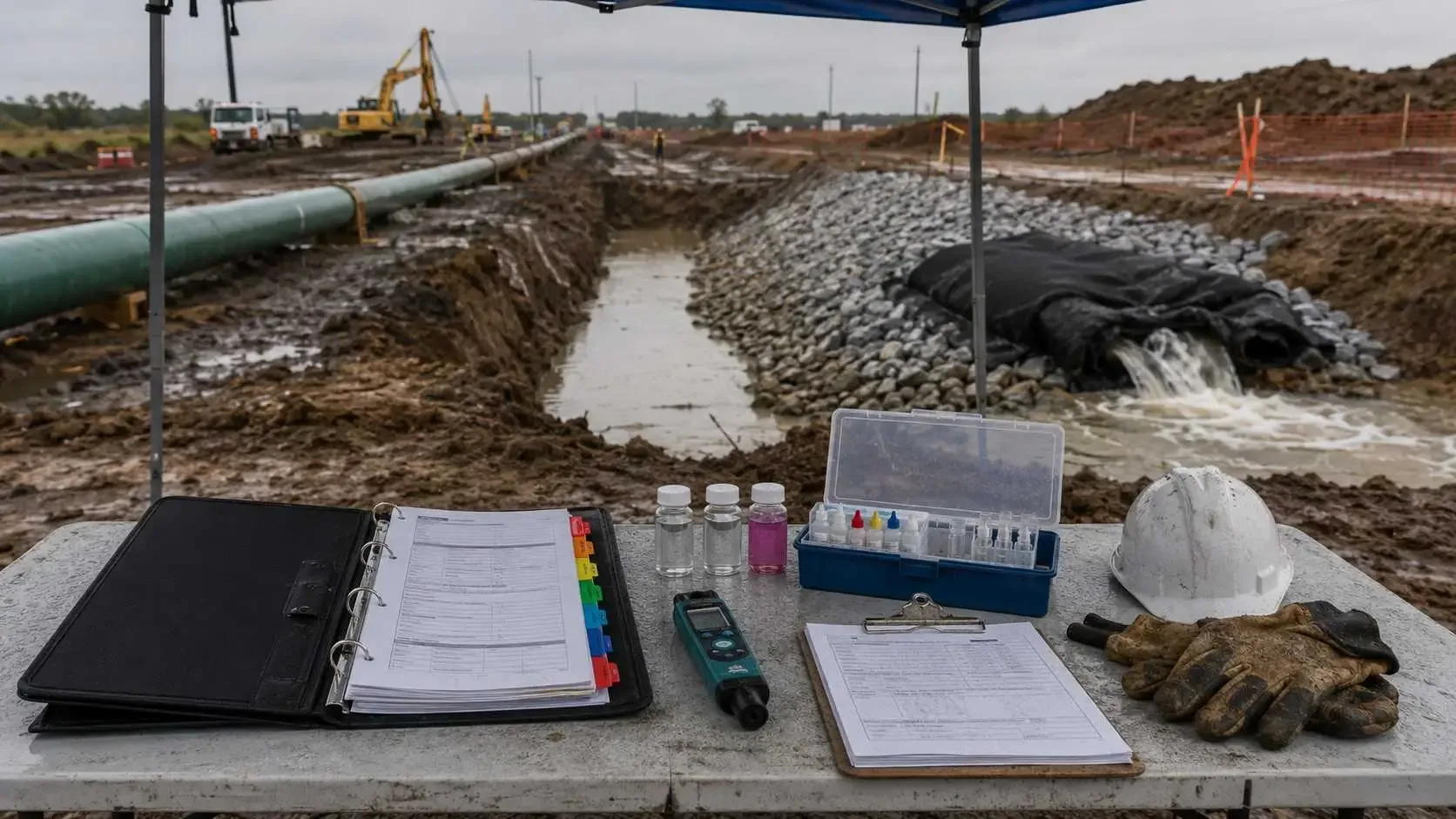
A hydrostatic test and discharge can be handled correctly in the field and still create a real compliance problem if the contractor cannot prove it afterward. When a compliance inspector, an owner’s representative, a city inspector, or a TCEQ reviewer asks questions about a specific discharge, the only thing that actually answers those questions is a complete, organized record showing what was tested, what water was used, what the discharge looked like, and what readings and approvals were in place at the time. Contractors who handle testing correctly but keep records scattered across text messages, a field notebook, and someone’s memory are in a considerably weaker position than contractors who build a documentation system into the testing process from the start.
Why “We Did It Right” Isn’t Enough on Its Own
Field crews that follow proper disinfection, dechlorination, and discharge procedures are doing the hard part of compliance correctly. But if a question comes up days, weeks, or months later, whether from a downstream complaint, a routine inspection, or a specific regulatory inquiry, “we did it right” is not a defensible answer without a record showing exactly what was done, when, and by whom. Memory fades, personnel change between the time of testing and the time of a question, and verbal assurance carries no weight against a documented record, or the absence of one, when a question about a specific discharge event needs to be answered.
This is the gap that catches contractors who handle the field work well but treat documentation as an afterthought: the compliance failure isn’t in the field procedure, it’s in the inability to prove the field procedure happened as described.
What a Complete Hydrostatic Testing Record Actually Includes
A defensible hydrostatic testing record starts with the basic identifying information: test date, project location, and the specific pipe or tank segment tested, since a record that can’t be tied to a specific location and specific infrastructure segment is difficult to use as evidence for any particular discharge event later. Water source used for the test matters as well, since the source water’s characteristics, and whether it was treated water, raw water, or another source, affects what water quality parameters are relevant to document for that specific test.
Test volume, the actual quantity of water used and subsequently discharged, should be recorded rather than estimated after the fact, since volume affects both the water quality and erosion control evaluation for that discharge and is a basic fact an inspector or reviewer is likely to ask about directly.
Discharge Location and Water Quality Readings
Discharge location needs to be documented specifically enough that it can be identified later, not just described generally as “near the site,” since the specific discharge point determines which storm drain, sanitary sewer, or receiving water was involved and what requirements applied to that particular location. Chlorine residual readings and pH readings, taken at the times and frequency appropriate for the discharge duration, form the core water quality record demonstrating the discharge met applicable parameters before and during release. Recording the specific reading, the time it was taken, and who took it, rather than a general note that “chlorine was checked and was fine,” gives the record actual evidentiary value if it’s ever reviewed.
Neutralization Method and Erosion Controls
Where chlorine neutralization was performed, the record should specify the method used, sodium thiosulfate or dechlorination tablets, along with dosing information and the timing of application relative to testing and discharge. This detail matters because it demonstrates the specific corrective step taken, not just that a general awareness of chlorine existed. Erosion control measures in place at the discharge point, whether a stabilized outlet, filter bags, or other controls, should be documented as well, ideally including when those controls were installed relative to when discharge began, since installation timing is exactly what an inspector evaluating erosion control adequacy is likely to ask about.
Photographs as Evidence of Field Conditions
Photographs taken at the discharge point, before, during, and after discharge, provide visual evidence of field conditions that written notes alone cannot fully capture. A photograph showing a stabilized outlet in place before discharge began, or showing the condition of the ground and flow path during discharge, gives a reviewer direct visual confirmation of conditions that a written description can only approximate. Photographs should be dated and, where possible, include some reference point confirming location, since an undated or unlocated photograph loses much of its evidentiary value if a question arises about which specific discharge event it documents.
Inspection Logs, Contractor Notes, and Sampling Records
Inspection logs and contractor field notes, recorded contemporaneously rather than reconstructed later from memory, create the day-to-day record of what actually happened during testing and discharge activities. Sampling logs specifically tracking chlorine, pH, and any other tested parameters over the course of a discharge event, discussed as part of proper field procedure for chlorine neutralization, double as compliance documentation once organized and retained, meaning the same testing discipline that protects a discharge in the field also generates the record that protects the contractor afterward, as long as those records are actually captured and kept rather than only used in the moment and discarded.
Approvals and Communication with Owners or Regulators
Any approval obtained before discharge, whether from a municipal utility for a sanitary sewer discharge, from a property owner for a discharge crossing private land, or any other permission specific to the discharge location, should be documented and retained alongside the testing and water quality records. Communication with an owner’s representative, a city inspector, or a regulator, whether a pre-discharge notification, a question raised and answered during the process, or a post-discharge confirmation, should also be captured in writing where possible, since a documented approval or communication carries considerably more weight than a recollection that “we talked to someone about it” without a record of who, when, or what was actually discussed and agreed to.
Why Scattered Records Are as Risky as No Records
A contractor with records spread across individual text messages, a field notebook that stayed in one supervisor’s truck, and informal conversations that were never written down faces nearly the same practical problem as a contractor with no records at all, because when a specific question arises, the ability to quickly assemble a complete, organized answer matters as much as whether the underlying information technically exists somewhere. An inspector or regulator asking a specific question about a specific discharge event expects a coherent answer within a reasonable timeframe, and a scramble to piece together scattered records from multiple sources and multiple people creates its own credibility problem, independent of whether the underlying compliance work was actually done correctly.
Building a Documentation System Before Testing Begins
The practical solution is establishing a documentation system, even a simple standardized form or checklist covering the categories described above, before hydrostatic testing and discharge activities begin, so that field crews know exactly what to record and how, rather than improvising documentation inconsistently across different testing events on the same project. A consistent system also makes it considerably easier to demonstrate a pattern of proper compliance across an entire project with multiple testing events, rather than needing to reconstruct each event’s records individually and inconsistently after the fact.
Frequently Asked Questions
How long should hydrostatic testing and discharge records be retained?
Retention requirements can vary depending on the specific permit or approval governing the discharge and the project owner’s own record retention requirements, so this should be confirmed for your specific project rather than assumed, and retaining records longer than the minimum required is generally a low-cost way to protect against a question arising well after project completion.
Who on the project team should be responsible for maintaining these records?
This should be clearly assigned to a specific role, whether a site superintendent, a project engineer, or another designated person, before testing begins, since records scattered across multiple people with no single point of responsibility are a common reason documentation ends up incomplete or difficult to locate when needed.
Do we need a photograph for every single test event, or only for larger discharges?
Photographic documentation is valuable regardless of discharge size, since a smaller discharge can still become the subject of a question or complaint, and the cost of taking and retaining a few photographs is minor compared to the value of that evidence if a question arises later.
What should we do if we realize partway through a project that our documentation has been inconsistent?
Correcting the documentation practice going forward is the most important immediate step, and organizing whatever records do exist from earlier testing events, even if incomplete, is better than leaving them scattered, though this situation also highlights why establishing a documentation system before testing begins is preferable to correcting one mid-project.
Related Resources
- Erosion and Sedimentation Control at the Discharge Point: What Inspectors Check When Test Water Hits Open Ground
- Discharging to a Storm Drain vs. Sanitary Sewer: Why Texas Contractors Get It Wrong on Pipeline and Tank Projects
- Chlorine Neutralization Before Discharge: The Field Step Contractors Skip Until It Becomes a Compliance Problem
- TPDES General Permit vs. Individual Permit for Construction Discharges: When the Standard Permit Is Not Enough
Setting Up a Documentation System for an Upcoming Testing or Discharge Program?
MES helps project teams set up practical documentation systems, prepare discharge plans, coordinate compliance records, and reduce risk if questions arise during or after construction.
We specialize in:
- Discharge plan development covering water quality, erosion control, and documentation requirements before testing begins
- Standardized field documentation forms and checklists for hydrostatic testing and discharge events
- Coordination with owners, municipal utilities, and regulators on approvals and communication records
- Sampling log and photographic documentation systems that hold up under later review
- Compliance record organization for multi phase or multi segment testing programs
- Support responding to inspector, owner, or regulator questions using an organized audit trail
Modern Engineering Solutions, McKinney, Texas. Contact: (214) 833-6748 or mod-eng.com
Keep reading
More to read.
Talk to an engineer
Tell us about your project.
An engineer reads it
Not a salesperson. Someone who can tell you whether the pathway is real.
You get a first answer
Your options, the agencies involved and the questions that decide cost and schedule.
You decide
No commitment to have the first call.
Prefer the phone? (214) 833-6748