
Blog
New Water Main Disinfection and Test Water Discharge: How to Coordinate AWWA Standards with TCEQ Rules
AWWA disinfection and TCEQ discharge rules apply to the same water main but pull in different directions when not coordinated.
Quick Answer
Getting a new water main accepted by a utility and getting its test water discharged compliantly are two different compliance goals that can pull against each other if they aren’t planned together. AWWA-style disinfection procedures call for a strong enough chlorine concentration to properly disinfect a new main, but that same chlorinated water then needs to be neutralized, monitored, and discharged in a way that meets environmental discharge requirements before it can leave the site. A main disinfected correctly but discharged carelessly still creates a compliance problem, and a discharge plan built without understanding the disinfection procedure it’s downstream of can create testing delays or utility acceptance problems of its own. These two processes need to be coordinated from the start, not treated as sequential steps handled by different people with no communication between them.
Two Compliance Goals, One Water Main
A new water main going into service needs to satisfy a water utility’s acceptance requirements, which typically involve disinfection strong enough to meet bacteriological standards, successful pressure testing to confirm the main holds pressure without leaks, and bacteriological sample results confirming the main is safe to place into service. At the same time, the water used to accomplish disinfection and pressure testing, now carrying chlorine residual and potentially some sediment from the new pipe, needs to be discharged somewhere, and that discharge needs to satisfy an entirely separate set of environmental and local requirements having nothing to do with whether the main itself passed its utility acceptance criteria.
The tension is straightforward: stronger, more thorough disinfection generally means higher chlorine concentration in the water that eventually needs to be discharged, and a discharge plan that wasn’t built with that specific concentration and volume in mind can struggle to keep pace with what the disinfection procedure actually produces.
Chlorination and Flushing Under AWWA Style Procedures
Disinfecting a new water main typically involves introducing a chlorine solution at a specified concentration, holding that concentration in the main for a specified contact time, and then flushing the main to remove the chlorinated water before final flushing and sampling confirm the main is ready for bacteriological testing. This procedure, generally following AWWA-style guidance for new main disinfection, is well established among water utility teams and contractors, and most crews executing this procedure are doing so correctly on the disinfection side.
Where coordination often breaks down is in planning for where the water goes once flushing begins, since flushing a main filled with a strong chlorine solution produces exactly the chlorinated discharge water that needs dechlorination and testing before release, and a crew focused on completing the disinfection procedure efficiently can treat the flushing discharge as an afterthought rather than planning it with the same care given to the disinfection process itself.
Pressure Testing and the Water That Comes With It
Pressure testing a new water main, confirming the main holds the required test pressure without excessive leakage, typically occurs using water that may or may not carry the same chlorine concentration as the disinfection flush, depending on project sequencing and whether pressure testing occurs before, during, or after disinfection. Regardless of sequencing, pressure test water still needs its own discharge evaluation, since even water not carrying disinfection level chlorine concentration may carry some sediment from the new pipe or, in the case of test water reused from a disinfection procedure, still carry meaningful chlorine residual.
Confirming exactly what water quality characteristics apply to each specific discharge event within the overall testing sequence, rather than assuming all test water across the project carries the same characteristics, is a necessary part of coordinating disinfection with discharge planning.
Bacteriological Testing and Utility Acceptance Timing
After flushing, a new main typically needs to sit for a period before bacteriological samples are collected and sent for testing, and utility acceptance of the main depends on those sample results confirming the absence of bacteriological contamination. This timing matters for discharge planning because it affects the overall project schedule, if bacteriological results come back unsatisfactory, requiring redisinfection and reflushing, the discharge planning and controls established for the first flushing event need to be available again for a second round, and a discharge plan that assumed only a single flushing and discharge event may not have adequate capacity, whether in terms of dechlorination chemical supply, erosion control setup, or discharge location approval duration, for a repeated event.
Chlorine Residual, Dechlorination, and pH Testing
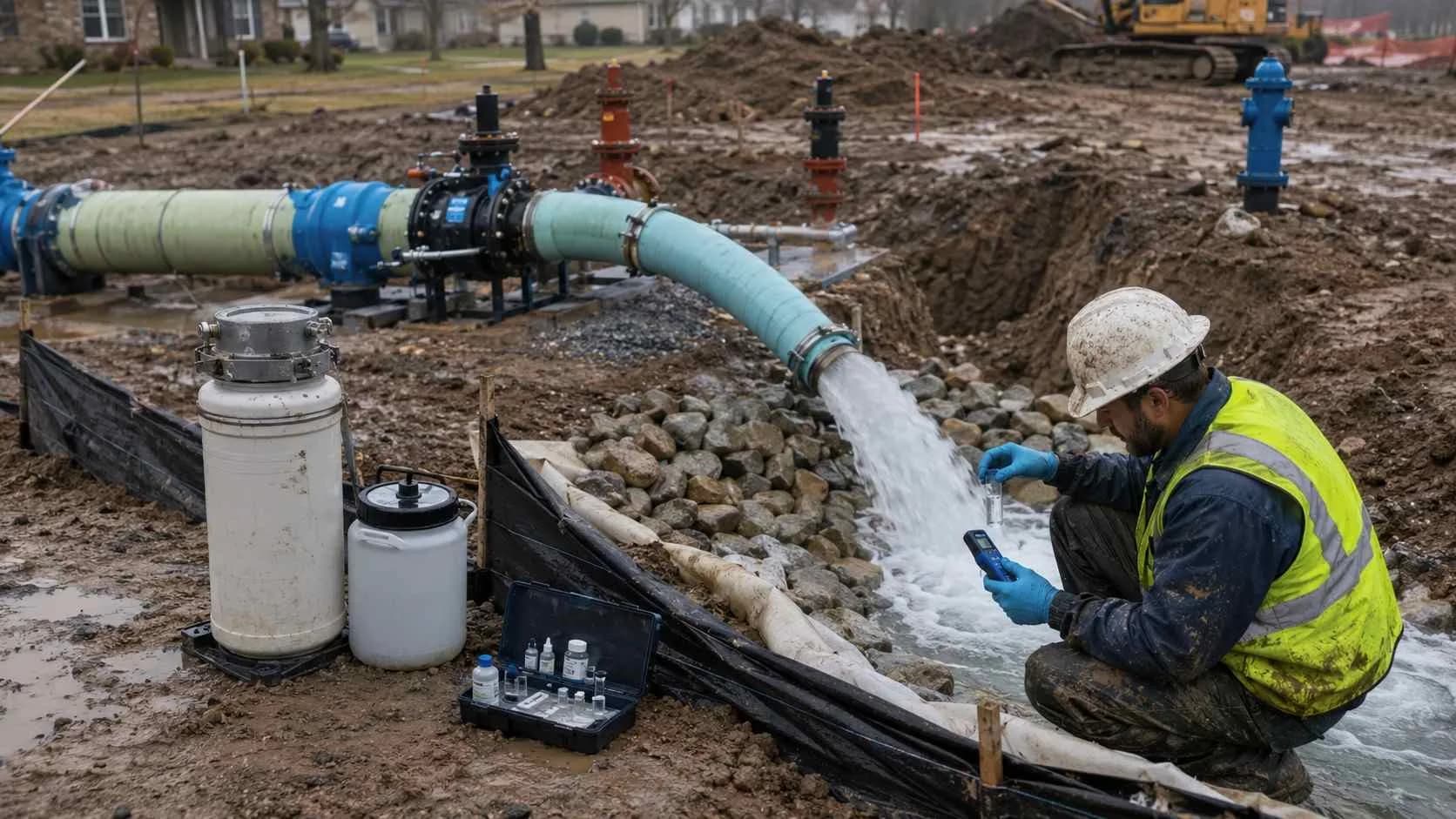
The chlorine residual and dechlorination principles discussed for hydrostatic test water discharge generally apply directly to new water main flushing and testing discharge, since this is precisely the scenario that generates chlorinated water needing neutralization before release. Confirming actual chlorine residual through field testing, applying an appropriately dosed dechlorination treatment using sodium thiosulfate or dechlorination tablets, and verifying the treatment worked through follow-up testing, rather than assuming a standard dose neutralizes whatever concentration happens to be present, applies here with the same importance described for any chlorinated discharge. pH testing alongside chlorine residual testing catches any pH shift introduced by the dechlorination process itself, giving a complete picture of the discharge water’s actual compliance status before release.
Discharge Flow Control and Erosion Protection
Because new water main flushing and testing discharges can involve significant volume over a relatively short period, discharge flow control and erosion protection at the discharge point deserve the same attention described for erosion control planning generally. A flushing discharge released at high velocity directly onto unstabilized ground can create a visible erosion problem even after chlorine residual has been properly neutralized, meaning the discharge point needs planning for both water quality and physical erosion risk, not just the water quality component that disinfection planning tends to focus on most directly.
Sampling Documentation Across Both Compliance Tracks
Because a new water main going into service generates two parallel compliance records, bacteriological sampling supporting utility acceptance, and chlorine residual and pH sampling supporting discharge compliance, keeping these records organized and clearly distinguished from each other matters for anyone reviewing the project’s documentation later. A sampling log that clearly identifies which samples relate to utility acceptance testing and which relate to discharge compliance testing, rather than a single undifferentiated set of notes, makes it considerably easier to respond to a specific question from either the water utility or an environmental compliance reviewer without confusion about which record answers which question.
Water Utility Acceptance and Construction Sequencing
Coordinating disinfection and discharge planning also affects overall construction sequencing, since a main that requires redisinfection due to unsatisfactory bacteriological results, or a discharge that requires additional dechlorination treatment due to higher than expected chlorine residual, both add time to a schedule that may have assumed a single, uninterrupted testing sequence. Building some schedule flexibility around this testing sequence, and confirming discharge planning is ready to support a potential second round of flushing and discharge if bacteriological results require it, reduces the risk that a redisinfection event becomes a scramble to arrange discharge controls on short notice.
Frequently Asked Questions
Does a stronger chlorine concentration used for disinfection always mean a more difficult discharge?
Generally, yes, higher chlorine concentration in the water being flushed and discharged requires correspondingly higher dechlorination dosing and more careful verification testing, which is exactly why discharge planning needs to reflect the specific disinfection procedure’s actual chlorine concentration rather than a generic assumption about typical test water.
If bacteriological testing fails and we need to redisinfect, do we need a completely new discharge plan?
Not necessarily a new plan, but the existing discharge plan needs to have anticipated the possibility of a repeated flushing and discharge event, with adequate dechlorination chemical supply and erosion controls still in place and functional for a second round, rather than assuming the first flushing event was the only one that would occur.
Who typically coordinates disinfection procedures with discharge compliance planning on a project?
This varies by project, but the coordination needs to happen between whoever is managing the disinfection and pressure testing procedure and whoever is responsible for discharge compliance, and on many projects these responsibilities sit with different people or even different firms, making explicit coordination between them a necessary planning step rather than something that happens automatically.
Can pressure testing and disinfection flushing share the same discharge point and controls?
Often yes, but the water quality characteristics of each event should be confirmed individually, since pressure test water and disinfection flush water may carry different chlorine residual and sediment characteristics depending on project sequencing, and the discharge point’s controls should be adequate for whichever event carries the higher relative risk.
Related Resources
- Chlorine Neutralization Before Discharge: The Field Step Contractors Skip Until It Becomes a Compliance Problem
- Hydrostatic Testing Records and the TCEQ Audit Trail: What Contractors Need Before an Inspector Shows Up
- Erosion and Sedimentation Control at the Discharge Point: What Inspectors Check When Test Water Hits Open Ground
- Discharging to a Storm Drain vs. Sanitary Sewer: Why Texas Contractors Get It Wrong on Pipeline and Tank Projects
Coordinating Disinfection and Discharge Planning for a New Water Main Project?
MES helps developers and contractors coordinate pressure testing, disinfection, flushing, discharge planning, documentation, and utility acceptance so one compliance step doesn’t create a problem for another.
We specialize in:
- Disinfection and flushing sequencing planned alongside discharge water quality requirements
- Dechlorination dosing and verification testing matched to actual disinfection chlorine concentrations
- Discharge flow control and erosion protection for new main flushing and pressure testing events
- Sampling documentation systems that clearly separate utility acceptance and discharge compliance records
- Construction sequencing that builds in flexibility for redisinfection and repeat testing scenarios
- Coordination between disinfection, testing, and discharge compliance teams from project outset
Modern Engineering Solutions, McKinney, Texas. Contact: (214) 833-6748 or mod-eng.com
Keep reading
More to read.
Talk to an engineer
Tell us about your project.
An engineer reads it
Not a salesperson. Someone who can tell you whether the pathway is real.
You get a first answer
Your options, the agencies involved and the questions that decide cost and schedule.
You decide
No commitment to have the first call.
Prefer the phone? (214) 833-6748