
Blog
Understanding Water System Design Quotes: What You’re Really Paying For
Water system design quotes differ because scopes differ, so compare the hydraulic model, profiles, specs, TCEQ submittal and construction support first.
Water system design quotes differ mostly because the scopes differ. One proposal pays for a hydraulic model, plan and profile sheets, specifications, a sealed state submittal and support during construction. Another pays for a pipe layout. Line up the deliverables before you compare the totals, and the gap usually explains itself.
Why do water system design quotes vary so much?
Because two quotes for the same project rarely price the same work. The scope is the variable, and most proposals do not spell it out.
A request that says "design the water system for the subdivision" leaves each firm to decide what that means. One reads it as a model, a construction set, specifications, the state submittal and help during construction. Another reads it as a layout a contractor can price. Both quotes can be honest. Only one gets you a design a reviewer can approve and a contractor can build without stopping to ask questions.
Experience moves the number too. A team that knows water systems prices hours for the problems that bite later, such as a tie-in that crosses three other utilities.
What should a complete water system design include?
Five things: a hydraulic model, a full construction set, written specifications, a sealed regulatory submittal and construction-phase services. Leave one out and someone pays to fill the gap later.
On a typical water distribution design, that breaks down like this:
- A hydraulic model that checks demands, pressures, fire flow and pipe sizes.
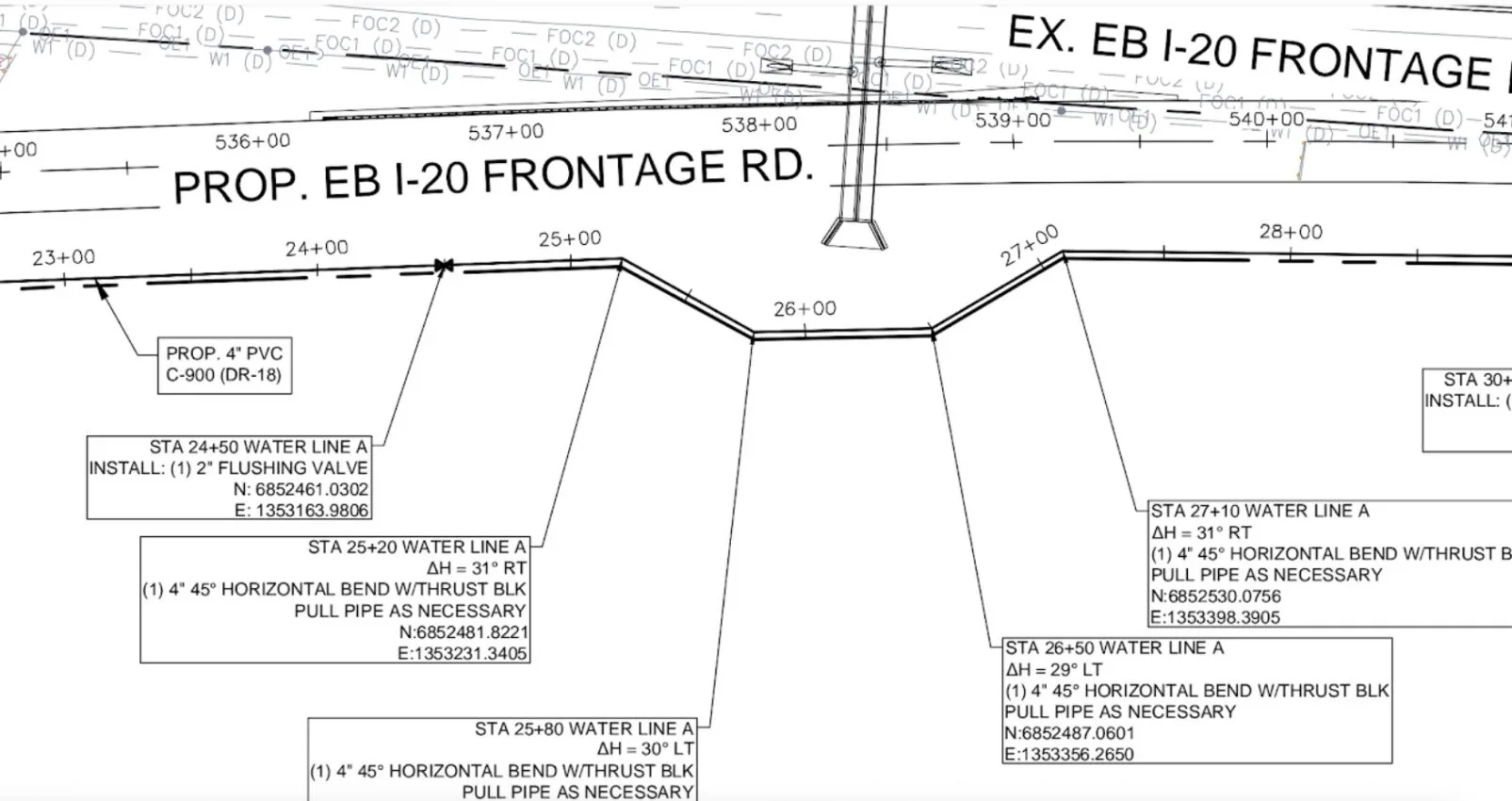
- Plan and profile sheets with tie-in details, valves, hydrants and service connections.
- Specifications that name the material, pressure class and standard for each item.
- The regulatory submittal, plus responses to review comments.
- Construction-phase services: submittal review, contractor questions, site visits and the completion notice.
A pump station or storage tank adds its mechanical, electrical, structural and controls design to the list.
What does hydraulic modeling actually buy you?
Proof that the system meets pressure and fire flow before anyone digs. Without a model, pipe sizes are a guess.
A model built in a tool such as EPA's EPANET software tracks the flow in each pipe and the pressure at each node. In Texas, TCEQ's water distribution rule, 30 TAC §290.44, requires a system designed to hold at least 35 psi at all points at flows of at least 1.5 gallons per minute per connection, and 20 psi under combined fire and drinking water flow where the system is meant to fight fires. The model is how your engineer shows both.
It also finds the weak spots a layout hides: the high lots, the dead end, the last hydrant on a long main. Fixing those on paper means a bigger pipe or a loop. Finding them after construction can mean adding a booster pump station, which the same rule expects to draw from a storage tank. That is why work like a water model with a fire flow memo settles fire flow with the fire chief and then tests it in the model.
What does a plan-view-only drawing set leave out?
The vertical. A plan view shows where the pipe goes. It does not show how deep it sits, what it crosses or how it connects.
Profile sheets show cover, grades and every crossing with storm drains, sewers and other utilities. In Texas, §290.44 also keeps new waterlines nine feet in all directions from wastewater collection facilities, with pressure-rated pipe and other measures where that cannot be met. A conflict caught on a profile is a design change. A conflict caught in the trench is a stopped crew and often a change order.
Specifications matter as much. The same rule requires current AWWA standards, and plastic pipe must carry the NSF-pw seal and an ASTM pressure rating of at least 150 psi or a dimension ratio of 26 or less. A spec such as HDPE PE4710 DR 11 tells the contractor exactly what to buy. "4-inch pipe" does not. TCEQ's general provisions for public water systems, 30 TAC §290.39, also require specifications with all plans, so a drawing-only package is not a complete Texas submittal.
Who reviews the design, and what does the state not check?
A licensed professional engineer prepares and seals the design. The state then reviews it against its drinking water rules.
Under §290.39, TCEQ will not consider plans and specifications unless they were prepared under the direction of a licensed professional engineer and sealed, signed and dated. The drinking water program is a reviewing body only and does not examine structural features such as concrete strength or reinforcing, so a tank foundation or pump station slab rests with your engineer.
TCEQ's drinking water plan review page lists the package: a cover letter, the submittal form (TCEQ-10233), an engineering report, and sealed plans and specifications. A new system adds a core data form, financial documents, requests for service and, for a community system, a business plan. Ask whether each quote covers that package and the review comments.
Not every waterline gets that review. A new public water system needs TCEQ's written approval of its plans and specifications before construction. A change to an existing system needs notice to TCEQ first, and plans when it is greater than 10% of the number of connections, leaves the system short of required capacity or interconnects with another public water system. Ask which path yours takes.
Is the lowest water system design quote the cheapest project?
Often not. The design fee is one line in the total. Construction, change orders, delay and decades of operation are the rest.
Compare the whole equation:
Total project cost = design fee + construction cost + change orders + schedule impacts + long-term operating cost
A thin design moves work from the first term to the others. If you are a developer or builder carrying land while the field sorts it out, schedule is part of the price.
Construction support is easy to leave out of a quote, but someone still does it. On a project TCEQ reviews, Section 290.39 requires the engineer or owner to watch construction closely enough to make sure it matches the approved plans, then tell TCEQ in writing at completion that the work substantially follows the plans and change orders on file. If the quote has no construction-phase services, ask who signs that letter.
How do you compare two water system design proposals?
Score both against the same list. Where one says yes and the other is silent, you have found the price gap.
- Does it include a hydraulic model with named pressure and fire flow cases?
- Does it list plan and profile sheets, tie-in details and service connections?
- Does it include specifications that name materials and standards?
- Does it include the state submittal, where your project needs one, and responses to review comments?
- Does a licensed engineer seal it after an internal review?
- Does it include construction-phase services, including the completion notice?
- Does it list what is excluded?
Treat a silent item as an exclusion and ask before you compare prices. Then ask both firms three questions:
- Can we see a sample plan set from a similar water project?
- Who will review the design, and what water systems has that engineer designed?
- How often have your recent projects needed design-related change orders?
A note on limits: this is general education based on 30 TAC §290.39 and §290.44 as amended through December 2023. Other states, utilities and fire officials add their own criteria, and your engineer applies them to your site.
Frequently asked questions
What is included in a water system design quote?
It depends on the firm, which is the problem. A complete scope covers a hydraulic model, plan and profile sheets, specifications, the state submittal and construction-phase services. Get the list in writing.
Does a water system design need a PE seal in Texas?
Yes, for plans submitted to TCEQ for a public water system. TCEQ will not consider plans and specifications unless a licensed professional engineer directed the work and sealed, signed and dated them.
I'm a Texas developer with two proposals for the water system in a new subdivision, and one is far lower. What should I ask before I sign the cheaper one?
Ask both firms for a sheet list and a deliverables list, then run the checklist above. If the lower quote drops the model, the profiles, the specifications, the TCEQ submittal or construction support, find out who does that work before you decide.
I sit on the board of a Texas water district and we need a waterline extension designed. Can we just take the lowest engineering quote?
No. Under Texas Government Code Chapter 2254, a district is a governmental entity, so it must first select the most highly qualified engineer on demonstrated competence and qualifications, then try to negotiate a contract at a fair and reasonable price (§2254.004). The Texas engineering board's guide to the Professional Services Procurement Act says fees stay out of that first selection, and a contract made in violation of the Act is void.
Related resources
- Public Water System Design and Implementation in Texas
- How to Conduct a Fire Flow Analysis for a Texas Development or Subdivision
- Why EPANET Is the First Choice for Water Network Modeling
- The Cheapest Engineering Decision on Your Texas Pro Forma Isn't the Low Bid
Comparing water system design proposals?
MES designs water systems for developments and utilities, from the hydraulic model through the TCEQ submittal and construction administration.
Modern Engineering Solutions, McKinney, Texas, with offices in Golden, Colorado and San Jose, California. (214) 833-6748.
Keep reading
More to read.
Talk to an engineer
Tell us about your project.
An engineer reads it
Not a salesperson. Someone who can tell you whether the pathway is real.
You get a first answer
Your options, the agencies involved and the questions that decide cost and schedule.
You decide
No commitment to have the first call.
Prefer the phone? (214) 833-6748